PUBLISHER: Mordor Intelligence | PRODUCT CODE: 2154801

PUBLISHER: Mordor Intelligence | PRODUCT CODE: 2154801
Lemon Compound - Market Share Analysis, Industry Trends & Statistics, Growth Forecasts (2026 - 2031)
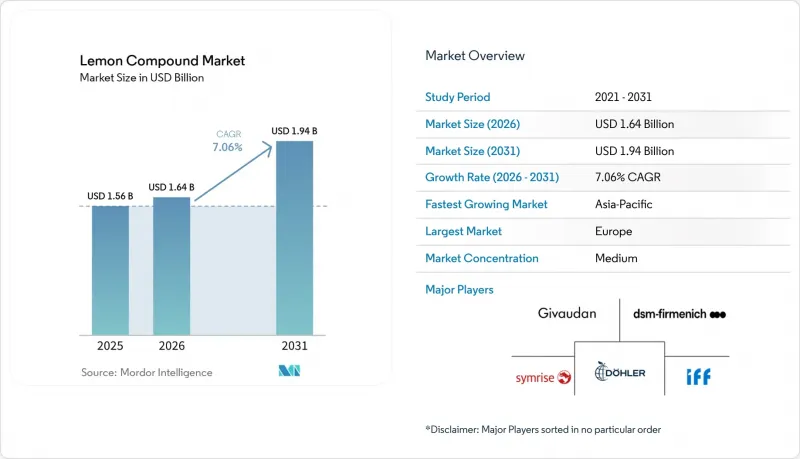
According to Mordor Intelligence, the lemon compounds market is expected to grow from USD 1.56 billion in 2025 to USD 1.64 billion in 2026, reaching USD 1.94 billion by 2031, at a CAGR of 3.42% during the 2026-2031 forecast period.
Global Lemon Compound Market Trends and Insights
Clean-Label Replacement of Synthetic Flavor Systems
Clean-label replacement of synthetic flavor systems is gaining momentum as consumers increasingly prefer recognizable, minimally processed, and naturally derived ingredients. In response, food and beverage manufacturers are reducing their reliance on synthetic flavor systems and increasing the use of naturally derived lemon compounds and citrus fractions in product reformulation and new product development. Regulatory scrutiny of synthetic food ingredients further encourages manufacturers to reassess conventional flavor systems and evaluate natural alternatives. Lemon compounds support clean-label positioning by delivering recognizable, citrus-derived flavor profiles while maintaining the desired sensory characteristics of finished products.
Expansion of Functional Beverages and Nutraceutical Delivery Formats
The expansion of functional beverages and nutraceutical formulations is increasing demand for lemon-derived compounds, including D-limonene, citral, Y-terpinene, and B-pinene. Formulators seek customized lemon compound systems that provide specific aroma profiles, taste-masking properties, and formulation performance across beverages, nutrition products, and pharmaceutical applications. Citral delivers characteristic lemon notes, while D-limonene, Y-terpinene, and B-pinene provide complementary citrus and terpene characteristics. The development of liquid concentrates, powdered functional beverages, and nutraceutical premixes is driving demand for application-specific lemon compounds. This trend enables suppliers to differentiate through purity, compositional control, stability, and formulation compatibility.
Climate, Disease, and Seasonality-Driven Lemon Oil Supply Volatility
Lemon oil supply remains vulnerable to climate variability, disease pressure, and seasonal fluctuations in lemon harvests across major producing regions. Changes in rainfall, temperature, flowering cycles, and fruit-set conditions can affect lemon yields and reduce the availability of peels for oil extraction. Extreme weather events, such as droughts, excessive rainfall, and frost, can further disrupt harvest volumes. Disease and pest pressures can also reduce orchard productivity, leading to uneven supply across sourcing origins. Because lemon oil production is closely linked to fruit-processing volumes, fluctuations in these volumes can affect the consistency and availability of raw materials used in lemon compound production.
Other drivers and restraints analyzed in the detailed report include:
- Growing Demand for Processing-Stable Lemon Compounds
- Citrus By-Product Valorization and Circular Ingredient Sourcing
- Oxidation and Specification Variability in Natural Lemon Compounds
For complete list of drivers and restraints, kindly check the Table Of Contents.
Segment Analysis
D-limonene accounted for 33.40% of revenue in 2025, driven by its widespread use in food and beverages, cosmetics, fragrances, and industrial applications. As a major component of citrus processing streams, D-limonene benefits from a broad supply base. Its use in citrus flavors, fragrances, and solvents also supports consistent demand. Citral is projected to grow at a 4.12% CAGR through 2031, outpacing the overall lemon compounds market. Its application in premium flavor profiles and pharmaceutical synthesis positions it as a higher-value ingredient, particularly for formulators requiring a strong lemon note with controlled terpene content. This demand drives fractionation, deterpenation, and tighter composition control, creating a clearer distinction between high-volume D-limonene and specialized citral-based ingredients.
Other lemon compounds, including Y-terpinene, B-pinene, B-myrcene, linalool, and geraniol, serve specialized applications in fragrances, cosmetics, aroma chemicals, and select pharmaceutical formulations. Their value depends on achieving specific aroma and functional profiles, while variations in raw materials and extraction methods can influence composition and consistency. These factors create opportunities for suppliers to provide targeted or full-spectrum fractions with controlled quality, traceable origins, and clearly defined functional properties. Growing interest in upcycled citrus materials and fermentation-based production may further expand the availability of specialty lemon compounds and support higher-value applications.
Complete Report Scope:
- By Compound
- D-Limonene
- Citral
- Y-Terpinene
- B-Pinene
- Others
- By Source
- Natural
- Synthetic
- By Application
- Food and Beverage
- Cosmetics
- Pharmaceuticals
- Nutraceuticals
- Others
- By Geography
- North America
- United States
- Canada
- Mexico
- Rest of North America
- Europe
- United Kingdom
- Germany
- France
- Italy
- Spain
- Netherlands
- Poland
- Belgium
- Sweden
- Rest of Europe
- Asia-Pacific
- China
- Japan
- India
- Australia
- Indonesia
- South Korea
- Thailand
- Singapore
- Rest of Asia-Pacific
- South America
- Brazil
- Argentina
- Colombia
- Chile
- Peru
- Rest of South America
- Middle East and Africa
- South Africa
- Saudi Arabia
- United Arab Emirates
- Nigeria
- Egypt
- Morocco
- Turkey
- Rest of Middle East and Africa
- North America
Geography Analysis
Europe accounted for 40.02% of revenue in 2025, making it the largest regional market for lemon compounds. Strong citrus processing activities in Spain and Italy, combined with established flavor and fragrance industries in France, Germany, and the United Kingdom, support regional demand. The region also shows a strong preference for traceability, natural sourcing, and consistent quality. However, fluctuations in European lemon production may affect the availability of raw materials. Asia-Pacific is projected to grow at a CAGR of 5.11% through 2031, making it the fastest-growing regional market. Growth is driven by the expansion of the packaged food, functional beverage, and personal care industries, as well as increasing local flavor production. Demand ranges from premium natural ingredients in Japan and Southeast Asia to cost-sensitive, standardized compounds in China, India, and Indonesia.
North America, comprising the United States, Canada, Mexico, and the Rest of North America, has an established demand base for lemon compounds across the food and beverage, cosmetics, fragrance, and personal care industries. The region's demand is driven by the widespread use of lemon compounds in flavoring, household products, skincare formulations, and fragrance blends. The United States remains the primary market, supported by its large processed food and beverage industry and strong consumer demand for natural and citrus-based ingredients. Canada and Mexico contribute additional demand through growing consumer product manufacturing, flavor production, and expanding food processing activities. Suppliers benefit from diversified end-use demand across multiple industries but must compete on product consistency, quality, pricing, and the ability to meet evolving regulatory and sustainability requirements.
South America includes Brazil, Argentina, Colombia, Chile, Peru, and the Rest of South America. Argentina serves as a major lemon-processing and export hub for lemon oils, juice, and pulp, supported by its well-established citrus cultivation and processing infrastructure. Brazil provides additional citrus-processing capacity and supports the regional availability of ingredients, while Colombia, Chile, and Peru contribute to the supply of fruits and lemon-derived ingredients. The region's position in the lemon compounds market is supported by its processing capabilities, export activity, and demand from the food, beverage, and personal care industries. The Middle East and Africa includes South Africa, Saudi Arabia, the United Arab Emirates, Nigeria, Egypt, Morocco, Turkey, and the Rest of the Middle East and Africa. The region represents a developing demand market, supported by the beverage, packaged food, hospitality, and personal care industries.
- Givaudan SA
- International Flavors and Fragrances Inc.
- dsm-firmenich
- Symrise AG
- Dohler Group
- Lionel Hitchen
- Citromax Group
- Treatt
- Robertet
- Takasago International
- Archer Daniels Midland Company
- Citrus Oleo
- Citrus & Allied Essences
- Berje
- Ultra International
- Capol (Blue Pacific Flavors)
- Carbery Group (Synergy Flavors)
- Ernesto Ventos
- Bontoux
- Azelis Group (Vigon)
Additional Benefits:
- The market estimate (ME) sheet in Excel format
- 3 months of analyst support
TABLE OF CONTENTS
1 INTRODUCTION
- 1.1 Study Assumptions and Market Definition
- 1.2 Scope of the Study
2 RESEARCH METHODOLOGY
3 EXECUTIVE SUMMARY
4 MARKET LANDSCAPE
- 4.1 Market Overview
- 4.2 Market Drivers
- 4.2.1 Clean-Label Replacement of Synthetic Flavor Systems
- 4.2.2 Expansion of Functional Beverages and Nutraceutical Delivery Formats
- 4.2.3 Growing demand for processing-stable lemon compounds
- 4.2.4 Citrus By-Product Valorization and Circular Ingredient Sourcing
- 4.2.5 Rising Demand for Customized Lemon Flavor Profiles
- 4.2.6 Advancements in Lemon Compound Extraction and Purification Technologies
- 4.3 Market Restraints
- 4.3.1 Climate, Disease, and Seasonality-Driven Lemon Oil Supply Volatility
- 4.3.2 Oxidation and Specification Variability in Natural Lemon Compounds
- 4.3.3 Regionally Divergent Safety, Labeling, and Purity Requirements
- 4.3.4 Synthetic and Biotechnology-Derived Substitution Pressure
- 4.4 Supply-Chain Analysis
- 4.5 Regulatory Landscape
- 4.6 Technological Outlook
- 4.7 Porter's Five Forces Analysis
- 4.7.1 Threat of New Entrants
- 4.7.2 Bargaining Power of Suppliers
- 4.7.3 Bargaining Power of Buyers
- 4.7.4 Threat of Substitutes
- 4.7.5 Competitive Rivalry
5 MARKET SIZE AND GROWTH FORECASTS
- 5.1 By Compound
- 5.1.1 D-Limonene
- 5.1.2 Citral
- 5.1.3 Y-Terpinene
- 5.1.4 B-Pinene
- 5.1.5 Others
- 5.2 By Source
- 5.2.1 Natural
- 5.2.2 Synthetic
- 5.3 By Application
- 5.3.1 Food and Beverage
- 5.3.2 Cosmetics
- 5.3.3 Pharmaceuticals
- 5.3.4 Nutraceuticals
- 5.3.5 Others
- 5.4 By Geography
- 5.4.1 North America
- 5.4.1.1 United States
- 5.4.1.2 Canada
- 5.4.1.3 Mexico
- 5.4.1.4 Rest of North America
- 5.4.2 Europe
- 5.4.2.1 United Kingdom
- 5.4.2.2 Germany
- 5.4.2.3 France
- 5.4.2.4 Italy
- 5.4.2.5 Spain
- 5.4.2.6 Netherlands
- 5.4.2.7 Poland
- 5.4.2.8 Belgium
- 5.4.2.9 Sweden
- 5.4.2.10 Rest of Europe
- 5.4.3 Asia-Pacific
- 5.4.3.1 China
- 5.4.3.2 Japan
- 5.4.3.3 India
- 5.4.3.4 Australia
- 5.4.3.5 Indonesia
- 5.4.3.6 South Korea
- 5.4.3.7 Thailand
- 5.4.3.8 Singapore
- 5.4.3.9 Rest of Asia-Pacific
- 5.4.4 South America
- 5.4.4.1 Brazil
- 5.4.4.2 Argentina
- 5.4.4.3 Colombia
- 5.4.4.4 Chile
- 5.4.4.5 Peru
- 5.4.4.6 Rest of South America
- 5.4.5 Middle East and Africa
- 5.4.5.1 South Africa
- 5.4.5.2 Saudi Arabia
- 5.4.5.3 United Arab Emirates
- 5.4.5.4 Nigeria
- 5.4.5.5 Egypt
- 5.4.5.6 Morocco
- 5.4.5.7 Turkey
- 5.4.5.8 Rest of Middle East and Africa
- 5.4.1 North America
6 COMPETITIVE LANDSCAPE
- 6.1 Market Concentration
- 6.2 Strategic Moves
- 6.3 Market Share Analysis
- 6.4 Company Profiles (includes Global Level Overview, Market Level Overview, Core Segments, Financials as available, Strategic Information, Market Rank/Share, Products and Services, Recent Developments)
- 6.4.1 Givaudan SA
- 6.4.2 International Flavors and Fragrances Inc.
- 6.4.3 dsm-firmenich
- 6.4.4 Symrise AG
- 6.4.5 Dohler Group
- 6.4.6 Lionel Hitchen
- 6.4.7 Citromax Group
- 6.4.8 Treatt
- 6.4.9 Robertet
- 6.4.10 Takasago International
- 6.4.11 Archer Daniels Midland Company
- 6.4.12 Citrus Oleo
- 6.4.13 Citrus & Allied Essences
- 6.4.14 Berje
- 6.4.15 Ultra International
- 6.4.16 Capol (Blue Pacific Flavors)
- 6.4.17 Carbery Group (Synergy Flavors)
- 6.4.18 Ernesto Ventos
- 6.4.19 Bontoux
- 6.4.20 Azelis Group (Vigon)
7 MARKET OPPORTUNITIES AND FUTURE OUTLOOK

