PUBLISHER: Mordor Intelligence | PRODUCT CODE: 2154815

PUBLISHER: Mordor Intelligence | PRODUCT CODE: 2154815
Vodka Seltzer - Market Share Analysis, Industry Trends & Statistics, Growth Forecasts (2026 - 2031)
According to Mordor Intelligence, the vodka seltzer market size was valued at USD 7.83 billion in 2025 to USD 8.51 billion in 2026, and is forecast to reach USD 13.38 billion by 2031 at a 5.39% CAGR over 2026-2031.
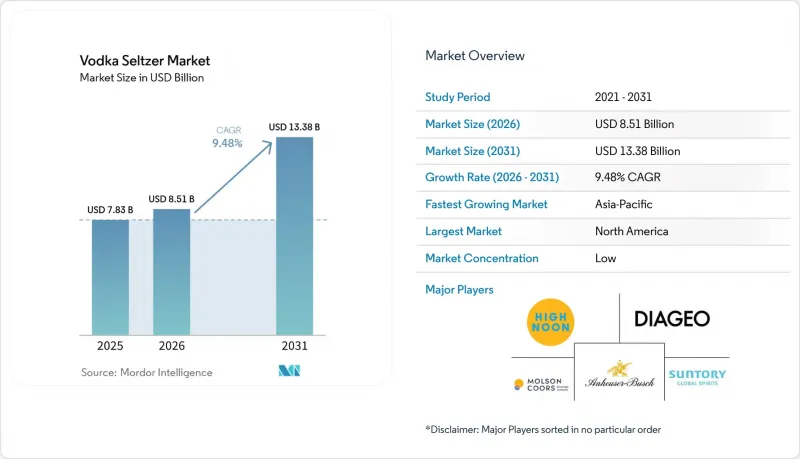
Global Vodka Seltzer Market Trends and Insights
Rising Consumer Preference for RTD Alcoholic Beverages
Consumer demand is shifting toward spirit-based RTDs, and vodka remains a recognizable base for this transition. The vodka seltzer market benefits from this shift by offering a ready-mixed serve that allows consumers to retain the identity of the spirit. Consumers can move away from malt-based alternatives while maintaining the portability and simple format that initially drove hard seltzer adoption. This reduces the need for brands to change the core drinking occasion when introducing a spirit-based product. Flavor and convenience remain key purchase considerations, so product quality alone cannot secure repeat purchases. Brands must combine a clear vodka proposition with accessible flavors and dependable availability across occasions where consumers seek a quick serve. This trend supports the vodka seltzer market by positioning the format as an additional consumption choice within spirits rather than a temporary replacement for existing products. It also allows producers to use RTDs to address occasions that may not suit a full-strength pour, a bartender-prepared drink, or a large multi-serve package.
Demand for Convenient Single-Serve Alcoholic Beverages
Single-serve formats are a key driver of vodka seltzer demand, offering portability, convenience, consistent serving sizes, and ready-to-consume products without preparation. In September 2024, the International Wine and Spirits Research (IWSR) reported that the share of 355 ml RTD cans in the United States increased from 7% to 69% over five years, driven by strong consumer demand for single-serve formats. The organization also noted that single-serve canned RTDs have enabled brands to expand into locations such as sports venues, concerts, and beaches, where glass bottles are typically restricted. Therefore, the growing adoption of single-serve cans and convenient multipack formats supports vodka seltzer consumption by making products easier to purchase, transport, store, and consume across both at-home and out-of-home occasions.
Stringent Alcohol Regulations and Restrictions on Sales and Marketing
Spirit-based vodka seltzers face regulations that do not always apply to malt beverages. In many United States jurisdictions, retailers cannot sell distilled spirits through grocery or convenience stores, limiting access to key impulse-purchase locations. Federal labeling and advertising requirements also add review steps and require additional planning from producers. These regulations increase lead times and compliance costs, particularly for smaller brands with limited regulatory resources. While the same rules can support quality and authenticity claims, the vodka seltzer market continues to face a structural access disadvantage when competing with products distributed through more open channels.
Other drivers and restraints analyzed in the detailed report include:
- Expansion of Flavor Innovation
- Demand for Low-Calorie and Low-Sugar Alcoholic Beverages
- High Taxation and Excise Duties on Alcoholic Beverages
For complete list of drivers and restraints, kindly check the Table Of Contents.
Segment Analysis
The 4.6%-6.0% ABV tier accounts for 45.24% of revenue in 2025 and is projected to expand at a CAGR of 9.73% through 2031. This band combines a lighter drinking proposition with a clear vodka-led experience, making the product feel more substantial than a flavored sparkling beverage without reaching the strength of a conventional canned cocktail. It also gives consumers a product suited to casual social occasions without the higher alcohol content associated with many canned cocktails. The segment's leadership makes it the key reference point for portfolio design, pricing, and pack formats, as brands that miss this range may struggle to meet the expectations set by the category's best-known products.
The below-4.6% tier serves a more specific consumption occasion. Virginia Distillery Co launched Kinda Light Vodka Seltzer at 2.5% ABV in June 2026 for consumers who want to extend social occasions while reducing alcohol intake. Crystal Light Vodka Refreshers also sits below the leading tier at 3.8% ABV and adds a low-calorie, zero-sugar positioning. These products can attract consumers who manage both alcohol and calorie intake without leaving the category completely, giving suppliers a way to retain demand that might otherwise shift to no-alcohol products or other moderation-led alternatives. Products above 6.0% ABV address another adjacent occasion, but they compete more directly with canned cocktails and stronger flavored malt beverages.
Fruit flavors account for 41.35% of revenue in 2025, securing the largest position within the vodka seltzer market. Their broad appeal provides an accessible entry point for consumers who seek light, approachable refreshment from RTDs, particularly when brands aim to encourage trial among shoppers who are familiar with vodka but do not regularly purchase ready-to-drink products. Tropical and exotic profiles can expand shelf interest by aligning with globally inspired beverage preferences. Diageo applied this approach with Ciroc Colada RTD, while Suntory's -196 variety pack includes Yuzu and Lemon and Grapefruit and Cherry combinations. Herbal and botanical profiles address a smaller, more premium audience that seeks complexity rather than sweeter flavor profiles.
Classic vodka-lemon, vodka-grapefruit, and vodka-lime profiles are projected to register a 10.25% CAGR through 2031. This trend indicates that experimentation can drive initial purchases, while familiar serves can support repeat purchases. Consumers can understand these profiles without lengthy explanations of ingredients or occasions, enabling the products to perform across casual at-home consumption, organized social events, and bar settings where menu descriptions must remain simple. This simplicity helps brands operate across retail, bars, restaurants, and casual social settings. It also gives operators a stable product set for scaling production volumes and strengthening retailer discussions.
Complete Report Scope:
- By ABV Content
- Below 4.6%
- 4.6%-6.0%
- Above 6.0%
- By Flavour
- Fruit Flavours
- Tropical and Exotic Flavours
- Herbal and Botanical Flavours
- Classic Flavours
- By Packaging
- Metal Cans
- Glass Bottles
- Others
- By Distribution Channel
- On-Trade
- Off-Trade
- Liquor Stores / Specialty Alcohol Retailers
- Other Retail Channels
- By Geography
- North America
- United States
- Canada
- Mexico
- Rest of North America
- Europe
- Germany
- United Kingdom
- Italy
- France
- Spain
- Netherlands
- Poland
- Belgium
- Sweden
- Rest of Europe
- Asia-Pacific
- China
- India
- Japan
- Australia
- Indonesia
- South Korea
- Thailand
- Singapore
- Rest of Asia-Pacific
- South America
- Brazil
- Argentina
- Colombia
- Chile
- Peru
- Rest of South America
- Middle East and Africa
- South Africa
- Saudi Arabia
- United Arab Emirates
- Nigeria
- Egypt
- Morocco
- Turkey
- Rest of Middle East and Africa
- North America
Geography Analysis
North America accounted for 37.12% of vodka seltzer revenue in 2025, making it the largest regional market. The United States serves as the category's primary commercial base, supported by its well-established spirits distribution system and extensive retail network. In June 2025, the United States Alcohol and Tobacco Tax and Trade Bureau (TTB) stated that each state has the authority to regulate the production, sale, and distribution of alcohol within its borders. As state and local requirements vary significantly, brands must adopt locally adaptable route-to-market strategies. Established brands benefit from distributor access and occasion-specific marketing, while regional brands can build momentum through disciplined state coverage. Carbliss reached 4.2 million cases across 22 states in 2025, demonstrating that selective geographic expansion can generate meaningful velocity without an immediate national rollout. Canada offers an additional growth path as consumers adopt RTDs across more on-premise occasions.
Europe presents a varied vodka seltzer market environment, as consumer preferences, retail access, and alcohol taxes differ significantly across countries. The United Kingdom serves as a practical launch market for United States-origin brands because its retail structure and younger consumers support low-calorie RTDs. DRTY's shift from the hard seltzer description to vodka seltzer in 2024 highlighted the value of clearly identifying the spirit base. High Noon has also used vodka soda positioning in the United Kingdom, where the hard seltzer label has less cultural relevance. Germany, the Netherlands, France, and Poland provide additional urban growth opportunities for low-ABV, fruit-led RTDs.
Asia-Pacific is forecast to grow at a CAGR of 10.64% through 2031, the fastest rate among the regions in the vodka seltzer market. Japan combines a large RTD consumer base with process-led innovation that global producers can later apply internationally. This makes the country a key market for developing flavor, processing, and packaging approaches before adapting them to other markets. Suntory's -196 illustrates this link, as the brand uses a Japanese-developed Freeze Crush Infusion process for its United States launch. Australia is another adoption market where the alcohol base affects tax treatment and formulation economics. China, India, South Korea, Indonesia, Thailand, and Singapore offer longer-term potential as urban consumers gain access to modern retail and new drinking occasions.
- High Noon
- Diageo plc
- Molson Coors Beverage
- Suntory Holdings Limited
- Anheuser-Busch
- Boston Beer Company
- Cutwater Spirits
- Mark Anthony Group
- White Claw Seltzer Works
- Mighty Swell
- Kirkland Signature
- Canteen Spirits
- Kirin Brewery
- Volley
- Ashland Hard Seltzer
- Playboy Spirits
- Breckenridge Distillery
- Lake Hour
- Stateside Brands
- La Dolce Vodka Seltzer
Additional Benefits:
- The market estimate (ME) sheet in Excel format
- 3 months of analyst support
TABLE OF CONTENTS
1 INTRODUCTION
- 1.1 Study Assumptions and Market Definition
- 1.2 Scope of the Study
2 RESEARCH METHODOLOGY
3 EXECUTIVE SUMMARY
4 MARKET LANDSCAPE
- 4.1 Market Overview
- 4.2 Market Drivers
- 4.2.1 Rising consumer preference for RTD alcoholic beverages
- 4.2.2 Demand for convenient single-serve alcoholic beverages
- 4.2.3 Availability across retail and consumption occasions
- 4.2.4 Expansion of flavor innovation
- 4.2.5 Demand for low-calorie and low-sugar alcoholic beverages
- 4.2.6 Rising preference for clean-label and simple-ingredient formulations
- 4.3 Market Restraints
- 4.3.1 Stringent alcohol regulations and restrictions on sales and marketing
- 4.3.2 High taxation and excise duties on alcoholic beverages
- 4.3.3 Competition from non-alcoholic and low-alcohol alternatives
- 4.3.4 Fragmented alcohol distribution and market-access regulations
- 4.4 Supply Chain Analysis
- 4.5 Regulatory Outlook
- 4.6 Porter's Five Forces Analysis
- 4.6.1 Threat of New Entrants
- 4.6.2 Bargaining Power of Buyers/Consumers
- 4.6.3 Bargaining Power of Suppliers
- 4.6.4 Threat of Substitute Products
- 4.6.5 Intensity of Competitive Rivalry
5 MARKET SIZE AND GROWTH FORECASTS (VALUE)
- 5.1 By ABV Content
- 5.1.1 Below 4.6%
- 5.1.2 4.6%-6.0%
- 5.1.3 Above 6.0%
- 5.2 By Flavour
- 5.2.1 Fruit Flavours
- 5.2.2 Tropical and Exotic Flavours
- 5.2.3 Herbal and Botanical Flavours
- 5.2.4 Classic Flavours
- 5.3 By Packaging
- 5.3.1 Metal Cans
- 5.3.2 Glass Bottles
- 5.3.3 Others
- 5.4 By Distribution Channel
- 5.4.1 On-Trade
- 5.4.2 Off-Trade
- 5.4.2.1 Liquor Stores / Specialty Alcohol Retailers
- 5.4.2.2 Other Retail Channels
- 5.5 By Geography
- 5.5.1 North America
- 5.5.1.1 United States
- 5.5.1.2 Canada
- 5.5.1.3 Mexico
- 5.5.1.4 Rest of North America
- 5.5.2 Europe
- 5.5.2.1 Germany
- 5.5.2.2 United Kingdom
- 5.5.2.3 Italy
- 5.5.2.4 France
- 5.5.2.5 Spain
- 5.5.2.6 Netherlands
- 5.5.2.7 Poland
- 5.5.2.8 Belgium
- 5.5.2.9 Sweden
- 5.5.2.10 Rest of Europe
- 5.5.3 Asia-Pacific
- 5.5.3.1 China
- 5.5.3.2 India
- 5.5.3.3 Japan
- 5.5.3.4 Australia
- 5.5.3.5 Indonesia
- 5.5.3.6 South Korea
- 5.5.3.7 Thailand
- 5.5.3.8 Singapore
- 5.5.3.9 Rest of Asia-Pacific
- 5.5.4 South America
- 5.5.4.1 Brazil
- 5.5.4.2 Argentina
- 5.5.4.3 Colombia
- 5.5.4.4 Chile
- 5.5.4.5 Peru
- 5.5.4.6 Rest of South America
- 5.5.5 Middle East and Africa
- 5.5.5.1 South Africa
- 5.5.5.2 Saudi Arabia
- 5.5.5.3 United Arab Emirates
- 5.5.5.4 Nigeria
- 5.5.5.5 Egypt
- 5.5.5.6 Morocco
- 5.5.5.7 Turkey
- 5.5.5.8 Rest of Middle East and Africa
- 5.5.1 North America
6 COMPETITIVE LANDSCAPE
- 6.1 Market Concentration
- 6.2 Strategic Moves
- 6.3 Market Positioning Analysis
- 6.4 Company Profiles (includes Global-level Overview, Market-level Overview, Core Segments, Financials (if available), Strategic Information, Market Rank/Share, Products and Services, Recent Developments)
- 6.4.1 High Noon
- 6.4.2 Diageo plc
- 6.4.3 Molson Coors Beverage
- 6.4.4 Suntory Holdings Limited
- 6.4.5 Anheuser-Busch
- 6.4.6 Boston Beer Company
- 6.4.7 Cutwater Spirits
- 6.4.8 Mark Anthony Group
- 6.4.9 White Claw Seltzer Works
- 6.4.10 Mighty Swell
- 6.4.11 Kirkland Signature
- 6.4.12 Canteen Spirits
- 6.4.13 Kirin Brewery
- 6.4.14 Volley
- 6.4.15 Ashland Hard Seltzer
- 6.4.16 Playboy Spirits
- 6.4.17 Breckenridge Distillery
- 6.4.18 Lake Hour
- 6.4.19 Stateside Brands
- 6.4.20 La Dolce Vodka Seltzer
7 MARKET OPPORTUNITIES AND FUTURE OUTLOOK

