PUBLISHER: Mordor Intelligence | PRODUCT CODE: 2154820

PUBLISHER: Mordor Intelligence | PRODUCT CODE: 2154820
Asia-Pacific Food Grade Carbon Dioxide - Market Share Analysis, Industry Trends & Statistics, Growth Forecasts (2026 - 2031)
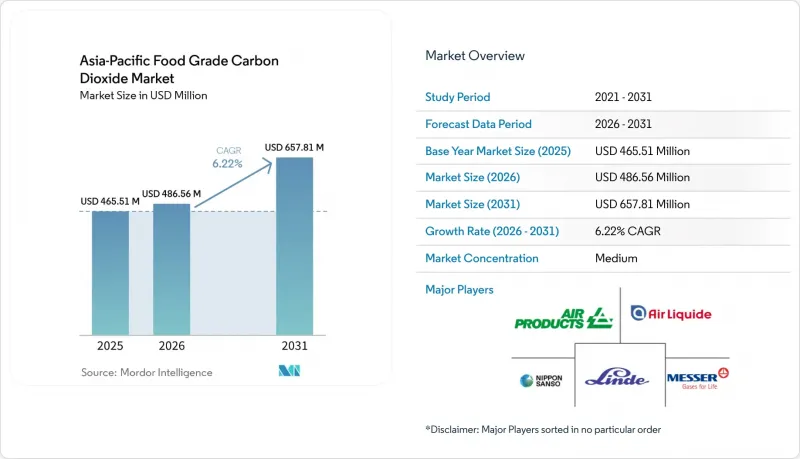
According to Mordor Intelligence, the asia-pacific food grade carbon dioxide market size is expected to grow from USD 465.51 million in 2025 to USD 486.56 million in 2026 and is forecast to reach USD 657.81 million by 2031 at 6.22% CAGR over 2026-2031.
Asia-Pacific Food Grade Carbon Dioxide Market Trends and Insights
Growth in carbonated beverage consumption
Carbonated beverages remain the main source of food-grade carbon dioxide demand across the region. China reported a 6.1% year-on-year increase in production of liquor, beverages, and refined tea in June 2026, indicating continued manufacturing activity in a large beverage base. The Asia-Pacific food-grade carbon dioxide market benefits when beverage plants add bottling and carbonation capacity in developing urban centers. Sparkling water, flavored carbonated drinks, and sugar-free products require reliable carbonation control. That requirement favors suppliers that can deliver consistent purity and dependable bulk volumes. It also makes long-term supply arrangements more relevant for large beverage producers than occasional spot purchases. The same operating requirements place value on local storage, scheduled tanker deliveries, and supplier quality documentation.
Expansion of food processing and preservation
Food processing is widening the use of carbon dioxide beyond beverage manufacturing. India's Ministry of Food Processing Industries identified a substantial need for cold-chain infrastructure investment between 2025 and 2047, particularly for the handling of meat and dairy products. Pre-cooling, tunnel freezing, and temperature-controlled storage can require liquid carbon dioxide or dry ice. The Asia-Pacific food-grade carbon dioxide market therefore gains from the shift toward refrigerated and packaged food. This demand is strongest where processors are extending distribution distances and shelf life. Supply providers that pair gas delivery with storage and handling support are better placed to serve these applications. Their role becomes more important when processors move from local sales toward longer distribution routes that require consistent temperature management. This also links gas demand to investments in refrigerated warehouses, transport, and food handling equipment.
Regional imbalances in food-grade CO2 availability
Food-grade carbon dioxide supply does not always match the location of food-processing demand. Large recovery sites are concentrated around ammonia and ethanol facilities in India, China, and Thailand. Indonesia, Malaysia, Vietnam, and northeastern India can face limited nearby purification, storage, and distribution capacity. The Asia-Pacific food-grade carbon dioxide market can therefore operate differently for coastal processors and inland processors. Plants located near liquid carbon dioxide terminals can use longer-term supply arrangements. Processors farther from those networks face a greater risk of seasonal supply tightening during peak beverage demand. The distance between recovery sites and customers can also increase delivery costs and reduce the flexibility of smaller processors.
Other drivers and restraints analyzed in the detailed report include:
- Increasing adoption of modified atmosphere packaging (MAP)
- Rising demand for meat and poultry processing
- High investment requirements for storage and distribution infrastructure
For complete list of drivers and restraints, kindly check the Table Of Contents.
Segment Analysis
Ammonia-plant recovery held 35.14% of regional supply in 2025. Fertilizer complexes in India, China, and Vietnam generate concentrated carbon dioxide streams that can be recovered and purified for food applications. This route benefits from the scale of existing ammonia and urea production. It can also expose food-gas supply to changes in fertilizer output, natural gas costs, or plant maintenance schedules. Hydrogen production, natural gas processing, and other industrial sources serve more localized supply positions. These alternatives often support one large beverage, food, or meat processor through captive arrangements or long-term commercial contracts. Their contribution depends on local feedstock availability, purification capability, and the customer's food-grade quality requirements.
Ethanol recovery is projected to grow at a 7.37% CAGR through 2031 within the Asia-Pacific food-grade carbon dioxide market. Fermentation creates a high-concentration carbon dioxide stream that can be purified for food and beverage use. India's ethanol blending program and Thailand's biofuel expansion are increasing distillation capacity across the region. A 100-KLPD ethanol plant can recover 13,000 to 15,000 tonnes of carbon dioxide each year from fermentation exhaust. Nippon Sanso Thailand and Thai Special Gas launched Green CO2 Co., Ltd. in 2026 to purify carbon dioxide from BBGI's ethanol process in Chachoengsao Province for food, beverage, and industrial supply.
Complete Report Scope:
- By Source
- Ammonia
- Ethanol
- Hydrogen
- Natural Gas Processing
- Other Sources
- By Form
- Liquid
- Gas
- Solid/Dry Ice
- By End-use Industry
- Beverages
- Meat & Poultry
- Dairy & Frozen Foods
- Fruits & Vegetables
- Bakery & Confectionery
- Other Food Industries
- By Country
- China
- Japan
- India
- South Korea
- Australia
- New Zealand
- Indonesia
- Malaysia
- Vietnam
- Rest of Asia-Pacific
List of Companies Covered in this Report:
- Linde plc
- Air Liquide S.A.
- Air Products and Chemicals, Inc.
- TAIYO NIPPON SANSO CORPORATION
- Messer SE & Co. KGaA
- Sicgil India Limited
- Ellenbarrie Industrial Gases Limited
- IFB Agro Industries Limited
- WKS Industrial Gas Pte Ltd.
- Southern Gas Limited
- Yingde Gases Group Company Limited
- Hangzhou Hangyang Co., Ltd.
- Sichuan Tianyi Science and Technology Co., Ltd.
- Shandong Shouguang Juneng Golden Corn Co., Ltd.
- Jiangsu Huachang Chemical Co., Ltd.
- Guangdong Huate Gas Co., Ltd.
- Zhejiang Juhua Co., Ltd.
- India Glycols Limited
- PT Samator Indo Gas Tbk
- Air Water, Inc.
Additional Benefits:
- The market estimate (ME) sheet in Excel format
- 3 months of analyst support
TABLE OF CONTENTS
1 INTRODUCTION
- 1.1 Study Assumptions and Market Definition
- 1.2 Scope of the Study
2 RESEARCH METHODOLOGY
3 EXECUTIVE SUMMARY
4 MARKET LANDSCAPE
- 4.1 Market Overview
- 4.2 Market Drivers
- 4.2.1 Growth in carbonated beverage consumption
- 4.2.2 Expansion of food processing and preservation
- 4.2.3 Increasing adoption of modified atmosphere packaging (MAP)
- 4.2.4 Rising demand for meat and poultry processing
- 4.2.5 Expansion of frozen and chilled food production
- 4.2.6 Growth in packaged dairy and frozen products
- 4.3 Market Restraints
- 4.3.1 Regional imbalances in food-grade CO2 availability
- 4.3.2 High investment requirements for storage and distribution infrastructure
- 4.3.3 Energy-price volatility affecting CO2 production economics
- 4.3.4 Stringent food-grade purity and certification requirements
- 4.4 Supply Chain Analysis
- 4.5 Regulatory Outlook
- 4.6 Porter's Five Forces
- 4.6.1 Threat of New Entrants
- 4.6.2 Bargaining Power of Buyers/Consumers
- 4.6.3 Bargaining Power of Suppliers
- 4.6.4 Threat of Substitute Products
- 4.6.5 Intensity of Competitive Rivalry
5 MARKET SIZE AND GROWTH FORECASTS (VALUE)
- 5.1 By Source
- 5.1.1 Ammonia
- 5.1.2 Ethanol
- 5.1.3 Hydrogen
- 5.1.4 Natural Gas Processing
- 5.1.5 Other Sources
- 5.2 By Form
- 5.2.1 Liquid
- 5.2.2 Gas
- 5.2.3 Solid/Dry Ice
- 5.3 By End-use Industry
- 5.3.1 Beverages
- 5.3.2 Meat & Poultry
- 5.3.3 Dairy & Frozen Foods
- 5.3.4 Fruits & Vegetables
- 5.3.5 Bakery & Confectionery
- 5.3.6 Other Food Industries
- 5.4 By Country
- 5.4.1 China
- 5.4.2 Japan
- 5.4.3 India
- 5.4.4 South Korea
- 5.4.5 Australia
- 5.4.6 New Zealand
- 5.4.7 Indonesia
- 5.4.8 Malaysia
- 5.4.9 Vietnam
- 5.4.10 Rest of Asia-Pacific
6 COMPETITIVE LANDSCAPE
- 6.1 Market Concentration
- 6.2 Strategic Moves
- 6.3 Market Ranking Analysis
- 6.4 Company Profiles (includes Company Highlights, Core Segments, Financials (if available), Strategic Information, Market Rank/Share, Products and Services, Recent Developments)
- 6.4.1 Linde plc
- 6.4.2 Air Liquide S.A.
- 6.4.3 Air Products and Chemicals, Inc.
- 6.4.4 TAIYO NIPPON SANSO CORPORATION
- 6.4.5 Messer SE & Co. KGaA
- 6.4.6 Sicgil India Limited
- 6.4.7 Ellenbarrie Industrial Gases Limited
- 6.4.8 IFB Agro Industries Limited
- 6.4.9 WKS Industrial Gas Pte Ltd.
- 6.4.10 Southern Gas Limited
- 6.4.11 Yingde Gases Group Company Limited
- 6.4.12 Hangzhou Hangyang Co., Ltd.
- 6.4.13 Sichuan Tianyi Science and Technology Co., Ltd.
- 6.4.14 Shandong Shouguang Juneng Golden Corn Co., Ltd.
- 6.4.15 Jiangsu Huachang Chemical Co., Ltd.
- 6.4.16 Guangdong Huate Gas Co., Ltd.
- 6.4.17 Zhejiang Juhua Co., Ltd.
- 6.4.18 India Glycols Limited
- 6.4.19 PT Samator Indo Gas Tbk
- 6.4.20 Air Water, Inc.
7 MARKET OPPORTUNITIES AND FUTURE OUTLOOK

