PUBLISHER: Mordor Intelligence | PRODUCT CODE: 2154835

PUBLISHER: Mordor Intelligence | PRODUCT CODE: 2154835
Plasticizers - Market Share Analysis, Industry Trends & Statistics, Growth Forecasts (2026 - 2031)
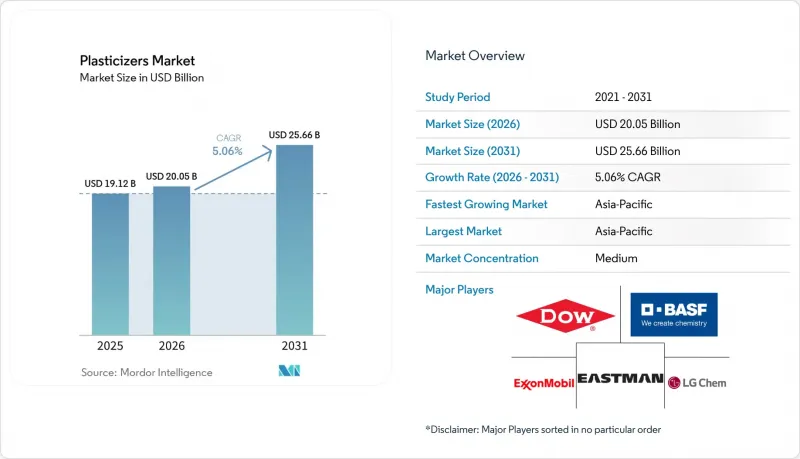
According to Mordor Intelligence, the plasticizers market size was valued at USD 19.12 billion in 2025 and is estimated to grow from USD 20.05 billion in 2026 to reach USD 25.66 billion by 2031, at a CAGR of 5.06% during the forecast period (2026-2031).
Global Plasticizers Market Trends and Insights
Flexible PVC Demand in Grid Modernization and Renewable Energy Cabling
Global electricity grid investment reached USD 400 billion across 2024 and 2025, with spending directed toward renewable interconnections, offshore wind cables, and underground distribution systems. These systems use flexible cable compounds in which plasticizers enhance insulation and jacketing performance. Project owners increasingly require documented performance under repeated exposure to heat and moisture over long operating periods. These qualification requirements narrow the supplier base for cable projects and increase the value of established application documentation. Renewable energy wiring also increases demand for grades that retain flexibility at low temperatures.
Regulatory-Led Conversion to Non-Phthalate Formulations
The European Union continues to regulate specific phthalates under the REACH framework, including restrictions on plasticized articles. Compliance requires converters to assess formulation choices, documentation, and applicable use conditions. Switching to a non-phthalate formulation can require new qualification work for products used in regulated applications, making it difficult to reverse conversion decisions once customers approve a replacement material. Research on chemical regulation has also highlighted the risk of replacing a restricted substance with a closely related alternative that raises similar concerns. The plasticizers market benefits when suppliers can provide compliant options with clear technical and regulatory support.
Higher Cost of Non-Phthalate Alternatives
Non-phthalate alternatives continue to carry a cost burden in applications that are highly sensitive to material costs. Flooring, pipes, coated fabrics, and standard cable insulation often compete on the cost of finished PVC products. This affects the pace at which converters adopt di(2-ethylhexyl) terephthalate (DOTP), diisononyl cyclohexane-1,2-dicarboxylate (DINCH), and other compliant alternatives where regulation does not require a change. The conversion process also involves reformulation, qualification testing, and documentation work. These activities can delay revenue for compounders operating on limited margins. The plasticizers market remains split between regulated applications that require conversion and price-sensitive applications that continue to favor established phthalate grades.
Other drivers and restraints analyzed in the detailed report include:
- Electrification of Vehicles and Charging Infrastructure
- High-Temperature Cable Demand in Data Centers and Power Electronics
- Petrochemical Feedstock and Esterification-Capacity Volatility
For complete list of drivers and restraints, kindly check the Table Of Contents.
Segment Analysis
Phthalate plasticizers accounted for 53.55% of the plasticizers market revenue share in 2025. Their position reflects a long-established cost advantage in construction flooring, general cable insulation, and PVC pipe compounding. They remain widely used in markets where substitution regulations have not been imposed. Established DOP and DINP supply chains support continued use across many Asian applications. Familiar processing behavior helps converters maintain productivity and material consistency. A large base of demand persists where these products meet performance and cost requirements. Competitive pricing in commodity grades, however, limits value growth for producers with limited product differentiation. This keeps demand resilient while increasing pressure on suppliers to manage feedstock costs and operating rates.
Non-phthalate plasticizers are forecast to expand at a 5.65% CAGR from 2026 to 2031. Their higher growth reflects regulatory-driven conversion in Europe and North America, as well as increasing use of compliant materials in sensitive applications. DOTP has emerged as a high-output option due to its balance of cost and performance. DINCH is used in medical and sensitive consumer applications where certification and low-migration characteristics influence procurement decisions. The market is therefore moving toward a broader product mix rather than a complete replacement of phthalates. In February 2025, BASF launched International Sustainability and Carbon Certification (ISCC) PLUS-certified biomass-balanced Palatinol DOTP and TOTM grades, along with a Ccycled Palatinol DOTP grade. These products are intended to support customers seeking sustainability-certified materials without reformulating existing products. In October 2024, Evonik expanded production capacity for ELATUR CH and ELATUR DINCD at Marl, Germany.
Complete Report Scope:
- By Product Grade
- Phthalate Plasticizers
- Non-Phthalate Plasticizers
- By Application
- Wires and Cables
- Flooring and Wall Coverings
- Films and Sheets
- Coated Fabrics
- Pipes and Tubing
- Other Applications
- By End-User Industry
- Building and Construction
- Automotive
- Electrical and Electronics
- Packaging
- Healthcare
- Other End-Use Industries
- By Geography
- Asia-Pacific
- China
- India
- Japan
- South Korea
- Rest of Asia-Pacific
- North America
- United States
- Canada
- Mexico
- Europe
- Germany
- United Kingdom
- France
- Italy
- Russia
- Rest of Europe
- South America
- Brazil
- Argentina
- Rest of South America
- Middle East and Africa
- Saudi Arabia
- South Africa
- Rest of Middle East and Africa
- Asia-Pacific
Geography Analysis
Asia-Pacific accounted for 43.54% of the plasticizers market revenue in 2025 and is projected to expand at a 5.95% CAGR through 2031. China has a large flexible PVC base serving construction, cable, and consumer goods applications. Environmental requirements and procurement standards among export-oriented manufacturers are increasing interest in non-phthalate alternatives. India provides strong regional demand for infrastructure, housing, piping, flooring, and cabling projects. South Korea and Japan supply premium non-phthalate and specialty trimellitate products to regional and global customers.
The North American plasticizers market combines stable construction demand with growth in specialty plasticizers for wire and cable and medical applications. Grid modernization and data-center investment support cable procurement that is less tied to consumer-facing demand for flexible polyvinyl chloride (PVC). Europe has advanced further toward non-phthalate formulations than other major regions. The European plasticizers market relies on diisononyl cyclohexane-1,2-dicarboxylate (DINCH), terephthalates, and bio-based alternatives for medical, food-contact, and sensitive consumer applications. European regulatory requirements increase the value of documented product portfolios and qualified supply chains.
The plasticizers markets in South America, the Middle East, and Africa comprise smaller demand centers linked to construction cycles and industrial diversification. Brazil's 2026 anti-dumping investigation concerning dioctyl phthalate (DOP), dioctyl terephthalate (DOTP), and diisononyl phthalate (DINP) imports signals growing attention to domestic capacity and regional trade flows. The Middle East and Africa benefit from construction pipelines and industrial demand, including projects associated with Saudi Arabia's Vision 2030. Growth is supported by residential construction, infrastructure investment, and wider use of flexible PVC products.
- Aekyung Chemical
- BASF
- Bluesail Chemical Group Co., Ltd.
- DIC CORPORATION
- Dow
- Eastman Chemical Company
- Evonik Industries AG
- Exxon Mobil Corporation
- LANXESS
- LG Chem
- NAN YA PLASTICS CORPORATION
- Perstorp
- Polynt S.p.A.
- UPC Technology Corporation
- Velsicol Chemical LLC
Additional Benefits:
- The market estimate (ME) sheet in Excel format
- 3 months of analyst support
TABLE OF CONTENTS
1 Introduction
- 1.1 Study Assumptions and Market Definition
- 1.2 Scope of the Study
2 Research Methodology
3 Executive Summary
4 Market Landscape
- 4.1 Market Overview
- 4.2 Market Drivers
- 4.2.1 Flexible PVC Demand in Grid Modernization and Renewable-Energy Cabling
- 4.2.2 Regulatory-Led Conversion to Non-Phthalate Formulations
- 4.2.3 Electrification of Vehicles and Charging Infrastructure
- 4.2.4 Medical-Device Qualification of Low-Migration Plasticizers
- 4.2.5 High-Temperature Cable Demand in Data Centers and Power Electronics
- 4.3 Market Restraints
- 4.3.1 Higher Cost of Non-Phthalate Alternatives
- 4.3.2 Petrochemical Feedstock and Esterification-Capacity Volatility
- 4.3.3 Performance Trade-Offs Across Temperature, Migration, and Fusion
- 4.4 Value Chain Analysis
- 4.5 Porter's Five Forces Analysis
- 4.5.1 Bargaining Power of Suppliers
- 4.5.2 Bargaining Power of Buyers
- 4.5.3 Threat of New Entrants
- 4.5.4 Threat of Substitutes
- 4.5.5 Competitive Rivalry
5 Market Size and Growth Forecasts (Value)
- 5.1 By Product Grade
- 5.1.1 Phthalate Plasticizers
- 5.1.2 Non-Phthalate Plasticizers
- 5.2 By Application
- 5.2.1 Wires and Cables
- 5.2.2 Flooring and Wall Coverings
- 5.2.3 Films and Sheets
- 5.2.4 Coated Fabrics
- 5.2.5 Pipes and Tubing
- 5.2.6 Other Applications
- 5.3 By End-User Industry
- 5.3.1 Building and Construction
- 5.3.2 Automotive
- 5.3.3 Electrical and Electronics
- 5.3.4 Packaging
- 5.3.5 Healthcare
- 5.3.6 Other End-Use Industries
- 5.4 By Geography
- 5.4.1 Asia-Pacific
- 5.4.1.1 China
- 5.4.1.2 India
- 5.4.1.3 Japan
- 5.4.1.4 South Korea
- 5.4.1.5 Rest of Asia-Pacific
- 5.4.2 North America
- 5.4.2.1 United States
- 5.4.2.2 Canada
- 5.4.2.3 Mexico
- 5.4.3 Europe
- 5.4.3.1 Germany
- 5.4.3.2 United Kingdom
- 5.4.3.3 France
- 5.4.3.4 Italy
- 5.4.3.5 Russia
- 5.4.3.6 Rest of Europe
- 5.4.4 South America
- 5.4.4.1 Brazil
- 5.4.4.2 Argentina
- 5.4.4.3 Rest of South America
- 5.4.5 Middle East and Africa
- 5.4.5.1 Saudi Arabia
- 5.4.5.2 South Africa
- 5.4.5.3 Rest of Middle East and Africa
- 5.4.1 Asia-Pacific
6 Competitive Landscape
- 6.1 Market Concentration
- 6.2 Strategic Moves
- 6.3 Market Share (%)/Ranking Analysis
- 6.4 Company Profiles (includes Global Overview, Market Overview, Core Segments, Financials as available, Strategic Information, Products and Services, and Recent Developments)
- 6.4.1 Aekyung Chemical
- 6.4.2 BASF
- 6.4.3 Bluesail Chemical Group Co., Ltd.
- 6.4.4 DIC CORPORATION
- 6.4.5 Dow
- 6.4.6 Eastman Chemical Company
- 6.4.7 Evonik Industries AG
- 6.4.8 Exxon Mobil Corporation
- 6.4.9 LANXESS
- 6.4.10 LG Chem
- 6.4.11 NAN YA PLASTICS CORPORATION
- 6.4.12 Perstorp
- 6.4.13 Polynt S.p.A.
- 6.4.14 UPC Technology Corporation
- 6.4.15 Velsicol Chemical LLC
7 Market Opportunities and Future Outlook
- 7.1 White-Space and Unmet-Need Assessment

