PUBLISHER: Mordor Intelligence | PRODUCT CODE: 2154854

PUBLISHER: Mordor Intelligence | PRODUCT CODE: 2154854
Industrial Catalysts - Market Share Analysis, Industry Trends & Statistics, Growth Forecasts (2026 - 2031)
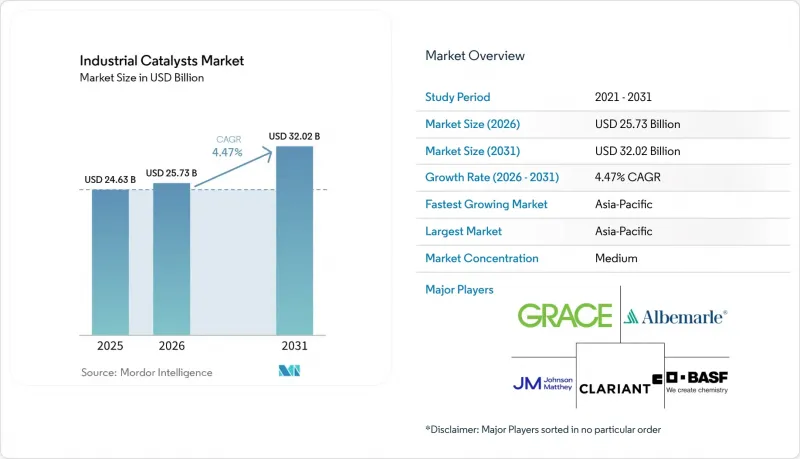
According to Mordor Intelligence, the industrial catalysts market size was valued at USD 24.63 billion in 2025 and is estimated to grow from USD 25.73 billion in 2026 to reach USD 32.02 billion by 2031, at a CAGR of 4.47% during the forecast period (2026-2031).
Global Industrial Catalysts Market Trends and Insights
Refinery and Petrochemical Capacity Expansion
New greenfield units support the industrial catalysts market because each process unit needs a fresh catalyst charge at start-up. Those units also create recurring demand through regeneration and replacement cycles over the life of the plant. Projects in China, India, and the Gulf require catalyst systems for fluid catalytic cracking, hydrotreating, hydrocracking, and propylene production. Honeywell International Inc secured a catalyst and technology contract for Dangote's Lekki complex in April 2026, covering 750,000 metric tons per year of propylene capacity. Petrochemical-integrated refineries designed to maximize propylene yield use more catalyst per unit of feedstock than conventional gasoline-focused operations. This makes the current project pipeline an important source of sustained demand for the industrial catalysts market.
Tightening Fuel and Industrial Emission Standards
Emission rules increase the required catalyst loading in industrial equipment and fuel-processing systems. The U.S. Environmental Protection Agency finalized amendments to New Source Performance Standards for stationary combustion turbines on January 9, 2026, requiring selective catalytic reduction for nitrogen oxide control in specified turbine subcategories. The International Maritime Organization designated the North-East Atlantic as an Emission Control Area for nitrogen oxides, sulfur oxides, and particulate matter on May 1, 2026. These requirements extend demand for selective catalytic reduction and related exhaust-treatment technologies. Operators must meet performance thresholds even when input costs are high. This compliance need supports the industrial catalysts market because spending cannot be deferred as easily as discretionary capital projects.
Precious-Metal and Critical-Mineral Price Volatility
Platinum, palladium, and rhodium are essential active components in many high-performance heterogeneous formulations. Price movements for these materials can quickly raise manufacturing costs and pressure supplier margins. Johnson Matthey reported that the platinum market remained in structural deficit for a third consecutive year in 2025, while industrial consumption in chemicals, glass, and synthetic-fuels applications grew modestly. Higher metal prices can prompt customers to extend regeneration cycles to defer replacement purchases. This may reduce selectivity and raise the risk of process losses at the operating plant. The effect restrains the industrial catalysts market by making purchasing decisions more sensitive to short-term input costs.
Other drivers and restraints analyzed in the detailed report include:
- Process Intensification and Higher Catalyst Selectivity
- Low-Carbon Hydrogen, Ammonia, and Circular Chemistry Investment
- Long Qualification and Plant-Validation Cycles
For complete list of drivers and restraints, kindly check the Table Of Contents.
Segment Analysis
Metals held 38.23% of the industrial catalysts market in 2025, supported by their role in hydrotreating, steam methane reforming, and catalytic reforming. Nickel, cobalt, molybdenum, and platinum-group metals provide the activity and stability required in continuous industrial processes. Zeolites are important in fluid catalytic cracking and hydrocracking because they determine conversion and product distribution. Zeolyst International's hydrocracking catalyst portfolio addresses 30% of global hydrocracking catalyst requirements, and its Opal Renew zeolites serve renewable diesel and sustainable aviation fuel applications. Chemical compounds support acid-catalyzed alkylation and isomerization, where replacement timing depends heavily on plant economics.
Organometallic materials are projected to advance at a 5.32% CAGR through 2031. Demand is linked to active pharmaceutical ingredient synthesis, specialty polymers, and carbon dioxide utilization pathways. A 2025 Journal of the American Chemical Society study by researchers from the Leibniz Institute for Catalysis, Ruhr University Bochum, and Evonik Industries AG described a bimetallic iridium-palladium system that directly converts carbon dioxide and green hydrogen into chemical intermediates. Umicore is constructing a Grubbs catalyst production facility at Catoosa, Oklahoma, with production targeted for early 2027. Mixed-metal oxides and bimetallic systems also have a role in electrochemical and environmental uses.
Complete Report Scope:
- By Material
- Metals
- Zeolites
- Chemical Compounds
- Organometallic Materials
- Other Materials
- By Type
- Heterogeneous Catalysts
- Homogeneous Catalysts
- By Application
- Petroleum Refining
- Petrochemicals
- Chemical Synthesis
- Environmental Catalysis
- Other Applications
- By Geography
- Asia-Pacific
- China
- India
- Japan
- South Korea
- ASEAN Countries
- Rest of Asia-Pacific
- North America
- United States
- Canada
- Mexico
- Europe
- Germany
- United Kingdom
- France
- Italy
- NORDIC Countries
- Rest of Europe
- South America
- Brazil
- Argentina
- Rest of South America
- Middle East and Africa
- Saudi Arabia
- South Africa
- Rest of Middle East and Africa
- Asia-Pacific
Geography Analysis
Asia-Pacific held 35.67% of the industrial catalysts market in 2025 and is projected to advance at a 5.45% CAGR through 2031. China's large refining system supports demand for fluid catalytic cracking, hydrotreating, and reforming catalysts. India's refinery and petrochemical expansion adds demand for processing catalysts. Topsoe reported strong Asia-Pacific catalyst sales in 2025, with India emerging as a key growth driver, and 3 sustainable aviation fuel projects secured in China. South Korea, Japan, Vietnam, and Indonesia add demand through petrochemical clusters, fuel-quality requirements, and refinery self-sufficiency programs.
North America and Europe form a major demand base for replacement catalysts, low-sulfur fuel processing, and environmental control systems. In North America, complex refinery configurations create a continued need for specialized hydrocracking and hydrotreating formulations. Incentives for low-carbon hydrogen and ammonia also create catalyst demand outside conventional refinery operations. Europe is focused on reducing industrial carbon intensity through bio-derived feedstock co-processing and refinery-petrochemical integration. The industrial catalysts market in both regions is shaped more by replacement, compliance, and process upgrades than by large new refinery construction.
South America and Middle East and Africa represent a smaller but distinct part of the industrial catalysts market. Brazil requires specialized solutions for sugarcane ethanol processing and hydrotreated vegetable oil production. Topsoe supports the Yanbu Green Hydrogen Project in Saudi Arabia, while Honeywell International Inc's contract for Dangote's Lekki complex adds petrochemical catalyst demand in Nigeria. Economic volatility in some markets can delay procurement and catalyst replacement cycles.
- BASF
- Albemarle Corporation
- Axens
- CLARIANT
- Evonik Industries AG
- Honeywell International Inc.
- JGC C&C
- Johnson Matthey
- NIPPON KETJEN Co.,Ltd.
- Shell plc
- Sinopec Catalyst CO.,LTD.
- Topsoe A/S
- Umicore
- W. R. Grace & Co.-Conn
- Zeolyst International
Additional Benefits:
- The market estimate (ME) sheet in Excel format
- 3 months of analyst support
TABLE OF CONTENTS
1 Introduction
- 1.1 Study Assumptions and Market Definition
- 1.2 Scope of the Study
2 Research Methodology
3 Executive Summary
4 Market Landscape
- 4.1 Market Overview
- 4.2 Market Drivers
- 4.2.1 Refinery and Petrochemical Capacity Expansion
- 4.2.2 Tightening Fuel and Industrial Emission Standards
- 4.2.3 Process Intensification and Higher Catalyst Selectivity
- 4.2.4 Low-Carbon Hydrogen, Ammonia, and Circular Chemistry Investment
- 4.2.5 Digital Catalyst Monitoring and Performance-Based Services
- 4.3 Market Restraints
- 4.3.1 Precious-Metal and Critical-Mineral Price Volatility
- 4.3.2 Long Qualification and Plant-Validation Cycles
- 4.3.3 Deactivation Risk from Variable Biofeeds and Co-Processing Streams
- 4.4 Value Chain Analysis
- 4.5 Porter's Five Forces Analysis
- 4.5.1 Threat of New Entrants
- 4.5.2 Bargaining Power of Suppliers
- 4.5.3 Bargaining Power of Buyers
- 4.5.4 Threat of Substitutes
- 4.5.5 Competitive Rivalry
5 Market Size and Growth Forecasts (Value)
- 5.1 By Material
- 5.1.1 Metals
- 5.1.2 Zeolites
- 5.1.3 Chemical Compounds
- 5.1.4 Organometallic Materials
- 5.1.5 Other Materials
- 5.2 By Type
- 5.2.1 Heterogeneous Catalysts
- 5.2.2 Homogeneous Catalysts
- 5.3 By Application
- 5.3.1 Petroleum Refining
- 5.3.2 Petrochemicals
- 5.3.3 Chemical Synthesis
- 5.3.4 Environmental Catalysis
- 5.3.5 Other Applications
- 5.4 By Geography
- 5.4.1 Asia-Pacific
- 5.4.1.1 China
- 5.4.1.2 India
- 5.4.1.3 Japan
- 5.4.1.4 South Korea
- 5.4.1.5 ASEAN Countries
- 5.4.1.6 Rest of Asia-Pacific
- 5.4.2 North America
- 5.4.2.1 United States
- 5.4.2.2 Canada
- 5.4.2.3 Mexico
- 5.4.3 Europe
- 5.4.3.1 Germany
- 5.4.3.2 United Kingdom
- 5.4.3.3 France
- 5.4.3.4 Italy
- 5.4.3.5 NORDIC Countries
- 5.4.3.6 Rest of Europe
- 5.4.4 South America
- 5.4.4.1 Brazil
- 5.4.4.2 Argentina
- 5.4.4.3 Rest of South America
- 5.4.5 Middle East and Africa
- 5.4.5.1 Saudi Arabia
- 5.4.5.2 South Africa
- 5.4.5.3 Rest of Middle East and Africa
- 5.4.1 Asia-Pacific
6 Competitive Landscape
- 6.1 Market Concentration
- 6.2 Strategic Moves
- 6.3 Market Share (%)/Ranking Analysis
- 6.4 Company Profiles (includes Global Overview, Market Overview, Core Segments, Financials as available, Strategic Information, Products and Services, and Recent Developments)
- 6.4.1 BASF
- 6.4.2 Albemarle Corporation
- 6.4.3 Axens
- 6.4.4 CLARIANT
- 6.4.5 Evonik Industries AG
- 6.4.6 Honeywell International Inc.
- 6.4.7 JGC C&C
- 6.4.8 Johnson Matthey
- 6.4.9 NIPPON KETJEN Co.,Ltd.
- 6.4.10 Shell plc
- 6.4.11 Sinopec Catalyst CO.,LTD.
- 6.4.12 Topsoe A/S
- 6.4.13 Umicore
- 6.4.14 W. R. Grace & Co.-Conn
- 6.4.15 Zeolyst International
7 Market Opportunities and Future Outlook
- 7.1 White-Space and Unmet-Need Assessment

