PUBLISHER: Mordor Intelligence | PRODUCT CODE: 2154872

PUBLISHER: Mordor Intelligence | PRODUCT CODE: 2154872
Commercial Payments - Market Share Analysis, Industry Trends & Statistics, Growth Forecasts (2026 - 2031)
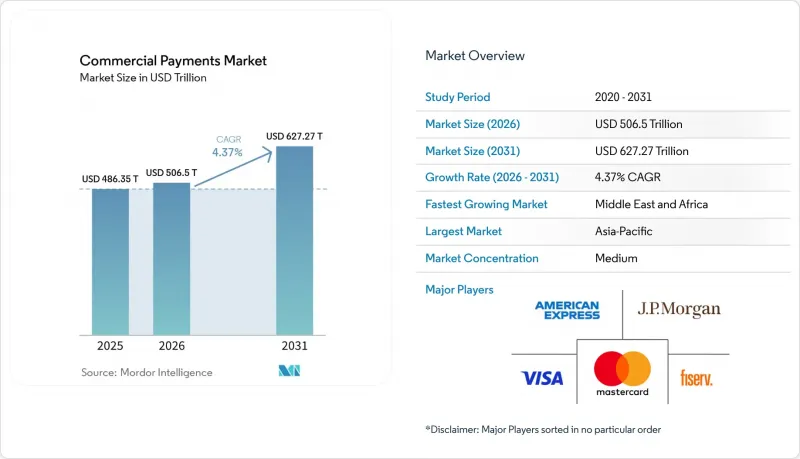
According to Mordor Intelligence, the commercial payments market size is projected to expand from USD 486.35 trillion in 2025 and USD 506.5 trillion in 2026 to USD 627.27 trillion by 2031, registering a CAGR of 4.37% between 2026 and 2031.
Global Commercial Payments Market Trends and Insights
Rising Demand for Virtual Cards and Dynamic Spend Controls
Virtual cards are becoming more relevant to corporate payment programs as companies seek greater control over individual transactions. Commercial cards accounted for less than 3% of global B2B payment value, but spending surpassed USD 4.3 trillion in 2024 and is projected to exceed USD 6 trillion by 2029. The gap between card penetration and spending shows that adoption remains concentrated among large enterprises and procurement platforms. Single-use card numbers and vendor-level limits can reduce reconciliation uncertainty and may generate rebate income that offsets program costs. Mastercard expanded embedded virtual card number capabilities across SAP Concur, SAP Taulia, and expense platforms in October 2025, showing that networks are competing through ERP connections as well as card acceptance. J.P. Morgan Payments launched its European B2B virtual card offering with Mastercard in March 2026, extending the model to insurance, healthcare, travel, and commercial real estate users
ERP and Accounts Payable Automation Integration Across Enterprises
ERP-native payment execution is moving accounts payable teams closer to working-capital management. Direct integrations allow payment initiation, approval, and status information to remain within the finance systems used by corporate buyers. Manual invoice processing costs averaged USD 10 per invoice, according to FIS Global, creating a clear cost case for automation. Global Payments embedded vendor payments in Sage Intacct in June 2025, allowing accounts payable teams to initiate and track payments without separate logins. Acumatica and BILL introduced a similar embedded accounts payable integration for United States mid-market ERP users in October 2025. In the commercial payments market, competition is increasingly taking place in ERP application marketplaces rather than traditional banking channels.
Fragmented Legacy Banking Rails Slow Multi-System Commercial Payment Orchestration
Legacy payment infrastructure remains a persistent limitation because it was not designed for the needs of modern multi-entity enterprises. Many businesses face friction in international payments, including settlement windows of 2-5 days, unclear foreign exchange charges, and fragmented banking data. Enterprises with many banking relationships can face incompatibility between ERP payment modules and bank application programming interfaces. This fragmentation supports demand for middleware and payment orchestration platforms, but it can also reduce straight-through processing rates. Replacing core banking connections is difficult because companies often operate under multiyear banking contracts and internal technology priorities. These conditions can lengthen the sales cycle for commercial payment infrastructure providers.
Other drivers and restraints analyzed in the detailed report include:
- Cross-Border B2B Commerce Requiring Faster and More Traceable Settlement
- ISO 20022 and Rich Remittance Data Adoption Improving Reconciliation Efficiency
- Merchant Acceptance Friction for Commercial Cards in High-Fee Categories
For complete list of drivers and restraints, kindly check the Table Of Contents.
Segment Analysis
Domestic payments accounted for 72.16% of the commercial payments market share in 2025. This leading position reflects recurring intercompany transfers, supplier disbursements, and payroll funding that settle through national payment rails. Cross-border payments are projected to expand at a 6.21% CAGR through 2031. International flows can create greater revenue potential because foreign exchange, payment data, and compliance services are associated with these transactions. Nacha reported that United States B2B ACH payments reached 7.35 billion transactions and USD 58.24 trillion in value in 2024.
The commercial payments market size for cross-border payments is expected to benefit from multinational supply-chain expansion and growing intra-Asia-Pacific trade. Cross-border users need reliable payment tracking because settlement, currency conversion, and documentation can involve multiple parties. Domestic payments will continue to support most transaction volume because they rely on established national infrastructure. Providers are responding by developing workflows that support invoice matching, remittance information, and working-capital visibility. McKinsey identified growing investment in cross-border reconciliation, invoice automation, and working-capital tools in 2025, which signals the importance of higher-value international payment workflows.
Bank transfers accounted for 79.45% of the commercial payments market share in 2025. Their position is supported by long-standing treasury integration and the high values involved in many B2B payments. Cards are projected to record a 9.34% CAGR through 2031. The growth is primarily linked to virtual cards used within accounts payable workflows rather than physical card issuance. The Association for Financial Professionals reported that checks represented 26% of B2B payment volume in 2025, down from 33% in 2022.
The commercial payments market size for card-based methods is supported by spend-control features, rebate structures, and better data capture. Bank transfers will remain important because they can efficiently handle high-value transfers and are deeply embedded in corporate treasury systems. Other digital methods, including real-time payments and account-to-account transfers, are gaining greater relevance as FedNow, UPI, and Pix expand into B2B use cases. The choice of rail is increasingly based on payment corridor, supplier preference, and settlement urgency. The Association for Financial Professionals also reported that 76% of organizations planned to update their payment strategies within 3 years, indicating a continuing shift away from paper-centered processes.
Complete Report Scope:
- By Payment Type
- Domestic Payments
- Cross-Border Payments
- By Payment Method
- Cards
- Bank Transfers
- Cheques and Other Paper-based Instruments
- Other Digital Methods
- By Enterprise Size
- Large Enterprises
- Small and Medium-Sized Enterprises
- By Industry Vertical
- BFSI
- IT and Telecom
- Manufacturing
- Retail and E-Commerce
- Transportation and Logistics
- Energy and Utilities
- Healthcare
- Government and Public Sector
- Other Industry Verticals
- By Geography
- North America
- United States
- Canada
- Mexico
- South America
- Brazil
- Argentina
- Rest of South America
- Europe
- United Kingdom
- Germany
- France
- Italy
- Spain
- Rest of Europe
- Asia-Pacific
- China
- Japan
- India
- South Korea
- Australia
- Indonesia
- Thailand
- Malaysia
- Singapore
- Vietnam
- Rest of Asia-Pacific
- Middle East and Africa
- Saudi Arabia
- United Arab Emirates
- Turkey
- South Africa
- Egypt
- Rest of Middle East and Africa
- North America
Geography Analysis
Asia-Pacific accounted for 48.75% of the commercial payments market share in 2025 and remained the largest regional contributor. China's Cross-Border Interbank Payment System exceeded 200 direct participants in 2026 and extended renminbi payment connectivity to more than 100 countries. India's UPI is linked with Singapore's PayNow and is being extended through Project Nexus. Japan and South Korea have card-oriented commercial payment ecosystems suited to enterprise B2B activity. ASEAN markets are developing application programming interface interoperability through the ASEAN Payment Connectivity initiative.
North America and Europe were the second- and third-largest commercial payments geographies. North America benefits from corporate card programs, accounts payable automation, and advanced treasury systems. Full ISO 20022 enforcement on Fedwire and CHIPS by November 2026 affects high-value domestic and cross-border users. The European Instant Payments Regulation required eurozone providers to send and receive instant payments from October 2025.
The Middle East and Africa commercial payments market size is projected to expand at a 6.86% CAGR from 2026 to 2031. Saudi Arabia reported that electronic payments made up 79% of retail transactions in 2025. GSMA reported that mobile money transactions in the Middle East and North Africa reached USD 62 billion in 2025, up 25% year over year. The UAE's AANI system and Saudi Arabia's SARIE platform support B2B payment digitization across the Gulf Cooperation Council. The region is shifting attention from consumer adoption toward enterprise payment workflows.
- Visa Inc.
- Mastercard Incorporated
- American Express Company
- J.P. Morgan
- Citigroup Inc.
- Bank of America Corporation
- U.S. Bancorp
- Wells Fargo and Company
- Barclays PLC
- Fiserv, Inc.
- FIS
- PayPal Holdings, Inc.
- Stripe, Inc.
- Adyen N.V.
- Airwallex
- Brex Inc.
- Corpay, Inc.
- WEX Inc.
- Coupa Software Incorporated
- Edenred SE
Additional Benefits:
- The market estimate (ME) sheet in Excel format
- 3 months of analyst support
TABLE OF CONTENTS
1 INTRODUCTION
- 1.1 Study Assumptions and Market Definition
- 1.2 Scope of the Study
2 RESEARCH METHODOLOGY
3 EXECUTIVE SUMMARY
4 MARKET LANDSCAPE
- 4.1 Market Overview
- 4.2 Market Drivers
- 4.2.1 Rising Demand for Virtual Cards and Dynamic Spend Controls
- 4.2.2 ERP and Accounts Payable Automation Integration Across Enterprises
- 4.2.3 Cross-Border B2B Commerce Requiring Faster and More Traceable Settlement
- 4.2.4 Supplier Push for Straight-Through Processing and Digital Remittance Reconciliation
- 4.2.5 Growth of Embedded Commercial Payment Workflows in Procurement and Expense Platforms
- 4.2.6 ISO 20022 and Rich Remittance Data Adoption Improving Reconciliation Efficiency
- 4.3 Market Restraints
- 4.3.1 Fragmented Legacy Banking Rails Slow Multi-System Commercial Payment Orchestration
- 4.3.2 Merchant Acceptance Friction for Commercial Cards in High-Fee Categories
- 4.3.3 Corporate Security and Approval Complexity Limits Automation Rollout
- 4.3.4 Uneven Cross-Border Compliance and Tax Documentation Requirements Increase Operational Burden
- 4.4 Value Chain Analysis
- 4.4.1 Issuers, Networks, Processors, and Software Platforms
- 4.4.2 Corporate Buyers, Procurement Teams, and Finance Operations
- 4.4.3 Suppliers, Merchants, and Payment Acceptance Partners
- 4.5 Regulatory Landscape
- 4.6 Technological Outlook
- 4.6.1 Tokenization and Virtual Card Infrastructure
- 4.6.2 API-First Payment Orchestration and Embedded Finance
- 4.6.3 ERP-Native Reconciliation and Data Enrichment Tools
- 4.6.4 Commercial Payments Pricing and Fee Stack Analysis
- 4.7 Porter's Five Forces Analysis
- 4.7.1 Threat of New Entrants
- 4.7.2 Bargaining Power of Buyers
- 4.7.3 Bargaining Power of Suppliers
- 4.7.4 Threat of Substitutes
- 4.7.5 Competitive Rivalry
5 MARKET SIZE AND GROWTH FORECASTS
- 5.1 By Payment Type
- 5.1.1 Domestic Payments
- 5.1.2 Cross-Border Payments
- 5.2 By Payment Method
- 5.2.1 Cards
- 5.2.2 Bank Transfers
- 5.2.3 Cheques and Other Paper-based Instruments
- 5.2.4 Other Digital Methods
- 5.3 By Enterprise Size
- 5.3.1 Large Enterprises
- 5.3.2 Small and Medium-Sized Enterprises
- 5.4 By Industry Vertical
- 5.4.1 BFSI
- 5.4.2 IT and Telecom
- 5.4.3 Manufacturing
- 5.4.4 Retail and E-Commerce
- 5.4.5 Transportation and Logistics
- 5.4.6 Energy and Utilities
- 5.4.7 Healthcare
- 5.4.8 Government and Public Sector
- 5.4.9 Other Industry Verticals
- 5.5 By Geography
- 5.5.1 North America
- 5.5.1.1 United States
- 5.5.1.2 Canada
- 5.5.1.3 Mexico
- 5.5.2 South America
- 5.5.2.1 Brazil
- 5.5.2.2 Argentina
- 5.5.2.3 Rest of South America
- 5.5.3 Europe
- 5.5.3.1 United Kingdom
- 5.5.3.2 Germany
- 5.5.3.3 France
- 5.5.3.4 Italy
- 5.5.3.5 Spain
- 5.5.3.6 Rest of Europe
- 5.5.4 Asia-Pacific
- 5.5.4.1 China
- 5.5.4.2 Japan
- 5.5.4.3 India
- 5.5.4.4 South Korea
- 5.5.4.5 Australia
- 5.5.4.6 Indonesia
- 5.5.4.7 Thailand
- 5.5.4.8 Malaysia
- 5.5.4.9 Singapore
- 5.5.4.10 Vietnam
- 5.5.4.11 Rest of Asia-Pacific
- 5.5.5 Middle East and Africa
- 5.5.5.1 Saudi Arabia
- 5.5.5.2 United Arab Emirates
- 5.5.5.3 Turkey
- 5.5.5.4 South Africa
- 5.5.5.5 Egypt
- 5.5.5.6 Rest of Middle East and Africa
- 5.5.1 North America
6 COMPETITIVE LANDSCAPE
- 6.1 Market Concentration
- 6.2 Strategic Moves
- 6.3 Market Share Analysis
- 6.4 Company Profiles (includes Global Level Overview, Market Level Overview, Core Segments, Financials as available, Strategic Information, Market Rank/Share, Products and Services, Recent Developments)
- 6.4.1 Visa Inc.
- 6.4.2 Mastercard Incorporated
- 6.4.3 American Express Company
- 6.4.4 J.P. Morgan
- 6.4.5 Citigroup Inc.
- 6.4.6 Bank of America Corporation
- 6.4.7 U.S. Bancorp
- 6.4.8 Wells Fargo and Company
- 6.4.9 Barclays PLC
- 6.4.10 Fiserv, Inc.
- 6.4.11 FIS
- 6.4.12 PayPal Holdings, Inc.
- 6.4.13 Stripe, Inc.
- 6.4.14 Adyen N.V.
- 6.4.15 Airwallex
- 6.4.16 Brex Inc.
- 6.4.17 Corpay, Inc.
- 6.4.18 WEX Inc.
- 6.4.19 Coupa Software Incorporated
- 6.4.20 Edenred SE
7 MARKET OPPORTUNITIES AND FUTURE OUTLOOK
- 7.1 White-Space and Unmet-Need Assessment

