PUBLISHER: Mordor Intelligence | PRODUCT CODE: 2154883

PUBLISHER: Mordor Intelligence | PRODUCT CODE: 2154883
South America Data Center Cooling - Market Share Analysis, Industry Trends & Statistics, Growth Forecasts (2026 - 2031)
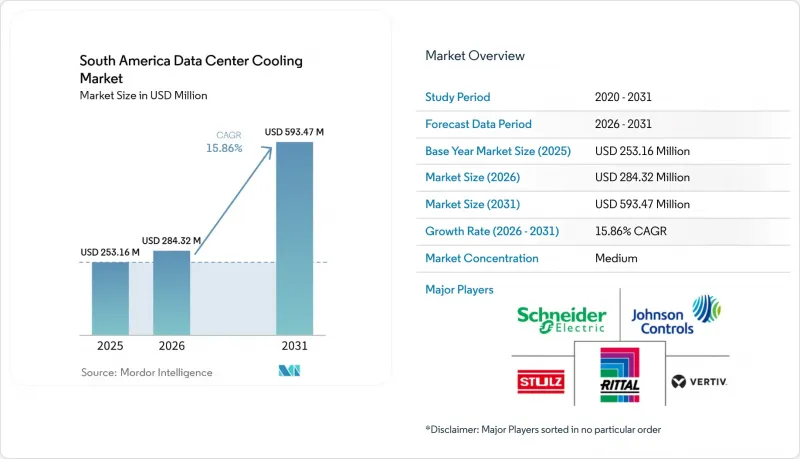
According to Mordor Intelligence, the South America data center cooling market size was valued at USD 253.16 million in 2025 and is estimated to grow from USD 284.32 million in 2026 to reach USD 593.47 million by 2031, at a CAGR of 15.86% during the forecast period (2026-2031).
South America Data Center Cooling Market Trends and Insights
Hyperscale and AI Workload Expansion
AI training and inference workloads are changing the cooling requirements of new data centers across the region. GPU clusters place greater demands on thermal management than traditional enterprise systems, which makes liquid-ready infrastructure more relevant in the South America data center cooling market. Ascenty began construction of its Sumare 3 facility in March 2026, a 90 MW AI-optimized site designed with direct-to-chip liquid cooling and a closed-loop cooling architecture with zero WUE. The facility is scheduled for delivery in Q3 2027, with a further 90 MW expansion phase planned. This type of project makes cooling capability an early design decision rather than a later equipment selection. It also increases the value of suppliers capable of supporting high-density racks, integrating hydraulic systems, and commissioning equipment on a demanding construction schedule. Equipment selection now has to account for piping paths, floor loading, maintenance access, leak detection, controls integration, and the ability to expand capacity without interrupting a customer's compute environment. These requirements move more of the project discussion toward engineering capability and lifetime service support.
Cloud, Colocation, and Digital Infrastructure Investment
Cloud and colocation projects are driving the growth of large-scale cooling procurement programs in the South America data center cooling market. Amazon announced in May 2025 that it plans to invest more than USD 4 billion to launch the AWS South America Chile Region by the end of 2026. The planned region includes 3 Availability Zones in Santiago, each with independent power and cooling infrastructure. Ascenty also secured 150 MW of new AI contracts and committed USD 1.2 billion to 4 new data centers in Brazil. These investments require cooling decisions well before a facility begins operating, which gives vendors a defined window to qualify designs, establish supply arrangements, and plan field support. The concentration of capacity additions in major hubs also favors providers that can serve several projects from regional inventory and service bases. A supplier with a locally available product can reduce exposure to delivery delays during a narrow construction window. The benefit is especially important when several projects require similar cooling equipment simultaneously.
High Upfront Cost of Advanced Cooling Systems
Advanced liquid cooling requires more than a single piece of equipment. Direct-to-chip systems, immersion tanks, pumps, manifolds, coolant distribution units, compatible fluids, and installation services can increase a project's initial cost. This cost profile can delay adoption among operators without hyperscale purchasing power. The result is a divided adoption pattern in the South America data center cooling market, with large AI-oriented projects moving faster toward liquid systems while many enterprise facilities retain air-based equipment. Existing CRAH, CRAC, chiller, and cooling tower installations remain economically viable when rack densities are within their practical operating range. Import dependence and limited local availability of specialist components can further lengthen lead times and increase the capital needed for phased expansions. Operators may need to reserve key equipment earlier in the project cycle to protect commissioning dates. That approach can add planning complexity when capacity is being added in stages, and the final IT load remains uncertain.
Other drivers and restraints analyzed in the detailed report include:
- Energy-Efficiency and Sustainability Mandates
- Digitalization, 5G, and Edge Computing Deployment
- Water, Grid, and Site-Specific Infrastructure Constraints
For complete list of drivers and restraints, kindly check the Table Of Contents.
Segment Analysis
Air-based cooling held 78.24% of the South America data center cooling market share in 2025. The segment benefits from a substantial installed base of CRAH and CRAC units, chillers, economizers, and cooling towers across hyperscale, enterprise, and colocation facilities. Air-based systems remain practical for workloads that operate below the rack-density levels that require liquid cooling. Replacement of functional equipment is often difficult to justify before the end of its useful life. Cooling towers, chillers, and economizers continue to support many established campus facilities. Precision cooling equipment also remains relevant for telecom shelters and modular edge deployments. These uses maintain a broad installed base for service, replacement, and incremental upgrades in the South America data center cooling market.
Liquid-based cooling is forecast to grow at a 16.53% CAGR through 2031, which is the highest rate among cooling technologies. Direct-to-chip systems are gaining early use in new AI-oriented hyperscale developments, while immersion cooling is being considered for purpose-built AI environments and selected high-density retrofit zones. Rear-door heat exchangers offer a middle path for facilities that want to increase density without rebuilding every cooling circuit. The South America data center cooling industry is therefore likely to retain air equipment in volume while liquid systems take a larger role in high-value deployments. Liquid cooling can have higher revenue per kilowatt and a larger service requirement than air-based alternatives. Suppliers with both air and liquid portfolios can address existing facilities as well as new AI-ready projects. Their ability to support hybrid designs is important because many sites will adopt liquid cooling in phases rather than through a single full conversion.
CRAH and CRAC units accounted for 33.62% of the cooling component segment in 2025. Their leading position reflects their use across enterprise and colocation facilities, not only their role in new builds. Chillers and heat exchanger units, cooling towers and dry coolers, and pumps and valves form the physical infrastructure that moves heat away from IT loads. These components can serve air-side systems, liquid-side systems, or hybrid designs. Pumps and valves may have a lower unit value but remain essential, as hydraulic circuits require maintenance, replacement parts, and controls. The South America data center cooling market size for components is supported by this combination of installed-base service requirements and new capacity additions.
Control and monitoring software is forecast to expand at a 16.38% CAGR through 2031. Its growth is linked to operator needs for real-time thermal visibility, power planning, and performance reporting. Anatel's 2025 consultation on data center conformity assessment reinforces the importance of measuring energy, water, and carbon-related performance. Schneider Electric's Motivair MCDU-70, launched in January 2026, includes EcoStruxure software for digital-twin simulation, adaptive load balancing, and real-time monitoring. This product approach bundles monitoring functions with coolant distribution hardware. It also makes software more directly connected to compliance and cooling performance. The South America data center cooling industry can therefore see controls become a recurring part of cooling procurement rather than a separate discretionary purchase. When hardware and software are selected together, operators can establish a more consistent operating view across the cooling chain.
Complete Report Scope:
- By Cooling Technology
- Air-based Cooling
- Chillers and Economizers
- Computer Room Air Handlers (CRAHs)
- Cooling Towers (Direct, Indirect, and Two-Stage)
- Other Air-based Cooling Technologies
- Liquid-based Cooling
- Immersion Cooling
- Direct-to-Chip Cooling
- Rear-Door Heat Exchangers
- Air-based Cooling
- By Cooling Component
- Computer-Room Air Handlers (CRAH/CRAC)
- Chillers and Heat Exchanger Units
- Cooling Towers and Dry Coolers
- Pumps and Valves
- Control and Monitoring Software
- By Data Center Type
- Hyperscale (Owned and Leased)
- Enterprise (On-premise)
- Colocation
- By End-user Industry
- IT and Telecom
- Retail and Consumer Goods
- Healthcare
- Media and Entertainment
- Federal and Institutional Agencies
- Other End-user Industries
- By Geography
- Brazil
- Argentina
- Chile
- Colombia
- Rest of South America
List of Companies Covered in this Report:
- Vertiv Holdings Co
- Schneider Electric SE
- STULZ GmbH
- Rittal GmbH & Co. KG
- Johnson Controls International plc
- Munters Group AB
- Daikin Industries, Ltd.
- Mitsubishi Electric Corporation
- Alfa Laval AB
- Carrier Global Corporation
- Trane Technologies plc
- Modine Manufacturing Company
- Motivair Corporation
- CoolIT Systems Inc.
- LiquidStack Inc.
- Submer Technologies S.L.
- Iceotope Technologies Limited
- Green Revolution Cooling, Inc.
- Asperitas B.V.
- Delta Electronics, Inc.
- Huawei Technologies Co., Ltd.
Additional Benefits:
- The market estimate (ME) sheet in Excel format
- 3 months of analyst support
TABLE OF CONTENTS
1 INTRODUCTION
- 1.1 Study Assumptions and Market Definition
- 1.2 Scope of the Study
2 RESEARCH METHODOLOGY
3 EXECUTIVE SUMMARY
4 MARKET LANDSCAPE
- 4.1 Market Overview
- 4.2 Market Drivers
- 4.2.1 Hyperscale and AI Workload Expansion
- 4.2.2 Cloud, Colocation, and Digital Infrastructure Investment
- 4.2.3 Digitalization, 5G, and Edge Computing Deployment
- 4.2.4 Energy-Efficiency and Sustainability Mandates
- 4.2.5 Brownfield Liquid-Cooling Retrofit Demand
- 4.2.6 Local Manufacturing and Service-Capability Expansion
- 4.3 Market Restraints
- 4.3.1 High Upfront Cost of Advanced Cooling Systems
- 4.3.2 Cooling-System Energy Consumption
- 4.3.3 Limited Availability of Skilled Liquid-Cooling Service Personnel
- 4.3.4 Water, Grid, and Site-Specific Infrastructure Constraints
- 4.4 Impact of Macroeconomic Factors on the Market
- 4.5 Industry Value Chain Analysis
- 4.6 Regulatory Landscape
- 4.7 Technological Outlook
- 4.8 Porter's Five Forces Analysis
- 4.8.1 Bargaining Power of Suppliers
- 4.8.2 Bargaining Power of Buyers
- 4.8.3 Threat of New Entrants
- 4.8.4 Threat of Substitutes
- 4.8.5 Competitive Rivalry
5 MARKET SIZE AND GROWTH FORECASTS (VALUE)
- 5.1 By Cooling Technology
- 5.1.1 Air-based Cooling
- 5.1.1.1 Chillers and Economizers
- 5.1.1.2 Computer Room Air Handlers (CRAHs)
- 5.1.1.3 Cooling Towers (Direct, Indirect, and Two-Stage)
- 5.1.1.4 Other Air-based Cooling Technologies
- 5.1.2 Liquid-based Cooling
- 5.1.2.1 Immersion Cooling
- 5.1.2.2 Direct-to-Chip Cooling
- 5.1.2.3 Rear-Door Heat Exchangers
- 5.1.1 Air-based Cooling
- 5.2 By Cooling Component
- 5.2.1 Computer-Room Air Handlers (CRAH/CRAC)
- 5.2.2 Chillers and Heat Exchanger Units
- 5.2.3 Cooling Towers and Dry Coolers
- 5.2.4 Pumps and Valves
- 5.2.5 Control and Monitoring Software
- 5.3 By Data Center Type
- 5.3.1 Hyperscale (Owned and Leased)
- 5.3.2 Enterprise (On-premise)
- 5.3.3 Colocation
- 5.4 By End-user Industry
- 5.4.1 IT and Telecom
- 5.4.2 Retail and Consumer Goods
- 5.4.3 Healthcare
- 5.4.4 Media and Entertainment
- 5.4.5 Federal and Institutional Agencies
- 5.4.6 Other End-user Industries
- 5.5 By Geography
- 5.5.1 Brazil
- 5.5.2 Argentina
- 5.5.3 Chile
- 5.5.4 Colombia
- 5.5.5 Rest of South America
6 COMPETITIVE LANDSCAPE
- 6.1 Market Concentration
- 6.2 Strategic Moves
- 6.3 Market Share Analysis
- 6.4 Company Profiles (includes Global Level Overview, Market Level Overview, Core Segments, Financials as available, Strategic Information, Market Rank/Share, Products and Services, Recent Developments)
- 6.4.1 Vertiv Holdings Co
- 6.4.2 Schneider Electric SE
- 6.4.3 STULZ GmbH
- 6.4.4 Rittal GmbH & Co. KG
- 6.4.5 Johnson Controls International plc
- 6.4.6 Munters Group AB
- 6.4.7 Daikin Industries, Ltd.
- 6.4.8 Mitsubishi Electric Corporation
- 6.4.9 Alfa Laval AB
- 6.4.10 Carrier Global Corporation
- 6.4.11 Trane Technologies plc
- 6.4.12 Modine Manufacturing Company
- 6.4.13 Motivair Corporation
- 6.4.14 CoolIT Systems Inc.
- 6.4.15 LiquidStack Inc.
- 6.4.16 Submer Technologies S.L.
- 6.4.17 Iceotope Technologies Limited
- 6.4.18 Green Revolution Cooling, Inc.
- 6.4.19 Asperitas B.V.
- 6.4.20 Delta Electronics, Inc.
- 6.4.21 Huawei Technologies Co., Ltd.
7 MARKET OPPORTUNITIES AND FUTURE OUTLOOK
- 7.1 White-Space and Unmet-Need Assessment

