PUBLISHER: Mordor Intelligence | PRODUCT CODE: 2154895

PUBLISHER: Mordor Intelligence | PRODUCT CODE: 2154895
South America Video Conferencing Hardware - Market Share Analysis, Industry Trends & Statistics, Growth Forecasts (2026 - 2031)
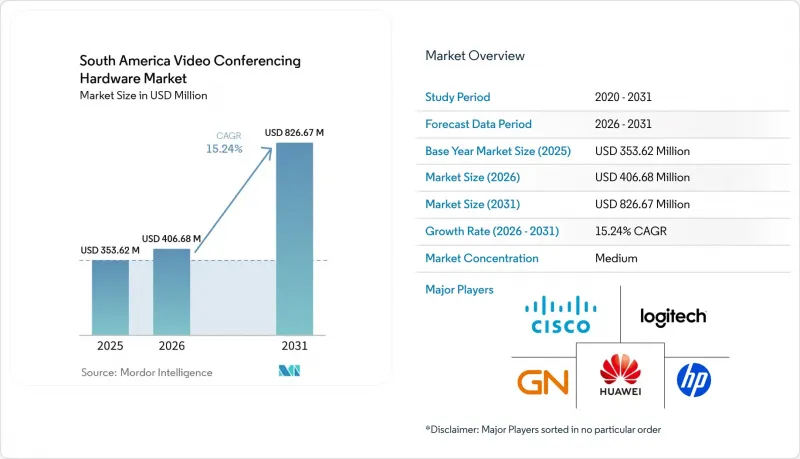
According to Mordor Intelligence, the South America video conferencing hardware market size is expected to increase from USD 353.62 million in 2025 to USD 406.68 million in 2026 and reach USD 826.67 million by 2031, expanding at a CAGR of 15.24% over 2026-2031.
South America Video Conferencing Hardware Market Trends and Insights
Hybrid Work and Distributed Team Expansion
Hybrid work has changed room hardware requirements across South America. Firms are using a mix of office and remote work that concentrates demand into scheduled meeting periods. This pattern increases the need for rooms that can be used without specialist AV support. Enterprises are therefore standardizing cloud-managed endpoints with automatic framing and multiple microphones. The South America video conferencing hardware market benefits when firms replace ad hoc laptop setups with certified room deployments. New telework obligations in Peru also reinforce the importance of secure and dependable systems for distributed teams.
Digital Transformation in Healthcare and Education
Healthcare demand is increasingly tied to recurring telehealth procurement rather than emergency purchasing. Brazil's SUS delivered millions of teleconsultations across thousands of municipalities over the recent period. The federal government allocated substantial funding for smart hospitals with interconnected ICUs over the coming years. In education, the Ministry of Education connected 100,000 public schools through Politica de Inovacao Educacao Conectada by May 2026. Health and education buyers need equipment that works reliably across repeated sessions and varied room formats. These programs support institutional demand for reliable cameras, displays, and room audio systems in the South America video conferencing hardware market.
High Hardware, Installation, and Maintenance Costs
Premium enterprise endpoints remain beyond the budget of many mid-market and public-sector buyers. Certified collaboration bars from leading suppliers carry high costs before installation, integration, and platform licensing. Brazilian import and industrial product taxes raise the landed cost of imported video communication equipment. The cost structure favors large enterprises that can standardize certified rooms across multiple sites. Smaller organizations often use software clients and consumer-grade peripherals instead. The South America video conferencing hardware market still has unmet demand for more affordable complete certified room systems.
Other drivers and restraints analyzed in the detailed report include:
- Fiber, 4G, 5G, and Broadband Infrastructure Improvements
- AI-Enabled Endpoint Upgrade Cycles
- Connectivity Limitations and Power Reliability Issues
For complete list of drivers and restraints, kindly check the Table Of Contents.
Segment Analysis
Collaboration Bars held 34.56% of the South America video conferencing hardware market size in 2025. They simplify deployment because the camera, microphone, speaker, and platform certification are integrated in one unit. This is valuable where in-house AV skills are limited outside major cities. Microsoft's approved device ecosystem reinforces the use of certified all-in-one systems in enterprise tenders. USB-Based Integrated Bars are projected to expand at a 15.73% CAGR through 2031. Their appeal is strongest in Colombia, Chile, and Argentina, where diverse laptop fleets increase demand for straightforward BYOD rooms.
Logitech's Rally AI Camera Pro illustrates the shift toward a higher-value collaboration bar category. The product combines dual-camera AI framing with an in-wall mounting option for boardrooms. PTZ cameras remain important where rooms exceed the field of view of an integrated bar. Codec systems remain relevant for government and regulated deployments that require security controls. Enterprise headsets, speakerphones, and microphone arrays address personal audio and larger-room acoustics. MCUs support multi-site conferencing, while bundled kits serve turnkey small and medium enterprise deployments. The South America video conferencing hardware industry relies on Microsoft and Zoom certification frameworks because these frameworks shape procurement shortlists and pricing.
Commercial Spaces held 62.27% of end-user demand in 2025. Financial services, technology, and professional services firms in Sao Paulo, Buenos Aires, Bogota, and Santiago have prioritized standardized workplace systems. Their programs commonly center on certified products that provide a consistent user experience across offices. Healthcare Facilities are projected to expand at a 15.62% CAGR through 2031. Health systems are moving toward repeatable telehealth workflows that require dependable room devices and support services. The resulting facility-level demand is more durable than emergency purchasing during the pandemic period.
Brazil's smart hospital program supports the standardized procurement of clinical video endpoints. Universities, government agencies, and public bodies procure these solutions through formal tender processes. These buyers prioritize compliance records and regional distribution coverage. Data residency requirements also influence deployment decisions in regulated sectors. Cross-border collaboration increases the value of systems that support local controls while enabling broader interoperability. Therefore, the South America video conferencing hardware industry must support cloud-based, hybrid, and on-premises architectures to meet diverse customer requirements.
Complete Report Scope:
- By Type of Hardware
- Multi-Control Units (MCU)
- Collaboration Bars
- Codec Systems
- USB Cameras
- USB-Based Integrated Bars
- Other Bundled Kits
- Enterprise Headsets
- PTZ Cameras
- Speakerphones and Microphone Arrays
- By End User
- Institutions
- Commercial Spaces
- Healthcare Facilities
- By Application
- Huddle Rooms
- Small Meeting Rooms
- Large Conference Rooms
- Boardrooms and Auditoriums
- By Deployment Mode
- On-Premises
- Cloud-Connected and Hybrid
- By Geography
- Brazil
- Argentina
- Colombia
- Chile
- Peru
- Rest of South America
List of Companies Covered in this Report:
- Logitech International S.A.
- Cisco Systems, Inc.
- HP Inc.
- GN Audio A/S
- Huawei Technologies Co., Ltd.
- EPOS Group A/S
- Barco NV
- AVer Information Inc.
- Panasonic Corporation
- Dahua Technology Co., Ltd.
- Yealink Network Technology Co., Ltd.
- ClearOne, Inc.
- Crestron Electronics, Inc.
- Shure Incorporated
- Huddly AS
- Neatframe Ltd.
- Lifesize, Inc.
- Owl Labs Inc.
- DTEN Inc.
- Konftel AB
- MAXHUB, a brand of Returnstar Interactive Technology Group Co., Ltd.
- Lumens Digital Optics Inc.
- ZTE Corporation
- AudioCodes Ltd.
Additional Benefits:
- The market estimate (ME) sheet in Excel format
- 3 months of analyst support
TABLE OF CONTENTS
1 INTRODUCTION
- 1.1 Study Assumptions and Market Definition
- 1.2 Scope of the Study
2 RESEARCH METHODOLOGY
3 EXECUTIVE SUMMARY
4 MARKET LANDSCAPE
- 4.1 Market Overview
- 4.2 Market Drivers
- 4.2.1 Hybrid Work and Distributed-Team Expansion
- 4.2.2 Digital Transformation in Healthcare and Education
- 4.2.3 Fiber, 4G, 5G, and Broadband Infrastructure Improvements
- 4.2.4 AI-Enabled Endpoint Upgrade Cycles
- 4.2.5 Brazil-Led Scale and Geographic Dispersion
- 4.2.6 Interoperability and Platform-Certification Requirements
- 4.3 Market Restraints
- 4.3.1 High Hardware, Installation, and Maintenance Costs
- 4.3.2 Connectivity Limitations and Power Reliability Issues
- 4.3.3 Data Sovereignty and Regulatory Fragmentation
- 4.3.4 Import Duties, Currency Volatility, and Channel Inventory Risk
- 4.4 Industry Value Chain Analysis
- 4.5 Impact of Macroeconomic Factors on the Market
- 4.6 Regulatory Landscape
- 4.7 Technological Outlook
- 4.8 Porter's Five Forces Analysis
- 4.8.1 Bargaining Power of Suppliers
- 4.8.2 Bargaining Power of Buyers
- 4.8.3 Threat of New Entrants
- 4.8.4 Threat of Substitutes
- 4.8.5 Competitive Rivalry
5 MARKET SIZE AND GROWTH FORECASTS (VALUE)
- 5.1 By Type of Hardware
- 5.1.1 Multi-Control Units (MCU)
- 5.1.2 Collaboration Bars
- 5.1.3 Codec Systems
- 5.1.4 USB Cameras
- 5.1.5 USB-Based Integrated Bars
- 5.1.6 Other Bundled Kits
- 5.1.7 Enterprise Headsets
- 5.1.8 PTZ Cameras
- 5.1.9 Speakerphones and Microphone Arrays
- 5.2 By End User
- 5.2.1 Institutions
- 5.2.2 Commercial Spaces
- 5.2.3 Healthcare Facilities
- 5.3 By Application
- 5.3.1 Huddle Rooms
- 5.3.2 Small Meeting Rooms
- 5.3.3 Large Conference Rooms
- 5.3.4 Boardrooms and Auditoriums
- 5.4 By Deployment Mode
- 5.4.1 On-Premises
- 5.4.2 Cloud-Connected and Hybrid
- 5.5 By Geography
- 5.5.1 Brazil
- 5.5.2 Argentina
- 5.5.3 Colombia
- 5.5.4 Chile
- 5.5.5 Peru
- 5.5.6 Rest of South America
6 COMPETITIVE LANDSCAPE
- 6.1 Market Concentration
- 6.2 Strategic Moves
- 6.3 Market Share Analysis
- 6.4 Company Profiles (includes Global Level Overview, Market Level Overview, Core Segments, Financials as available, Strategic Information, Market Rank/Share, Products and Services, Recent Developments)
- 6.4.1 Logitech International S.A.
- 6.4.2 Cisco Systems, Inc.
- 6.4.3 HP Inc.
- 6.4.4 GN Audio A/S
- 6.4.5 Huawei Technologies Co., Ltd.
- 6.4.6 EPOS Group A/S
- 6.4.7 Barco NV
- 6.4.8 AVer Information Inc.
- 6.4.9 Panasonic Corporation
- 6.4.10 Dahua Technology Co., Ltd.
- 6.4.11 Yealink Network Technology Co., Ltd.
- 6.4.12 ClearOne, Inc.
- 6.4.13 Crestron Electronics, Inc.
- 6.4.14 Shure Incorporated
- 6.4.15 Huddly AS
- 6.4.16 Neatframe Ltd.
- 6.4.17 Lifesize, Inc.
- 6.4.18 Owl Labs Inc.
- 6.4.19 DTEN Inc.
- 6.4.20 Konftel AB
- 6.4.21 MAXHUB, a brand of Returnstar Interactive Technology Group Co., Ltd.
- 6.4.22 Lumens Digital Optics Inc.
- 6.4.23 ZTE Corporation
- 6.4.24 AudioCodes Ltd.
7 MARKET OPPORTUNITIES AND FUTURE OUTLOOK
- 7.1 White-Space and Unmet-Need Assessment
- 7.2 Future Outlook, 2026-2031

