PUBLISHER: Mordor Intelligence | PRODUCT CODE: 2154902

PUBLISHER: Mordor Intelligence | PRODUCT CODE: 2154902
South America Trace Detection - Market Share Analysis, Industry Trends & Statistics, Growth Forecasts (2026 - 2031)
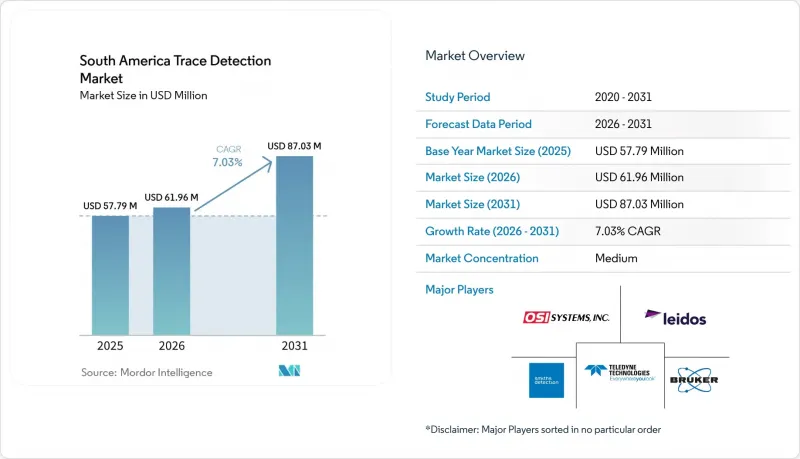
According to Mordor Intelligence, the South America trace detection market size was USD 57.79 million in 2025 and is forecast to reach USD 87.03 million by 2031, advancing at a CAGR of 7.03% from 2026 to 2031.
South America Trace Detection Market Trends and Insights
Growth in Airport and International Passenger Screening
South American aviation capacity additions are increasing the number of checkpoints that require trace detection equipment. In January 2025, 6 explosive trace detectors, 3 body scanners, and 5 dual-view X-ray machines began operating at Viracopos International Airport in Campinas, Brazil, through a U.S. government donation. The equipment deployment made the airport the first in South America to receive a donation of this scale for screening equipment. Jorge Chavez International Airport added 19 automated border-control gates in 2025 and planned terminal capacity for 40 million annual passengers. Airport additions create demand for equipment at passenger and baggage screening points under aviation security requirements. This makes airport capacity projects a useful near-term indicator for the South America trace detection market.
Intensifying Cocaine and Synthetic Narcotics Interdiction
Counternarcotics agencies now face a wider range of substances than bulk cocaine alone. A 2026 peer-reviewed study reported nitazene production infrastructure in Brazil from May 2025 and fentanyl analogs in ketamine and MDMA or Ecstasy samples in Colombia. These substances present a challenge for instruments that depend on threat libraries built for established compounds. INTERPOL's Operation Orca XI ran from October to November 2025 across 20 countries, including Argentina, Bolivia, Brazil, Chile, Colombia, Ecuador, Peru, and Paraguay. The operation seized substantial quantities of drugs, including cocaine, cocaine base paste, methamphetamine, and marijuana. These conditions support demand in the South America trace detection market for devices that can assess multiple substances with greater specificity.
High Total Cost of Ownership and Consumable Dependence
Operating a trace detection fleet involves more than the initial equipment purchase. Agencies must fund certified swabs, reagent cartridges, calibration services, and threat-library licenses during the equipment life cycle. These operating costs can exceed the original capital outlay within 3 to 5 years. Imported consumables priced in USD can create added pressure for agencies whose operating budgets are denominated in pesos or reais. Argentina's currency-management challenges during 2024 and 2025 reduced purchasing power for imported security consumables without changing formal appropriations. Supply is also concentrated among 2 to 3 original equipment manufacturers for each platform, which limits price leverage at renewal and can slow expansion in the South America trace detection market.
Other drivers and restraints analyzed in the detailed report include:
- Stricter Cargo, Customs, and Border Security Requirements
- Expansion of Ports, Logistics Hubs, and Cross-Border Trade
- Limited Specialist Training and Calibration Infrastructure
For complete list of drivers and restraints, kindly check the Table Of Contents.
Segment Analysis
Explosive detection held 61.24% of the South America trace detection market share in 2025. The installed base reflects long-standing use at certified airports, where ion mobility spectrometry equipment has been widely used for military and commercial explosive screening and where international aviation security standards continue to guide baseline equipment requirements. ICAO Annex 17 requirements support baseline explosive screening at internationally certified airports and create recurring demand for replacement devices, approved swabs, certified consumables, and calibration support. Suppliers with established certifications, threat libraries, and service relationships can retain a strong position in replacement tenders, particularly where airport operators need proven systems that fit existing screening processes. Airport security requirements, therefore, continue to support this part of the South America trace detection market.
Narcotics detection is projected to expand at a 7.36% CAGR from 2026 to 2031, exceeding the overall regional rate. Colombia's port modernization, Brazil's synthetic opioid concerns, and reported fentanyl analogs are increasing the need for narcotics-capable instruments that can be deployed with existing explosive screening coverage. Dual-mode platforms can screen for explosives and narcotics through one system, allowing agencies to strengthen detection without operating separate single-purpose instruments at each screening point. Their use can be particularly important where library-dependent instruments do not reliably resolve compounds that have not yet been catalogued. This can increase revenue per unit even when tenders do not call for more individual devices in the South America trace detection market.
Complete Report Scope:
- By Detection Type
- Explosive
- Narcotics
- By Product
- Handheld
- Portable/Movable
- Fixed
- By End-user Industry
- Commercial
- Military and Defense
- Law Enforcement
- Ports and Borders
- Public Safety
- Other End-user Industries
- By Geography
- Brazil
- Argentina
- Chile
- Colombia
- Rest of South America
List of Companies Covered in this Report:
- Smiths Detection Group Ltd.
- Leidos Holdings, Inc.
- OSI Systems, Inc.
- Rapiscan Systems, Inc.
- Bruker Corporation
- Teledyne Technologies Incorporated
- Analogic Corporation
- Autoclear LLC
- DetectaChem GmbH
- NUCTECH COMPANY LIMITED
- Chemring Group PLC
- Rigaku Holdings Corporation
- 908 Devices Inc.
- RS DYNAMICS LLC
- Morphix Technologies
- IDenta Corp.
- 1st Detect Corporation
- High Tech Detection Systems
- DSA Detection LLC
- Westminster Group PLC
Additional Benefits:
- The market estimate (ME) sheet in Excel format
- 3 months of analyst support
TABLE OF CONTENTS
1 INTRODUCTION
- 1.1 Study Assumptions and Market Definition
- 1.2 Scope of the Study
2 RESEARCH METHODOLOGY
3 EXECUTIVE SUMMARY
4 MARKET LANDSCAPE
- 4.1 Market Overview
- 4.2 Market Drivers
- 4.2.1 Growth in Airport and International Passenger Screening
- 4.2.2 Intensifying Cocaine and Synthetic Narcotics Interdiction
- 4.2.3 Stricter Cargo, Customs, and Border-Security Requirements
- 4.2.4 Expansion of Ports, Logistics Hubs, and Cross-Border Trade
- 4.2.5 Distributed Screening Demand From Mobile Interdiction Teams
- 4.2.6 Local Threat-Library Adaptation for Emerging Narcotics and Homemade Explosives
- 4.3 Market Restraints
- 4.3.1 High Total Cost of Ownership and Consumable Dependence
- 4.3.2 Limited Specialist Training and Calibration Infrastructure
- 4.3.3 Fragmented Procurement and Budget Release Cycles
- 4.3.4 Inconsistent Field Validation of New Psychoactive Substances
- 4.4 Industry Value Chain Analysis
- 4.5 Impact of Macroeconomic Factors on the Market
- 4.6 Regulatory Landscape
- 4.7 Technological Outlook
- 4.8 Porter's Five Forces Analysis
- 4.8.1 Bargaining Power of Suppliers
- 4.8.2 Bargaining Power of Buyers
- 4.8.3 Threat of New Entrants
- 4.8.4 Threat of Substitutes
- 4.8.5 Competitive Rivalry
5 MARKET SIZE AND GROWTH FORECASTS (VALUE)
- 5.1 By Detection Type
- 5.1.1 Explosive
- 5.1.2 Narcotics
- 5.2 By Product
- 5.2.1 Handheld
- 5.2.2 Portable/Movable
- 5.2.3 Fixed
- 5.3 By End-user Industry
- 5.3.1 Commercial
- 5.3.2 Military and Defense
- 5.3.3 Law Enforcement
- 5.3.4 Ports and Borders
- 5.3.5 Public Safety
- 5.3.6 Other End-user Industries
- 5.4 By Geography
- 5.4.1 Brazil
- 5.4.2 Argentina
- 5.4.3 Chile
- 5.4.4 Colombia
- 5.4.5 Rest of South America
6 COMPETITIVE LANDSCAPE
- 6.1 Market Concentration
- 6.2 Strategic Moves
- 6.3 Market Share Analysis
- 6.4 Company Profiles (includes Global Level Overview, Market Level Overview, Core Segments, Financials as available, Strategic Information, Market Rank/Share, Products and Services, Recent Developments)
- 6.4.1 Smiths Detection Group Ltd.
- 6.4.2 Leidos Holdings, Inc.
- 6.4.3 OSI Systems, Inc.
- 6.4.4 Rapiscan Systems, Inc.
- 6.4.5 Bruker Corporation
- 6.4.6 Teledyne Technologies Incorporated
- 6.4.7 Analogic Corporation
- 6.4.8 Autoclear LLC
- 6.4.9 DetectaChem GmbH
- 6.4.10 NUCTECH COMPANY LIMITED
- 6.4.11 Chemring Group PLC
- 6.4.12 Rigaku Holdings Corporation
- 6.4.13 908 Devices Inc.
- 6.4.14 RS DYNAMICS LLC
- 6.4.15 Morphix Technologies
- 6.4.16 IDenta Corp.
- 6.4.17 1st Detect Corporation
- 6.4.18 High Tech Detection Systems
- 6.4.19 DSA Detection LLC
- 6.4.20 Westminster Group PLC
7 MARKET OPPORTUNITIES AND FUTURE OUTLOOK
- 7.1 White-space and Unmet-Need Assessment

