PUBLISHER: Mordor Intelligence | PRODUCT CODE: 2154915

PUBLISHER: Mordor Intelligence | PRODUCT CODE: 2154915
Commercial Vacuum Cleaner - Market Share Analysis, Industry Trends & Statistics, Growth Forecasts (2026 - 2031)
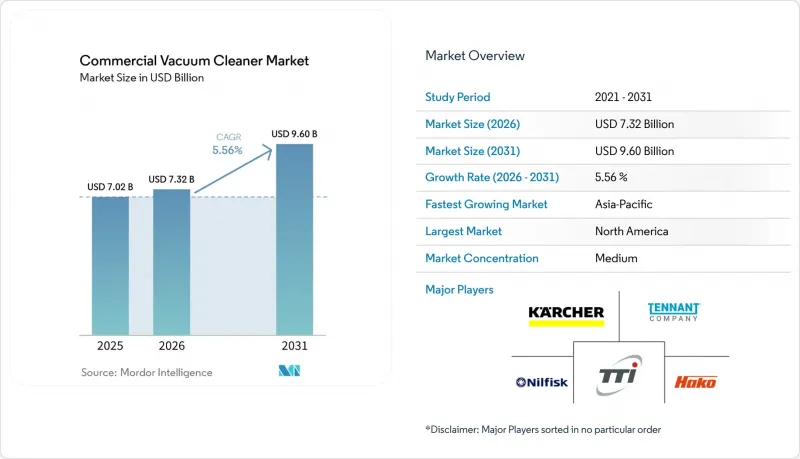
According to Mordor Intelligence, the commercial vacuum cleaner market size is expected to increase from USD 7.02 billion in 2025 to USD 7.32 billion in 2026 and reach USD 9.60 billion by 2031, growing at a CAGR of 5.56% over 2026-2031.
Global Commercial Vacuum Cleaner Market Trends and Insights
Expansion of Contract Cleaning Services
Contract cleaning services are a central demand channel for the commercial vacuum cleaner market. Large building service contractors buy equipment for several sites, which favors standardized fleets and serviceable products. Their multi-site contracts make replacement planning more predictable than one-time purchases by individual facilities. These providers need equipment that can move between offices, government locations, health care sites, and hospitality properties. They also need suppliers that can support maintenance, consumables, and replacement units across their service areas. Direct sales, distributor support, and B2B ordering systems, therefore, remain important to the commercial vacuum cleaner market.
Stricter Commercial Hygiene and Indoor Air Quality Requirements
Indoor air quality requirements are changing how commercial buyers assess filtration and cleaning performance. Health Canada recommends vacuum systems with HEPA filters for office buildings and states that HEPA filters remove at least 99.97% of particles at or above 0.3 microns. ASHRAE Standard 62.1 provides ventilation requirements for nonresidential buildings, while Standard 241 addresses infection-risk management in occupied spaces. These expectations affect specifications in offices, health care facilities, life sciences sites, data centers, and government buildings. Buyers are placing greater value on certified filtration, lower noise, and equipment suitable for cleaning during occupied hours. The commercial vacuum cleaner market benefits when filtration becomes part of a facility's operating standard rather than an optional feature.
High Upfront Cost of Professional-Grade Equipment
Professional equipment can require a substantial initial outlay, especially for robotic and HEPA-filtered units. This limits adoption by smaller cleaning contractors and independent operators with limited access to equipment finance. Traditional cleaning tools remain a lower-cost alternative in several emerging markets. Nexaro's case study identifies operating savings from autonomous vacuum deployment, but buyers must fund the equipment before realizing those benefits. Larger operators can spread this cost across multi-site contracts, while smaller firms often cannot. This gap keeps premium equipment from reaching its full potential in the commercial vacuum cleaner market.
Other drivers and restraints analyzed in the detailed report include:
- Autonomous Cleaning for Labor-Constrained Facilities
- HEPA Filtration Demand From High-Compliance Facilities
- Battery Replacement and End-of-Life Management Complexity
For complete list of drivers and restraints, kindly check the Table Of Contents.
Segment Analysis
Upright vacuum cleaners held 34.26% of the value in 2025, giving them the leading position in the commercial vacuum cleaner market. Their established role reflects dependable pickup performance on carpeted surfaces in hotels, large offices, and education facilities. Robotic vacuum cleaners are forecast to grow at a 6.65% CAGR through 2031. BrainOS-powered commercial robots exceeded 50,000 deployed units globally in the first half of 2026 and recorded more than 5.3 million autonomous operating hours. The International Federation of Robotics reported that professional cleaning robot sales rose 34% in 2024 to more than 25,000 units worldwide. These deployments show that robots are moving beyond limited trials in large facilities.
Canister vacuum cleaners remain important in mixed-surface settings such as health care and retail locations. Nilfisk launched its VP300 and VP400 compact canister vacuum cleaners in 2025 for users who need flexibility in congested areas. Drum and wet-and-dry products continue to serve industrial sites that handle both liquid and solid debris. Handheld units support spot cleaning in transportation and hospitality locations. Tennant introduced the X16 SWEEP in April 2026 for complex industrial settings such as warehouses, logistics centers, and light manufacturing sites. The product illustrates how autonomous formats are moving into demanding operating environments. The commercial vacuum cleaner market is therefore retaining conventional formats while adding automation for specialized use cases.
Corded equipment represented 56.85% of the value in 2025 and remained the largest cord type in the commercial vacuum cleaner market. Its position reflects uninterrupted runtime and stable suction in airports, retail centers, and industrial facilities. Cordless equipment is projected to grow at a 6.15% CAGR through 2031. Numatic's NX300 36V commercial battery platform provides up to 80 minutes of runtime. Dyson's V15 Detect Pro for commercial use provides up to 120 minutes when used with dual click-in batteries and includes HEPA H13 filtration. These specifications show why cordless models are becoming more viable for routine professional work.
Cordless models can reduce trip hazards in hospitals, schools, shopping centers, and other occupied spaces. They can also help teams clean during the day without moving cords through public areas. The TASKI AERO 8 FLEXX combines cordless operation with a 52 dB motor and HEPA H13 filtration. Karcher's T-Range offers corded and battery-powered models for hospitality, facilities management, and office cleaning. The commercial vacuum cleaner market still relies on corded units for long shifts, but cordless options are gaining where safety, noise, and mobility matter. Battery replacement and end-of-life management remain key limits on wider adoption.
Complete Report Scope:
- By Product Type
- Upright
- Canister
- Central
- Drum
- Wet and Dry
- Handheld
- Robotic
- By Cord Type
- Corded
- Cordless
- By End-User
- Commercial Offices
- Hospitality (Hotels, Restaurants & Cafes)
- Healthcare Facilities
- Educational Institutions
- Retail & Shopping Centers
- Industrial & Manufacturing Facilities
- Transportation & Logistics
- Government & Public Buildings
- Cleaning Service Providers
- Other Commercial End Users
- By Distribution Channel
- Direct Sales / B2B
- Distributors & Dealers
- Specialty Stores
- Online
- Other Distribution Channels
- By Geography
- North America
- Canada
- United States
- Mexico
- South America
- Brazil
- Peru
- Chile
- Argentina
- Rest of South America
- Europe
- United Kingdom
- Germany
- France
- Spain
- Italy
- BENELUX (Belgium, Netherlands, and Luxembourg)
- NORDICS (Denmark, Finland, Iceland, Norway, and Sweden)
- Rest of Europe
- Asia-Pacific
- India
- China
- Japan
- Australia
- South Korea
- South East Asia (Singapore, Malaysia, Thailand, Indonesia, Vietnam, and the Philippines)
- Rest of Asia-Pacific
- Middle East and Africa
- United Arab Emirates
- Saudi Arabia
- South Africa
- Nigeria
- Rest of the Middle East and Africa
- North America
Geography Analysis
North America held 33.16% of the value in 2025 and was the largest regional part of the commercial vacuum cleaner market. Large building service contractors operate standardized fleets across commercial facilities under service-level agreements. The United States requirements and guidance on ventilation and indoor air quality support demand for equipment with stronger filtration. Health Canada recommends HEPA-filter vacuuming systems for office buildings. Mexico also adds demand as manufacturing and nearshoring activity expand its commercial building base.
Europe remains an important region for professional cleaning equipment, automation, and sustainability specifications. Freudenberg Home and Cleaning Solutions completed its takeover of Nilfisk in April 2026, bringing Nilfisk into Freudenberg as a standalone brand. The transaction may increase competitive pressure on European suppliers that have smaller research and development resources. Germany, the United Kingdom, and Austria have active demand from logistics, hospitals, airports, and hospitality facilities. The region also has mature buyers who are more likely to evaluate energy use, recycled content, filtration, and equipment durability. This creates favorable conditions for premium and automated equipment.
Asia-Pacific is forecast to grow at a 6.23% CAGR through 2031, making it the fastest-growing geography in the commercial vacuum cleaner market. Commercial development in India, mainland China, South Korea, Japan, Australia, and Southeast Asia is enlarging the installed base of offices and institutional buildings. China is both an end market and a manufacturing center for commercial cleaning robots, and Gausium operates in more than 70 countries. Japan and South Korea are premium upgrade markets with developed facility management services. Singapore, Malaysia, Vietnam, and Indonesia are building their contract-cleaning ecosystems. The Middle East and Africa add demand through commercial, hospitality, and airport projects, although pricing and financing constraints can delay uptake of premium equipment.
- Alfred Karcher SE & Co. KG
- Tennant Company
- Nilfisk A/S
- Hako GmbH
- Techtronic Industries Company Limited
- Numatic International Limited
- Makita Corporation
- Dyson Limited
- Tacony Corporation
- BISSELL Group
- ProTeam, Inc.
- SEBO America, LLC
- Pacvac Pty Ltd
- SPRiNTUS GmbH
- Solenis LLC
- Diversey Holdings LTD
- Comac S.p.A.
- IPC
- Ghibli and Wirbel S.p.A.
- Roots Multiclean Limited
Additional Benefits:
- The market estimate (ME) sheet in Excel format
- 3 months of analyst support
TABLE OF CONTENTS
1 Introduction
- 1.1 Study Assumptions & Market Definition
- 1.2 Scope of the Study
2 Research Methodology
3 Executive Summary
4 Market Landscape
- 4.1 Market Overview
- 4.2 Market Drivers
- 4.2.1 Expansion of Contract Cleaning Services
- 4.2.2 Stricter Commercial Hygiene and Indoor Air Quality Requirements
- 4.2.3 Growth of Commercial Infrastructure in Emerging Economies
- 4.2.4 B2B E-Commerce Adoption for Cleaning Equipment Procurement
- 4.2.5 Autonomous Cleaning for Labor-Constrained Facilities
- 4.2.6 HEPA Filtration Demand From High-Compliance Facilities
- 4.3 Market Restraints
- 4.3.1 High Upfront Cost of Professional-Grade Equipment
- 4.3.2 Availability of Traditional Cleaning Alternatives
- 4.3.3 Battery Replacement and End-of-Life Management Complexity
- 4.3.4 Interoperability Gaps Across Robotic Cleaning Fleets
- 4.4 Industry Value Chain Analysis
- 4.5 Porter's Five Forces Analysis
- 4.5.1 Threat of New Entrants
- 4.5.2 Bargaining Power of Suppliers
- 4.5.3 Bargaining Power of Buyers
- 4.5.4 Threat of Substitutes
- 4.5.5 Industry Rivalry
- 4.6 Insights into the Latest Trends and Innovations in the Industry
- 4.7 Insights into the Recent Developments (New Product Launches, Strategic Initiatives, Investments, Partnerships, JVs, Expansion, M&As, etc.) in the Industry
5 Market Size & Growth Forecasts (Value in USD Billion)
- 5.1 By Product Type
- 5.1.1 Upright
- 5.1.2 Canister
- 5.1.3 Central
- 5.1.4 Drum
- 5.1.5 Wet and Dry
- 5.1.6 Handheld
- 5.1.7 Robotic
- 5.2 By Cord Type
- 5.2.1 Corded
- 5.2.2 Cordless
- 5.3 By End-User
- 5.3.1 Commercial Offices
- 5.3.2 Hospitality (Hotels, Restaurants & Cafes)
- 5.3.3 Healthcare Facilities
- 5.3.4 Educational Institutions
- 5.3.5 Retail & Shopping Centers
- 5.3.6 Industrial & Manufacturing Facilities
- 5.3.7 Transportation & Logistics
- 5.3.8 Government & Public Buildings
- 5.3.9 Cleaning Service Providers
- 5.3.10 Other Commercial End Users
- 5.4 By Distribution Channel
- 5.4.1 Direct Sales / B2B
- 5.4.2 Distributors & Dealers
- 5.4.3 Specialty Stores
- 5.4.4 Online
- 5.4.5 Other Distribution Channels
- 5.5 By Geography
- 5.5.1 North America
- 5.5.1.1 Canada
- 5.5.1.2 United States
- 5.5.1.3 Mexico
- 5.5.2 South America
- 5.5.2.1 Brazil
- 5.5.2.2 Peru
- 5.5.2.3 Chile
- 5.5.2.4 Argentina
- 5.5.2.5 Rest of South America
- 5.5.3 Europe
- 5.5.3.1 United Kingdom
- 5.5.3.2 Germany
- 5.5.3.3 France
- 5.5.3.4 Spain
- 5.5.3.5 Italy
- 5.5.3.6 BENELUX (Belgium, Netherlands, and Luxembourg)
- 5.5.3.7 NORDICS (Denmark, Finland, Iceland, Norway, and Sweden)
- 5.5.3.8 Rest of Europe
- 5.5.4 Asia-Pacific
- 5.5.4.1 India
- 5.5.4.2 China
- 5.5.4.3 Japan
- 5.5.4.4 Australia
- 5.5.4.5 South Korea
- 5.5.4.6 South East Asia (Singapore, Malaysia, Thailand, Indonesia, Vietnam, and the Philippines)
- 5.5.4.7 Rest of Asia-Pacific
- 5.5.5 Middle East and Africa
- 5.5.5.1 United Arab Emirates
- 5.5.5.2 Saudi Arabia
- 5.5.5.3 South Africa
- 5.5.5.4 Nigeria
- 5.5.5.5 Rest of the Middle East and Africa
- 5.5.1 North America
6 Competitive Landscape
- 6.1 Market Concentration
- 6.2 Strategic Moves
- 6.3 Market Share Analysis
- 6.4 Company Profiles {(includes Global level Overview, Market level overview, Core Segments, Financials as available, Strategic Information, Market Rank/Share for key companies, Products & Services, and Recent Developments)}
- 6.4.1 Alfred Karcher SE & Co. KG
- 6.4.2 Tennant Company
- 6.4.3 Nilfisk A/S
- 6.4.4 Hako GmbH
- 6.4.5 Techtronic Industries Company Limited
- 6.4.6 Numatic International Limited
- 6.4.7 Makita Corporation
- 6.4.8 Dyson Limited
- 6.4.9 Tacony Corporation
- 6.4.10 BISSELL Group
- 6.4.11 ProTeam, Inc.
- 6.4.12 SEBO America, LLC
- 6.4.13 Pacvac Pty Ltd
- 6.4.14 SPRiNTUS GmbH
- 6.4.15 Solenis LLC
- 6.4.16 Diversey Holdings LTD
- 6.4.17 Comac S.p.A.
- 6.4.18 IPC
- 6.4.19 Ghibli and Wirbel S.p.A.
- 6.4.20 Roots Multiclean Limited
7 Market Opportunities & Future Outlook
- 7.1 Autonomous Cleaning for Mid-Sized Commercial Facilities
- 7.2 Battery-as-a-Service for Commercial Cleaning Fleets

