PUBLISHER: Mordor Intelligence | PRODUCT CODE: 2154922

PUBLISHER: Mordor Intelligence | PRODUCT CODE: 2154922
South America Residential Real Estate - Market Share Analysis, Industry Trends & Statistics, Growth Forecasts (2026 - 2031)
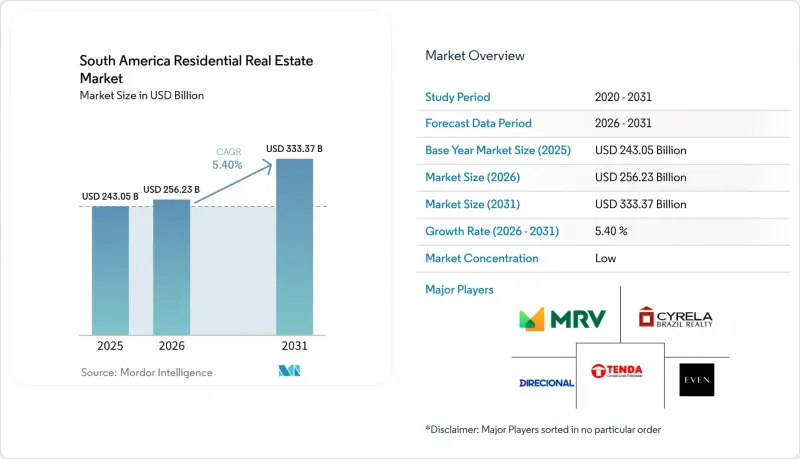
According to Mordor Intelligence, the South America residential real estate market size is projected to expand from USD 243.05 billion in 2025 and USD 256.23 billion in 2026 to USD 333.37 billion by 2031, registering a CAGR of 5.40% between 2026 and 2031.
South America Residential Real Estate Market Trends and Insights
Structural Housing Deficits and Household Formation Drive Housing Demand
Housing shortages give the South America residential real estate market a demand base that remains present during economic slowdowns. Brazil recorded a deficit of 5.77 million units in 2024, its lowest level since the current measurement series began in 2016. The same release showed a 4.34% rise in inadequate housing conditions, including households carrying high rental costs. Chile required 980,000 homes for urgent needs in January 2026, and the metropolitan region represented 42% of that total. Smaller and single-person households increase the number of homes needed, even where population growth is limited. Colombia's deficit covered 25.6% of households in 2025, equal to 4.81 million families, which supports a continuing need for formal supply.
Government Affordable Housing Programs Support Residential Construction
Affordable housing policy remains important because it supports both buyer demand and developers' construction schedules. Brazil's Minha Casa, Minha Vida program had financed more than 10 million homes since 2009, and by late 2025, it accounted for over 50% of residential financing. Reforma Casa Brasil took effect in May 2026 with USD 3.85 billion from the Fundo Social, a higher income limit of USD 2,503 per month, and a USD 115.5 billion property ceiling for Faixa 4. The expansion opens a route for households previously outside both subsidy programs and market-rate lending. Paraguay's Che Roga Pora 2.0 program offered qualifying families 30-year mortgages at a 6.5% annual rate from April 2025.. Subsidized Fundo de Garantia do Tempo de Servico mortgages also make a share of Brazilian demand less exposed to the Selic benchmark.
High Construction Costs and Supply Chain Volatility Pressure Developers
Construction cost inflation limits margins and can delay lower-priced projects within the South America residential real estate market. Brazil's national civil construction index increased 5.63% in 2025 after rising 3.98% in 2024. Labor costs rose 7.63%, while material costs increased 4.2% during 2025. Imported finishes, heating and cooling equipment, and modular systems leave many developers exposed to currency and supply shocks. Developers with pre-procured land and standardized designs have a cost advantage over smaller builders. Brazil's technical standards and Chile's building rules add compliance requirements, while proposed Chilean changes were expected to reduce new-home prices by 10%-15%.
Other drivers and restraints analyzed in the detailed report include:
- Mortgage and Interest Rate Normalization Improves Buyer Affordability
- Urbanization Increases Demand for Vertical and Gated Housing
- High Mortgage Rates Reduce Housing Affordability
For complete list of drivers and restraints, kindly check the Table Of Contents.
Segment Analysis
Sales commanded 77.65% of the South America residential real estate market size in 2025, supported by homeownership preferences and public mortgage programs. The sales model remains central to the South America residential real estate market because developers can align presales with construction finance. Rental housing is the fastest-growing business model, with a forecast CAGR of 6.02% through 2031. Higher borrowing costs are shifting some households from ownership into renting, while institutions are adding purpose-built rental homes. This change gives developers and asset managers separate routes to serve the same underlying housing need.
Brio Asset Management raised USD 48.2 million in May 2025 for a fund that financed 5 Sao Paulo buildings with 700 homes managed by Greystar. The transaction showed that investment decisions increasingly compare rental returns with fixed-income alternatives. Colombia reported 7.7 million rental households in 2025, and renters exceeded owner-occupiers for the first time in its recorded statistics. This shift supports multifamily investment in Bogota, Medellin, and Cali. The South America residential real estate market will therefore continue to balance a subsidized ownership pipeline with a more formal rental stock.
Apartments & condominiums held 63.55% of the 2025 value, making them the leading format in the South America residential real estate market. Their lower land cost per home supports density, household affordability, and access to public financing. Villas & landed houses are forecast to grow at a 6.15% CAGR through 2031. Gated communities in secondary metropolitan areas and demand for more living space support this faster growth. The two formats serve different household budgets, urban locations, and lifestyle preferences.
Compact two-bedroom apartments were prominent in Sao Paulo launches during 2025, particularly within USD 48,000-USD 67,400 price bands. Premium studios in Florianopolis reached rents of up to USD 5,200 per month in 2026, showing the distance between mass-market and premium apartment demand. Chile recorded 9.1% nominal residential price growth in the first quarter of 2026, while larger homes in Las Condes and Vitacura retained premium pricing. Mixed-use projects combine apartment density with shared amenities that buyers associate with larger homes. This approach helps developers use constrained urban land while responding to changing household preferences.
Complete Report Scope:
- By Business Model
- Sales
- Rental
List of Companies Covered in this Report:
- MRV Engenharia e Participacoes S.A.
- Cyrela Brazil Realty S.A.
- Direcional Engenharia S.A.
- Construtora Tenda S.A.
- Even Construtora e Incorporadora S.A.
- Cury Construtora e Incorporadora S.A.
- EZTEC Empreendimentos e Participacoes S.A.
- Plano&Plano Desenvolvimento Imobiliario S.A.
- Gafisa S.A.
- Tecnisa S.A.
- Construtora e Incorporadora RNI S.A.
- Constructora Bolivar S.A.
- Amarilo S.A.S.
- Constructora Capital
- Constructora Marval S.A.
- Socovesa S.A.
- Paz Corp S.A.
- Besalco S.A.
- SalfaCorp S.A.
- IRSA Inversiones y Representaciones S.A.
Additional Benefits:
- The market estimate (ME) sheet in Excel format
- 3 months of analyst support
TABLE OF CONTENTS
1 Introduction
- 1.1 Study Assumptions and Market Definition
- 1.2 Scope of the Study
2 Research Methodology
3 Executive Summary
4 Market Landscape
- 4.1 Market Overview
- 4.2 Residential Real Estate Buying Trends - Socio-economic & Demographic Insights
- 4.3 Rental Yield Analysis
- 4.4 Regulatory Outlook
- 4.5 Technological Outlook
- 4.6 Insights into Affordable Housing Support Provided by Government and Public-private Partnerships
- 4.7 Insights into Existing and Upcoming Projects
- 4.8 Value / Supply-Chain Analysis
- 4.8.1 Overview
- 4.8.2 Real Estate Developers and Contractors - Key Quantitative and Qualitative Insights
- 4.8.3 Real Estate Brokers and Agents - Key Quantitative and Qualitative Insights
- 4.8.4 Property Management Companies - Key Quantitative and Qualitative Insights
- 4.8.5 Insights on Valuation Advisory and Other Real Estate Services
- 4.8.6 State of the Building Materials Industry and Partnerships with Key Developers
- 4.8.7 Insights on Key Strategic Real Estate Investors/Buyers in the Market
- 4.9 Market Drivers
- 4.9.1 Structural Housing Deficits and Household Formation Drive Housing Demand
- 4.9.2 Government Affordable Housing Programs Support Residential Construction
- 4.9.3 Mortgage and Interest Rate Normalization Improves Buyer Affordability
- 4.9.4 Urbanization Increases Demand for Vertical and Gated Housing
- 4.9.5 Rental Housing Institutionalization Supports Delayed Homeownership Trends
- 4.9.6 Smaller Housing Units Improve Mortgage Accessibility and Market Absorption
- 4.10 Market Restraints
- 4.10.1 High Construction Costs and Supply Chain Volatility Pressure Developers
- 4.10.2 High Mortgage Rates Reduce Housing Affordability
- 4.10.3 Informal Employment and Limited Housing Finance Data Restrict Mortgage Access
- 4.10.4 Subsidy Dependence and Allocation Risks Affect Market Efficiency
- 4.11 Industry Attractiveness - Porter's Five Forces Analysis
- 4.11.1 Bargaining Power of Suppliers
- 4.11.2 Bargaining Power of Consumers
- 4.11.3 Threat of New Entrants
- 4.11.4 Threat of Substitutes
- 4.11.5 Intensity of Competitive Rivalry
5 South America Residential Real Estate Market, Market Size & Growth Forecasts (Value, USD) - 2020-2031
- 5.1 By Business Model
- 5.1.1 Sales
- 5.1.2 Rental
6 South America Residential Real Estate Market (Sales Model), Market Size & Growth Forecasts (Value, USD) - 2020-2031
- 6.1 By Property Type
- 6.1.1 Apartments and Condominiums
- 6.1.2 Villas and Landed Houses
- 6.2 By Price Band
- 6.2.1 Affordable
- 6.2.2 Mid-Market
- 6.2.3 Luxury
- 6.3 Mode of Sale
- 6.3.1 Primary (New-Build)
- 6.3.2 Secondary (Resale)
- 6.4 By Country
- 6.4.1 Brazil
- 6.4.2 Argentina
- 6.4.3 Colombia
- 6.4.4 Chile
- 6.4.5 Rest of South America
7 Competitive Landscape
- 7.1 Market Concentration
- 7.2 Strategic Moves
- 7.3 Market Share Analysis
- 7.4 Company Profiles (Includes Global Level Overview, Market Level Overview, Core Segments, Financials as Available, Strategic Information, Products & Services, and Recent Developments)
- 7.4.1 MRV Engenharia e Participacoes S.A.
- 7.4.2 Cyrela Brazil Realty S.A.
- 7.4.3 Direcional Engenharia S.A.
- 7.4.4 Construtora Tenda S.A.
- 7.4.5 Even Construtora e Incorporadora S.A.
- 7.4.6 Cury Construtora e Incorporadora S.A.
- 7.4.7 EZTEC Empreendimentos e Participacoes S.A.
- 7.4.8 Plano&Plano Desenvolvimento Imobiliario S.A.
- 7.4.9 Gafisa S.A.
- 7.4.10 Tecnisa S.A.
- 7.4.11 Construtora e Incorporadora RNI S.A.
- 7.4.12 Constructora Bolivar S.A.
- 7.4.13 Amarilo S.A.S.
- 7.4.14 Constructora Capital
- 7.4.15 Constructora Marval S.A.
- 7.4.16 Socovesa S.A.
- 7.4.17 Paz Corp S.A.
- 7.4.18 Besalco S.A.
- 7.4.19 SalfaCorp S.A.
- 7.4.20 IRSA Inversiones y Representaciones S.A.
8 Market Opportunities & Future Outlook
- 8.1 White-Space and Unmet-Need Assessment

