PUBLISHER: Mordor Intelligence | PRODUCT CODE: 2154928

PUBLISHER: Mordor Intelligence | PRODUCT CODE: 2154928
South America Pouch Packaging - Market Share Analysis, Industry Trends & Statistics, Growth Forecasts (2026 - 2031)
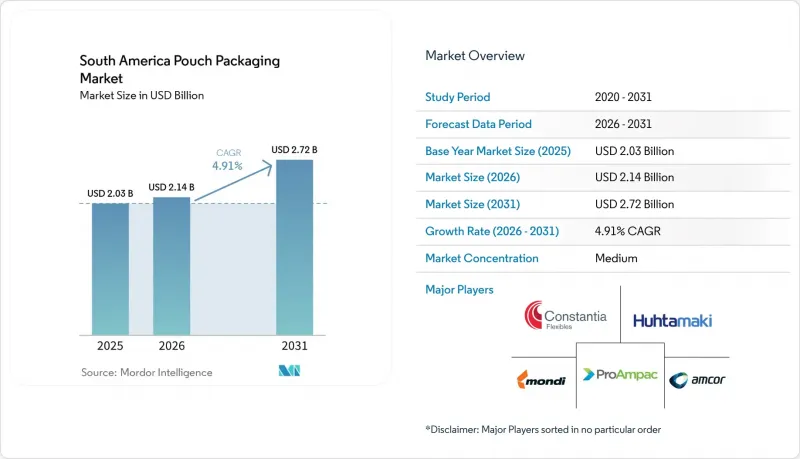
According to Mordor Intelligence, the South America pouch packaging market size is projected to expand from USD 2.03 billion in 2025 and USD 2.14 billion in 2026 to USD 2.72 billion by 2031, registering a CAGR of 4.91% between 2026 to 2031.
South America Pouch Packaging Market Trends and Insights
Shift From Rigid to Flexible Packaging
The shift from rigid packaging to pouches supports demand across South America's food processing sector. Pouches can substantially reduce packaging weight compared with glass or metal alternatives, which can lower freight costs on export and domestic distribution routes. Flexible packaging demand for polyethylene has continued to outpace rigid-plastic demand as brand owners adapt lines for pouch-compatible form-fill-seal systems. Once a producer invests in pouch filling equipment, returning to rigid formats can require further capital spending. Retort and aseptic pouches are also widening the use of flexible packaging in shelf-stable proteins, ready-to-eat meals, and infant nutrition. This gives the South America pouch packaging market a more durable base of demand than a short-term format preference.
Expansion of Organized Retail and Modern Trade
Organized retail favors pouches because retailers need shelf-ready packs, standardized displays, and formats that support repeat purchases. Cencosud allocated substantial capital expenditure, with the majority directed toward store growth and greenfield development across its South American operations. Jeronimo Martins opened numerous Ara stores and integrated dozens of Colsubsidio stores in Colombia, increasing the reach of formal grocery retail in the Bogota area. These networks rely on shorter refresh cycles and packaging that meets display requirements. Resealable and shelf-stable pouches fit those requirements in food, dairy, snacks, and personal care. The South America pouch packaging market, therefore, benefits as modern trade gains share from informal retail channels.
Volatile Polyethylene and Polypropylene Resin Costs
Polyethylene and polypropylene represent a substantial share of pouch converters' material costs. South American producers are exposed to external pricing changes because regional steam crackers depend mainly on naphtha feedstocks. Polyethylene and polypropylene prices returned to elevated levels before supply disruptions in the Middle East affected pricing. Braskem raised domestic LDPE, HDPE, and LLDPE prices, while Brazil imposed an antidumping duty on U.S.-origin polyethylene. These pressures limit sourcing flexibility and can narrow margins for smaller and mid-sized converters.
Other drivers and restraints analyzed in the detailed report include:
- Growth of Lightweight and Portable Food Packaging
- Adoption of Recycle-Ready Mono-Material Pouches
- Underdeveloped Collection and Recycling Infrastructure
For complete list of drivers and restraints, kindly check the Table Of Contents.
Segment Analysis
Polyethylene held 32.46% of the South America pouch packaging market share in 2025, making it the largest material category. Its position reflects cost competitiveness, broad converter compatibility, and production availability from Braskem's regional operations. Blown-film and cast-extrusion lines in Brazil, Argentina, and Chile are designed for LDPE, LLDPE, and metallocene polyethylene grades. These grades serve food, agro-industrial, and consumer goods packaging applications. Polypropylene has an important role in hot-fill and retort uses because it offers stronger heat resistance than polyethylene. PET and PVC remain relevant for selected transparent, thermoformed, and specialty pouch uses.
Biodegradable and compostable formats are projected to expand at a 5.14% CAGR from 2026 to 2031, the fastest rate among material subsegments. Brands are assessing these options as they seek packaging with clearer end-of-life credentials. Braskem's I'm green bio-based polyethylene is produced from sugarcane ethanol and can be used as a food-contact material. The company states that the material has a certified negative cradle-to-gate carbon footprint. Aluminum foil remains important in pharmaceutical packs, high-barrier retort pouches, and premium foods where oxygen and moisture protection requirements are high. At the same time, recycled-content targets and mono-material redesign programs are encouraging suppliers to reconsider multilayer structures.
Stand-up pouches held 33.42% of the product category in 2025, giving them the leading position in the South America pouch packaging market. They are widely used in food, pet care, and personal care because they provide shelf visibility, portability, and compatibility with zipper and spout closures. Existing form-fill-seal equipment in Brazil and Argentina is already configured for common stand-up pouch dimensions. This installed base supports continued use across high-volume packaged goods. Flat pillow and side-seal formats remain common in commodity food and single-serve applications. Retort and aseptic designs are also being adopted for processed meats, ready meals, and infant nutrition that require ambient shelf life.
Spouted pouches are projected to expand at a 5.11% CAGR from 2026 to 2031. Beverage, baby food, condiment, and personal care applications use this format when controlled dispensing and resealing are needed. SIG consolidated its bag-in-box and spouted pouch operations in South America in March 2026, naming its Vinhedo facility as the regional hub. The company described the facility as one of its largest spouted pouch operations globally in the draft. Stick packs and sachets serve price-sensitive customers who purchase smaller units of nutrition, detergent, and pharmaceutical products. Rollstock and premade pouches also support co-manufacturers and brand-owned lines that handle many product variations.
Complete Report Scope:
- By Material
- Plastics
- Polyethylene (PE)
- Polypropylene (PP)
- Polyethylene Terephthalate (PET)
- Polyvinyl Chloride Resin (PVC)
- Other Plastics
- Paper
- Aluminum Foil
- Bio-degradable/Compostable
- Plastics
- By Product Type
- Flat (Pillow and Side-Seal)
- Stand-Up
- Spouted
- Retort
- Aseptic
- Stick-Pack / Sachet
- Rollstock / Premade Pouch
- By Closure Type
- Zipper
- Spout and Cap
- Tear-Notch
- Slider
- Other Closure Type
- By End-User Industry
- Food
- Candy and Confectionery
- Frozen Foods
- Fresh Produce
- Dairy Products
- Dry Foods and Cereals
- Meat, Poultry and Seafood
- Pet Food
- Other Foods (Sauces, Condiments, Spreads)
- Beverage
- Alcoholic
- Non-Alcoholic
- Medical and Pharmaceutical
- Personal Care and Cosmetics
- Home Care and Household
- Other End-User Industry
- Food
- By Geography
- Brazil
- Argentina
- Colombia
- Chile
- Peru
- Rest of South America
List of Companies Covered in this Report:
- Amcor plc
- ProAmpac Holdings, Inc.
- Mondi plc
- Constantia Flexibles Group GmbH
- Huhtamaki Oyj
- Sonoco Products Company
- Gualapack S.p.a.
- SIG Group AG
- Sealed Air Corporation
- Uflex Ltd.
- Berry Global Group, Inc.
- Toppan Holdings Inc.
- ZARAPLAST S.A.
- Plastrela Embalagens Flexiveis Ltda
- Bolsafilm S.A.
- Transcontinental Inc.
- FlexPak Services
- Coveris Holdings S.A.
- Aluflexpack AG
- Bischof + Klein SE and Co. KG
Additional Benefits:
- The market estimate (ME) sheet in Excel format
- 3 months of analyst support
TABLE OF CONTENTS
1 INTRODUCTION
- 1.1 Study Assumptions and Market Definition
- 1.2 Scope of the Study
2 RESEARCH METHODOLOGY
3 EXECUTIVE SUMMARY
4 MARKET LANDSCAPE
- 4.1 Market Overview
- 4.2 Market Drivers
- 4.2.1 Shift From Rigid to Flexible Packaging
- 4.2.2 Expansion of Organized Retail and Modern Trade
- 4.2.3 Growth of Lightweight and Portable Food Packaging
- 4.2.4 Adoption of Recycle-Ready Mono-Material Pouches
- 4.2.5 Localized High-Barrier and Retort Capability
- 4.2.6 Premium Pet Food and Portion-Control Packaging
- 4.3 Market Restraints
- 4.3.1 Volatile Polyethylene and Polypropylene Resin Costs
- 4.3.2 Underdeveloped Collection and Recycling Infrastructure
- 4.3.3 Capital Intensity of High-Speed Filling and Retort Equipment
- 4.3.4 Technical Trade-Offs Between Recyclability and Barrier Performance
- 4.4 Industry Value Chain Analysis
- 4.5 Impact of Macroeconomic Factors on the Market
- 4.6 Regulatory Landscape
- 4.7 Technological Outlook
- 4.8 Porter's Five Forces Analysis
- 4.8.1 Bargaining Power of Suppliers
- 4.8.2 Bargaining Power of Buyers
- 4.8.3 Threat of New Entrants
- 4.8.4 Threat of Substitutes
- 4.8.5 Competitive Rivalry
5 MARKET SIZE AND GROWTH FORECASTS (VALUE)
- 5.1 By Material
- 5.1.1 Plastics
- 5.1.1.1 Polyethylene (PE)
- 5.1.1.2 Polypropylene (PP)
- 5.1.1.3 Polyethylene Terephthalate (PET)
- 5.1.1.4 Polyvinyl Chloride Resin (PVC)
- 5.1.1.5 Other Plastics
- 5.1.2 Paper
- 5.1.3 Aluminum Foil
- 5.1.4 Bio-degradable/Compostable
- 5.1.1 Plastics
- 5.2 By Product Type
- 5.2.1 Flat (Pillow and Side-Seal)
- 5.2.2 Stand-Up
- 5.2.3 Spouted
- 5.2.4 Retort
- 5.2.5 Aseptic
- 5.2.6 Stick-Pack / Sachet
- 5.2.7 Rollstock / Premade Pouch
- 5.3 By Closure Type
- 5.3.1 Zipper
- 5.3.2 Spout and Cap
- 5.3.3 Tear-Notch
- 5.3.4 Slider
- 5.3.5 Other Closure Type
- 5.4 By End-User Industry
- 5.4.1 Food
- 5.4.1.1 Candy and Confectionery
- 5.4.1.2 Frozen Foods
- 5.4.1.3 Fresh Produce
- 5.4.1.4 Dairy Products
- 5.4.1.5 Dry Foods and Cereals
- 5.4.1.6 Meat, Poultry and Seafood
- 5.4.1.7 Pet Food
- 5.4.1.8 Other Foods (Sauces, Condiments, Spreads)
- 5.4.2 Beverage
- 5.4.2.1 Alcoholic
- 5.4.2.2 Non-Alcoholic
- 5.4.3 Medical and Pharmaceutical
- 5.4.4 Personal Care and Cosmetics
- 5.4.5 Home Care and Household
- 5.4.6 Other End-User Industry
- 5.4.1 Food
- 5.5 By Geography
- 5.5.1 Brazil
- 5.5.2 Argentina
- 5.5.3 Colombia
- 5.5.4 Chile
- 5.5.5 Peru
- 5.5.6 Rest of South America
6 COMPETITIVE LANDSCAPE
- 6.1 Market Concentration
- 6.2 Strategic Moves
- 6.3 Market Share Analysis
- 6.4 Company Profiles (includes Global Level Overview, Market Level Overview, Core Segments, Financials as available, Strategic Information, Market Rank/Share, Products and Services, Recent Developments)
- 6.4.1 Amcor plc
- 6.4.2 ProAmpac Holdings, Inc.
- 6.4.3 Mondi plc
- 6.4.4 Constantia Flexibles Group GmbH
- 6.4.5 Huhtamaki Oyj
- 6.4.6 Sonoco Products Company
- 6.4.7 Gualapack S.p.a.
- 6.4.8 SIG Group AG
- 6.4.9 Sealed Air Corporation
- 6.4.10 Uflex Ltd.
- 6.4.11 Berry Global Group, Inc.
- 6.4.12 Toppan Holdings Inc.
- 6.4.13 ZARAPLAST S.A.
- 6.4.14 Plastrela Embalagens Flexiveis Ltda
- 6.4.15 Bolsafilm S.A.
- 6.4.16 Transcontinental Inc.
- 6.4.17 FlexPak Services
- 6.4.18 Coveris Holdings S.A.
- 6.4.19 Aluflexpack AG
- 6.4.20 Bischof + Klein SE and Co. KG
7 MARKET OPPORTUNITIES AND FUTURE OUTLOOK
- 7.1 White-Space and Unmet-Need Assessment

