PUBLISHER: Mordor Intelligence | PRODUCT CODE: 2154929

PUBLISHER: Mordor Intelligence | PRODUCT CODE: 2154929
South America Ampoules Packaging - Market Share Analysis, Industry Trends & Statistics, Growth Forecasts (2026 - 2031)
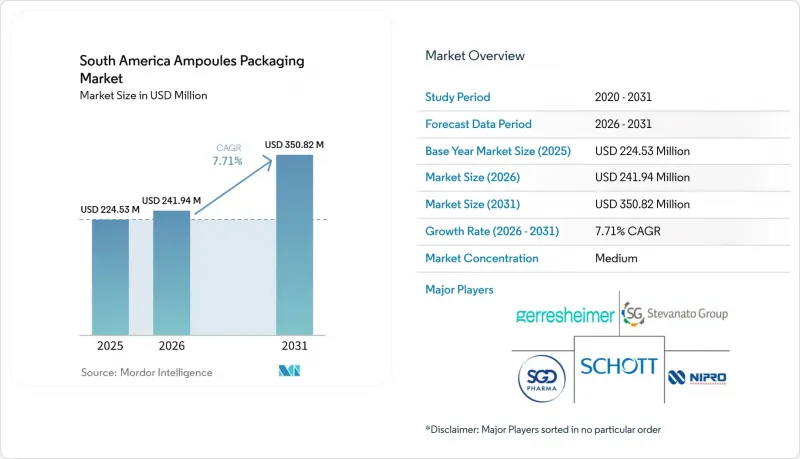
According to Mordor Intelligence, the South America ampoules packaging market size was valued at USD 224.53 million in 2025 and estimated to grow from USD 241.94 million in 2026 to reach USD 350.82 million by 2031, at a CAGR of 7.71% during the forecast period (2026-2031).
South America Ampoules Packaging Market Trends and Insights
Expansion of Injectable Drug Manufacturing in Brazil
Brazil is adding injectable drug capacity across established pharmaceutical locations, creating a direct need for more qualified sterile primary packaging. Novo Nordisk announced an expansion of DKK 8 billion (USD 1.16 billion) at its Montes Claros site in Minas Gerais, one of South America's largest insulin production facilities, in April 2025. The program adds aseptic production lines, a quality control laboratory, and warehouse capacity, and construction is expected to be completed in 2028. Blanver announced a BRL 592 million (USD 116 million) investment to establish a new injectable manufacturing plant in Mairipora, Sao Paulo. The company secured BRL 420 million (USD 82 million) in funding from BNDES and FINEP. A separate injectable facility in Santa Catarina was built with an investment exceeding BRL 160 million (USD 27.7 million), expanding capacity beyond the Sao Paulo and Minas Gerais corridor. These sites need packaging suppliers that can satisfy ANVISA good manufacturing practice expectations, complete qualification work, and maintain supply after a product enters commercial manufacture.
Growth of Biologics, Vaccines, and Specialty Injectables
Biologic medicines require sterile primary containers with documented material performance because their formulations can be sensitive to interaction with the packaging surface. Brazil approved 14 biosimilars in 2025, and each product requires validated sterile packaging and stability work before commercial launch. Bio-Manguinhos is installing 4 isolator filling lines for high-volume production of sterile biologics, underscoring the scale of public-sector capacity being added. Funed activated an injectable-grade unit for domestic aflibercept production through its partnership with Bionovis and Samsung Bioepis in March 2026. These initiatives distribute demand across public institutions and commercial manufacturers, rather than concentrating it in a single group of buyers. The South America ampoules packaging market benefits when suppliers can provide the material knowledge, validated processes, and consistent specifications required for these programs.
Import Dependence for Pharmaceutical-Grade Glass Tubing
South American converters rely on imported Type I borosilicate glass tubing for high-purity pharmaceutical applications, and the supplied research states that reliance exceeds 70% across the region. European and specialized Asian forming centers supply much of this material, leading to greater exposure to concentrated global sources and longer procurement cycles. Standard lead times of 12-20 weeks limit converters' ability to respond quickly when regional fill-finish demand rises. New upstream glass-tubing capacity requires lengthy investment and commissioning periods, while South American investment remains better suited to standard products than to high-end Type I requirements. Converters use buffer inventories and long-term contracts to protect production schedules, but these measures increase working-capital requirements. ANVISA container-closure integrity expectations also narrow the range of tubing sources that can be used for registered medicines, making import dependency a structural issue rather than a short-term imbalance.
Other drivers and restraints analyzed in the detailed report include:
- Rising Demand for Single-Dose Sterile Packaging
- Increasing Adoption of Serialization-Ready Primary Packaging
- Currency Volatility and High Landed Costs for Imported Packaging
For complete list of drivers and restraints, kindly check the Table Of Contents.
Segment Analysis
Glass held 72.46% of the South America ampoules packaging market share in 2025, reflecting its established role in pharmaceutical containers for sterile injectable medicines. Type I borosilicate glass is chemically inert, withstands thermal shock, and provides the hermetic seal needed to protect parenteral products during storage and distribution. These properties help manufacturers manage pH change, delamination, and metallic ion migration, which can affect sensitive biologics and other injectable formulations. The Brazilian Farmacopeia, along with other pharmacopeial standards used by drug manufacturers, supports glass specifications for many pharmaceutical applications. Demand is concentrated where product quality records, container-closure integrity, and material consistency are required before a medicine can be registered or released.
Glass suppliers, therefore, serve the most regulated part of regional packaging demand and benefit from the concentration of injectable production in Brazil and Argentina. Plastic ampoules are projected to grow at a CAGR of 8.19% through 2031, led by applications that benefit from blow-fill-seal processing. This technology forms, fills, and seals the container in a single aseptic sequence, reducing handling associated with pre-formed containers. It can lower logistics costs for large-volume runs and is relevant to personal care, veterinary products, and selected lower-acuity pharmaceutical applications. Plastic is not displacing glass across high-sensitivity medicines, because each material addresses different quality, cost, and filling needs in the South America ampoules packaging market.
Straight-stem ampoules accounted for 38.42% of the South America ampoules packaging market size in 2025, making them the largest format within the ampoule type segmentation. Their design is compatible with standard filling lines and familiar to hospital pharmacies, which supports continued use across established injectable supply chains. The format is used for antibiotics, hormones, analgesics, and other routine injectable medicines supplied to hospitals and clinics. Funnel-type and closed-form designs support more specialized clinical uses in which liquid management during dispensing is important. Controlled hospital settings may choose these designs when pharmacists handling procedures or product presentation require a specific format.
The installed base of conventional production equipment and well-understood user practices continue to support demand for straight-stem ampoules. Easy-open formats are projected to grow at a CAGR of 8.24% through 2031 and include one-point-cut, score-ring, and color-break-ring products. Hospitals value formats that enable a cleaner opening without additional tools, helping reduce injury risk for nurses and pharmacists. Precise score-line placement adds manufacturing steps and can increase per-unit cost compared with straight-stem production. Buyers are increasingly accepting this cost when it supports medication safety and sterile barrier performance
Complete Report Scope:
- By Material Type
- Glass
- Plastic
- By Ampoule Type
- Straight-stem
- Funnel-type
- Closed (Form D)
- Easy-Open (OPC, Score-Ring, CBR)
- By Capacity
- Less than 2 mL
- 3-5 mL
- 6-10 mL
- More than 10 mL
- By Manufacturing Technology
- Conventional Tubular Forming
- Blow-Fill-Seal Plastic
- Advanced Laser Scoring
- By End-user Industry
- Pharmaceutical
- Personal Care and Cosmetics
- By Geography
- Brazil
- Argentina
- Chile
- Colombia
- Rest of South America
List of Companies Covered in this Report:
- Gerresheimer AG
- SCHOTT Pharma AG & Co. KGaA
- Stevanato Group S.p.A.
- Nipro PharmaPackaging International N.V.
- SGD S.A.
- Shandong Pharmaceutical Glass Co., Ltd.
- James Alexander Corporation
- Essco Glass Pvt. Ltd.
- Global Pharmatech Pvt. Ltd.
- AAPL Solutions Pvt. Ltd.
- Hindusthan National Glass and Industries Limited
- PGP Glass Private Limited
- Weiler Engineering, Inc.
- DWK Life Sciences GmbH
- Amposan S.A.
- Borosil Scientific Limited
- Crestani S.r.l.
- Vetter Pharma-Fertigung GmbH & Co. KG
Additional Benefits:
- The market estimate (ME) sheet in Excel format
- 3 months of analyst support
TABLE OF CONTENTS
1 INTRODUCTION
- 1.1 Study Assumptions and Market Definition
- 1.2 Scope of the Study
2 RESEARCH METHODOLOGY
3 EXECUTIVE SUMMARY
4 MARKET LANDSCAPE
- 4.1 Market Overview
- 4.2 Market Drivers
- 4.2.1 Expansion of Injectable Drug Manufacturing in Brazil
- 4.2.2 Rising Demand for Single-Dose Sterile Packaging
- 4.2.3 Growth of Biologics, Vaccines, and Specialty Injectables
- 4.2.4 Increasing Adoption of Serialization-Ready Primary Packaging
- 4.2.5 Demand for Low-Extractables Packaging for Sensitive Formulations
- 4.2.6 Localization of Fill-and-Finish Capacity in South America
- 4.3 Market Restraints
- 4.3.1 Import Dependence for Pharmaceutical-Grade Glass Tubing
- 4.3.2 Currency Volatility and High Landed Costs for Imported Packaging
- 4.3.3 Ampoule Breakage and Particulate-Contamination Risk
- 4.3.4 Limited Regional Availability of High-Speed Ampoule Inspection and Conversion Equipment
- 4.4 Impact of Macroeconomic Factors on the Market
- 4.5 Industry Value Chain Analysis
- 4.6 Regulatory Landscape
- 4.7 Technological Outlook
- 4.8 Porter's Five Forces Analysis
- 4.8.1 Bargaining Power of Suppliers
- 4.8.2 Bargaining Power of Buyers
- 4.8.3 Threat of New Entrants
- 4.8.4 Threat of Substitutes
- 4.8.5 Competitive Rivalry
5 MARKET SIZE AND GROWTH FORECASTS (VALUE)
- 5.1 By Material Type
- 5.1.1 Glass
- 5.1.2 Plastic
- 5.2 By Ampoule Type
- 5.2.1 Straight-stem
- 5.2.2 Funnel-type
- 5.2.3 Closed (Form D)
- 5.2.4 Easy-Open (OPC, Score-Ring, CBR)
- 5.3 By Capacity
- 5.3.1 Less than 2 mL
- 5.3.2 3-5 mL
- 5.3.3 6-10 mL
- 5.3.4 More than 10 mL
- 5.4 By Manufacturing Technology
- 5.4.1 Conventional Tubular Forming
- 5.4.2 Blow-Fill-Seal Plastic
- 5.4.3 Advanced Laser Scoring
- 5.5 By End-user Industry
- 5.5.1 Pharmaceutical
- 5.5.2 Personal Care and Cosmetics
- 5.6 By Geography
- 5.6.1 Brazil
- 5.6.2 Argentina
- 5.6.3 Chile
- 5.6.4 Colombia
- 5.6.5 Rest of South America
6 COMPETITIVE LANDSCAPE
- 6.1 Market Concentration
- 6.2 Strategic Moves
- 6.3 Market Share Analysis
- 6.4 Company Profiles (includes Global Level Overview, Market Level Overview, Core Segments, Financials as available, Strategic Information, Market Rank/Share, Products and Services, Recent Developments)
- 6.4.1 Gerresheimer AG
- 6.4.2 SCHOTT Pharma AG & Co. KGaA
- 6.4.3 Stevanato Group S.p.A.
- 6.4.4 Nipro PharmaPackaging International N.V.
- 6.4.5 SGD S.A.
- 6.4.6 Shandong Pharmaceutical Glass Co., Ltd.
- 6.4.7 James Alexander Corporation
- 6.4.8 Essco Glass Pvt. Ltd.
- 6.4.9 Global Pharmatech Pvt. Ltd.
- 6.4.10 AAPL Solutions Pvt. Ltd.
- 6.4.11 Hindusthan National Glass and Industries Limited
- 6.4.12 PGP Glass Private Limited
- 6.4.13 Weiler Engineering, Inc.
- 6.4.14 DWK Life Sciences GmbH
- 6.4.15 Amposan S.A.
- 6.4.16 Borosil Scientific Limited
- 6.4.17 Crestani S.r.l.
- 6.4.18 Vetter Pharma-Fertigung GmbH & Co. KG
7 MARKET OPPORTUNITIES AND FUTURE OUTLOOK
- 7.1 White-Space and Unmet-Need Assessment

