PUBLISHER: Mordor Intelligence | PRODUCT CODE: 2154941

PUBLISHER: Mordor Intelligence | PRODUCT CODE: 2154941
Thermally Conductive Plastics - Market Share Analysis, Industry Trends & Statistics, Growth Forecasts (2026 - 2031)
According to Mordor Intelligence, the thermally conductive plastics market was valued at USD 213.45 million in 2025 and is projected to grow from USD 240.88 million in 2026 to USD 479.65 million by 2031, at a CAGR of 14.77% during the forecast period (2026-2031).
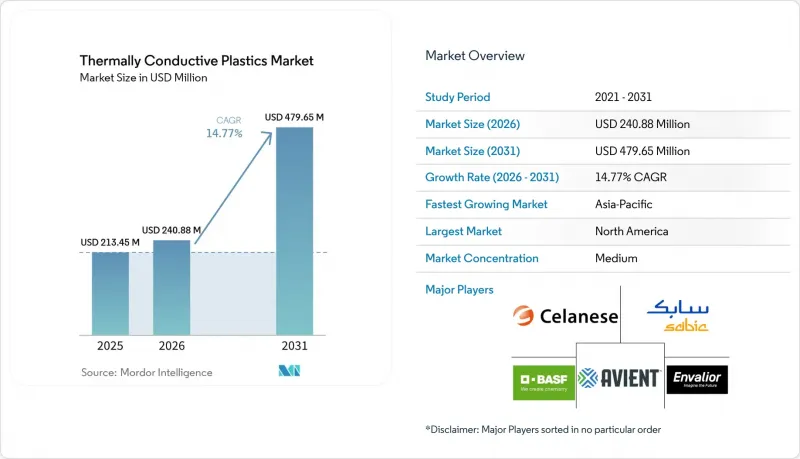
Global Thermally Conductive Plastics Market Trends and Insights
Miniaturization Of Electronic Components Compressing Thermal Budgets
Rising transistor density increases chip power per unit area as component footprints continue to shrink. Processors used in AI infrastructure generate localized heat, requiring nearby plastics to maintain dimensional stability, electrical insulation, and thermal diffusivity. The thermally conductive plastics market benefits from this trend, as thinner walls require more efficient heat-transfer pathways. Formulators use boron nitride platelets, hybrid boron nitride-graphene networks, and liquid-crystal polymer substrates for applications requiring higher performance. These materials command a higher value than standard enclosure resins because they must balance thermal management capabilities with molding performance. UL 94 V-0 and IEC 60695 requirements further increase formulation complexity and favor established specialty producers.
Electric Vehicle Battery Thermal Management Driving Materials Convergence
Battery-module compounds must deliver bulk thermal conductivity of 1.0-5.0 W/m*K and dielectric strength above 20 kV/mm. They must also meet Comparative Tracking Index requirements for PLC 0 or PLC 1 while complying with stringent vehicle weight limits. This combination of requirements supports growth in the thermally conductive plastics market, as metals cannot provide all these properties in a single molded component. Premium electric vehicles with 800V architectures are expanding the use of PPS and PA grades in drivetrain and DC-DC converter housings. In June 2026, Envalior is set to introduce Xytron M5080ET, an impact-modified PPS grade for EV busbars that offers a UL 94 V-0 classification at 2 mm. The company reports that the material provides more than 70% greater stress-crack resistance than comparable materials in thermal-shock tests ranging from -50°C to +180°C. This focus on application-specific performance is raising the standards for qualified materials used in battery and powertrain components.
Lower Thermal Conductivity Than Metals Constrains High-Power Interfaces
Aluminum offers thermal conductivity of approximately 200 W/m*K, while advanced commercial thermally conductive plastic grades provide substantially lower conductivity. SABIC lists LNP KONDUIT grades with thermal conductivity of up to 18 W/m*K. This performance gap limits the use of polymers in direct chip-contact interfaces, high-current busbars without overmolding, and extreme-duty industrial heat exchangers. Consequently, the thermally conductive plastics market will continue to support many applications through hybrid metal-plastic designs. OEMs can retain aluminum or copper in high-load zones while using plastics for secondary heat-spreading and insulated structural functions. This division of roles maintains the relevance of polymers without overstating their suitability for all thermal interface applications.
Other drivers and restraints analyzed in the detailed report include:
- Lightweight Metal Replacement In Thermal Components Redefining OEM Material Choices
- AI, 5G, IoT, And High-Power Electronics Expanding Addressable Scope
- High Filler And Processing Costs Limiting Adoption In Cost-Sensitive Segments
For complete list of drivers and restraints, kindly check the Table Of Contents.
Segment Analysis
Polyamide held a 56.22% share of the thermally conductive plastics market in 2025 and is expected to grow at a CAGR of 14.67% through 2031. Its leading position stems from its processing versatility, broad operating-temperature range, and established compatibility with boron nitride, graphite, and mineral filler systems. Polyamide can achieve thermal conductivity of 1-5 W/m*K while maintaining electrical insulation, making it suitable for high-voltage automotive and power electronics applications. These properties are particularly valuable where dielectric strength is as critical as heat transfer. In June 2025, BASF introduced Ultramid Advanced N3U42G6, a non-halogenated PA9T grade for high-voltage EV connectors and automotive battery systems. This introduction reflects the market's shift toward electrification-specific requirements.
Other resin types serve specialized applications in the thermally conductive plastics market. Polycarbonate is used in 5G connectivity enclosures and data center PCB overmolding applications, where impact strength and RF performance requirements complement thermal management needs. PPS is gaining traction in 800V powertrain overmolding applications due to its high-temperature stability and resistance to automotive fluids. Envalior introduced Xytron M5080ET for EV busbar applications; the material carries a UL 94 V-0 rating at a thickness of 2 mm. PBT supports EV control-unit covers through laser-weldable, flame-retardant grades. PEI remains a premium material for aerospace and medical housings requiring continuous-use temperatures above 180°C.
Complete Report Scope:
- By Resin Type
- Polyamide
- Polycarbonate
- Polybutylene Terephthalate
- Polyphenylene Sulfide
- Polyetherimide
- Other Resin Types
- By Application
- Lighting Systems
- Battery Modules and Packs
- Heat Sinks and Heat Spreaders
- Other Applications
- By End-Use Industry
- Electrical and Electronics
- Automotive
- Industrial
- Aerospace
- Healthcare
- Telecommunications
- Other End-Use Industries
- By Geography
- Asia-Pacific
- China
- India
- Japan
- South Korea
- ASEAN Countries
- Rest of Asia-Pacific
- North America
- United States
- Canada
- Mexico
- Europe
- Germany
- United Kingdom
- France
- Italy
- NORDIC Countries
- Rest of Europe
- South America
- Brazil
- Argentina
- Rest of South America
- Middle East and Africa
- Saudi Arabia
- South Africa
- Rest of Middle East and Africa
- Asia-Pacific
Geography Analysis
North America accounted for 38.78% of the thermally conductive plastics market in 2025. Hyperscale data centers, an established EV supply chain, and lighting upgrades driven by energy-efficiency requirements support regional demand. OEM production in the United States and Canada also drives demand for qualified automotive compounds. Mexico's expanding role in EV assembly is further increasing demand for thermally conductive plastics across border-state manufacturing operations. Avient's planned June 2026 Therma-Tech expansion is expected to support applications in lighting, automotive heat sinks, and heat-exchange systems.
Asia-Pacific is forecast to expand at a CAGR of 14.89% through 2031, representing the highest regional growth rate. China's EV production base, Japan's electronics ecosystem, and South Korea's investments in semiconductor packaging support this outlook. According to the supplied draft, China's new-energy vehicle penetration is expected to exceed 35% of new vehicle sales in 2025. Japanese producers are also targeting applications that combine electrical insulation with thermal management. In January 2026, Sumitomo Bakelite is expected to announce the adoption of its BLA-6051 heat-dissipating insulating sheet in resin-insulated substrates for DENSO automotive inverters. India and ASEAN countries are expected to generate incremental demand as electronics and automotive manufacturing capacity expands.
Europe generates significant demand for thermally conductive plastics, supported by Germany's automotive OEM base and the concentrated research and development capabilities of major polymer suppliers. REACH compliance and End-of-Life Vehicles Directive requirements are encouraging the reformulation of compounds using halogen-free and low-VOC materials. In 2025, Envalior began PPS compounding production at its Uerdingen facility for Xytron grades used in EV water-pump housings, high-temperature connectors, and thermal assemblies. South America, the Middle East, and Africa account for smaller volumes in the thermally conductive plastics market. Brazil's automotive cluster, Saudi Arabia's industrial diversification initiatives, and South Africa's mining-electronics applications represent the primary demand centers. These regions remain dependent on imported specialty compounds and have limited local distribution infrastructure.
- Avient Corporation
- BASF
- Celanese Corporation
- Covestro AG
- Envalior
- DuPont
- Ensinger
- KANEKA CORPORATION
- LANXESS
- LATI Industria Termoplastici S.p.A.
- LOTTE Chemical Corporation
- Mitsubishi Engineering-Plastics Corporation
- RTP Company
- SABIC
- Sumitomo Bakelite Co., Ltd.
- TORAY INDUSTRIES, INC.
Additional Benefits:
- The market estimate (ME) sheet in Excel format
- 3 months of analyst support
TABLE OF CONTENTS
1 INTRODUCTION
- 1.1 Study Assumptions and Market Definition
- 1.2 Scope of the Study
2 RESEARCH METHODOLOGY
3 EXECUTIVE SUMMARY
4 MARKET LANDSCAPE
- 4.1 Market Overview
- 4.2 Market Drivers
- 4.2.1 Miniaturization of Electronic Components
- 4.2.2 Electric Vehicle Battery Thermal Management
- 4.2.3 Lightweight Metal Replacement in Thermal Components
- 4.2.4 Proliferation of AI, 5G, IoT and High-Power Electronics
- 4.2.5 Recycled-Filler and Electrically Insulating Formulation Innovation
- 4.3 Market Restraints
- 4.3.1 Lower Thermal Conductivity Than Metals
- 4.3.2 High Filler and Processing Costs
- 4.3.3 Filler Dispersion and Anisotropic Conductivity Challenges
- 4.4 Value Chain Analysis
- 4.5 Porter's Five Forces Analysis
- 4.5.1 Threat of New Entrants
- 4.5.2 Bargaining Power of Suppliers
- 4.5.3 Bargaining Power of Buyers
- 4.5.4 Threat of Substitutes
- 4.5.5 Competitive Rivalry
5 MARKET SIZE AND GROWTH FORECASTS (VALUE)
- 5.1 By Resin Type
- 5.1.1 Polyamide
- 5.1.2 Polycarbonate
- 5.1.3 Polybutylene Terephthalate
- 5.1.4 Polyphenylene Sulfide
- 5.1.5 Polyetherimide
- 5.1.6 Other Resin Types
- 5.2 By Application
- 5.2.1 Lighting Systems
- 5.2.2 Battery Modules and Packs
- 5.2.3 Heat Sinks and Heat Spreaders
- 5.2.4 Other Applications
- 5.3 By End-Use Industry
- 5.3.1 Electrical and Electronics
- 5.3.2 Automotive
- 5.3.3 Industrial
- 5.3.4 Aerospace
- 5.3.5 Healthcare
- 5.3.6 Telecommunications
- 5.3.7 Other End-Use Industries
- 5.4 By Geography
- 5.4.1 Asia-Pacific
- 5.4.1.1 China
- 5.4.1.2 India
- 5.4.1.3 Japan
- 5.4.1.4 South Korea
- 5.4.1.5 ASEAN Countries
- 5.4.1.6 Rest of Asia-Pacific
- 5.4.2 North America
- 5.4.2.1 United States
- 5.4.2.2 Canada
- 5.4.2.3 Mexico
- 5.4.3 Europe
- 5.4.3.1 Germany
- 5.4.3.2 United Kingdom
- 5.4.3.3 France
- 5.4.3.4 Italy
- 5.4.3.5 NORDIC Countries
- 5.4.3.6 Rest of Europe
- 5.4.4 South America
- 5.4.4.1 Brazil
- 5.4.4.2 Argentina
- 5.4.4.3 Rest of South America
- 5.4.5 Middle East and Africa
- 5.4.5.1 Saudi Arabia
- 5.4.5.2 South Africa
- 5.4.5.3 Rest of Middle East and Africa
- 5.4.1 Asia-Pacific
6 COMPETITIVE LANDSCAPE
- 6.1 Market Concentration
- 6.2 Strategic Moves
- 6.3 Market Share (%)/Ranking Analysis
- 6.4 Company Profiles (includes Global Level Overview, Market Level Overview, Core Segments, Financials as available, Strategic Information, Products and Services, Recent Developments)
- 6.4.1 Avient Corporation
- 6.4.2 BASF
- 6.4.3 Celanese Corporation
- 6.4.4 Covestro AG
- 6.4.5 Envalior
- 6.4.6 DuPont
- 6.4.7 Ensinger
- 6.4.8 KANEKA CORPORATION
- 6.4.9 LANXESS
- 6.4.10 LATI Industria Termoplastici S.p.A.
- 6.4.11 LOTTE Chemical Corporation
- 6.4.12 Mitsubishi Engineering-Plastics Corporation
- 6.4.13 RTP Company
- 6.4.14 SABIC
- 6.4.15 Sumitomo Bakelite Co., Ltd.
- 6.4.16 TORAY INDUSTRIES, INC.
7 MARKET OPPORTUNITIES AND FUTURE OUTLOOK
- 7.1 White-Space and Unmet-Need Assessment

