PUBLISHER: Mordor Intelligence | PRODUCT CODE: 2154950

PUBLISHER: Mordor Intelligence | PRODUCT CODE: 2154950
Genital Warts Treatment - Market Share Analysis, Industry Trends & Statistics, Growth Forecasts (2026 - 2031)
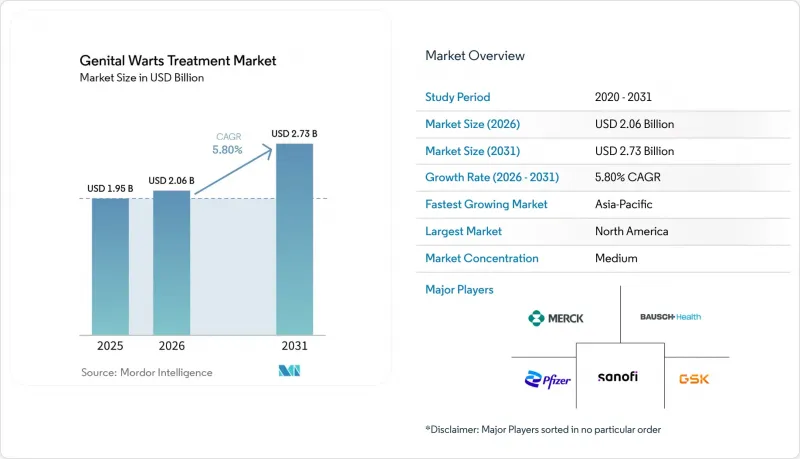
According to Mordor Intelligence, the genital warts treatment market size was valued at USD 1.95 billion in 2025 and is estimated to grow from USD 2.06 billion in 2026 to reach USD 2.73 billion by 2031, at a CAGR of 5.80% during the forecast period (2026-2031).
Global Genital Warts Treatment Market Trends and Insights
Persistent Incidence of Low-Risk HPV Infection
Low-risk HPV infections continue to support demand in the genital warts treatment market despite long-standing vaccination programs. The CDC estimates that more than 42 million people in the United States have active HPV infection, with 13 million new infections occurring annually. Nearly half of new infections occur among individuals aged 15-24 years. Dutch primary care records showed that genital warts incidence increased from 2.0 to 2.8 cases per 1,000 residents between 2011 and 2024, while male incidence rose from 2.0 to 3.5 cases per 1,000 residents. Adults aged 25-45 years who were outside catch-up programs remain a key treatment population, supporting prescription volumes over the forecast period.
Rising Preference for Patient-Applied Treatment
Patient-applied therapies are gaining importance in the genital warts treatment market as eligible virtual consultations enable convenient prescribing. The CDC recommends imiquimod 5% cream, podofilox 0.5% solution, and sinecatechins 15% ointment for external anogenital warts. These options reduce repeat clinic visits when remote diagnosis and prescribing are appropriate, while shortening the time from consultation to prescription fulfillment. Virtual care also addresses patient reluctance to seek in-person care due to stigma. Improved outpatient access supports treatment initiation and patient retention compared with clinic-based treatment schedules.
High Recurrence After Visible Wart Clearance
Recurrence remains a key clinical limitation in the genital warts treatment market, as visible lesion clearance does not ensure viral eradication. A Dutch primary care analysis estimated post-treatment recurrence rates at 20%-30%, with higher rates among immunocompromised patients. The 2024 BASHH guideline stated that all treatment modalities carry a recurrence risk and that no available treatment guarantees HPV eradication. This may reduce patient confidence and increase repeat prescriptions and follow-up care. France's 2024 guidance shifted toward first-line combination treatment with cryotherapy and topical imiquimod or podophyllotoxin to improve durable clearance where monotherapy is insufficient.
Other drivers and restraints analyzed in the detailed report include:
- Increasing Treatment Demand in Immunocompromised Patients
- Commercialization of Novel Topical and Lesion-Destructive Therapies
- Stigma-Driven Diagnosis and Treatment Delays
For complete list of drivers and restraints, kindly check the Table Of Contents.
Segment Analysis
Imiquimod held 42.35% of the genital warts treatment market share in 2025, supported by guideline recommendations and the availability of 5% and 3.75% patient-applied cream formulations. It activates local innate immune responses through toll-like receptor 7/8 activity and is used for eligible patients with external genital and perianal warts. Patent expiry increased generic competition from Glenmark, Teva, Taro, Perrigo, and Padagis. Generic availability reduced patient out-of-pocket costs while placing pressure on manufacturer margins. Podophyllin and podofilox remained relevant cytotoxic options, with podophyllotoxin accounting for 80.6% of topical prescriptions in participating Netherlands practices.
Sinecatechins is forecast to be the fastest-growing drug category at a CAGR of 6.56% through 2031. Growth is supported by Veregen, a sinecatechins ointment supplied by ANI Pharmaceuticals for external genital and perianal warts. Its green tea-derived catechin compounds offer a differentiated mechanism and may benefit patients who do not tolerate imiquimod-related skin reactions. Trichloroacetic acid remains a physician-applied option for resource-limited settings and lesions unsuitable for patient-applied therapies. Other drug types include interferon products, isotretinoin for recalcitrant cases, and pipeline therapies.
Complete Report Scope:
- By Drug Type
- Imiquimod
- Podophyllin and Podofilox
- Trichloroacetic Acid
- Sinecatechins
- Other Drug Types
- By Route of Administration
- Topical
- Parenteral
- Others
- By Distribution Channel
- Hospital Pharmacies
- Retail Pharmacies
- Online Pharmacies
- Specialty Pharmacies
- Others
- By Geography
- North America
- United States
- Canada
- Mexico
- Europe
- Germany
- United Kingdom
- France
- Italy
- Spain
- Rest of Europe
- Asia-Pacific
- China
- India
- Japan
- Australia
- South Korea
- Rest of Asia-Pacific
- Middle East and Africa
- GCC
- South Africa
- Rest of Middle East and Africa
- South America
- Brazil
- Argentina
- Rest of South America
- North America
Geography Analysis
North America accounted for 40.67% of the genital warts treatment market share in 2025, supported by the availability of branded and generic medicines, reimbursed prescriptions, and widespread telehealth infrastructure. The United States represented the majority of regional demand due to its extensive prescription channels and broad access to clinician-directed care. Key treatment options included imiquimod formulations, sinecatechins, and podofilox. Generic competition increased the importance of product access and formulary placement over brand differentiation. Canada and Mexico made smaller contributions, while demand through 2031 is supported by immunocompromised patient needs and expanding telehealth use.
Europe remained the second-largest regional market, with Germany, the United Kingdom, France, Italy, and Spain accounting for a substantial share of treatment demand. The regional diagnosis burden remained significant despite lower incidence among vaccinated younger populations, with annual diagnoses estimated at 600,000-800,000 individuals. France updated its anogenital condyloma guidance in 2024, placing combined cryotherapy with topical imiquimod or podophyllotoxin in first-line care. This approach can increase the number of treatments used during an episode of care. Italian surveillance published in 2025 showed a growing share of older patients at diagnosis, supporting stable demand across public and private healthcare systems.
Asia-Pacific is forecast to grow at a CAGR of 6.88% through 2031, making it the fastest-growing region. China, India, Japan, South Korea, and Australia support growth through improved diagnostic access and pharmaceutical availability, while local treatment practices and domestic manufacturers influence market size. China has a concentrated domestic generic imiquimod segment, with 4 manufacturers controlling 98% of the segment. India's CERVAVAC is a quadrivalent HPV vaccine covering types 6, 11, 16, and 18; its rollout through India's Universal Immunization Program and planned exports in 2026-2027 can support long-term prevention but do not treat established infection. The Middle East and Africa remain earlier-stage markets, while GCC countries are investing in preventive and sexual health services, and Brazil leads South American demand.
- Abbvie
- ANI Pharmaceuticals
- Astellas Pharma
- Bausch Health
- Bayer
- CryoConcepts, LP
- Glenmark Pharmaceuticals
- GlaxoSmithKline
- Medtronic
- Merck
- Novan, Inc.
- Orgenesis Inc.
- Padagis US LLC
- Perrigo Company
- Pfizer
- Sanofi
- Serum Institute of India Private Limited
- Taro Pharmaceutical Industries Ltd.
- Teva Pharmaceutical Industries
- Verrica Pharmaceuticals Inc.
Additional Benefits:
- The market estimate (ME) sheet in Excel format
- 3 months of analyst support
TABLE OF CONTENTS
1 INTRODUCTION
- 1.1 Study Assumptions and Market Definition
- 1.2 Scope of the Study
2 RESEARCH METHODOLOGY
3 EXECUTIVE SUMMARY
4 MARKET LANDSCAPE
- 4.1 Market Overview
- 4.2 Market Drivers
- 4.2.1 Persistent Incidence of Low-Risk HPV Infection
- 4.2.2 Increasing Diagnosis of Anogenital Lesions
- 4.2.3 Rising Preference for Patient-Applied Treatment
- 4.2.4 Expansion of Outpatient and Ambulatory Care
- 4.2.5 Increasing Treatment Demand in Immunocompromised Patients
- 4.2.6 Commercialization of Novel Topical and Lesion-Destructive Therapies
- 4.3 Market Restraints
- 4.3.1 High Recurrence After Visible Wart Clearance
- 4.3.2 Treatment-Related Pain and Local Skin Reactions
- 4.3.3 Stigma-Driven Diagnosis and Treatment Delays
- 4.3.4 Limited Evidence for Durable HPV Eradication
- 4.4 Value / Supply-Chain Analysis
- 4.5 Regulatory Landscape
- 4.6 Technological Outlook
- 4.7 Porter's Five Forces Analysis
- 4.7.1 Bargaining Power of Suppliers
- 4.7.2 Bargaining Power of Buyers
- 4.7.3 Threat of New Entrants
- 4.7.4 Threat of Substitutes
- 4.7.5 Competitive Rivalry
5 MARKET SIZE AND GROWTH FORECASTS (VALUE, USD)
- 5.1 By Drug Type
- 5.1.1 Imiquimod
- 5.1.2 Podophyllin and Podofilox
- 5.1.3 Trichloroacetic Acid
- 5.1.4 Sinecatechins
- 5.1.5 Other Drug Types
- 5.2 By Route of Administration
- 5.2.1 Topical
- 5.2.2 Parenteral
- 5.2.3 Others
- 5.3 By Distribution Channel
- 5.3.1 Hospital Pharmacies
- 5.3.2 Retail Pharmacies
- 5.3.3 Online Pharmacies
- 5.3.4 Specialty Pharmacies
- 5.3.5 Others
- 5.4 By Geography
- 5.4.1 North America
- 5.4.1.1 United States
- 5.4.1.2 Canada
- 5.4.1.3 Mexico
- 5.4.2 Europe
- 5.4.2.1 Germany
- 5.4.2.2 United Kingdom
- 5.4.2.3 France
- 5.4.2.4 Italy
- 5.4.2.5 Spain
- 5.4.2.6 Rest of Europe
- 5.4.3 Asia-Pacific
- 5.4.3.1 China
- 5.4.3.2 India
- 5.4.3.3 Japan
- 5.4.3.4 Australia
- 5.4.3.5 South Korea
- 5.4.3.6 Rest of Asia-Pacific
- 5.4.4 Middle East and Africa
- 5.4.4.1 GCC
- 5.4.4.2 South Africa
- 5.4.4.3 Rest of Middle East and Africa
- 5.4.5 South America
- 5.4.5.1 Brazil
- 5.4.5.2 Argentina
- 5.4.5.3 Rest of South America
- 5.4.1 North America
6 COMPETITIVE LANDSCAPE
- 6.1 Market Concentration
- 6.2 Market Share Analysis
- 6.3 Company Profiles (includes Global Level Overview, Market Level Overview, Core Segments, Financials as available, Strategic Information, Market Rank/Share, Products and Services, Recent Developments)
- 6.3.1 AbbVie Inc.
- 6.3.2 ANI Pharmaceuticals, Inc.
- 6.3.3 Astellas Pharma Inc.
- 6.3.4 Bausch Health Companies Inc.
- 6.3.5 Bayer AG
- 6.3.6 CryoConcepts, LP
- 6.3.7 Glenmark Pharmaceuticals Limited
- 6.3.8 GSK plc
- 6.3.9 Medtronic plc
- 6.3.10 Merck & Co., Inc.
- 6.3.11 Novan, Inc.
- 6.3.12 Orgenesis Inc.
- 6.3.13 Padagis US LLC
- 6.3.14 Perrigo Company plc
- 6.3.15 Pfizer Inc.
- 6.3.16 Sanofi S.A.
- 6.3.17 Serum Institute of India Private Limited
- 6.3.18 Taro Pharmaceutical Industries Ltd.
- 6.3.19 Teva Pharmaceutical Industries Limited
- 6.3.20 Verrica Pharmaceuticals Inc.
7 MARKET OPPORTUNITIES AND FUTURE OUTLOOK
- 7.1 White-Space and Unmet-Need Assessment

