PUBLISHER: Mordor Intelligence | PRODUCT CODE: 2154958

PUBLISHER: Mordor Intelligence | PRODUCT CODE: 2154958
South America Internet Of Things (IoT) Security - Market Share Analysis, Industry Trends & Statistics, Growth Forecasts (2026 - 2031)
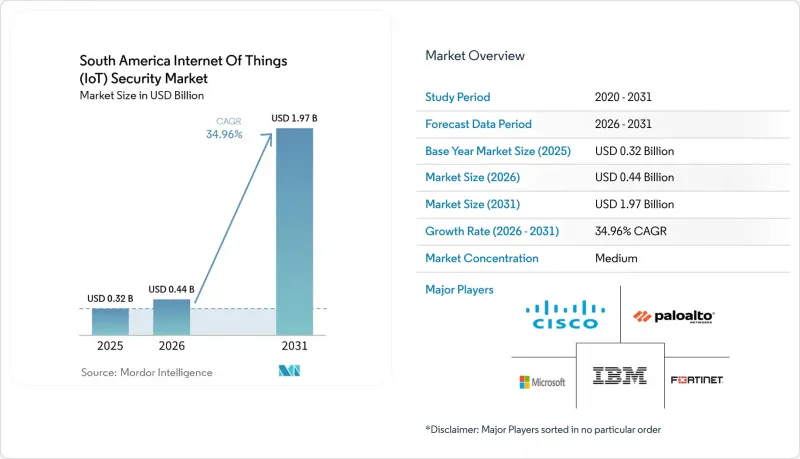
According to Mordor Intelligence, the South America internet of Things (IoT) security market size was valued at USD 0.32 billion in 2025 and estimated to expand from USD 0.44 billion in 2026 to reach USD 1.97 billion by 2031, at a CAGR of 34.96% during the forecast period (2026-2031).
South America Internet Of Things (IoT) Security Market Trends and Insights
Expansion of Connected Industrial and Critical-Infrastructure Assets
Industrial digitalization is increasing the number of connected assets across oil and gas, mining, hydropower, and manufacturing sites. These assets require security coverage throughout their operating life, not only at the time of installation. A refinery or hydropower facility can operate equipment from 5 or more vendors, with different firmware practices and authentication methods. That mix makes a standardized perimeter defense insufficient for many operating environments. Security providers, therefore, need to combine asset visibility, integration work, and ongoing monitoring for each site. The South America Internet of Things (IoT) security market is benefiting as security engagements extend from one-time deployments into longer service relationships.
Rising IoT-Targeted Cyberattacks and Operational Disruption Risks
Cyberattacks on industrial environments are increasing the need for continuous monitoring among operators in South America. Manufacturing and energy utilities remain exposed because connected devices can provide entry points to broader operational systems. The fastest incidents in 2025 reached full data exfiltration in 1.2 hours, compared with 4.8 hours in 2024, reducing the time available for reactive response measures. Firmware in industrial devices may not be patched immediately because maintenance activity can interrupt production. Cloud-delivered managed security and SECaaS offerings address this issue through continuous detection and response coverage. This operating need supports demand for the South America Internet of Things (IoT) security market beyond traditional perimeter security tools.
High Implementation and Integration Costs
IoT security deployments can require hardware, specialized labor, and continuing integration support. This cost structure is difficult for many small and mid-size industrial enterprises to sustain outside Sao Paulo, Buenos Aires, and Santiago. Operators frequently manage devices from several vendors with incompatible application programming interfaces, authentication approaches, and data formats. Custom work is often required before a central platform can collect and interpret device telemetry. The South America Internet of Things (IoT) security market, therefore, faces slower adoption where an operator cannot justify an extensive on-premise security stack. Cloud-based models can reduce some initial infrastructure needs, but they do not remove the cost of assessing and integrating legacy operational technology.
Other drivers and restraints analyzed in the detailed report include:
- Brazil PAC 4.0 and Smart-City Security Procurement
- 5G, NB-IoT, and Open Gateway Security Upselling
- Fragmented IoT Standards and Interoperability Requirements
For complete list of drivers and restraints, kindly check the Table Of Contents.
Segment Analysis
Network Security accounted for 41.32% of the South America IoT security market in 2025, making it the largest security category. Industrial operators continue to prioritize the network layer because connected endpoints communicate through enterprise and operational networks. Phishing activity, malicious scripts, and web-based threats remain relevant risks for industrial control system users in the region. Kaspersky reported that ICS computers in South America faced email-client threats at 1.9 times the global average during the fourth quarter of 2025. The same report showed exposure to malicious phishing pages at 1.5 times the global rate during that quarter. These conditions support continuing demand for network visibility, segmentation, intrusion prevention, and threat monitoring.
Cloud/Virtual Security is projected to expand at a 35.76% CAGR from 2026 to 2031, the fastest rate among security types. It enables centralized monitoring of distributed device fleets without requiring a full security operation at each site. This model is useful for industrial facilities located far from major cybersecurity talent pools. Endpoint/Device Security is becoming increasingly relevant as device certification requirements draw greater attention to security controls at the hardware and firmware levels. Application Security also addresses risks created by connected dashboards, cloud-native industrial applications, and digital control interfaces. The market is likely to use network controls as its foundation while placing more monitoring and management functions in cloud environments.
Solutions accounted for 57.74% of the South America Internet of Things (IoT) security market size in 2025. The category includes Identity and Access Management, Public Key Infrastructure, DDoS protection, IDS/IPS, encryption, and tokenization. These capabilities help organizations establish device identity and protect communications across manufacturing and energy environments. Machine-to-machine authentication is particularly important when large device fleets operate with limited direct human intervention. SABESP, Vivo, and IDEMIA Secure Transactions announced a 14-year partnership in August 2026 to connect 4.4 million eSIM-secured smart water meters in Sao Paulo City and Sao Jose dos Campos. Such deployments demonstrate the operational scale at which security, identity, and connectivity controls need to work together.
Services are projected to expand at a 35.37% CAGR from 2026 to 2031. Managed Security Services and Professional Services can support companies that lack dedicated staff for ongoing detection, response, tuning, and incident handling. Implementation services also remain important where older devices need to connect with modern monitoring tools. Vendors can use service relationships to address the operational gap that follows an initial technology purchase. The South America IoT security industry is consequently supported by demand for both tools and the skilled personnel needed to operate them. Service delivery becomes more important when customers need continuous protection rather than periodic product upgrades.
Complete Report Scope:
- By Security Type
- Network Security
- Endpoint/Device Security
- Application Security
- Cloud/Virtual Security
- By Component
- Solutions
- IAM and PKI
- DDoS Protection
- IDS/IPS
- Encryption and Tokenization
- Services
- Professional Services
- Managed Security Services
- Solutions
- By End-user Industry
- Smart Manufacturing
- Connected Healthcare
- Automotive and Mobility
- Energy and Utilities
- BFSI
- Government and Smart Cities
- Retail and Logistics
- By Deployment Mode
- On-premise
- Cloud/SECaaS
- Hybrid Edge
- By Geography
- Brazil
- Argentina
- Rest of South America
List of Companies Covered in this Report:
- Cisco Systems, Inc.
- International Business Machines Corporation
- Microsoft Corporation
- Palo Alto Networks, Inc.
- Fortinet, Inc.
- Check Point Software Technologies Ltd.
- Trend Micro Incorporated
- Broadcom Inc.
- CrowdStrike Holdings, Inc.
- Zscaler, Inc.
- Sophos Group plc
- Kaspersky Lab JSC
- Trellix
- Armis Security
- Dell Technologies Inc.
- Huawei Technologies Co., Ltd.
- Telefonica, S.A.
- Tempest Servicos de Informatica S.A.
- VaultOne Software Ltd.
- Nozomi Networks Inc.
Additional Benefits:
- The market estimate (ME) sheet in Excel format
- 3 months of analyst support
TABLE OF CONTENTS
1 INTRODUCTION
- 1.1 Study Assumptions and Market Definition
- 1.2 Scope of the Study
2 RESEARCH METHODOLOGY
3 EXECUTIVE SUMMARY
4 MARKET LANDSCAPE
- 4.1 Market Overview
- 4.2 Market Drivers
- 4.2.1 Expansion of Connected Industrial and Critical-Infrastructure Assets
- 4.2.2 Rising IoT-Targeted Cyberattacks and Operational Disruption Risks
- 4.2.3 Brazil PAC 4.0 and Smart-City Security Procurement
- 4.2.4 5G, NB-IoT, and Open Gateway Security Upselling
- 4.2.5 IoT Cyber-Insurance Incentives for Continuous Security Monitoring
- 4.2.6 Edge-Linux SBOM Adoption and Secure Software Procurement
- 4.3 Market Restraints
- 4.3.1 High Implementation and Integration Costs
- 4.3.2 Fragmented IoT Standards and Interoperability Requirements
- 4.3.3 Secure-Element Supply Constraints and Hardware Cost Inflation
- 4.3.4 Unpatchable Legacy 3G Devices in Rural Deployments
- 4.4 Impact of Macroeconomic Factors on the Market
- 4.5 Industry Value Chain Analysis
- 4.6 Regulatory Landscape
- 4.7 Technological Outlook
- 4.8 Porter's Five Forces Analysis
- 4.8.1 Bargaining Power of Suppliers
- 4.8.2 Bargaining Power of Buyers
- 4.8.3 Threat of New Entrants
- 4.8.4 Threat of Substitutes
- 4.8.5 Intensity of Competitive Rivalry
5 MARKET SIZE AND GROWTH FORECASTS (VALUE)
- 5.1 By Security Type
- 5.1.1 Network Security
- 5.1.2 Endpoint/Device Security
- 5.1.3 Application Security
- 5.1.4 Cloud/Virtual Security
- 5.2 By Component
- 5.2.1 Solutions
- 5.2.1.1 IAM and PKI
- 5.2.1.2 DDoS Protection
- 5.2.1.3 IDS/IPS
- 5.2.1.4 Encryption and Tokenization
- 5.2.2 Services
- 5.2.2.1 Professional Services
- 5.2.2.2 Managed Security Services
- 5.2.1 Solutions
- 5.3 By End-user Industry
- 5.3.1 Smart Manufacturing
- 5.3.2 Connected Healthcare
- 5.3.3 Automotive and Mobility
- 5.3.4 Energy and Utilities
- 5.3.5 BFSI
- 5.3.6 Government and Smart Cities
- 5.3.7 Retail and Logistics
- 5.4 By Deployment Mode
- 5.4.1 On-premise
- 5.4.2 Cloud/SECaaS
- 5.4.3 Hybrid Edge
- 5.5 By Geography
- 5.5.1 Brazil
- 5.5.2 Argentina
- 5.5.3 Rest of South America
6 COMPETITIVE LANDSCAPE
- 6.1 Market Concentration
- 6.2 Strategic Moves
- 6.3 Market Share Analysis
- 6.4 Company Profiles (includes Global Level Overview, Market Level Overview, Core Segments, Financials as available, Strategic Information, Market Rank/Share, Products and Services, Recent Developments)
- 6.4.1 Cisco Systems, Inc.
- 6.4.2 International Business Machines Corporation
- 6.4.3 Microsoft Corporation
- 6.4.4 Palo Alto Networks, Inc.
- 6.4.5 Fortinet, Inc.
- 6.4.6 Check Point Software Technologies Ltd.
- 6.4.7 Trend Micro Incorporated
- 6.4.8 Broadcom Inc.
- 6.4.9 CrowdStrike Holdings, Inc.
- 6.4.10 Zscaler, Inc.
- 6.4.11 Sophos Group plc
- 6.4.12 Kaspersky Lab JSC
- 6.4.13 Trellix
- 6.4.14 Armis Security
- 6.4.15 Dell Technologies Inc.
- 6.4.16 Huawei Technologies Co., Ltd.
- 6.4.17 Telefonica, S.A.
- 6.4.18 Tempest Servicos de Informatica S.A.
- 6.4.19 VaultOne Software Ltd.
- 6.4.20 Nozomi Networks Inc.
7 MARKET OPPORTUNITIES AND FUTURE OUTLOOK
- 7.1 White-Space and Unmet-Need Assessment

