PUBLISHER: Mordor Intelligence | PRODUCT CODE: 2154971

PUBLISHER: Mordor Intelligence | PRODUCT CODE: 2154971
South America Video Surveillance Storage - Market Share Analysis, Industry Trends & Statistics, Growth Forecasts (2026 - 2031)
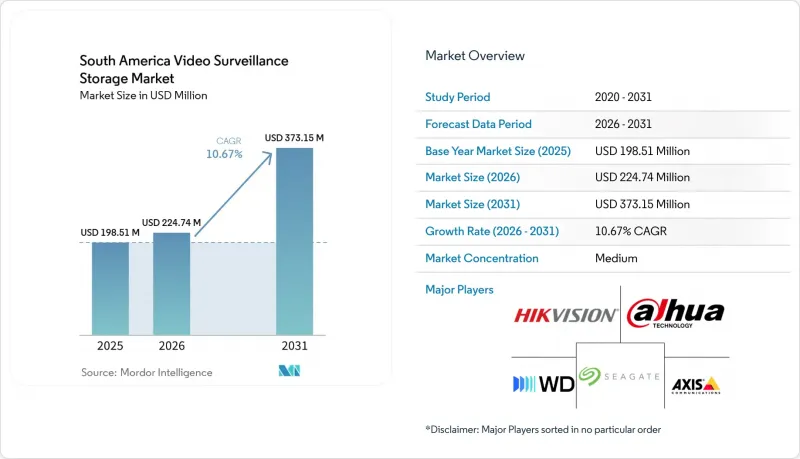
According to Mordor Intelligence, the South America video surveillance storage market size was valued at USD 198.51 million in 2025 and estimated to expand from USD 224.74 million in 2026 to reach USD 373.15 million by 2031, at a CAGR of 10.67% during the forecast period 2026-2031.
South America Video Surveillance Storage Market Trends and Insights
Expansion of Smart-City and Public-Safety Video Networks
Public safety programs are creating a sustained requirement for centralized recording and searchable archives across the South America video surveillance storage market. Rio de Janeiro's CIVITAS center raised its annual operating budget from BRL 16 million to BRL 180 million in 2026 and managed more than 10,000 monitoring devices. The city planned 6,000 city-owned super-cameras by the end of 2026, compared with 5,300 cameras at the June 2024 launch. These installations need storage that can support continuous recording, rapid retrieval, and system expansion without interrupting control-room operations. Medellin's planned C5i command center will combine cameras, automatic number-plate recognition readers, and IoT sensors under a unified dispatch platform. The South America video surveillance storage market benefits when such projects move from trial systems to permanent city infrastructure.
Migration From Analog Recording to IP and AI-Enabled Surveillance
The move from analog DVR systems to IP-based recording changes both the scale and character of storage demand. A 4K IP camera using H.265 encoding can generate 2 TB of raw video monthly during continuous recording, while AI functions add event images and searchable records. Replacing older equipment also requires sites to reconsider retention policies, network capacity, and the design of their recording platform. Seagate introduced its 32 TB SkyHawk AI drive in January 2026 for AI-enabled NVR systems that retain annotated footage. The drive supports more than 10,000 hours of AI-annotated video and has a workload rating 3 times that of standard surveillance drives. This replacement cycle supports demand in the South America video surveillance storage market because higher-resolution cameras require compatible recording and archive capacity.
High Infrastructure and Lifecycle Costs for Long-Term Video Retention
Long retention periods increase the total cost of surveillance systems because storage requirements rise with resolution and metadata use. Hardware costs can be difficult for municipal buyers to fund when surveillance upgrades compete with other public services. Many local governments continue to use hybrid DVR and analog systems because full replacement needs state or federal co-financing. Hyperconverged platforms can reduce management complexity, but they require a larger initial investment than a standard NVR refresh. This cost gap can delay adoption by public buyers with limited capital budgets. The South America video surveillance storage market therefore remains sensitive to financing structures and procurement timing.
Other drivers and restraints analyzed in the detailed report include:
- Rising Demand for High-Resolution and Continuous Video Retention
- Growth of Cloud and Hybrid Video Storage Among Multi-Site Organizations
- Bandwidth, Power Reliability, and Connectivity Gaps
For complete list of drivers and restraints, kindly check the Table Of Contents.
Segment Analysis
NVRs held 27.52% of the storage system segment in 2025, making them the established recording architecture for commercial and government sites. Their installed base reflects straightforward integration with IP cameras and broad availability through regional suppliers. Municipal agencies often favor NVRs because local partners can configure and support systems without extensive internal IT resources. NAS and DAS systems serve enterprise users that operate campuses or distributed locations. DVRs retain a limited role at public sites where capital constraints delay a complete IP transition.
Hyperconverged infrastructure-based surveillance storage is projected to expand at an 11.25% CAGR from 2026 to 2031. City-scale control rooms need combined processing and storage capacity for real-time analytics and continuous video recording. Pooling resources across nodes reduces the risk associated with a single appliance failure. Axis Communications introduced the AXIS S1228 AI-Optimized Server in June 2025 with 28 simultaneous stream licenses and 12 TB of local storage. The product illustrates how compute and recording functions are moving closer together in the South America video surveillance storage market.
Hardware accounted for 64.83% of the offering segment in 2025 because initial projects require drives, NVRs, servers, and storage enclosures. Hardware retained a substantial position as older DVR systems were replaced with IP-focused equipment. Government and enterprise buyers also need physical capacity at sites that cannot rely on continuous connectivity. Professional services support integration, commissioning, and capacity planning for larger deployments. These requirements keep equipment spending central even when operators introduce cloud tools.
Software and solutions is projected to expand at an 11.40% CAGR from 2026 to 2031. Video management platforms increasingly include AI-based search, cloud synchronization, and automated retention controls as standard functions. Managed services are relevant to financial services and retail organizations that lack dedicated security IT teams. Open platforms can support camera fleets that include equipment from several generations and different suppliers. This flexibility changes the South America video surveillance storage market by moving part of the customer relationship toward subscriptions, updates, and archive management.
On-premises deployment accounted for 61.36% of the market in 2025, supported by data control requirements and a large installed base of local recording systems. Government agencies frequently operate networks where local storage is a practical requirement rather than a preference. Unreliable connectivity in some municipalities also makes local recording essential for continuous capture. Organizations handling biometric imagery must consider rules governing sensitive personal data. These factors preserve a major role for local equipment in the South America video surveillance storage market.
Cloud and video surveillance as a service is projected to expand at an 11.19% CAGR from 2026 to 2031. Multi-site retailers, financial institutions, and transportation operators value centralized management without a large initial hardware purchase. Edge and on-device storage remain relevant for fleets, mines, and agricultural sites with intermittent connectivity. Hybrid systems pair local NVR caches with cloud upload for flagged events and longer archive periods. This model lets users retain operational control while extending access beyond the physical site.
Complete Report Scope:
- By Storage System
- Network Attached Storage
- Storage Area Network
- Direct Attached Storage
- Network Video Recorders
- Digital Video Recorders
- Hyperconverged Infrastructure-Based Surveillance Storage
- Other Storage Systems
- By Offering
- Hardware
- Software and Solutions
- Managed Services
- Professional Services
- By Deployment Mode
- On-Premises
- Cloud and Video Surveillance as a Service
- Edge and On-Device Storage
- Hybrid Storage
- By Storage Media
- Hard Disk Drives
- Solid-State Drives
- Hybrid Media Architectures
- By Storage Capacity
- Up to 1 Terabyte
- Above 1 Terabyte to 2 Terabytes
- Above 2 Terabytes to 4 Terabytes
- Above 4 Terabytes
- By Organization Size
- Small and Medium-Sized Enterprises
- Large Enterprises
- By End-User Vertical
- Government and Public Safety
- Banking, Financial Services, and Insurance
- Retail and Consumer Goods
- Transportation and Logistics
- Manufacturing and Industrial
- Healthcare and Life Sciences
- Energy and Utilities
- Education
- Residential and Multi-Unit Housing
- Mining and Remote Sites
- Media and Entertainment
- By Application
- Public Safety and Law Enforcement
- Traffic Monitoring and Automatic Number-Plate Recognition
- Retail Loss Prevention
- Perimeter and Intrusion Protection
- Industrial Safety and Process Monitoring
- Remote-Site and Mining Surveillance
- Residential Monitoring
- By Geography
- Brazil
- Argentina
- Colombia
- Rest of South America
List of Companies Covered in this Report:
- Western Digital Corporation
- Seagate Technology Holdings plc
- Toshiba Electronic Devices and Storage Corporation
- Hangzhou Hikvision Digital Technology Co., Ltd.
- Dahua Technology Co., Ltd.
- Axis Communications AB
- Hanwha Vision Co., Ltd.
- Synology Inc.
- QNAP Systems, Inc.
- VIVOTEK Inc.
- MOBOTIX AG
- i-PRO Co., Ltd.
- Milestone Systems A/S
- Genetec Inc.
- Verkada Inc.
- Avigilon Corporation
- Arecont Vision Costar, LLC
- March Networks Corporation
- GeoVision Inc.
- Uniview Technologies Co., Ltd.
- Tiandy Technologies Co., Ltd.
- Intelbras S.A. Industria de Telecomunicacao Eletronica Brasileira
- Infinova International, Inc.
- Pelco, Inc.
Additional Benefits:
- The market estimate (ME) sheet in Excel format
- 3 months of analyst support
TABLE OF CONTENTS
1 INTRODUCTION
- 1.1 Study Assumptions and Market Definition
- 1.2 Scope of the Study
2 RESEARCH METHODOLOGY
3 EXECUTIVE SUMMARY
4 MARKET LANDSCAPE
- 4.1 Market Overview
- 4.2 Impact of Macroeconomic Factors on the Market
- 4.3 Market Drivers
- 4.3.1 Expansion of Smart-City and Public-Safety Video Networks
- 4.3.2 Migration From Analog Recording to IP and AI-Enabled Surveillance
- 4.3.3 Rising Demand for High-Resolution and Continuous Video Retention
- 4.3.4 Growth of Cloud and Hybrid Video Storage Among Multi-Site Organizations
- 4.3.5 Local Data Processing for Connectivity-Constrained Surveillance Sites
- 4.3.6 Regional Data-Center Expansion Enabling Lower-Latency Video Storage
- 4.4 Market Restraints
- 4.4.1 High Infrastructure and Lifecycle Costs for Long-Term Video Retention
- 4.4.2 Bandwidth, Power Reliability, and Connectivity Gaps
- 4.4.3 Fragmented Privacy and Facial-Recognition Governance
- 4.4.4 Import Duties, Currency Volatility, and Replacement-Part Lead Times
- 4.5 Industry Value Chain Analysis
- 4.6 Regulatory Landscape
- 4.7 Technological Outlook
- 4.8 Porter's Five Forces Analysis
- 4.8.1 Bargaining Power of Suppliers
- 4.8.2 Bargaining Power of Buyers
- 4.8.3 Threat of New Entrants
- 4.8.4 Threat of Substitutes
- 4.8.5 Competitive Rivalry
5 MARKET SIZE AND GROWTH FORECASTS (VALUE)
- 5.1 By Storage System
- 5.1.1 Network Attached Storage
- 5.1.2 Storage Area Network
- 5.1.3 Direct Attached Storage
- 5.1.4 Network Video Recorders
- 5.1.5 Digital Video Recorders
- 5.1.6 Hyperconverged Infrastructure-Based Surveillance Storage
- 5.1.7 Other Storage Systems
- 5.2 By Offering
- 5.2.1 Hardware
- 5.2.2 Software and Solutions
- 5.2.3 Managed Services
- 5.2.4 Professional Services
- 5.3 By Deployment Mode
- 5.3.1 On-Premises
- 5.3.2 Cloud and Video Surveillance as a Service
- 5.3.3 Edge and On-Device Storage
- 5.3.4 Hybrid Storage
- 5.4 By Storage Media
- 5.4.1 Hard Disk Drives
- 5.4.2 Solid-State Drives
- 5.4.3 Hybrid Media Architectures
- 5.5 By Storage Capacity
- 5.5.1 Up to 1 Terabyte
- 5.5.2 Above 1 Terabyte to 2 Terabytes
- 5.5.3 Above 2 Terabytes to 4 Terabytes
- 5.5.4 Above 4 Terabytes
- 5.6 By Organization Size
- 5.6.1 Small and Medium-Sized Enterprises
- 5.6.2 Large Enterprises
- 5.7 By End-User Vertical
- 5.7.1 Government and Public Safety
- 5.7.2 Banking, Financial Services, and Insurance
- 5.7.3 Retail and Consumer Goods
- 5.7.4 Transportation and Logistics
- 5.7.5 Manufacturing and Industrial
- 5.7.6 Healthcare and Life Sciences
- 5.7.7 Energy and Utilities
- 5.7.8 Education
- 5.7.9 Residential and Multi-Unit Housing
- 5.7.10 Mining and Remote Sites
- 5.7.11 Media and Entertainment
- 5.8 By Application
- 5.8.1 Public Safety and Law Enforcement
- 5.8.2 Traffic Monitoring and Automatic Number-Plate Recognition
- 5.8.3 Retail Loss Prevention
- 5.8.4 Perimeter and Intrusion Protection
- 5.8.5 Industrial Safety and Process Monitoring
- 5.8.6 Remote-Site and Mining Surveillance
- 5.8.7 Residential Monitoring
- 5.9 By Geography
- 5.9.1 Brazil
- 5.9.2 Argentina
- 5.9.3 Colombia
- 5.9.4 Rest of South America
6 COMPETITIVE LANDSCAPE
- 6.1 Market Concentration
- 6.2 Strategic Moves
- 6.3 Market Share Analysis
- 6.4 Company Profiles (includes Global Level Overview, Market Level Overview, Core Segments, Financials as available, Strategic Information, Market Rank/Share, Products and Services, Recent Developments)
- 6.4.1 Western Digital Corporation
- 6.4.2 Seagate Technology Holdings plc
- 6.4.3 Toshiba Electronic Devices and Storage Corporation
- 6.4.4 Hangzhou Hikvision Digital Technology Co., Ltd.
- 6.4.5 Dahua Technology Co., Ltd.
- 6.4.6 Axis Communications AB
- 6.4.7 Hanwha Vision Co., Ltd.
- 6.4.8 Synology Inc.
- 6.4.9 QNAP Systems, Inc.
- 6.4.10 VIVOTEK Inc.
- 6.4.11 MOBOTIX AG
- 6.4.12 i-PRO Co., Ltd.
- 6.4.13 Milestone Systems A/S
- 6.4.14 Genetec Inc.
- 6.4.15 Verkada Inc.
- 6.4.16 Avigilon Corporation
- 6.4.17 Arecont Vision Costar, LLC
- 6.4.18 March Networks Corporation
- 6.4.19 GeoVision Inc.
- 6.4.20 Uniview Technologies Co., Ltd.
- 6.4.21 Tiandy Technologies Co., Ltd.
- 6.4.22 Intelbras S.A. Industria de Telecomunicacao Eletronica Brasileira
- 6.4.23 Infinova International, Inc.
- 6.4.24 Pelco, Inc.
7 MARKET OPPORTUNITIES AND FUTURE OUTLOOK
- 7.1 White-Space and Unmet-Need Assessment

