PUBLISHER: Mordor Intelligence | PRODUCT CODE: 2154986

PUBLISHER: Mordor Intelligence | PRODUCT CODE: 2154986
Tenofovir Disoproxil Fumarate - Market Share Analysis, Industry Trends & Statistics, Growth Forecasts (2026 - 2031)
According to Mordor Intelligence, the tenofovir disoproxil fumarate market size is projected to be USD 4.31 billion in 2025, USD 4.53 billion in 2026, and reach USD 5.95 billion by 2031, growing at a CAGR of 5.61% from 2026 to 2031.
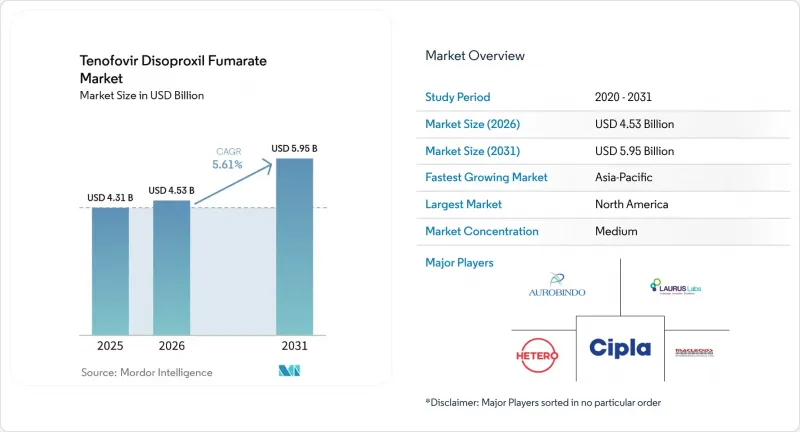
Global Tenofovir Disoproxil Fumarate Market Trends and Insights
Persistent HIV Treatment Demand
The tenofovir disoproxil fumarate market benefits from the continuing expansion of antiretroviral treatment coverage. By the end of 2025, 32.1 million people were accessing ART, compared with 7.6 million in 2010. WHO treatment recommendations support tenofovir-containing first-line regimens for adults and adolescents. This keeps medicine purchasing linked to the number of people enrolled in treatment programs. The 4.9 million people who knew their status but were not on treatment represent a continuing treatment-access gap. Multi-year procurement arrangements can give qualified manufacturers clearer volume visibility than short-term purchases.
Hepatitis B Treatment Expansion
Chronic hepatitis B adds a second long-duration source of demand for the tenofovir disoproxil fumarate market. Treatment coverage remained limited, with an estimated 2.2% of people with chronic hepatitis B receiving treatment in 2025. Updated 2025 clinical guidance broadened the treatment discussion for several patient groups. EASL continued to recognize TDF as a preferred first-line nucleos(t)ide analogue in pregnancy, HIV coinfection, and hepatocellular carcinoma settings. China, Southeast Asia, and Sub-Saharan Africa have substantial unmet diagnosis and treatment needs. Wider surveillance and treatment access can increase demand for qualified oral formulations.
Generic Price Compression After Patent Expiry
Generic price competition limits revenue expansion in the tenofovir disoproxil fumarate market even when treatment volumes increase. Large institutional buyers use competitive tenders to seek lower medicine prices. Lower prices favor producers with integrated active ingredient and finished-dose operations. Smaller suppliers can face difficulty maintaining margins when they lack comparable scale. Procurement agencies continue to use supplier qualification processes to reduce single-source risk. The result is pressure for manufacturers to combine price discipline with dependable supply.
Other drivers and restraints analyzed in the detailed report include:
- Public Procurement and Donor Programs
- HIV Pre-Exposure Prophylaxis Adoption
- Substitution Toward Tenofovir Alafenamide
For complete list of drivers and restraints, kindly check the Table Of Contents.
Segment Analysis
Generic formulations held 75.61% of the tenofovir disoproxil fumarate market share in 2025. They are also the fastest-growing product type, with a projected 5.91% CAGR through 2031. Their position reflects post-patent competition and broad acceptance of qualified generic products. WHO prequalification remains an important requirement for many multilateral procurement channels. The United States FDA approvals also support access to regulated purchasing programs. These requirements favor manufacturers with stable quality systems and established documentation.
Branded products retain a role in some higher-income private-pay channels. Gilead's Viread and Truvada remain relevant reference products in these settings. The branded portfolio has faced continuing share pressure as generic products become more widely available. Manufacturers with control overactive ingredients and finished doses can better manage cost pressure. The February 2026 reconfirmation of Styrax Pharma's TDF API prequalification illustrates the continuing supplier qualification cycle. The tenofovir disoproxil fumarate industry, therefore, places lasting value on regulatory compliance and integrated manufacturing.
HIV treatment represented 48.47% of the tenofovir disoproxil fumarate market size in 2025. Lifelong ART use gives this indication a recurring base of medicine demand. TDF-containing regimens remain widely used within first-line treatment programs. Program enrollment increases the number of patients requiring ongoing medicine supply. Treatment demand is especially important in countries using TLD as a national protocol. Public procurement planning, therefore, remains closely connected to patient coverage targets.
HIV pre-exposure prophylaxis is expected to grow at a 9.28% CAGR through 2031. Its growth reflects broader use of oral prevention services across Africa, Europe, and North America. Chronic hepatitis B remains under-treated despite substantial clinical need. Broader treatment criteria can increase the number of people diagnosed who become eligible for care. TDF also has a protected role in some HIV and hepatitis B coinfection settings. The tenofovir disoproxil fumarate market consequently serves treatment and prevention needs that develop at different rates.
Complete Report Scope:
- By Product Type
- Branded Formulations
- Generic Formulations
- By Indication
- HIV Treatment
- HIV Pre-Exposure Prophylaxis
- Chronic Hepatitis B Treatment
- HIV and Hepatitis B Coinfection Treatment
- By Patient Population
- HIV-Positive Adults
- HIV-Positive Adolescents
- HIV-Exposed Newborns and Infants
- Chronic Hepatitis B Adults
- Chronic Hepatitis B Adolescents and Children
- By Dose Frequency
- Once-Daily
- Twice-Daily
- By End User
- Hospitals
- Specialty Clinics
- Community Health Centers
- Other End Users
- By Distribution Channel
- Hospital Pharmacies
- Retail Pharmacies
- Online Pharmacies
- Government and NGO Procurement
- By Geography
- North America
- United States
- Canada
- Mexico
- Europe
- Germany
- United Kingdom
- France
- Italy
- Spain
- Rest of Europe
- Asia-Pacific
- China
- Japan
- India
- Australia
- South Korea
- Rest of Asia-Pacific
- Middle East and Africa
- GCC
- South Africa
- Rest of Middle East and Africa
- South America
- Brazil
- Argentina
- Rest of South America
- North America
Geography Analysis
North America held 41.85% of the tenofovir disoproxil fumarate market share in 2025. The region combines generic and branded PrEP purchasing with broad insurance coverage. U.S. The United States PrEP use reached 644,170 people in 2025. The 10% increase was the smallest growth rate in 5 years. Access gaps remained among Black, Hispanic, and Southern populations. Online pharmacies and telehealth services are expanding alongside institutional dispensing. Canada and Mexico add demand through national HIV programs and public purchasing.
Europe remained the second-largest regional position for the tenofovir disoproxil fumarate market. Germany, the United Kingdom, France, Italy, and Spain are major revenue contributors. Safety monitoring expectations can favor companies with established post-approval systems. TDF use for hepatitis B differs across national settings. South America adds demand through sovereign medicine purchasing. Brazil centrally procures TLD and other TDF-based combinations for its national HIV program. This supports an ongoing public-sector demand base across the region.
Asia-Pacific is forecast to grow at a 7.56% CAGR through 2031. In 2024, 1 in 4 new global HIV infections occurred in the Asia-Pacific region, while 69% of people living with HIV were on treatment. India combines substantial domestic need with a major pharmaceutical manufacturing role. China's chronic hepatitis B burden supports continuing demand for nucleos(t)ide analog treatment. Sub-Saharan Africa remains central to TDF-based ART procurement through PEPFAR and Global Fund channels. South Africa and Gulf Cooperation Council countries are additional regional demand corridors. African manufacturing development can gradually reduce reliance on imported supplies.
- Anhui Biochem Pharmaceutical Co., Ltd.
- Aurobindo Pharma
- Cipla
- Dr. Reddy's Laboratories Limited
- Emcure Pharmaceuticals Limited
- Gilead Sciences
- Hetero Labs Limited
- Laurus Labs Limited
- Lupin
- Macleods Pharmaceuticals Limited
- Qilu Pharmaceutical Co., Ltd.
- Sandoz Group AG
- Shanghai Desano Chemical Pharmaceutical Co., Ltd.
- Strides Pharma Science
- Sun Pharmaceuticals Industries
- Teva Pharmaceutical Industries
- Torrent Pharmaceuticals Limited
- Viatris
- Zhejiang Huahai Pharmaceutical Co., Ltd.
- Zydus Lifesciences Limited
Additional Benefits:
- The market estimate (ME) sheet in Excel format
- 3 months of analyst support
TABLE OF CONTENTS
1 Introduction
- 1.1 Study Assumptions & Market Definition
- 1.2 Scope of the Study
2 Research Methodology
3 Executive Summary
4 Market Landscape
- 4.1 Market Overview
- 4.2 Market Drivers
- 4.2.1 Persistent HIV Treatment Demand
- 4.2.2 Chronic Hepatitis B Treatment Expansion
- 4.2.3 Public Procurement and Donor-Funded Antiretroviral Programs
- 4.2.4 HIV Pre-Exposure Prophylaxis Adoption
- 4.2.5 Fixed-Dose Combination Procurement Alignment
- 4.2.6 India-Centered API and Formulation Export Hubs
- 4.3 Market Restraints
- 4.3.1 Generic Price Compression After Patent Expiry
- 4.3.2 Substitution Toward Tenofovir Alafenamide
- 4.3.3 Concentrated Tender Supply and Single-Source Exposure
- 4.3.4 Renal and Bone Monitoring Requirements
- 4.4 Value-Chain Analysis
- 4.5 Regulatory Landscape
- 4.6 Technological Outlook
- 4.7 Porter's Five Forces Analysis
- 4.7.1 Threat of New Entrants
- 4.7.2 Bargaining Power of Suppliers
- 4.7.3 Bargaining Power of Buyers
- 4.7.4 Threat of Substitutes
- 4.7.5 Competitive Rivalry
5 Market Size & Growth Forecasts (Value in USD)
- 5.1 By Product Type
- 5.1.1 Branded Formulations
- 5.1.2 Generic Formulations
- 5.2 By Indication
- 5.2.1 HIV Treatment
- 5.2.2 HIV Pre-Exposure Prophylaxis
- 5.2.3 Chronic Hepatitis B Treatment
- 5.2.4 HIV and Hepatitis B Coinfection Treatment
- 5.3 By Patient Population
- 5.3.1 HIV-Positive Adults
- 5.3.2 HIV-Positive Adolescents
- 5.3.3 HIV-Exposed Newborns and Infants
- 5.3.4 Chronic Hepatitis B Adults
- 5.3.5 Chronic Hepatitis B Adolescents and Children
- 5.4 By Dose Frequency
- 5.4.1 Once-Daily
- 5.4.2 Twice-Daily
- 5.5 By End User
- 5.5.1 Hospitals
- 5.5.2 Specialty Clinics
- 5.5.3 Community Health Centers
- 5.5.4 Other End Users
- 5.6 By Distribution Channel
- 5.6.1 Hospital Pharmacies
- 5.6.2 Retail Pharmacies
- 5.6.3 Online Pharmacies
- 5.6.4 Government and NGO Procurement
- 5.7 By Geography
- 5.7.1 North America
- 5.7.1.1 United States
- 5.7.1.2 Canada
- 5.7.1.3 Mexico
- 5.7.2 Europe
- 5.7.2.1 Germany
- 5.7.2.2 United Kingdom
- 5.7.2.3 France
- 5.7.2.4 Italy
- 5.7.2.5 Spain
- 5.7.2.6 Rest of Europe
- 5.7.3 Asia-Pacific
- 5.7.3.1 China
- 5.7.3.2 Japan
- 5.7.3.3 India
- 5.7.3.4 Australia
- 5.7.3.5 South Korea
- 5.7.3.6 Rest of Asia-Pacific
- 5.7.4 Middle East and Africa
- 5.7.4.1 GCC
- 5.7.4.2 South Africa
- 5.7.4.3 Rest of Middle East and Africa
- 5.7.5 South America
- 5.7.5.1 Brazil
- 5.7.5.2 Argentina
- 5.7.5.3 Rest of South America
- 5.7.1 North America
6 Competitive Landscape
- 6.1 Market Concentration
- 6.2 Market Share Analysis
- 6.3 Company Profiles {(includes Global level Overview, Market level overview, Core Segments, Financials as available, Strategic Information, Market Rank/Share for key companies, Products & Services, and Recent Developments)}
- 6.3.1 Anhui Biochem Pharmaceutical Co., Ltd.
- 6.3.2 Aurobindo Pharma Limited
- 6.3.3 Cipla Limited
- 6.3.4 Dr. Reddy's Laboratories Limited
- 6.3.5 Emcure Pharmaceuticals Limited
- 6.3.6 Gilead Sciences, Inc.
- 6.3.7 Hetero Labs Limited
- 6.3.8 Laurus Labs Limited
- 6.3.9 Lupin Limited
- 6.3.10 Macleods Pharmaceuticals Limited
- 6.3.11 Qilu Pharmaceutical Co., Ltd.
- 6.3.12 Sandoz Group AG
- 6.3.13 Shanghai Desano Chemical Pharmaceutical Co., Ltd.
- 6.3.14 Strides Pharma Science Limited
- 6.3.15 Sun Pharmaceutical Industries Limited
- 6.3.16 Teva Pharmaceutical Industries Ltd.
- 6.3.17 Torrent Pharmaceuticals Limited
- 6.3.18 Viatris Inc.
- 6.3.19 Zhejiang Huahai Pharmaceutical Co., Ltd.
- 6.3.20 Zydus Lifesciences Limited
7 Market Opportunities & Future Outlook
- 7.1 White-space & unmet-need assessment

