PUBLISHER: Mordor Intelligence | PRODUCT CODE: 2154991

PUBLISHER: Mordor Intelligence | PRODUCT CODE: 2154991
Smart City Data Exchange Platforms - Market Share Analysis, Industry Trends & Statistics, Growth Forecasts (2026 - 2031)
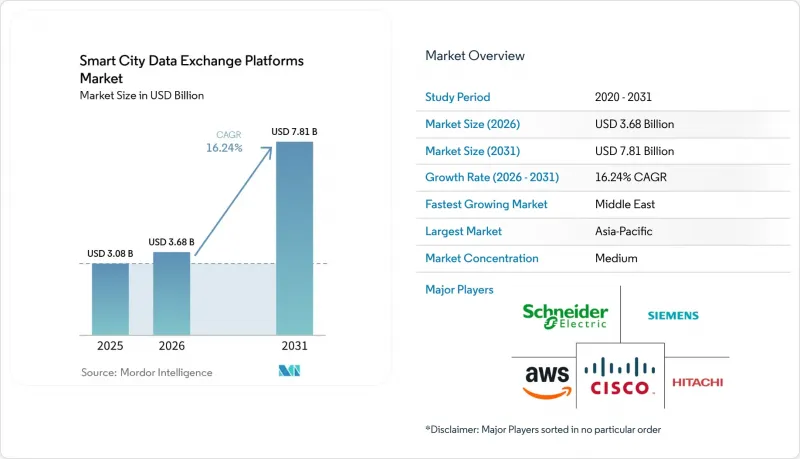
According to Mordor Intelligence, the smart city data exchange platforms market size is projected to be USD 3.08 billion in 2025, USD 3.68 billion in 2026, and reach USD 7.81 billion by 2031, growing at a CAGR of 16.24% from 2026 to 2031.
Global Smart City Data Exchange Platforms Market Trends and Insights
Rising Interoperability Demand Across Municipal Data Silos
Municipal agencies in transport, utilities, public safety, and planning still use systems that cannot readily exchange data. This fragmentation creates a direct need for platforms that establish shared data formats, access rules, and operating processes. A 2026 European study on the DS4SSCC initiative identified modular architecture, common governance, semantic alignment, procurement clauses, and capacity building as core conditions for interoperability by design. ETSI updated the NGSI-LD API specification in July 2025 to support distributed environments and digital twin integration. The smart city data exchange platforms market benefits because a city adopting a standards-based exchange layer also needs governance design, semantic alignment, and continuing operational support. These needs can extend supplier relationships beyond the initial platform deployment.
Expansion of Cross-Sector City Data Sharing Programs
Data sharing among public agencies, utilities, and mobility operators is moving beyond limited pilots into larger operating programs. India's Intelligent Universal Data Exchange, or IUDX, was deployed in 55 smart cities by April 2026 and supported real-time data flows for mobility, utilities, environmental monitoring, and public services. The platform uses a governed design intended to preserve ownership and privacy through confidential computing and secure enclaves. In April 2026, ONESTRUCTION and DataKaveri signed an agreement to integrate IFC-compliant openBIM construction data with IUDX for urban planning and digital twin work. Representatives from Japanese and Indian ministries attended the signing, showing public support for the collaboration. The smart city data exchange platforms market can benefit when city platforms connect to broader cross-border public data programs.
Fragmented Municipal Procurement and Long Sales Cycles
Municipal procurement remains a significant barrier even when a city has the technical case for a data exchange platform. Annual budgets are commonly held by separate departments, making it difficult to structure integrated multiyear contracts. Cross-agency programs also require executive backing and formal agreements on roles, spending, and access rights. The issue becomes more complex when cities move from centralized management to federated governance. Vendors may need to negotiate separate liability and indemnity terms for each participating organization. These lengthy negotiations consume pre-sale technical resources and delay revenue from the smart city data exchange platforms market.
Other drivers and restraints analyzed in the detailed report include:
- Increasing Open API and Open Standards Adoption
- Scaling Real-Time Urban Operations and Command Centers
- Legacy IT and OT Integration Complexity
For complete list of drivers and restraints, kindly check the Table Of Contents.
Segment Analysis
Interoperability and Integration Platforms accounted for 25.59% of the smart city data exchange platforms market share in 2025. The segment addresses the fundamental need to connect traffic management, utility SCADA, emergency dispatch, and building systems through a shared semantic and governance framework. European procurement requirements increasingly reference interoperability principles and the NGSI-LD API. These requirements support adoption among cities that need common exchange layers before deploying more advanced applications.
Digital Twin-Enabled Data Exchange Platforms are projected to grow at a CAGR of 18.71% from 2026 to 2031. European public programs and sovereign infrastructure investments in the Middle East support their adoption. The TWINVERSE project includes 26 partners across seven European countries and works with five EU Mission Cities, including Milan and Cork. The project generates demand for exchange infrastructure that enables local digital twins to operate across organizational boundaries. ISO 37187:2026 guides data exchange through City Information Modeling platforms. It covers integration across GIS, BIM, IoT, and business data. This guidance strengthens the case for Digital Twin-Enabled platforms in tenders that reference international standards. The segment also benefits when city developers require simulation tools before constructing or operating assets.
Cloud deployment accounted for 46.72% of the smart city data exchange platforms market size in 2025 and is projected to grow at a CAGR of 19.22% from 2026 to 2031. Cloud-native platforms provide cities with flexible capacity, regular security updates, and vendor-managed compliance capabilities. These features are particularly important for smaller municipalities with limited internal technology teams. IBM Consulting introduced its GICA solution in November 2025 using AWS, FIWARE's Garnet Framework, and NGSI-LD context management. The offering demonstrates how managed services can package smart city standards into a ready-to-use platform. This approach benefits the Smart City Data Exchange Platforms Market by reducing the technical burden of connecting multiple municipal systems. It can also support consistent maintenance across a distributed user base.
On-premise deployment remains relevant in jurisdictions where regulations require the processing of sensitive information within national borders. Local hosting gives public authorities more direct control over security, access, and data location. Hybrid models combine this local control with cloud capacity for analytics and artificial intelligence workloads. This approach allows sensitive operational data to remain local while using centralized resources for less sensitive processing. Sovereign data requirements can influence platform architecture before a city evaluates platform features. They can also increase the value of implementation projects, as suppliers must design and operate both local and cloud components. The smart city data exchange platforms market must support these varied requirements rather than treat cloud adoption as a single replacement path. Platforms that provide clear control over data movement can be better positioned in jurisdictions with stringent public-sector requirements.
Complete Report Scope:
- By Platform Type
- Open Data Exchange Platforms
- Interoperability and Integration Platforms
- Data Marketplace and Monetization Platforms
- Command, Control, and Urban Operations Platforms
- Digital Twin-Enabled Data Exchange Platforms
- By Deployment Model
- Cloud
- On-Premise
- Hybrid
- By Data Governance Model
- Centralized
- Federated
- Data Space-Based
- By End User
- Municipal Governments
- Transport Authorities
- Utilities
- Public Safety Agencies
- Urban Developers and System Integrators
- By Geography
- North America
- United States
- Canada
- Mexico
- South America
- Brazil
- Argentina
- Rest of South America
- Europe
- Germany
- United Kingdom
- France
- Rest of Europe
- Asia-Pacific
- China
- Japan
- India
- South Korea
- Rest of Asia-Pacific
- Middle East
- Saudi Arabia
- United Arab Emirates
- Rest of the Middle East
- Africa
- South Africa
- Nigeria
- Rest of Africa
- North America
Geography Analysis
Asia-Pacific is projected to account for 33.29% of the smart city data exchange platforms market in 2025. The region benefits from national exchange programs that span connected urban networks rather than from isolated city-level pilots. Shenzhen Data Exchange is expected to operate a national-level data trading platform and enter into an agreement with Zetrix AI in May 2026 to support ASEAN-China cross-border data activities. This initiative highlights the scale achievable when public institutions support data exchange infrastructure. India's IUDX is expected to be deployed across 55 smart cities by April 2026. Its India-Japan agreement is expected to incorporate construction data and urban artificial intelligence workflows. South Korea and Japan also maintain mature smart city programs supported by domestic technology suppliers. Singapore's planned command center, expected in August 2026, indicates continued regional investment in integrated urban operations.
Europe is expected to rank as the second-largest region in the smart city data exchange platforms market. Its regulatory environment increasingly directs public procurement toward interoperable platform architectures. The Interoperable Europe Board is scheduled to adopt the 2026 Interoperable Europe Agenda on February 3, 2026. The agenda identifies priorities, including semantic registries, API standardization, reusable vocabularies, and DCAT-AP solutions. The Interoperable Europe Act also establishes requirements for interoperability assessments in relevant digital public services. GDPR requirements support governance models that manage cross-border data sharing through clear controls. Germany's municipal Gaia-X initiatives connect cities such as Hamburg, Darmstadt, and Wolfsburg through a cloud-based data platform.
The Middle East is projected to expand at a CAGR of 19.11% from 2026 to 2031. Large-scale infrastructure programs, sovereign data requirements, and public investment in artificial intelligence capabilities support regional growth. These factors create demand for platforms that connect government services, urban operations, and infrastructure operators under defined data-sharing rules. Local data-hosting requirements may favor hybrid or locally controlled deployments. City-scale developments also require integrated mobility, energy, water, and building data from their earliest stages. North America remains active in command center and interoperability projects, as demonstrated by the Atlanta deployment. South America and Africa remain at earlier stages of development, although established command center models are emerging as regional reference points. Rio de Janeiro's COR center manages 1,200 urban incidents each month through integrated sensor, camera, and agency data, illustrating an operating model that other cities can evaluate.
- Siemens AG
- International Business Machines Corporation
- Cisco Systems, Inc.
- Microsoft Corporation
- Oracle Corporation
- Amazon Web Services, Inc.
- Schneider Electric SE
- SAP SE
- Nokia Corporation
- Huawei Technologies Co., Ltd.
- Ericsson AB
- Hitachi, Ltd.
- Bentley Systems, Incorporated
- ESRI, Inc.
- FIWARE Foundation e.V.
- Dawex Systems
- Monotch B.V.
- Cityzenith, Inc.
- Pangea Data Limited
- NEC Corporation
- Tata Communications Limited
- Advantech Co., Ltd.
Additional Benefits:
- The market estimate (ME) sheet in Excel format
- 3 months of analyst support
TABLE OF CONTENTS
1 INTRODUCTION
- 1.1 Study Assumptions and Market Definition
- 1.2 Scope of the Study
2 RESEARCH METHODOLOGY
3 EXECUTIVE SUMMARY
4 MARKET LANDSCAPE
- 4.1 Market Overview
- 4.2 Market Drivers
- 4.2.1 Rising Interoperability Demand Across Municipal Data Silos
- 4.2.2 Expansion of Cross-Sector City Data Sharing Programs
- 4.2.3 Increasing Open API and Open Standards Adoption
- 4.2.4 Scaling Real-Time Urban Operations and Command Centers
- 4.2.5 Privacy-First Data Collaboration Models Gaining Traction
- 4.2.6 Growing Demand for Federated Data Spaces and Sovereign Data Exchange
- 4.3 Market Restraints
- 4.3.1 Fragmented Municipal Procurement and Long Sales Cycles
- 4.3.2 Legacy IT and OT Integration Complexity
- 4.3.3 Limited Data Governance Maturity in Smaller Cities
- 4.3.4 Cybersecurity and Liability Concerns in Multi-Stakeholder Data Sharing
- 4.4 Industry Value Chain Analysis
- 4.5 Regulatory Landscape
- 4.6 Technological Outlook
- 4.7 Porter's Five Forces Analysis
- 4.7.1 Bargaining Power of Buyers
- 4.7.2 Bargaining Power of Suppliers
- 4.7.3 Threat of New Entrants
- 4.7.4 Threat of Substitutes
- 4.7.5 Competitive Rivalry
- 4.8 Impact of Macroeconomic Factors on the Market
5 MARKET SIZE AND GROWTH FORECASTS (VALUE)
- 5.1 By Platform Type
- 5.1.1 Open Data Exchange Platforms
- 5.1.2 Interoperability and Integration Platforms
- 5.1.3 Data Marketplace and Monetization Platforms
- 5.1.4 Command, Control, and Urban Operations Platforms
- 5.1.5 Digital Twin-Enabled Data Exchange Platforms
- 5.2 By Deployment Model
- 5.2.1 Cloud
- 5.2.2 On-Premise
- 5.2.3 Hybrid
- 5.3 By Data Governance Model
- 5.3.1 Centralized
- 5.3.2 Federated
- 5.3.3 Data Space-Based
- 5.4 By End User
- 5.4.1 Municipal Governments
- 5.4.2 Transport Authorities
- 5.4.3 Utilities
- 5.4.4 Public Safety Agencies
- 5.4.5 Urban Developers and System Integrators
- 5.5 By Geography
- 5.5.1 North America
- 5.5.1.1 United States
- 5.5.1.2 Canada
- 5.5.1.3 Mexico
- 5.5.2 South America
- 5.5.2.1 Brazil
- 5.5.2.2 Argentina
- 5.5.2.3 Rest of South America
- 5.5.3 Europe
- 5.5.3.1 Germany
- 5.5.3.2 United Kingdom
- 5.5.3.3 France
- 5.5.3.4 Rest of Europe
- 5.5.4 Asia-Pacific
- 5.5.4.1 China
- 5.5.4.2 Japan
- 5.5.4.3 India
- 5.5.4.4 South Korea
- 5.5.4.5 Rest of Asia-Pacific
- 5.5.5 Middle East
- 5.5.5.1 Saudi Arabia
- 5.5.5.2 United Arab Emirates
- 5.5.5.3 Rest of the Middle East
- 5.5.6 Africa
- 5.5.6.1 South Africa
- 5.5.6.2 Nigeria
- 5.5.6.3 Rest of Africa
- 5.5.1 North America
6 COMPETITIVE LANDSCAPE
- 6.1 Market Concentration
- 6.2 Strategic Moves
- 6.3 Market Share Analysis
- 6.4 Company Profiles (includes Global Level Overview, Market Level Overview, Core Segments, Financials as available, Strategic Information, Market Rank/Share, Products and Services, Recent Developments)
- 6.4.1 Siemens AG
- 6.4.2 International Business Machines Corporation
- 6.4.3 Cisco Systems, Inc.
- 6.4.4 Microsoft Corporation
- 6.4.5 Oracle Corporation
- 6.4.6 Amazon Web Services, Inc.
- 6.4.7 Schneider Electric SE
- 6.4.8 SAP SE
- 6.4.9 Nokia Corporation
- 6.4.10 Huawei Technologies Co., Ltd.
- 6.4.11 Ericsson AB
- 6.4.12 Hitachi, Ltd.
- 6.4.13 Bentley Systems, Incorporated
- 6.4.14 ESRI, Inc.
- 6.4.15 FIWARE Foundation e.V.
- 6.4.16 Dawex Systems
- 6.4.17 Monotch B.V.
- 6.4.18 Cityzenith, Inc.
- 6.4.19 Pangea Data Limited
- 6.4.20 NEC Corporation
- 6.4.21 Tata Communications Limited
- 6.4.22 Advantech Co., Ltd.
7 MARKET OPPORTUNITIES AND FUTURE OUTLOOK
- 7.1 White-Space and Unmet-Need Assessment

