PUBLISHER: Mordor Intelligence | PRODUCT CODE: 2155006

PUBLISHER: Mordor Intelligence | PRODUCT CODE: 2155006
Industrial Vision System Integration Services - Market Share Analysis, Industry Trends & Statistics, Growth Forecasts (2026 - 2031)
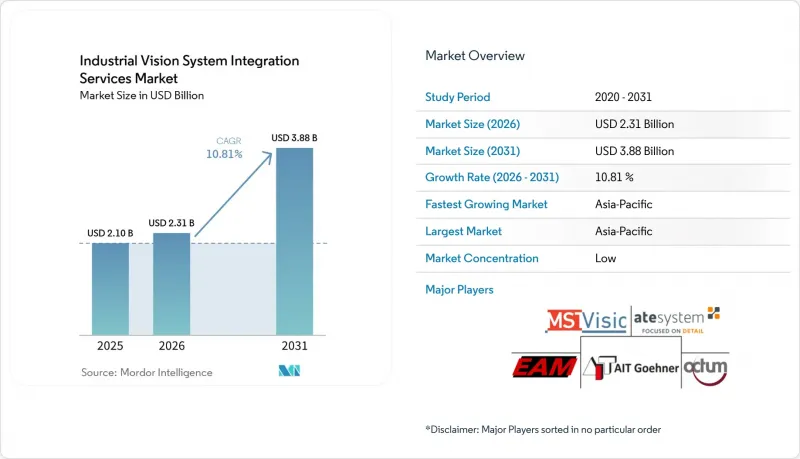
According to Mordor Intelligence, the industrial vision system integration services market size was valued at USD 2.10 billion in 2025 and is estimated to grow from USD 2.31 billion in 2026 to reach USD 3.88 billion by 2031, at a CAGR of 10.81% during the forecast period (2026-2031).
Global Industrial Vision System Integration Services Market Trends and Insights
Zero-Defect Manufacturing and Automated Quality Assurance
Zero-defect production has become a contractual requirement for many Tier 1 automotive and aerospace suppliers. This requirement places automated visual inspection within the core design of closed-loop quality systems. A 2026 systematic review found that deep-learning machine vision can recognize objects under changing production conditions, including vibration, dust, and uneven lighting. Rule-based systems are less adaptable when those conditions change during high-speed operations. The industrial vision system integration services market benefits because manufacturers need expertise to connect inspection data with production controls and quality records. AIAG guidance on measurement system analysis also gives integrators a documentation role when automotive suppliers validate AI-supported quality systems. Inspection images can become a useful operating asset after the initial project is complete. When linked to manufacturing execution systems, image records can help teams identify repeated defect patterns before they become broader quality failures. That requirement changes the scope of work from a camera installation into a continuing data and process-control service. The industrial vision system integration services market, therefore, favors providers that can maintain models, manage image data, and support quality teams after commissioning. Zero-defect requirements also make project timing less dependent on general equipment spending cycles. Suppliers can postpone some factory investments, but they have less room to postpone controls that support contractual quality performance.
Vision-Guided Robotics and Flexible Automation
Vision-guided robotics is extending beyond high-volume automotive work into manufacturing settings with frequent product changes and lower production volumes. The Association for Advancing Automation reported 36,766 robot orders in North America during 2025, valued at USD 2.25 billion. These environments require a system to locate components despite changing orientation, bin location, or surface variation. The industrial vision system integration services market gains from the additional work needed to connect cameras, robot controls, and production safety systems. 3D structured-light and depth-sensing equipment also require more careful design than fixed-coordinate robotic applications. A vision-to-robot interface often requires customized communication and motion logic for each production line. Integrators with libraries that support several robot brands can reduce repetitive engineering work and improve project delivery speed. KUKA describes AI-based vision tools for 2D and 3D image processing in robotic systems, showing the wider shift toward machine perception in automation. The industrial vision system integration services market has room for providers that can make these tools work safely in mixed production environments. European safety and AI rules also increase the value of suppliers that can prepare clear technical records for autonomous systems.
High Integration Complexity Across Legacy Production Assets
Brownfield factories create different technical and commercial conditions from new production sites. Older programmable logic controllers, conveyor systems, and human-machine interfaces may not use the communication methods expected by current vision platforms. The industrial vision system integration services market must address interface work that may not be visible during early project scoping. Multi-vendor production lines can require separate driver stacks and safety checks for equipment from several manufacturers. These discoveries add labor hours during deployment and can reduce margins on fixed-price contracts. Detailed communication mapping before equipment procurement can help reduce later disruption. The work must identify controls, safety logic, available downtime, and data interfaces across the complete line. The industrial vision system integration services market can respond with structured brownfield assessments and managed upgrade services. Such services can provide regular software updates and algorithm retraining when product mixes change. The restraint remains material because retrofit installations often need to fit into brief planned shutdowns, leaving little flexibility when unexpected compatibility issues appear.
Other drivers and restraints analyzed in the detailed report include:
- Artificial Intelligence and Deep-Learning Inspection
- Traceability Requirements Across Regulated Manufacturing
- Shortage of Qualified Vision and Automation Specialists
For complete list of drivers and restraints, kindly check the Table Of Contents.
Segment Analysis
Software, algorithm, and controls integration is projected to expand at a 12.34% CAGR through 2031, making it the fastest-expanding service type. System design and engineering held 25.45% of the industrial vision system integration services market share in 2025. Design work remains essential because every installation needs a feasibility review, optics selection, lighting design, and communication plan. These decisions determine whether an inspection system can meet both accuracy and cycle-time requirements. Demand for software-related work is supported by the need to train models using a manufacturer's own defect patterns.
Cognex's OneVision environment shows how some parts of AI development are becoming more standardized. Standard tools can simplify routine configuration, but custom models still require significant technical work. System installation and commissioning services remain closely tied to new-factory schedules. Testing, validation, and calibration are important where regulated manufacturing requires repeatable evidence of performance. Maintenance, support, and upgrades are becoming recurring activities because models need retraining after products or production conditions change. Providers with ongoing software revenue may have a different commercial profile from those that rely largely on one-time hardware margins.
New system integration accounted for 64.78% of revenue in 2025, supported by factory construction in North America and Asia-Pacific. Retrofit and modernization is forecast to expand at a 12.78% CAGR through 2031. New sites can incorporate vision equipment and data connections during the initial line design. This reduces some integration barriers compared with modifying established equipment. The industrial vision system integration services market size for retrofit work is supported by legacy inspection equipment that is approaching the end of its useful life.
Retrofit projects must account for communication interfaces, safety approvals, and limited production downtime. These requirements mean that replacing an inspection system is rarely a simple equipment exchange. A modular approach can reduce installation disruption when the line architecture and interfaces have been identified in advance. The industrial vision system integration services market favors firms with a record of rapid commissioning on active production lines. Each completed brownfield project also creates operating knowledge that is difficult for new competitors to reproduce quickly. Providers that scope such work carefully can protect project margins and build longer-term upgrade relationships.
Complete Report Scope:
- By Service Type
- System Design and Engineering
- System Installation and Commissioning
- Software, Algorithm, and Controls Integration
- Testing, Validation, and Calibration
- Maintenance, Support, and Upgrades
- By Project Type
- New System Integration
- Retrofit and Modernization
- By Customer Size
- Large Enterprises
- Small and Medium-Sized Enterprises (SMEs)
- By End-User Industry
- Automotive and Mobility
- Electronics and Semiconductor
- Food and Beverage
- Pharmaceuticals and Medical Devices
- Packaging
- Industrial Manufacturing
- Logistics and Warehousing
- Other End-User Industries
- By Geography
- North America
- United States
- Canada
- Mexico
- South America
- Brazil
- Argentina
- Rest of South America
- Europe
- Germany
- United Kingdom
- France
- Italy
- Spain
- Rest of Europe
- Asia-Pacific
- China
- Japan
- India
- South Korea
- ASEAN
- Rest of Asia-Pacific
- Middle East
- Saudi Arabia
- United Arab Emirates
- Rest of the Middle East
- Africa
- South Africa
- Rest of Africa
- North America
Geography Analysis
Asia-Pacific held 37.65% of revenue in 2025 and is expected to expand at an 11.93% CAGR through 2031. China supports demand through semiconductor fabrication, contract electronics assembly, and intelligent manufacturing programs. India is becoming a more important location for pharmaceutical and automotive supplier inspection projects that support export quality requirements. Malaysia's Penang industrial zones support new-factory commissioning work for semiconductor and consumer electronics production. Japan and South Korea sustain demand for precision assembly and advanced packaging inspection.
North America held the second-largest position, supported by reshoring investment, food traceability requirements, and pharmaceutical serialization activity. The region's 2025 robot orders provide a large base for vision commissioning, maintenance, and support work. STEMMER IMAGING completed the transition of Phase 1 Technology into STEMMER IMAGING USA in October 2025. Europe is shaped by stricter AI, cybersecurity, and product-security requirements for connected factory systems. Germany remains a major source of projects across automotive, machinery, and precision manufacturing.
South America, the Middle East, and Africa represent smaller geographic segments with a longer expansion path. Brazil concentrates work in automotive manufacturing and food processing, where local providers have language and proximity advantages. Saudi Arabia and the United Arab Emirates support demand through industrial-zone development and automation-first factory designs. South Africa has activity in automotive assembly and food processing. Egypt and other North African countries offer earlier-stage opportunities connected to manufacturing diversification. The industrial vision system integration services market has a broad geographic base, but local engineering capacity will affect how rapidly these smaller regions develop through 2031.
- AIT Goehner GmbH
- Avenir Vision Industrie
- ATEsystem s.r.o.
- Automatica y Control Numerico, S.L.
- Attentra GmbH
- DISYS S.r.l.
- EAM, Inc.
- Eberle Automatische Systeme GmbH & Co. KG
- GEFATEC Sistemas Software e Consultoria Ltda.
- Greatech Integration (M) Sdn. Bhd.
- Integro Technologies, LLC
- JLI vision A/S
- MSTVision GmbH
- OCTUM GmbH
- phil-vision GmbH
- Qualitas Technologies Pvt. Ltd.
- Smart Services VS GmbH
- STEMMER IMAGING AG
- USS Vision, Inc.
- VST Taiwan Co., Ltd.
- Vision and Control Systems, Inc.
Additional Benefits:
- The market estimate (ME) sheet in Excel format
- 3 months of analyst support
TABLE OF CONTENTS
1 INTRODUCTION
- 1.1 Study Assumptions and Market Definition
- 1.2 Scope of the Study
2 RESEARCH METHODOLOGY
3 EXECUTIVE SUMMARY
4 MARKET LANDSCAPE
- 4.1 Market Overview
- 4.2 Market Drivers
- 4.2.1 Zero-Defect Manufacturing and Automated Quality Assurance
- 4.2.2 Vision-Guided Robotics and Flexible Automation
- 4.2.3 Artificial Intelligence and Deep-Learning Inspection
- 4.2.4 Traceability Requirements Across Regulated Manufacturing
- 4.2.5 Semiconductor, Battery and Electronics Miniaturization
- 4.2.6 Shortage of In-House Machine Vision Engineering Talent
- 4.3 Market Restraints
- 4.3.1 High Integration Complexity Across Legacy Production Assets
- 4.3.2 Shortage of Qualified Vision and Automation Specialists
- 4.3.3 Cybersecurity and Data-Governance Risks in Connected Vision Systems
- 4.3.4 Hardware Commoditization and OEM-Bundled Vision Solutions
- 4.4 Impact of Macroeconomic Factors on the Market
- 4.5 Industry Value Chain Analysis
- 4.6 Regulatory Landscape
- 4.7 Technological Outlook
- 4.8 Porter's Five Forces Analysis
- 4.8.1 Bargaining Power of Suppliers
- 4.8.2 Bargaining Power of Buyers
- 4.8.3 Threat of New Entrants
- 4.8.4 Threat of Substitute Products
- 4.8.5 Intensity of Competitive Rivalry
5 MARKET SIZE AND GROWTH FORECASTS (VALUE)
- 5.1 By Service Type
- 5.1.1 System Design and Engineering
- 5.1.2 System Installation and Commissioning
- 5.1.3 Software, Algorithm, and Controls Integration
- 5.1.4 Testing, Validation, and Calibration
- 5.1.5 Maintenance, Support, and Upgrades
- 5.2 By Project Type
- 5.2.1 New System Integration
- 5.2.2 Retrofit and Modernization
- 5.3 By Customer Size
- 5.3.1 Large Enterprises
- 5.3.2 Small and Medium-Sized Enterprises (SMEs)
- 5.4 By End-User Industry
- 5.4.1 Automotive and Mobility
- 5.4.2 Electronics and Semiconductor
- 5.4.3 Food and Beverage
- 5.4.4 Pharmaceuticals and Medical Devices
- 5.4.5 Packaging
- 5.4.6 Industrial Manufacturing
- 5.4.7 Logistics and Warehousing
- 5.4.8 Other End-User Industries
- 5.5 By Geography
- 5.5.1 North America
- 5.5.1.1 United States
- 5.5.1.2 Canada
- 5.5.1.3 Mexico
- 5.5.2 South America
- 5.5.2.1 Brazil
- 5.5.2.2 Argentina
- 5.5.2.3 Rest of South America
- 5.5.3 Europe
- 5.5.3.1 Germany
- 5.5.3.2 United Kingdom
- 5.5.3.3 France
- 5.5.3.4 Italy
- 5.5.3.5 Spain
- 5.5.3.6 Rest of Europe
- 5.5.4 Asia-Pacific
- 5.5.4.1 China
- 5.5.4.2 Japan
- 5.5.4.3 India
- 5.5.4.4 South Korea
- 5.5.4.5 ASEAN
- 5.5.4.6 Rest of Asia-Pacific
- 5.5.5 Middle East
- 5.5.5.1 Saudi Arabia
- 5.5.5.2 United Arab Emirates
- 5.5.5.3 Rest of the Middle East
- 5.5.6 Africa
- 5.5.6.1 South Africa
- 5.5.6.2 Rest of Africa
- 5.5.1 North America
6 COMPETITIVE LANDSCAPE
- 6.1 Market Concentration
- 6.2 Strategic Moves
- 6.3 Market Share Analysis
- 6.4 Company Profiles (includes Global Level Overview, Market Level Overview, Core Segments, Financials as available, Strategic Information, Market Rank/Share, Products and Services, Recent Developments)
- 6.4.1 AIT Goehner GmbH
- 6.4.2 Avenir Vision Industrie
- 6.4.3 ATEsystem s.r.o.
- 6.4.4 Automatica y Control Numerico, S.L.
- 6.4.5 Attentra GmbH
- 6.4.6 DISYS S.r.l.
- 6.4.7 EAM, Inc.
- 6.4.8 Eberle Automatische Systeme GmbH & Co. KG
- 6.4.9 GEFATEC Sistemas Software e Consultoria Ltda.
- 6.4.10 Greatech Integration (M) Sdn. Bhd.
- 6.4.11 Integro Technologies, LLC
- 6.4.12 JLI vision A/S
- 6.4.13 MSTVision GmbH
- 6.4.14 OCTUM GmbH
- 6.4.15 phil-vision GmbH
- 6.4.16 Qualitas Technologies Pvt. Ltd.
- 6.4.17 Smart Services VS GmbH
- 6.4.18 STEMMER IMAGING AG
- 6.4.19 USS Vision, Inc.
- 6.4.20 VST Taiwan Co., Ltd.
- 6.4.21 Vision and Control Systems, Inc.
7 MARKET OPPORTUNITIES AND FUTURE OUTLOOK
- 7.1 White-Space and Unmet-Need Assessment

