PUBLISHER: Mordor Intelligence | PRODUCT CODE: 2155012

PUBLISHER: Mordor Intelligence | PRODUCT CODE: 2155012
Gastrin Hormone - Market Share Analysis, Industry Trends & Statistics, Growth Forecasts (2026 - 2031)
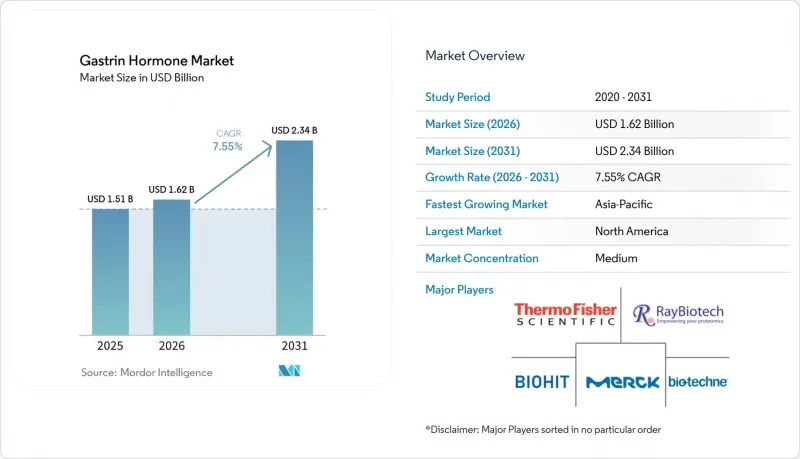
According to Mordor Intelligence, the gastrin hormone market size is projected to expand from USD 1.51 billion in 2025 and USD 1.62 billion in 2026 to USD 2.34 billion by 2031, registering a CAGR of 7.55% between 2026 and 2031.
Global Gastrin Hormone Market Trends and Insights
Rising Availability of Synthetic Gastrin and Pentagastrin Reagents
The Gastrin hormone market benefits from synthetic supply that is less dependent on biological sourcing. GenScript states that its microwave-assisted PepPower platform achieves a synthesis success rate above 95% and can deliver peptides at 95% purity or higher within 5 business days. Faster synthesis can improve access to research-grade gastrin and pentagastrin for laboratories that require custom peptides. Merck KGaA lists its Sigma-Aldrich Gastrin I product at 95% or higher HPLC purity, showing the continued availability of catalog synthetic material. A 2025 study reported that residual trifluoroacetic acid in synthetic peptides can affect cell-based work when counterion exchange is not performed. These quality considerations can increase demand for materials with validated purity and counterion profiles.
Expansion of Gastrin-17 Testing for Atrophic Gastritis and Helicobacter pylori-Associated Disease
The Gastrin hormone market gains clinical support as Gastrin-17 becomes part of noninvasive gastric risk assessment. The 2025 MAPS III guideline recommends serum pepsinogen I and the pepsinogen I to pepsinogen II ratio for identifying advanced atrophic gastritis that requires endoscopic surveillance. A 2025 BMC Gastroenterology study found that a panel of pepsinogen I, pepsinogen II, pepsinogen ratio, and Gastrin-17 achieved an AUC of 0.759 for progressive atrophic gastritis. Biohit reported that its GastroPanel program in Chile was associated with an 87% reduction in endoscopy waiting lists. Near-patient formats can extend this testing beyond central laboratories when referral pathways support their use. These programs create recurring demand for assay kits, calibrators, and other consumables.
Preanalytical Variability From Fasting, Proton Pump Inhibitor Use, Kidney Failure, and Biotin
Preanalytical variability limits more routine use across the Gastrin hormone market. Proton pump inhibitors elevate fasting serum gastrin by suppressing gastric acid, and patients are generally asked to discontinue them before testing. Biotin can interfere with assays that use streptavidin-biotin technology, which adds another preparation requirement for patients. A Heidelberg laboratory reported in July 2026 that repeated Siemens IMMULITE reagent supply disruptions led it to switch to the Yhlo iFlash Gastrin-17 assay on August 1, 2026. Such disruptions can interrupt laboratory workflows and require revised reference intervals and test procedures. Laboratories need validated collection, storage, and assay procedures to reduce avoidable result variation.
Other drivers and restraints analyzed in the detailed report include:
- Growing Use of Gastrin in Gastric Organoid and Cancer Research
- Increasing Referral for Hypergastrinemia and Zollinger-Ellison Syndrome Workups
- Limited Clinical Translation of CCK2 Receptor Antagonists
For complete list of drivers and restraints, kindly check the Table Of Contents.
Segment Analysis
Gastrin-17 held 34.31% of the Gastrin hormone market share in 2025 and is projected to grow at a CAGR of 8.25% through 2031. Gastrin-17 represents 80-90% of biologically active circulating gastrin, supporting its use in clinical testing and research. The PZ Cormay AURYX 90 Gastrin-17 ECLIA kit has a measuring range of 0.6-500 pmol/L and 56-day onboard stability. These features support use on laboratory platforms that need consistent throughput and reagent stability.
Gastrin-34, minigastrin, and other fragments address more specialized work in neuroendocrine research and tumor biology. Pentagastrin retains a role in gastric acid secretion testing and maximal acid output assessment. Control and reference materials become more important as laboratories use different platforms and measurement units. The July 2026 method change at a German laboratory moved gastrin reporting from ng/L to pmol/L after a platform migration. This transition creates a need for suitable calibrators, controls, and method verification.
Ammonium acetate held the largest salt type share at 45.24% in 2025. Acetate-form gastrin remains relevant in cell-based and bioassay applications where residual trifluoroacetic acid can be a concern. A 2025 scientific review discussed the importance of counterion analysis and exchange for synthetic peptides. This supports continued use of salt forms selected for specific assay conditions.
Trifluoroacetate is projected to grow at a CAGR of 8.22% through 2031. Fmoc solid-phase peptide synthesis commonly produces trifluoroacetate-salt peptides, and trifluoroacetic acid is also used in HPLC-based purity work. The 2025 United States Pharmacopeia chapter on trifluoroacetic acid in peptides sets quantification expectations for the substance as an impurity and counterion. This raises quality-control needs for materials supplied for chemistry, manufacturing, and controls work. Other salt types, including acetonitrile and hydrochloride variants, remain specialized formulations.
Complete Report Scope:
- By Product Type
- Gastrin-17
- Gastrin-34
- Minigastrin and Gastrin Fragments
- Pentagastrin
- Gastrin-Related Control and Reference Materials
- By Salt Type
- Ammonium Acetate
- Trifluoroacetate
- Other Salt Types
- By Application
- Research Reagents and Cell Signaling
- Gastrin and Gastrin-17 Testing
- Atrophic Gastritis and H. pylori Assessment
- Hypergastrinemia and Zollinger-Ellison Syndrome Workup
- Pernicious Anemia and Achlorhydria Assessment
- Other Applications
- By End User
- Hospitals
- Diagnostic Laboratories
- Specialty Clinics and Gastroenterology Centers
- Biopharmaceutical and Pharmaceutical Companies
- Academic and Research Institutes
- Other End Users
- By Geography
- North America
- United States
- Canada
- Mexico
- Europe
- Germany
- United Kingdom
- France
- Italy
- Spain
- Rest of Europe
- Asia-Pacific
- China
- Japan
- India
- Australia
- South Korea
- Rest of Asia-Pacific
- Middle East and Africa
- GCC
- South Africa
- Rest of Middle East and Africa
- South America
- Brazil
- Argentina
- Rest of South America
- North America
Geography Analysis
North America held a 35.61% regional share of the Gastrin hormone market in 2025. The United States supports testing through advanced immunoassay infrastructure, gastroenterology services, and specialist endocrinology networks. Thermo Fisher Scientific lists its Human Gastrin ELISA Kit with 9.38 pg/mL sensitivity and an assay range of 15.63-1,000 pg/mL. Canada maintains testing through centralized provincial reference laboratories. Mexico could develop additional testing capacity as population-based Helicobacter pylori screen-and-treat programs are implemented.
Europe ranks second and has varied national approaches to gastrin testing. Germany, the United Kingdom, France, Italy, and Spain support demand through hospitals and specialist laboratories. The MAPS III guideline supports greater consistency in serology-based assessment of atrophic gastritis. In August 2026, MVZ Labor Dr. Limbach changed from Siemens IMMULITE to the Yhlo iFlash Gastrin-17 assay after recurrent reagent supply difficulties. The change shows why laboratories may seek alternatives to single-platform dependence.
Asia-Pacific is projected to record the highest regional CAGR at 8.25% through 2031. China, Japan, India, South Korea, and Australia have substantial Helicobacter pylori and atrophic gastritis testing needs. China published national standard T/GDMDMA 0054-2026 for Gastrin-17 CLIA testing kits in 2026. Japan combines Helicobacter pylori serology and pepsinogen testing within established gastric cancer screening practices. India was a clinical trial site for Biohit GastroPanel Quick Test in 2025, where biopsy-confirmed atrophic gastritis was found in 15.3% of gastroscopy referral patients, and the test achieved an AUC of 0.990 for corpus atrophy. South America, particularly Brazil and Chile, is also building structured gastric biomarker screening programs.
- Abcam
- Abcepta
- Biohit
- Bio-Techne
- Cayman Chemical Company
- CPC Scientific, Inc.
- Creative Peptides
- Epitope Diagnostics
- Genscript
- Hello Bio Ltd.
- Isca Biochemicals
- KareBay Biochem, Inc.
- Merck
- PZ Cormay S.A.
- Qingdao Echemi Technology Co., Ltd.
- RayBiotech Life, Inc.
- Siemens Healthineers
- Thermo Fisher Scientific
- Tocris Bioscience
Additional Benefits:
- The market estimate (ME) sheet in Excel format
- 3 months of analyst support
TABLE OF CONTENTS
1 Introduction
- 1.1 Study Assumptions and Market Definition
- 1.2 Scope of the Study
2 Research Methodology
3 Executive Summary
4 Market Landscape
- 4.1 Market Overview
- 4.2 Market Drivers
- 4.2.1 Rising Availability of Synthetic Gastrin and Pentagastrin Reagents
- 4.2.2 Expansion of Gastrin-17 Testing for Atrophic Gastritis and H. pylori-Associated Disease
- 4.2.3 Growing Use of Gastrin in Gastric Organoid and Cancer Research
- 4.2.4 Increasing Referral for Hypergastrinemia and Zollinger-Ellison Syndrome Workups
- 4.2.5 Near-Patient Gastric Biomarker Testing Adoption
- 4.2.6 Gastrin-Targeted Oncology and Receptor-Targeted Research
- 4.3 Market Restraints
- 4.3.1 Preanalytical Variability from Fasting, PPI Use, Kidney Failure, and Biotin
- 4.3.2 Limited Clinical Translation of CCK2 Receptor Antagonists
- 4.3.3 Low Disease-Specific Ordering Frequency for Gastrin Tests
- 4.3.4 Cold-Chain, Purity, and Lot-Consistency Requirements for Peptides and Assays
- 4.4 Supply-Chain Analysis
- 4.5 Regulatory Landscape
- 4.6 Technological Outlook
- 4.7 Porter's Five Forces Analysis
- 4.7.1 Threat of New Entrants
- 4.7.2 Bargaining Power of Suppliers
- 4.7.3 Bargaining Power of Buyers
- 4.7.4 Threat of Substitutes
- 4.7.5 Competitive Rivalry
5 Market Size & Growth Forecasts (Value, USD)
- 5.1 By Product Type
- 5.1.1 Gastrin-17
- 5.1.2 Gastrin-34
- 5.1.3 Minigastrin and Gastrin Fragments
- 5.1.4 Pentagastrin
- 5.1.5 Gastrin-Related Control and Reference Materials
- 5.2 By Salt Type
- 5.2.1 Ammonium Acetate
- 5.2.2 Trifluoroacetate
- 5.2.3 Other Salt Types
- 5.3 By Application
- 5.3.1 Research Reagents and Cell Signaling
- 5.3.2 Gastrin and Gastrin-17 Testing
- 5.3.3 Atrophic Gastritis and H. pylori Assessment
- 5.3.4 Hypergastrinemia and Zollinger-Ellison Syndrome Workup
- 5.3.5 Pernicious Anemia and Achlorhydria Assessment
- 5.3.6 Other Applications
- 5.4 By End User
- 5.4.1 Hospitals
- 5.4.2 Diagnostic Laboratories
- 5.4.3 Specialty Clinics and Gastroenterology Centers
- 5.4.4 Biopharmaceutical and Pharmaceutical Companies
- 5.4.5 Academic and Research Institutes
- 5.4.6 Other End Users
- 5.5 By Geography
- 5.5.1 North America
- 5.5.1.1 United States
- 5.5.1.2 Canada
- 5.5.1.3 Mexico
- 5.5.2 Europe
- 5.5.2.1 Germany
- 5.5.2.2 United Kingdom
- 5.5.2.3 France
- 5.5.2.4 Italy
- 5.5.2.5 Spain
- 5.5.2.6 Rest of Europe
- 5.5.3 Asia-Pacific
- 5.5.3.1 China
- 5.5.3.2 Japan
- 5.5.3.3 India
- 5.5.3.4 Australia
- 5.5.3.5 South Korea
- 5.5.3.6 Rest of Asia-Pacific
- 5.5.4 Middle East and Africa
- 5.5.4.1 GCC
- 5.5.4.2 South Africa
- 5.5.4.3 Rest of Middle East and Africa
- 5.5.5 South America
- 5.5.5.1 Brazil
- 5.5.5.2 Argentina
- 5.5.5.3 Rest of South America
- 5.5.1 North America
6 Competitive Landscape
- 6.1 Market Concentration
- 6.2 Market Share Analysis
- 6.3 Company Profiles (includes Global Level Overview, Market Level Overview, Core Segments, Financials as available, Strategic Information, Market Rank/Share, Products and Services, Recent Developments)
- 6.3.1 Abcam plc
- 6.3.2 Abcepta
- 6.3.3 Biohit Oyj
- 6.3.4 Bio-Techne Corporation
- 6.3.5 Cayman Chemical Company
- 6.3.6 CPC Scientific, Inc.
- 6.3.7 Creative Peptides
- 6.3.8 Epitope Diagnostics Inc.
- 6.3.9 GenScript Biotech Corporation
- 6.3.10 Hello Bio Ltd.
- 6.3.11 Isca Biochemicals
- 6.3.12 KareBay Biochem, Inc.
- 6.3.13 Merck KGaA
- 6.3.14 PZ Cormay S.A.
- 6.3.15 Qingdao Echemi Technology Co., Ltd.
- 6.3.16 RayBiotech Life, Inc.
- 6.3.17 Siemens Healthineers AG
- 6.3.18 Thermo Fisher Scientific Inc.
- 6.3.19 Tocris Bioscience
7 Market Opportunities and Future Outlook
- 7.1 White-Space and Unmet-Need Assessment

