PUBLISHER: Mordor Intelligence | PRODUCT CODE: 2155211

PUBLISHER: Mordor Intelligence | PRODUCT CODE: 2155211
South America Dairy Packaging - Market Share Analysis, Industry Trends & Statistics, Growth Forecasts (2026 - 2031)
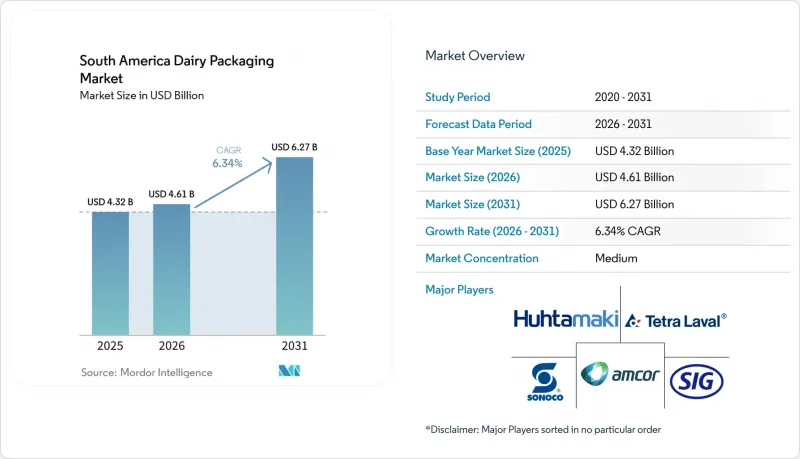
According to Mordor Intelligence, the South America dairy packaging market size was valued at USD 4.32 billion in 2025 and estimated to grow from USD 4.59 billion in 2026 to reach USD 6.27 billion by 2031, at a CAGR of 6.34% during the forecast period (2026-2031).
South America Dairy Packaging Market Trends and Insights
Growth of Aseptic and UHT Dairy Distribution
Aseptic and UHT distribution supports the South America dairy packaging market by expanding dairy access beyond well-developed cold chains. Brazil's long-life dairy association reported 3.9% growth in the UHT milk segment during 2024. This growth supports continued demand for multilayer cartons and related aseptic materials. School nutrition programs also provide a dependable channel for packaged dairy and carton formats. Aseptic equipment requires significant capital spending, which can keep a cooperative tied to a filling platform for 12-15 years. Early relationships with processors can therefore protect demand for the compatible package system.
Expansion of Formal Retail and Cold-Chain Coverage
Formal retail converts bulk dairy sales into branded units with dedicated packaging. In 2025, single-person households represented 19.7% of Brazilian households. This household structure supports smaller packs with greater packaging use per liter. Refrigerated distribution in inland Colombia and northeastern Brazil also supports the distribution of yogurt, fresh cheese, chilled bottles, and films. Food-contact and labeling compliance becomes necessary for supermarket placement as retail channels formalize. Converters with certified substrates can gain an advantage when chains apply consistent supplier requirements.
Currency Volatility and Imported Resin Exposure
Imported resin exposure remains a near-term challenge for the South America dairy packaging market. Brazil imported 3.32 million tonnes of polyethylene in 2025. Domestic chemical capacity utilization was 64% in 2025, limiting the local output's ability to cushion the impact of supply pressure. Brazil imposed definitive duties of USD 199.04 per tonne on U.S. polyethylene and USD 238.49 per tonne on Canadian polyethylene from March 2026. Higher resin costs can compress converter margins, raise prices for dairy processors, or encourage lighter package designs. Smaller regional converters face greater exposure because they have fewer resources for foreign-exchange risk management.
Other drivers and restraints analyzed in the detailed report include:
- Rising Demand for Functional and High-Protein Dairy Products
- Shift From Loose to Hygienically Packaged Dairy
- Uneven Rural Logistics and Refrigeration Infrastructure
For complete list of drivers and restraints, kindly check the Table Of Contents.
Segment Analysis
Plastic accounted for 58.41% of the 2025 South America Dairy Packaging Market share, supported by its established use in milk bottles, flexible pouches, and yogurt containers. HDPE bottles, LDPE pouches, and polypropylene containers benefit from existing converter capacity and retail familiarity. Imported resin costs and brand concerns about plastic waste are increasing pressure on these established formats. Brazil's Decree No. 12,688, issued in 2025, established reverse logistics requirements for plastic packaging and a 32% recovery target for 2026. The decree is influencing procurement discussions around traceability, recovery, and material choice. Plastic nevertheless remains central to dairy packaging because its formats address low cost, product visibility, and established filling processes. The material's broad installed base also means that package changes are usually considered alongside existing blowing, forming, sealing, and filling equipment. This favors incremental lightweighting or recycled-content approaches where food-contact and supply conditions allow them. The South America dairy packaging market, therefore, retains a substantial plastic requirement even as buyers assess alternatives.
Paper and paperboard are projected to grow at a 7.21% CAGR through 2031. The South America Dairy Packaging Market size for paper and paperboard is driven by growth in aseptic carton packaging and brand owners' interest in recyclable structures. The recovery target under Brazil's decree does not require recycled content in food-contact packaging, so adoption of fiber-based cartons depends substantially on brand strategy. Biobased coatings may replace conventional polyethylene layers while preserving shelf-life performance in dairy cartons. Glass continues to serve premium and organic dairy products in urban Chile and Brazil. Metal remains relevant for condensed and evaporated milk, particularly in shelf-stable and institutional channels. Fiber-based alternatives need to meet food safety, barrier, shelf-life, and filling-line requirements before they can replace established structures. Their adoption is strongest where aseptic distribution and brand recycling commitments overlap. Glass and metal remain specialized choices rather than broad substitutes for cartons or plastic.
Complete Report Scope:
- By Material
- Plastic
- Paper and Paperboard
- Glass
- Metal
- By Product
- Milk
- Cheese
- Frozen Foods
- Yogurt
- Cultured Products
- By Package Type
- Bottles
- Pouches
- Cartons and Boxes
- Bags and Wraps
- Other Package Types
- By Geography
- Brazil
- Argentina
- Chile
- Colombia
- Rest of South America
List of Companies Covered in this Report:
- Amcor plc
- SIG Group AG
- Tetra Laval Holdings & Finance S.A.
- Elopak ASA
- Mondi plc
- Huhtamaki Oyj
- Sonoco Products Company
- Sealed Air Corporation
- Winpak Ltd.
- AptarGroup, Inc.
- Silgan Holdings Inc.
- CANPACK S.A.
- Stora Enso Oyj
- Pactiv Evergreen Inc.
- Coveris Management GmbH
- Goglio S.p.A.
- Ecolean AB
- Greatview Aseptic Packaging Co., Ltd.
- Klockner Pentaplast Group
- Videplast Industria de Embalagens Ltda.
- Canguru Embalagens Ltda.
- Zaraplast S.A.
- Santa Rosa Embalagens Flexiveis Ltda.
Additional Benefits:
- The market estimate (ME) sheet in Excel format
- 3 months of analyst support
TABLE OF CONTENTS
1 INTRODUCTION
- 1.1 Study Assumptions and Market Definition
- 1.2 Scope of the Study
2 RESEARCH METHODOLOGY
3 EXECUTIVE SUMMARY
4 MARKET LANDSCAPE
- 4.1 Market Overview
- 4.2 Market Drivers
- 4.2.1 Growth of Aseptic and UHT Dairy Distribution
- 4.2.2 Expansion of Formal Retail and Cold-Chain Coverage
- 4.2.3 Rising Demand for Functional and High-Protein Dairy Products
- 4.2.4 Shift from Loose to Hygienically Packaged Dairy
- 4.2.5 Lightweight Flexible Formats for Cost-Constrained Distribution
- 4.2.6 Recyclability and Recycled-Content Commitments by Brand Owners
- 4.3 Market Restraints
- 4.3.1 Currency Volatility and Imported Resin Exposure
- 4.3.2 Uneven Rural Logistics and Refrigeration Infrastructure
- 4.3.3 Packaging Recovery and Recycling Gaps
- 4.3.4 Compliance Cost of EPR, Labeling, and Food-Contact Rules
- 4.4 Industry Value Chain Analysis
- 4.5 Regulatory Landscape
- 4.6 Technological Outlook
- 4.7 Porter's Five Forces Analysis
- 4.7.1 Bargaining Power of Suppliers
- 4.7.2 Bargaining Power of Buyers
- 4.7.3 Threat of New Entrants
- 4.7.4 Threat of Substitutes
- 4.7.5 Competitive Rivalry
- 4.8 Impact of Macroeconomic Factors on the Market
5 MARKET SIZE AND GROWTH FORECASTS (VALUES)
- 5.1 By Material
- 5.1.1 Plastic
- 5.1.2 Paper and Paperboard
- 5.1.3 Glass
- 5.1.4 Metal
- 5.2 By Product
- 5.2.1 Milk
- 5.2.2 Cheese
- 5.2.3 Frozen Foods
- 5.2.4 Yogurt
- 5.2.5 Cultured Products
- 5.3 By Package Type
- 5.3.1 Bottles
- 5.3.2 Pouches
- 5.3.3 Cartons and Boxes
- 5.3.4 Bags and Wraps
- 5.3.5 Other Package Types
- 5.4 By Geography
- 5.4.1 Brazil
- 5.4.2 Argentina
- 5.4.3 Chile
- 5.4.4 Colombia
- 5.4.5 Rest of South America
6 COMPETITIVE LANDSCAPE
- 6.1 Market Concentration
- 6.2 Strategic Moves
- 6.3 Market Share Analysis
- 6.4 Company Profiles (includes Global Level Overview, Market Level Overview, Core Segments, Financials as available, Strategic Information, Market Rank/Share, Products and Services, Recent Developments)
- 6.4.1 Amcor plc
- 6.4.2 SIG Group AG
- 6.4.3 Tetra Laval Holdings & Finance S.A.
- 6.4.4 Elopak ASA
- 6.4.5 Mondi plc
- 6.4.6 Huhtamaki Oyj
- 6.4.7 Sonoco Products Company
- 6.4.8 Sealed Air Corporation
- 6.4.9 Winpak Ltd.
- 6.4.10 AptarGroup, Inc.
- 6.4.11 Silgan Holdings Inc.
- 6.4.12 CANPACK S.A.
- 6.4.13 Stora Enso Oyj
- 6.4.14 Pactiv Evergreen Inc.
- 6.4.15 Coveris Management GmbH
- 6.4.16 Goglio S.p.A.
- 6.4.17 Ecolean AB
- 6.4.18 Greatview Aseptic Packaging Co., Ltd.
- 6.4.19 Klockner Pentaplast Group
- 6.4.20 Videplast Industria de Embalagens Ltda.
- 6.4.21 Canguru Embalagens Ltda.
- 6.4.22 Zaraplast S.A.
- 6.4.23 Santa Rosa Embalagens Flexiveis Ltda.
7 MARKET OPPORTUNITIES AND FUTURE TRENDS
- 7.1 White-Space and Unmet-Need Assessment

