PUBLISHER: Mordor Intelligence | PRODUCT CODE: 2155213

PUBLISHER: Mordor Intelligence | PRODUCT CODE: 2155213
Multi-Camera Industrial Inspection Systems - Market Share Analysis, Industry Trends & Statistics, Growth Forecasts (2026 - 2031)
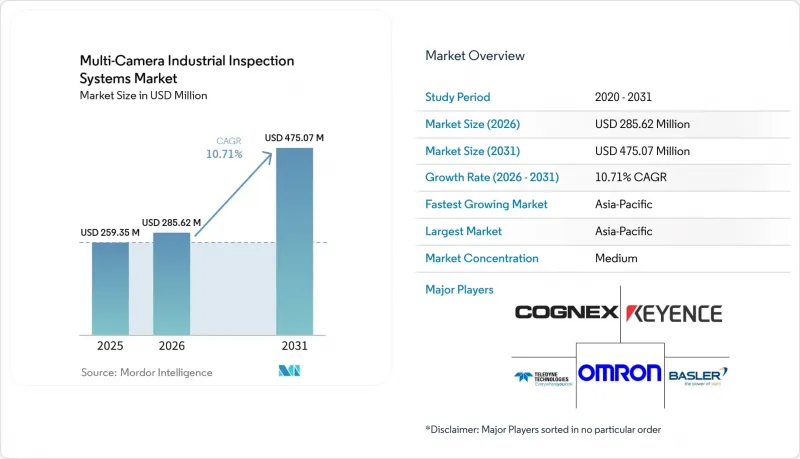
According to Mordor Intelligence, the Multi-Camera industrial inspection systems market size is projected to expand from USD 259.35 million in 2025 to USD 285.62 million in 2026, and to USD 475.07 million by 2031, registering a CAGR of 10.71% between 2026 and 2031.
Global Multi-Camera Industrial Inspection Systems Market Trends and Insights
Zero-Defect Manufacturing and Rising Cost of Escaped Defects
Manufacturers face greater financial exposure when defects pass inspection and reach customers. Quality-related costs can equal 15% to 20% of annual sales at typical manufacturers, while world-class operations reduce that level to less than 5%. The 1-10-100 principle favors detection early in the production process because repair after shipment requires far more effort. This makes multi-view inspection relevant where defects can occur on more than 1 surface. The Multi-Camera Industrial Inspection Systems Market benefits when suppliers must prove that each part meets specified requirements. Automotive and medical production are especially sensitive to quality escapes because the consequences can extend beyond rework costs. Camera arrays reduce gaps around curved, recessed, or partially hidden features and retain images for review of rejected parts. Demand can therefore reach beyond large manufacturers as supplier quality standards move through supply chains.
Industry 4.0, Smart-Factory, and Vision-Guided Robotics Adoption
Industry data reported 542,000 industrial robot installations during 2024, 4,664,000 operational industrial robots worldwide, and preliminary 2025 installations of 621,000 units. New robotic cells often need machine vision for positioning, guidance, or inspection. Multi-camera systems are useful where parts vary in shape or need inspection from several directions. The systems also create production images for process monitoring. For the Multi-Camera Industrial Inspection Systems Market, robotics expands the use of vision beyond fixed conveyor lines. Distributed cameras can collect data from several points, while software enables operators to update inspection logic across several factory locations. This supports the stated 12.27% growth outlook for software and encourages centralized model development tools.
High Upfront Cost and Extended Payback for Multi-Camera Cells
Multi-camera cells require cameras, lighting, optics, frame grabbers, calibration fixtures, and integration work. This creates a larger initial commitment than a basic single-camera installation. The cost can delay adoption where facilities have limited automation budgets or management expects a short payback period. The Multi-Camera Industrial Inspection Systems Market faces a barrier when a facility cannot support the full system and integration cost. This is particularly relevant for manufacturers with 50 to 500 employees, who may lack machine vision experience. Financing and implementation capacity are less developed in some South American, Middle East and African markets. Cloud-to-edge arrangements can lower repeated engineering work across several plants, but they do not eliminate the need for cameras, calibration, and local commissioning.
Other drivers and restraints analyzed in the detailed report include:
- Labor Shortages and Demand for Consistent High-Speed Inspection
- EV Battery and Advanced-Electronics Geometry Complexity Requiring Multi-View Coverage
- Shortage of Machine-Vision Integration and Calibration Skills
For complete list of drivers and restraints, kindly check the Table Of Contents.
Segment Analysis
Hardware held 62.13% of the Multi-Camera Industrial Inspection Systems Market share in 2025. Cameras, lighting, lenses, optics, frame grabbers, and image processors provide the foundation for each inspection cell. A calibrated camera array is generally upgraded rather than removed as inspection algorithms change. This creates a durable installed base for component suppliers. Hardware demand also rises when a manufacturer adds coverage to another line or site.
Software is forecast to grow at a 12.27% CAGR through 2031. Image processing, AI algorithms, and analytics extend the useful life of installed camera systems. Cognex made OneVision generally available in May 2026 after more than 100 customers used the platform. Services remain relevant because integration and maintenance needs rise with system complexity. Software and services allow continued vendor engagement after the equipment sale.
2D multi-camera inspection systems held 59.78% of revenue in 2025. They are used on automotive and electronics lines where texture, color, surface condition, and planar dimensions are core criteria. Their installed base reflects long use on high-volume production lines. Hikrobot introduced 8K and 16K true-color line-scan cameras in 2026 for PCB inspection, with 5-micron precision. These capabilities keep 2D systems relevant where depth measurement is not required.
3D multi-camera inspection systems are forecast to grow at a 13.21% CAGR through 2031. They support battery module checks, weld measurement, and semiconductor packaging metrology. Teledyne DALSA launched its Linea HS2 8k camera in June 2026 with a maximum line rate of 1 MHz and 5-micron resolution. Hybrid systems combine 2D and 3D acquisition in 1 cell. They suit applications where appearance and geometry are checked together.
Complete Report Scope:
- By Offering
- Hardware
- Cameras
- Lighting Equipment
- Lenses and Optics
- Frame Grabbers and Image Processors
- Other Hardware
- Software
- Image Processing Software
- Machine Learning and AI Algorithms
- Data Visualization and Analytics Platforms
- Other Software
- Services
- System Integration
- Maintenance and Support
- Hardware
- By System Type
- 2D Multi-Camera Inspection Systems
- 3D Multi-Camera Inspection Systems
- Hybrid Multi-Camera Inspection Systems
- By Deployment Mode
- In-Line Inspection
- Off-Line Inspection
- Robotic Inspection
- By Application
- Quality Control and Assurance
- Product and Surface Inspection
- Assembly Verification and Error Proofing
- Measurement and Dimensioning
- Other Applications
- By End-User Industry
- Automotive and Electric Vehicles
- Electronics and Semiconductors
- Food and Beverage
- Pharmaceuticals and Medical Devices
- Metals and Materials
- Other End-User Industries
- By Geography
- North America
- United States
- Canada
- Mexico
- South America
- Brazil
- Argentina
- Rest of South America
- Europe
- Germany
- United Kingdom
- France
- Italy
- Spain
- Rest of Europe
- Asia-Pacific
- China
- Japan
- India
- South Korea
- Rest of Asia-Pacific
- Middle East and Africa
- Middle East
- Saudi Arabia
- United Arab Emirates
- Rest of the Middle East
- Africa
- South Africa
- Rest of Africa
- Middle East
- North America
Geography Analysis
Asia-Pacific accounted for 35.49% of revenue in 2025 and is forecast to grow at an 11.54% CAGR through 2031. The region combines high manufacturing density with major production of automotive, electronics, and semiconductor products. China's Ministry of Industry and Information Technology issued its AI+ICT Innovation Development Implementation Plan for 2026 to 2028 in June 2026. The plan identifies industrial visual inspection as a priority application area. Japan remains important in the development of high-resolution sensors and cameras. South Korea's semiconductor memory and display facilities require demanding line-scan vision configurations.
India is expanding electronics and automotive assembly capacity, which supports greenfield inspection installations. The Multi-Camera Industrial Inspection Systems Market benefits when new production lines incorporate automated inspection from the start. Food traceability requirements and investments in industrial automation support North America. U.S. robot installations increased 11% to 38,000 units in 2025, according to preliminary data. Europe remains an important market for the installed base of automated manufacturing. Germany has strong automotive production and is also managing cybersecurity requirements for connected industrial products.
South America, the Middle East, and Africa offer expansion potential but face implementation constraints. Brazil's adoption is concentrated in food processing and automotive plants. Saudi Arabia and the United Arab Emirates are adding automated inspection to new manufacturing facilities. South African deployments are concentrated in food-export processing and in some pharmaceutical facilities. These markets often face a gap between customer quality expectations and available finance or specialist skills. Vendors that simplify commissioning and provide service support are better positioned to address this.
- Cognex Corporation
- KEYENCE CORPORATION
- Teledyne DALSA, Inc.
- Basler AG
- Omron Corporation
- SICK AG
- Allied Vision Technologies GmbH
- IDS Imaging Development Systems GmbH
- LMI Technologies Inc.
- JAI A/S
- Datalogic S.p.A.
- ISRA VISION AG
- STEMMER IMAGING AG
- MVTec Software GmbH
- Matrox Electronic Systems Ltd.
- Baumer Holding AG
- Hikrobot Co., Ltd.
- Daheng Imaging, Inc.
- Vision Components GmbH
- XIMEA GmbH
- Photonfocus AG
- Opto Engineering S.r.l.
- VisionX Inc.
- ViSCO Technologies Corporation
- Mapvision Oy
- CIMS S.p.A.
- Jekson Vision Private Limited
Additional Benefits:
- The market estimate (ME) sheet in Excel format
- 3 months of analyst support
TABLE OF CONTENTS
1 INTRODUCTION
- 1.1 Study Assumptions and Market Definition
- 1.2 Scope of the Study
2 RESEARCH METHODOLOGY
3 EXECUTIVE SUMMARY
4 MARKET LANDSCAPE
- 4.1 Market Overview
- 4.2 Market Drivers
- 4.2.1 Zero-Defect Manufacturing and Rising Cost of Escaped Defects
- 4.2.2 Industry 4.0, Smart-Factory, and Vision-Guided Robotics Adoption
- 4.2.3 Labor Shortages and Demand for Consistent High-Speed Inspection
- 4.2.4 Traceability and Quality Requirements in Food, Pharmaceutical, and Medical Production
- 4.2.5 Retroactive Image-Database Inspection for Recall Avoidance
- 4.2.6 EV Battery and Advanced-Electronics Geometry Complexity Requiring Multi-View Coverage
- 4.3 Market Restraints
- 4.3.1 High Upfront Cost and Extended Payback for Multi-Camera Cells
- 4.3.2 Shortage of Machine-Vision Integration and Calibration Skills
- 4.3.3 Calibration Drift and Camera-Synchronization Failure Across Long Production Runs
- 4.3.4 Image-Data Governance, Cybersecurity, and Model-Change-Control Burden
- 4.4 Impact of Macroeconomic Factors on the Market
- 4.5 Industry Supply Chain Analysis
- 4.6 Regulatory Landscape
- 4.7 Technological Outlook
- 4.8 Porter's Five Forces Analysis
- 4.8.1 Bargaining Power of Suppliers
- 4.8.2 Bargaining Power of Buyers
- 4.8.3 Threat of New Entrants
- 4.8.4 Threat of Substitutes
- 4.8.5 Competitive Rivalry
5 MARKET SIZE AND GROWTH FORECASTS (VALUE)
- 5.1 By Offering
- 5.1.1 Hardware
- 5.1.1.1 Cameras
- 5.1.1.2 Lighting Equipment
- 5.1.1.3 Lenses and Optics
- 5.1.1.4 Frame Grabbers and Image Processors
- 5.1.1.5 Other Hardware
- 5.1.2 Software
- 5.1.2.1 Image Processing Software
- 5.1.2.2 Machine Learning and AI Algorithms
- 5.1.2.3 Data Visualization and Analytics Platforms
- 5.1.2.4 Other Software
- 5.1.3 Services
- 5.1.3.1 System Integration
- 5.1.3.2 Maintenance and Support
- 5.1.1 Hardware
- 5.2 By System Type
- 5.2.1 2D Multi-Camera Inspection Systems
- 5.2.2 3D Multi-Camera Inspection Systems
- 5.2.3 Hybrid Multi-Camera Inspection Systems
- 5.3 By Deployment Mode
- 5.3.1 In-Line Inspection
- 5.3.2 Off-Line Inspection
- 5.3.3 Robotic Inspection
- 5.4 By Application
- 5.4.1 Quality Control and Assurance
- 5.4.2 Product and Surface Inspection
- 5.4.3 Assembly Verification and Error Proofing
- 5.4.4 Measurement and Dimensioning
- 5.4.5 Other Applications
- 5.5 By End-User Industry
- 5.5.1 Automotive and Electric Vehicles
- 5.5.2 Electronics and Semiconductors
- 5.5.3 Food and Beverage
- 5.5.4 Pharmaceuticals and Medical Devices
- 5.5.5 Metals and Materials
- 5.5.6 Other End-User Industries
- 5.6 By Geography
- 5.6.1 North America
- 5.6.1.1 United States
- 5.6.1.2 Canada
- 5.6.1.3 Mexico
- 5.6.2 South America
- 5.6.2.1 Brazil
- 5.6.2.2 Argentina
- 5.6.2.3 Rest of South America
- 5.6.3 Europe
- 5.6.3.1 Germany
- 5.6.3.2 United Kingdom
- 5.6.3.3 France
- 5.6.3.4 Italy
- 5.6.3.5 Spain
- 5.6.3.6 Rest of Europe
- 5.6.4 Asia-Pacific
- 5.6.4.1 China
- 5.6.4.2 Japan
- 5.6.4.3 India
- 5.6.4.4 South Korea
- 5.6.4.5 Rest of Asia-Pacific
- 5.6.5 Middle East and Africa
- 5.6.5.1 Middle East
- 5.6.5.1.1 Saudi Arabia
- 5.6.5.1.2 United Arab Emirates
- 5.6.5.1.3 Rest of the Middle East
- 5.6.5.2 Africa
- 5.6.5.2.1 South Africa
- 5.6.5.2.2 Rest of Africa
- 5.6.5.1 Middle East
- 5.6.1 North America
6 COMPETITIVE LANDSCAPE
- 6.1 Market Concentration
- 6.2 Strategic Moves
- 6.3 Market Share Analysis
- 6.4 Company Profiles (includes Global Level Overview, Market Level Overview, Core Segments, Financials as available, Strategic Information, Market Rank/Share, Products and Services, Recent Developments)
- 6.4.1 Cognex Corporation
- 6.4.2 KEYENCE CORPORATION
- 6.4.3 Teledyne DALSA, Inc.
- 6.4.4 Basler AG
- 6.4.5 Omron Corporation
- 6.4.6 SICK AG
- 6.4.7 Allied Vision Technologies GmbH
- 6.4.8 IDS Imaging Development Systems GmbH
- 6.4.9 LMI Technologies Inc.
- 6.4.10 JAI A/S
- 6.4.11 Datalogic S.p.A.
- 6.4.12 ISRA VISION AG
- 6.4.13 STEMMER IMAGING AG
- 6.4.14 MVTec Software GmbH
- 6.4.15 Matrox Electronic Systems Ltd.
- 6.4.16 Baumer Holding AG
- 6.4.17 Hikrobot Co., Ltd.
- 6.4.18 Daheng Imaging, Inc.
- 6.4.19 Vision Components GmbH
- 6.4.20 XIMEA GmbH
- 6.4.21 Photonfocus AG
- 6.4.22 Opto Engineering S.r.l.
- 6.4.23 VisionX Inc.
- 6.4.24 ViSCO Technologies Corporation
- 6.4.25 Mapvision Oy
- 6.4.26 CIMS S.p.A.
- 6.4.27 Jekson Vision Private Limited
7 MARKET OPPORTUNITIES AND FUTURE OUTLOOK
- 7.1 White-Space and Unmet-Need Assessment

