PUBLISHER: Mordor Intelligence | PRODUCT CODE: 2155214

PUBLISHER: Mordor Intelligence | PRODUCT CODE: 2155214
Industrial Imaging Retrofit Solutions - Market Share Analysis, Industry Trends & Statistics, Growth Forecasts (2026 - 2031)
According to Mordor Intelligence, the industrial imaging retrofit solutions market size is expected to increase from USD 0.54 billion in 2025 to USD 0.60 billion in 2026 and reach USD 1.02 billion by 2031, growing at a CAGR of 11.20% over 2026 to 2031.
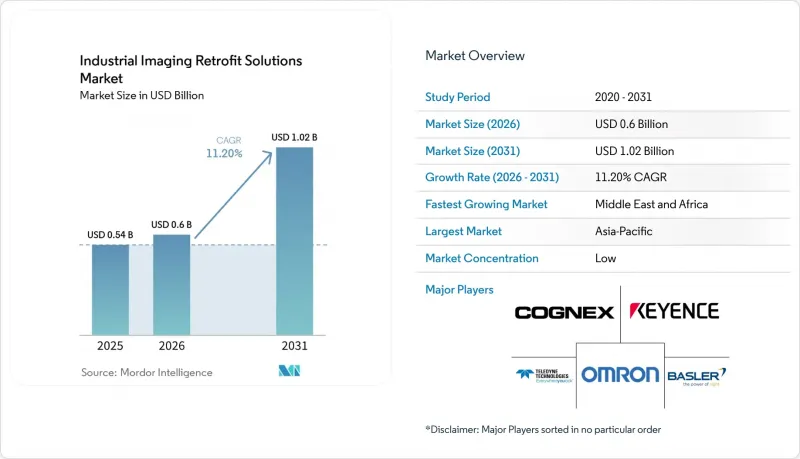
Global Industrial Imaging Retrofit Solutions Market Trends and Insights
Zero Defect Manufacturing and Automated Inspection
Zero-defect programs are making imaging upgrades a more regular production investment within the Industrial Imaging Retrofit Solutions Market. Manufacturers use these systems to identify defects before products move to later production stages, where rework and disposal become more costly. A 2026 review of more than 50 implementations reported defect detection accuracy above 95%, with some controlled cases reaching 98% to 100%. The same review found that 77% of implementations remained in prototype or pilot stages. This gap creates demand for suppliers that can combine a validated vision model with robust deployment, documented testing, and dependable support for line operators. China issued its AI+Manufacturing Specialized Action Plan in January 2026 and set a target of 500 high-quality manufacturing AI scenarios over 3 years.
AI Based Defect Detection on Existing Camera Assets
AI-based defect detection allows plants to improve results without replacing every installed camera. A 2026 framework for automated optical inspection outperformed a legacy rule-based approach by 8.9 percentage points on industrial datasets. The Industrial Imaging Retrofit Solutions Market benefits when existing optics have sufficient resolution, repeatable illumination, and stable image quality for the target defect class. MVTec's MERLIC deployment at Endress+Hauser began in March 2025 and was later extended to other manufacturing sites. The case shows how an initial deployment can support rollout across a manufacturer's network after the first site demonstrates operational reliability. Models trained on site-specific image sets can also preserve production knowledge and make later supplier changes less attractive.
Shortage of Vision Integration and Model Validation Skills
The shortage of integration and model validation skills can slow deployment in the Industrial Imaging Retrofit Solutions Market. Projects require practical knowledge of optics, machine learning models, programmable logic controller integration, and industrial control systems. The 2026 implementation review found that 77% of machine learning vision projects remained at prototype or pilot scale. This pattern points to deployment and validation constraints rather than a lack of algorithmic capability. Turnkey contracts can address the gap by bundling equipment, software, commissioning, operator training, documentation, and post-production support. Low-code tools can simplify model training, but regulated production still requires specialized validation work.
Other drivers and restraints analyzed in the detailed report include:
- Vision Guided Robotics and Flexible Automation
- Food, Pharmaceutical, and Medical Device Traceability Requirements
- High Cost of Advanced Cameras and Illumination
For complete list of drivers and restraints, kindly check the Table Of Contents.
Segment Analysis
Camera and Sensor Upgrade held 33.56% of the Industrial Imaging Retrofit Solutions Market share in 2025. Its lead reflected the large installed base of aging 1- to 5-megapixel cameras on established inspection lines, many of which were installed before higher-resolution sensors became more accessible. Plants can update sensors while retaining housings, lens mounts, control wiring, and familiar mechanical arrangements. This limits disruption and avoids lengthy shutdowns on lines that cannot pause production for full equipment replacement. Connectivity and Control Upgrade connects legacy cameras with current manufacturing execution systems, while Turnkey Inspection Station Retrofit serves sites where the optical and mechanical assembly cannot support a narrower upgrade.
AI Software Overlay is forecast to expand at a 15.89% CAGR through 2031. It can improve defect detection when installed cameras provide adequate resolution, stable lighting, usable image records, and consistent part presentation. The approach reduces the need to procure replacement hardware for every use case and lets suppliers place trained models close to the production process. Open industrial communication interfaces can make those models easier to connect with controllers, manufacturing systems, and existing production records. Specialized lighting, encoders, and triggers remain important because consistent image capture supports reliable model output and reduces variation between shifts.
2D Imaging held 63.11% of the Industrial Imaging Retrofit Solutions Market share in 2025. It supports surface defect detection, label verification, and dimensional gauging across automotive, packaging, food, and electronics lines. Area-scan and line-scan cameras remain practical for routine visual tasks, supported by a mature ecosystem of optics, controllers, software libraries, and integration expertise. This supports continued retrofits in which an inspection function does not require depth, material discrimination, or spectral information. The segment remains important because its integration path is familiar to plant engineers and control teams, thereby reducing commissioning effort.
Multispectral, hyperspectral, and thermal imaging is forecast to grow at a 12.46% CAGR through 2031. These systems can distinguish material properties that conventional 2D optics cannot detect, thereby supporting food sorting, pharmaceutical inspection, battery cell verification, and recycling. Teledyne DALSA's Kaleido camera targets applications in recycling, food safety, pharmaceuticals, and waste management. The European Commission's HyperImage project included quality control in high-power electronics among 4 industrial use cases and projected 10%-20% yield improvements in participating environments. Thermal systems can also support equipment health monitoring, allowing a retrofit to contribute to both quality management and maintenance planning.
Complete Report Scope:
- By Retrofit Solution Type
- Camera and Sensor Upgrade
- AI Software Overlay
- Connectivity and Control Upgrade
- Turnkey Inspection-Station Retrofit
- Other Retrofit Solution Types
- By Imaging Technology
- 2D Imaging
- 3D Imaging
- Multispectral, Hyperspectral, and Thermal Imaging
- By Retrofit Approach
- Component-Level Retrofit
- Subsystem Retrofit
- Full-System Retrofit
- By Application
- Quality Inspection
- Measurement and Metrology
- Identification, Traceability, and OCR
- Robot Guidance and Bin Picking
- Process Monitoring and Predictive Maintenance
- By Industry Vertical
- Automotive and Mobility
- Electronics and Semiconductors
- Food and Beverage
- Pharmaceuticals and Life Sciences
- Packaging
- Metals and Machinery
- Aerospace and Defense
- By Geography
- North America
- United States
- Canada
- Mexico
- South America
- Brazil
- Argentina
- Rest of South America
- Europe
- Germany
- United Kingdom
- France
- Italy
- Spain
- Rest of Europe
- Asia-Pacific
- China
- Japan
- India
- South Korea
- Rest of Asia-Pacific
- Middle East and Africa
- Middle East
- Saudi Arabia
- United Arab Emirates
- Rest of the Middle East
- Africa
- South Africa
- Rest of Africa
- Middle East
- North America
Geography Analysis
Asia Pacific accounted for 35.12% of the Industrial Imaging Retrofit Solutions Market in 2025. China's January 2026 manufacturing AI action plan identifies industrial vision inspection as a priority deployment area and targets 500 high-quality manufacturing AI scenarios over 3 years. Japan continues to introduce AI-based inspection systems, including Panasonic Connect's Bead Eye M edition, released in June 2026. South Korea and ASEAN add demand through semiconductor, display panel, and battery production.
North America is the second largest regional market, supported by an established installed base of inspection equipment across automotive, aerospace, and pharmaceutical facilities. The United States remains important for hardware upgrades and for AI vision software platforms used in overlay projects. Drug traceability rules continue to support demand for pharmaceutical imaging. Canada and Mexico contribute through automotive supply chains and food processing. South America has aging equipment and rising labor costs that can support retrofit demand, although limited integration skills can slow adoption.
The Middle East and Africa is forecast to grow at a 12.24% CAGR through 2031, making it the fastest-growing geographic segment. Europe is the third-largest geographic cluster, with Germany, Italy, and France driving steady demand for quality upgrades across automotive and machinery value chains. The GreenRetroTwin project began in Germany in March 2026 and is developing tools to convert legacy engineering data into standardized digital representations. This work can reduce planning effort for broader retrofit programs. Greenfield manufacturing and energy inspection are the Middle East's primary entry points.
- Keyence Corporation
- OMRON Corporation
- Teledyne Technologies Incorporated
- Basler AG
- Allied Vision Technologies GmbH
- JAI A/S
- IDS Imaging Development Systems GmbH
- Baumer Optronic GmbH
- LMI Technologies Inc.
- MVTec Software GmbH
- Datalogic S.p.A.
- Hikrobot Technology Co., Ltd.
- Adimec Advanced Image Systems B.V.
- Tordivel AS
- STEMMER IMAGING AG
- Pleora Technologies Inc.
- SICK AG
- Sony Semiconductor Solutions Corporation
- Matrox Electronic Systems Ltd.
Additional Benefits:
- The market estimate (ME) sheet in Excel format
- 3 months of analyst support
TABLE OF CONTENTS
1 INTRODUCTION
- 1.1 Study Assumptions and Market Definition
- 1.2 Scope of the Study
2 RESEARCH METHODOLOGY
3 EXECUTIVE SUMMARY
4 MARKET LANDSCAPE
- 4.1 Market Overview
- 4.2 Market Drivers
- 4.2.1 Zero-Defect Manufacturing and Automated Inspection
- 4.2.2 AI-Based Defect Detection on Existing Camera Assets
- 4.2.3 Vision-Guided Robotics and Flexible Automation
- 4.2.4 Food, Pharmaceutical, and Medical-Device Traceability Requirements
- 4.2.5 Legacy-Asset Connectivity Through Open Vision Protocols
- 4.2.6 Edge Inference for Low-Latency Closed-Loop Control
- 4.3 Market Restraints
- 4.3.1 Shortage of Vision Integration and Model-Validation Skills
- 4.3.2 High Cost of Advanced Cameras and Illumination
- 4.3.3 Retrofit-Induced Cybersecurity and Functional-Safety Exposure
- 4.3.4 Inconsistent Legacy Image Data and Line-Specific Model Drift
- 4.4 Impact of Macroeconomic Factors on the Market
- 4.5 Industry Supply-Chain Analysis
- 4.6 Regulatory Landscape
- 4.7 Technological Outlook
- 4.8 Porter's Five Forces Analysis
- 4.8.1 Bargaining Power of Suppliers
- 4.8.2 Bargaining Power of Buyers
- 4.8.3 Threat of New Entrants
- 4.8.4 Threat of Substitutes
- 4.8.5 Intensity of Competitive Rivalry
5 MARKET SIZE AND GROWTH FORECASTS (VALUE)
- 5.1 By Retrofit Solution Type
- 5.1.1 Camera and Sensor Upgrade
- 5.1.2 AI Software Overlay
- 5.1.3 Connectivity and Control Upgrade
- 5.1.4 Turnkey Inspection-Station Retrofit
- 5.1.5 Other Retrofit Solution Types
- 5.2 By Imaging Technology
- 5.2.1 2D Imaging
- 5.2.2 3D Imaging
- 5.2.3 Multispectral, Hyperspectral, and Thermal Imaging
- 5.3 By Retrofit Approach
- 5.3.1 Component-Level Retrofit
- 5.3.2 Subsystem Retrofit
- 5.3.3 Full-System Retrofit
- 5.4 By Application
- 5.4.1 Quality Inspection
- 5.4.2 Measurement and Metrology
- 5.4.3 Identification, Traceability, and OCR
- 5.4.4 Robot Guidance and Bin Picking
- 5.4.5 Process Monitoring and Predictive Maintenance
- 5.5 By Industry Vertical
- 5.5.1 Automotive and Mobility
- 5.5.2 Electronics and Semiconductors
- 5.5.3 Food and Beverage
- 5.5.4 Pharmaceuticals and Life Sciences
- 5.5.5 Packaging
- 5.5.6 Metals and Machinery
- 5.5.7 Aerospace and Defense
- 5.6 By Geography
- 5.6.1 North America
- 5.6.1.1 United States
- 5.6.1.2 Canada
- 5.6.1.3 Mexico
- 5.6.2 South America
- 5.6.2.1 Brazil
- 5.6.2.2 Argentina
- 5.6.2.3 Rest of South America
- 5.6.3 Europe
- 5.6.3.1 Germany
- 5.6.3.2 United Kingdom
- 5.6.3.3 France
- 5.6.3.4 Italy
- 5.6.3.5 Spain
- 5.6.3.6 Rest of Europe
- 5.6.4 Asia-Pacific
- 5.6.4.1 China
- 5.6.4.2 Japan
- 5.6.4.3 India
- 5.6.4.4 South Korea
- 5.6.4.5 Rest of Asia-Pacific
- 5.6.5 Middle East and Africa
- 5.6.5.1 Middle East
- 5.6.5.1.1 Saudi Arabia
- 5.6.5.1.2 United Arab Emirates
- 5.6.5.1.3 Rest of the Middle East
- 5.6.5.2 Africa
- 5.6.5.2.1 South Africa
- 5.6.5.2.2 Rest of Africa
- 5.6.5.1 Middle East
- 5.6.1 North America
6 COMPETITIVE LANDSCAPE
- 6.1 Market Concentration
- 6.2 Strategic Moves
- 6.3 Market Share Analysis
- 6.4 Company Profiles (includes Global Level Overview, Market Level Overview, Core Segments, Financials as available, Strategic Information, Market Rank/Share, Products and Services, Recent Developments)
- 6.4.1 Keyence Corporation
- 6.4.2 OMRON Corporation
- 6.4.3 Teledyne Technologies Incorporated
- 6.4.4 Basler AG
- 6.4.5 Allied Vision Technologies GmbH
- 6.4.6 JAI A/S
- 6.4.7 IDS Imaging Development Systems GmbH
- 6.4.8 Baumer Optronic GmbH
- 6.4.9 LMI Technologies Inc.
- 6.4.10 MVTec Software GmbH
- 6.4.11 Datalogic S.p.A.
- 6.4.12 Hikrobot Technology Co., Ltd.
- 6.4.13 Adimec Advanced Image Systems B.V.
- 6.4.14 Tordivel AS
- 6.4.15 STEMMER IMAGING AG
- 6.4.16 Pleora Technologies Inc.
- 6.4.17 SICK AG
- 6.4.18 Sony Semiconductor Solutions Corporation
- 6.4.19 Matrox Electronic Systems Ltd.
7 MARKET OPPORTUNITIES AND FUTURE OUTLOOK
- 7.1 White-Space and Unmet-Need Assessment

