PUBLISHER: Mordor Intelligence | PRODUCT CODE: 2155215

PUBLISHER: Mordor Intelligence | PRODUCT CODE: 2155215
Line-Scan Machine Vision Systems - Market Share Analysis, Industry Trends & Statistics, Growth Forecasts (2026 - 2031)
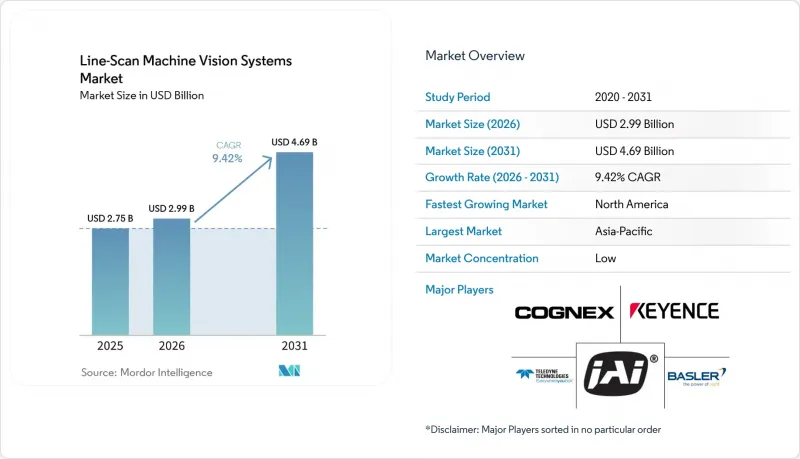
According to Mordor Intelligence, the Line-Scan machine vision systems market size was valued at USD 2.75 billion in 2025 and is estimated to grow from USD 2.99 billion in 2026 to reach USD 4.69 billion by 2031, at a CAGR of 9.42% during the forecast period (2026-2031).
Global Line-Scan Machine Vision Systems Market Trends and Insights
Zero-Defect Inspection in EV Battery and Semiconductor Lines
Battery electrode coating and semiconductor wafer inspection both require detecting defects before costly downstream processing. This makes inspection equipment a production requirement rather than an optional quality upgrade for many facilities. A 2025 peer-reviewed study reported 98.5% detection accuracy at 30 m/min for a YOLOv8 battery-electrode inspection system. The study also reported a false-alarm rate below 0.1%, a 67% reduction in defect rate, and an 81% reduction in quality-control cost. TSMC is deploying NVIDIA Metropolis and the TAO Toolkit for vision-based defect classification in fabs. New advanced packaging designs create fresh defect patterns, which can require recurring changes to TDI camera configurations in the Line-Scan Machine Vision Systems Market.
Expansion of Continuous-Web Manufacturing
Electrode coating, plastic film extrusion, lithium foil calendering, and paper production require full surface coverage at line speed. Line-scan cameras are suited to this work because they build a continuous image as material moves beneath the sensor. The input identifies electrode coating speeds of 400 m/min and paper machine output above 1,200 m/min. It also states that human inspection may cover 5% of output, while AI-enabled line-scan systems can cover 100% and record defect positions to the millimeter. Procemex states that its AI-based web inspection can classify up to 600 defects per second and has reduced web breaks by at least 50% at client sites. The data created by these installations can support process-control decisions, adding software and service value to the Line-Scan Machine Vision Systems Market.
Shortage of Line-Scan Integration Specialists
Effective deployment requires knowledge of sensors, optics, lighting, encoder synchronization, PLC connections, and AI model deployment. These skills are usually gained through production experience rather than through a single academic path. The U.S. Bureau of Labor Statistics reported 462,000 open manufacturing positions in March 2026 and a 2.3% hire rate. The draft notes that recruiting an experienced production line-scan integrator can take 9 to 12 weeks. Delayed commissioning can leave approved inspection capacity idle and postpone the expected return on investment. The issue can be more difficult for food, beverage, and packaging manufacturers that lack large internal project teams.
Other drivers and restraints analyzed in the detailed report include:
- Adoption of Edge AI for Real-Time Defect Classification
- Higher-Speed Interfaces and Sensor Resolution
- High Total Cost of Ownership for High-Resolution Systems
For complete list of drivers and restraints, kindly check the Table Of Contents.
Segment Analysis
PC-based platforms held 44.37% of the Line-Scan Machine Vision Systems Market size in 2025. Their position reflects the need for flexible configurations in semiconductor, flat-panel display, and multi-camera web inspection. These systems can coordinate lighting sequences, encoder compensation, and image fusion through frame grabbers and vision software. Their open design also accommodates GPU coprocessors and AI inference boards. This allows users to add local processing without replacing the core system design.
Contact Image Sensor systems are projected to grow at an 11.28% CAGR through 2031. Their wide-format coverage and direct contact geometry suit battery electrode inspection, where flat webs benefit from limited perspective distortion. Teledyne DALSA expanded its AxCIS family in May 2026 with models up to 1,800 dpi and 1,500 mm long. The models support monochrome line rates up to 80 kHz and native RGB 3-line rates up to 60 kHz. Smart-camera systems remain limited where multi-kilopixel output exceeds available memory bandwidth. Integrated designs also serve specialized hyperspectral and multispectral work that needs more than a standard camera and frame-grabber arrangement.
Standard line-scan accounted for 82.46% of the Line-Scan Machine Vision Systems Market in 2025. It remains the common choice for web, surface, and identification tasks across food, packaging, logistics, and metals production. Its lower unit cost and broad software compatibility support reach. High-speed multiline CMOS sensors are replacing older single-line CCD designs in many installations. This improves sensitivity while avoiding the added complexity of TDI systems.
TDI line-scan is forecast to expand at a 10.83% CAGR through 2031. Advanced semiconductor packaging inspection needs the signal-to-noise benefits of multi-stage integration when lighting is constrained. Teledyne DALSA released the Linea HS2 8K in June 2026 with a 1 MHz line rate, 8K resolution, a back-side-illuminated TDI sensor, and 5 µm pixel pitch. The product targets wafer, high-density interconnect, and genomics flow-cell inspection. The move from CCD-TDI to sCMOS-TDI improves quantum efficiency in the ultraviolet range and can shorten exposure times. Genomics and digital pathology add smaller sources of demand outside established industrial uses.
Complete Report Scope:
- By System Architecture
- PC-Based Line-Scan Systems
- Smart-Camera and Embedded/Edge-AI Line-Scan Systems
- Contact Image Sensor (CIS) Systems
- Other Integrated Line-Scan Systems
- By Scan Technique
- Standard Line-Scan
- TDI Line-Scan
- By Color Configuration
- Monochrome
- Color
- By Interface and Data-Transfer Standard
- USB3 Vision
- GigE Vision and 5GigE
- 10GigE and 25GigE
- Camera Link and Camera Link HS
- CoaXPress and CoaXPress-over-Fiber
- Proprietary and Hybrid Interfaces
- By Application
- Surface and Web Inspection
- Measurement and Metrology
- Identification, OCR, Barcode and Traceability
- Sorting and Classification
- Vision-Guided Robotics and Positioning
- Process Monitoring and Quality Control
- Other Applications
- Metals and Machinery
- Aerospace and Defense
- By End-User Industry
- Electronics and Semiconductors
- Automotive and EV/Battery
- Food and Beverage Processing
- Packaging and Printing
- Metals, Plastics, Glass and Textiles
- Pharmaceuticals and Medical Devices
- Logistics, Warehousing and E-Commerce
- Solar and Renewable Energy
- Aerospace and Defense
- Other Industrial Manufacturing
- By Geography
- North America
- United States
- Canada
- Mexico
- South America
- Brazil
- Argentina
- Rest of South America
- Europe
- Germany
- United Kingdom
- France
- Italy
- Spain
- Rest of Europe
- Asia-Pacific
- China
- Japan
- India
- South Korea
- Rest of Asia-Pacific
- Middle East and Africa
- Middle East
- Saudi Arabia
- United Arab Emirates
- Turkey
- Rest of the Middle East
- Africa
- South Africa
- Nigeria
- Rest of Africa
- Middle East
- North America
Geography Analysis
Asia-Pacific held 43.61% of the Line-Scan Machine Vision Systems Market share in 2025. Taiwan has a strong role because its semiconductor ecosystem includes fabs, equipment suppliers, integrators, and inspection OEMs. TSMC is using NVIDIA technology for AI-based wafer defect classification. South Korea is supported by Samsung and SK Hynix's capacity expansion in HBM and DRAM. China combines domestic fab construction with a large concentration of EV battery factories. Japan remains important through its precision manufacturing base and domestic electronics production.
North America is forecast to expand at an 11.47% CAGR through 2031, making it the fastest-growing regional segment. North America and Europe were the second- and third-largest regional blocs in 2025. Germany supports demand through EV assembly, battery-module production, and established web-converting activities. The EU Battery Regulation has required traceability data for certain EV battery categories since 2024. This increases the value of systems that log inspection results alongside surface-defect data. North American demand is supported by semiconductor reshoring and vision-guided robotics in automotive production. Cognex serves more than 30,000 customers across more than 30 countries, underscoring the region's role as both a technology hub and an end-user market.
South America, the Middle East, and Africa accounted for a smaller but developing share of the Line-Scan Machine Vision Systems Market. Brazil is the primary South American demand center due to automotive manufacturing and food-processing exports. Food processors use line-scan equipment for foreign-object detection and packaging-integrity checks. Saudi Arabia and the United Arab Emirates are investing in industrial automation, supporting early demand in electronics assembly and food processing. South Africa has an established automotive assembly base with Tier 1 suppliers using standard line-scan configurations for body-panel inspection. These regions are expected to adopt more high-resolution systems from 2028 as infrastructure develops and system costs decrease.
- Basler AG
- Teledyne Technologies Incorporated
- Cognex Corporation
- JAI A/S
- KEYENCE CORPORATION
- Vieworks Co., Ltd.
- Chromasens GmbH
- Nippon Electro-Sensory Devices Corporation
- Allied Vision Technologies GmbH
- IDS Imaging Development Systems GmbH
- Baumer Optronic GmbH
- SVS-Vistek GmbH
- Photonfocus AG
- LUCID Vision Labs Inc.
- Emergent Vision Technologies Inc.
- Alkeria S.r.l.
- Imperx, Inc.
- Raptor Photonics Limited
- OMRON SENTECH CO., LTD.
- Hefei I-TEK OptoElectronics Co., Ltd.
- Hikrobot Technology Co., Ltd.
- CMICRO Corporation
- PCO AG
- Adimec Advanced Image Systems B.V.
Additional Benefits:
- The market estimate (ME) sheet in Excel format
- 3 months of analyst support
TABLE OF CONTENTS
1 INTRODUCTION
- 1.1 Study Assumptions and Market Definition
- 1.2 Scope of the Study
2 RESEARCH METHODOLOGY
3 EXECUTIVE SUMMARY
4 MARKET LANDSCAPE
- 4.1 Market Overview
- 4.2 Market Drivers
- 4.2.1 Zero-Defect Inspection in EV Battery and Semiconductor Lines
- 4.2.2 Expansion of Continuous-Web Manufacturing
- 4.2.3 Adoption of Edge AI for Real-Time Defect Classification
- 4.2.4 Higher-Speed Interfaces and Sensor Resolution
- 4.2.5 Traceability and Quality Compliance in Regulated Production
- 4.2.6 Multispectral Imaging for Material-Level Defect Detection
- 4.3 Market Restraints
- 4.3.1 Shortage of Line-Scan Integration Specialists
- 4.3.2 High Total Cost of Ownership for High-Resolution Systems
- 4.3.3 Interface, Optics, Lighting, and Encoder Compatibility Complexity
- 4.3.4 Export Controls and Supply Volatility for Advanced Sensors
- 4.4 Impact of Macroeconomic Factors on the Market
- 4.5 Industry Supply Chain Analysis
- 4.6 Regulatory Landscape
- 4.7 Technological Outlook
- 4.8 Porter's Five Forces Analysis
- 4.8.1 Bargaining Power of Suppliers
- 4.8.2 Bargaining Power of Buyers
- 4.8.3 Threat of New Entrants
- 4.8.4 Threat of Substitutes
- 4.8.5 Intensity of Competitive Rivalry
5 MARKET SIZE AND GROWTH FORECASTS (VALUE)
- 5.1 By System Architecture
- 5.1.1 PC-Based Line-Scan Systems
- 5.1.2 Smart-Camera and Embedded/Edge-AI Line-Scan Systems
- 5.1.3 Contact Image Sensor (CIS) Systems
- 5.1.4 Other Integrated Line-Scan Systems
- 5.2 By Scan Technique
- 5.2.1 Standard Line-Scan
- 5.2.2 TDI Line-Scan
- 5.3 By Color Configuration
- 5.3.1 Monochrome
- 5.3.2 Color
- 5.4 By Interface and Data-Transfer Standard
- 5.4.1 USB3 Vision
- 5.4.2 GigE Vision and 5GigE
- 5.4.3 10GigE and 25GigE
- 5.4.4 Camera Link and Camera Link HS
- 5.4.5 CoaXPress and CoaXPress-over-Fiber
- 5.4.6 Proprietary and Hybrid Interfaces
- 5.5 By Application
- 5.5.1 Surface and Web Inspection
- 5.5.2 Measurement and Metrology
- 5.5.3 Identification, OCR, Barcode and Traceability
- 5.5.4 Sorting and Classification
- 5.5.5 Vision-Guided Robotics and Positioning
- 5.5.6 Process Monitoring and Quality Control
- 5.5.7 Other Applications
- 5.5.8 Metals and Machinery
- 5.5.9 Aerospace and Defense
- 5.6 By End-User Industry
- 5.6.1 Electronics and Semiconductors
- 5.6.2 Automotive and EV/Battery
- 5.6.3 Food and Beverage Processing
- 5.6.4 Packaging and Printing
- 5.6.5 Metals, Plastics, Glass and Textiles
- 5.6.6 Pharmaceuticals and Medical Devices
- 5.6.7 Logistics, Warehousing and E-Commerce
- 5.6.8 Solar and Renewable Energy
- 5.6.9 Aerospace and Defense
- 5.6.10 Other Industrial Manufacturing
- 5.7 By Geography
- 5.7.1 North America
- 5.7.1.1 United States
- 5.7.1.2 Canada
- 5.7.1.3 Mexico
- 5.7.2 South America
- 5.7.2.1 Brazil
- 5.7.2.2 Argentina
- 5.7.2.3 Rest of South America
- 5.7.3 Europe
- 5.7.3.1 Germany
- 5.7.3.2 United Kingdom
- 5.7.3.3 France
- 5.7.3.4 Italy
- 5.7.3.5 Spain
- 5.7.3.6 Rest of Europe
- 5.7.4 Asia-Pacific
- 5.7.4.1 China
- 5.7.4.2 Japan
- 5.7.4.3 India
- 5.7.4.4 South Korea
- 5.7.4.5 Rest of Asia-Pacific
- 5.7.5 Middle East and Africa
- 5.7.5.1 Middle East
- 5.7.5.1.1 Saudi Arabia
- 5.7.5.1.2 United Arab Emirates
- 5.7.5.1.3 Turkey
- 5.7.5.1.4 Rest of the Middle East
- 5.7.5.2 Africa
- 5.7.5.2.1 South Africa
- 5.7.5.2.2 Nigeria
- 5.7.5.2.3 Rest of Africa
- 5.7.5.1 Middle East
- 5.7.1 North America
6 COMPETITIVE LANDSCAPE
- 6.1 Market Concentration
- 6.2 Strategic Moves
- 6.3 Market Share Analysis
- 6.4 Company Profiles (includes Global Level Overview, Market Level Overview, Core Segments, Financials as available, Strategic Information, Market Rank/Share, Products and Services, Recent Developments)
- 6.4.1 Basler AG
- 6.4.2 Teledyne Technologies Incorporated
- 6.4.3 Cognex Corporation
- 6.4.4 JAI A/S
- 6.4.5 KEYENCE CORPORATION
- 6.4.6 Vieworks Co., Ltd.
- 6.4.7 Chromasens GmbH
- 6.4.8 Nippon Electro-Sensory Devices Corporation
- 6.4.9 Allied Vision Technologies GmbH
- 6.4.10 IDS Imaging Development Systems GmbH
- 6.4.11 Baumer Optronic GmbH
- 6.4.12 SVS-Vistek GmbH
- 6.4.13 Photonfocus AG
- 6.4.14 LUCID Vision Labs Inc.
- 6.4.15 Emergent Vision Technologies Inc.
- 6.4.16 Alkeria S.r.l.
- 6.4.17 Imperx, Inc.
- 6.4.18 Raptor Photonics Limited
- 6.4.19 OMRON SENTECH CO., LTD.
- 6.4.20 Hefei I-TEK OptoElectronics Co., Ltd.
- 6.4.21 Hikrobot Technology Co., Ltd.
- 6.4.22 CMICRO Corporation
- 6.4.23 PCO AG
- 6.4.24 Adimec Advanced Image Systems B.V.
7 MARKET OPPORTUNITIES AND FUTURE OUTLOOK
- 7.1 White-Space and Unmet-Need Assessment

