PUBLISHER: Mordor Intelligence | PRODUCT CODE: 2155216

PUBLISHER: Mordor Intelligence | PRODUCT CODE: 2155216
Area-Scan Machine Vision Systems - Market Share Analysis, Industry Trends & Statistics, Growth Forecasts (2026 - 2031)
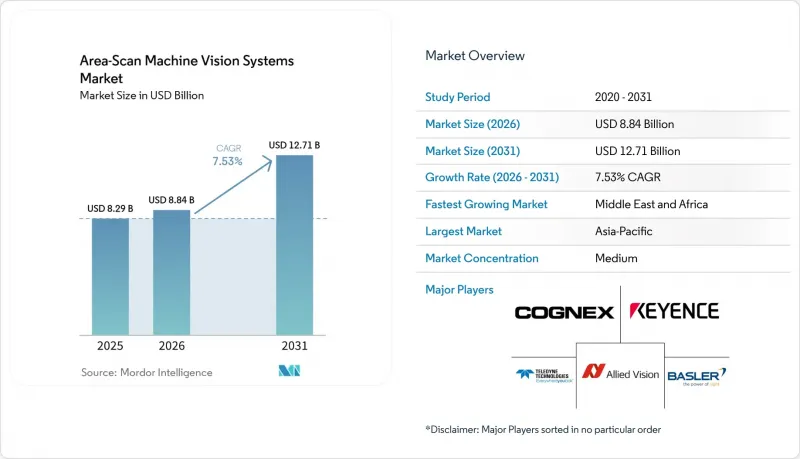
According to Mordor Intelligence, the Area-Scan machine vision systems market size was valued at USD 8.29 billion in 2025 and is estimated to grow from USD 8.84 billion in 2026 to reach USD 12.71 billion by 2031, at a CAGR of 7.53% during the forecast period (2026-2031).
Global Area-Scan Machine Vision Systems Market Trends and Insights
Zero-Defect Manufacturing and Traceability Requirements
Zero-defect requirements are moving camera deployments from selective checks to broader production-line coverage. Automotive and electronics suppliers need reliable records for critical parts and manufacturing steps. This raises the need for repeatable illumination, stable image capture, and connected data systems. A 2024 SPIE paper reported that AI-driven inline inspection reduced nuisance defects by up to 95% in high-volume manufacturing applications. The Area-Scan Machine Vision Systems Market benefits because broader traceability creates demand for cameras, storage, and local inference capacity. Suppliers that simplify validation can reduce the operational burden on manufacturers.
Semiconductor, Electronics, and EV Battery Capacity Expansion
Semiconductor and battery plants require inspection at multiple stages of production. Area-scan cameras support wafer identification, bonding checks, coating inspection, weld review, and foreign-object detection. A 2025 IEEE study described a system that combined high-speed 2D imaging with edge analytics across several stages of battery manufacturing. New capacity is usually delivered through multiyear projects rather than short purchase cycles. This gives the Area-Scan Machine Vision Systems Market a more visible pipeline in these applications. Demand remains exposed to changes in capital spending and consumer-electronics output.
Shortage of Skilled Machine Vision Integrators
A shortage of experienced integrators can delay system deployment even when suitable camera hardware is available. Many projects require skills in optics, lighting, software, AI model training, and manufacturing execution system connections. This combination is difficult to develop through standard automation training. OMRON is developing inspection agents using NVIDIA Metropolis Blueprint to reduce dependence on specialist engineering work. Pre-validated models and simpler configuration tools can shorten implementation work. The Area-Scan Machine Vision Systems Market faces slower adoption, where buyers cannot secure capable technical partners.
Other drivers and restraints analyzed in the detailed report include:
- Rising Adoption of Vision-Guided Robotics
- CMOS, Edge AI, and High-Bandwidth Interface Advancements
- High Total Cost of Ownership for High-Resolution Systems
For complete list of drivers and restraints, kindly check the Table Of Contents.
Segment Analysis
Monochrome systems held 62.14% of product-type revenue in 2025. Their position reflects strong use in electronics, automotive, and pharmaceutical inspection. These applications often need contrast detail rather than color information. Grayscale imaging can support high frame rates and consistent defect detection. The Area-Scan Machine Vision Systems Market size for monochrome systems is supported by installed production lines that use mature inspection methods.
Color systems are forecast to grow at an 8.81% CAGR through 2031. Food, beverage, pharmaceutical, and traceability tasks need visual distinctions that monochrome sensors cannot provide. Color cameras can check labels, coatings, produce condition, and package presentation. Better CMOS designs are improving color image quality under demanding lighting conditions. The Area-Scan Machine Vision Systems Market has room for color adoption where inspection decisions depend on spectral information.
CMOS sensors held 71.23% of sensor-type revenue in 2025. The Area-Scan Machine Vision Systems Market share for CMOS reflects gains in sensitivity, on-chip processing, and noise control. These devices support a broad range of inspection speeds and resolutions. Camera suppliers can also pair CMOS devices with newer Ethernet and CoaXPress interfaces. Emergent Vision introduced BOLT 25GigE camera models in 2026 with Sony Pregius S sensors and GigE Vision 3.0 support.
CCD sensors remain relevant where fixed-pattern noise requirements are especially strict. Scientific imaging and regulated life-sciences workflows can retain older sensor choices because qualification takes time. Other sensor types include SWIR InGaAs devices for moisture, seal, and subsurface inspections. A 2026 wafer-recognition study showed that 25 wafers could be processed in a cassette in 8 seconds with object-detection methods. The Area-Scan Machine Vision Systems Market continues to employ several sensor technologies for inspection conditions that differ.
Complete Report Scope:
- By Product Type
- Monochrome Area-Scan Systems
- Color Area-Scan Systems
- By Sensor Type
- CMOS Sensors
- CCD Sensors
- Other Sensor Types
- By Resolution
- Low Resolution: <1 MP
- Medium Resolution: 1-5 MP
- High Resolution: >5-20 MP
- Ultra-High Resolution: >20 MP
- By Interface Type
- GigE Vision
- USB3 Vision
- CoaXPress
- Camera Link
- Other Interface Types (includes MIPI CSI-2, Camera Link HS, and proprietary/embedded interfaces)
- By Application
- Defect Detection and Surface Inspection
- Measurement and Metrology
- Identification, Barcode Reading, and Optical Character Recognition
- Positioning and Robot Guidance
- Assembly Verification
- Sorting, Classification, and Grading
- By End-User Industry
- Automotive
- Electronics and Semiconductors
- Food and Beverage
- Pharmaceuticals and Healthcare
- Logistics and Packaging
- Industrial Machinery and Metals
- Printing and Labeling
- Scientific Research and Life Sciences
- By Geography
- North America
- United States
- Canada
- Mexico
- South America
- Brazil
- Argentina
- Rest of South America
- Europe
- Germany
- United Kingdom
- France
- Italy
- Spain
- Rest of Europe
- Asia-Pacific
- China
- Japan
- India
- South Korea
- Rest of Asia-Pacific
- Middle East and Africa
- Middle East
- Saudi Arabia
- United Arab Emirates
- Turkey
- Rest of the Middle East
- Africa
- South Africa
- Nigeria
- Rest of Africa
- Middle East
- North America
Geography Analysis
Asia-Pacific held 42.37% of global revenue in 2025. The Area-Scan Machine Vision Systems Market share in the region is supported by electronics manufacturing and semiconductor production in China, South Korea, Taiwan, and Japan. South Korea and Taiwan also supply demand from semiconductor and display manufacturing. Hikrobot reported FY2025 revenue of CNY 6.452 billion (USD 905 million) and completed its Tonglu manufacturing base in 2025, using the IRS yearly average exchange rate. Japan supports demand for high-specification monochrome and metrology cameras. India is drawing supplier attention as domestic factory automation expands.
North America and Europe represent the next major regional demand base. North American semiconductor plants and EV battery facilities require inspection equipment during greenfield construction and production ramp-up. Europe draws on Germany's automation base and inspection needs in food processing and pharmaceuticals. Basler reported FY2025 revenue of EUR 224.5 million (USD 253.3 million), compared with EUR 183.7 million (USD 198.8 million) in 2024, based on the IRS average annual exchange rate. Logistics, AI hardware production, and consumer-electronics battery manufacturing also contributed to project demand.
The Middle East and Africa are forecast to grow at an 8.92% CAGR through 2031. Industrial investment in Saudi Arabia and the United Arab Emirates is supporting manufacturing projects in food, pharmaceuticals, electronics assembly, and packaging. The Area-Scan Machine Vision Systems Market size in South America remains smaller, with Brazil leading demand for agricultural equipment inspection and food-safety automation. Currency volatility and economic uncertainty can limit long-cycle capital commitments. Suppliers need local service capacity to convert project interest into deployments.
- Basler AG
- Teledyne Technologies Incorporated
- Cognex Corporation
- KEYENCE CORPORATION
- Allied Vision Technologies GmbH
- Omron Corporation
- JAI A/S
- IDS Imaging Development Systems GmbH
- Baumer Holding AG
- SICK AG
- LMI Technologies Inc.
- Vieworks Co., Ltd.
- Toshiba Teli Corporation
- The Imaging Source Europe GmbH
- Daheng Imaging
- Hikrobot
- Sony Semiconductor Solutions Corporation
- Hamamatsu Photonics K.K.
- Adimec Advanced Image Systems B.V.
- Lucid Vision Labs Inc.
Additional Benefits:
- The market estimate (ME) sheet in Excel format
- 3 months of analyst support
TABLE OF CONTENTS
1 INTRODUCTION
- 1.1 Study Assumptions and Market Definition
- 1.2 Scope of the Study
2 RESEARCH METHODOLOGY
3 EXECUTIVE SUMMARY
4 MARKET LANDSCAPE
- 4.1 Market Overview
- 4.2 Market Drivers
- 4.2.1 Zero-Defect Manufacturing and Traceability Requirements
- 4.2.2 Semiconductor, Electronics, and EV Battery Capacity Expansion
- 4.2.3 Rising Adoption of Vision-Guided Robotics
- 4.2.4 CMOS, Edge AI, and High-Bandwidth Interface Advancements
- 4.2.5 Food, Pharmaceutical, and Packaging Inspection Automation
- 4.2.6 Labor Shortages and Factory Automation Investment
- 4.3 Market Restraints
- 4.3.1 Shortage of Skilled Machine Vision Integrators
- 4.3.2 High Total Cost of Ownership for High-Resolution Systems
- 4.3.3 Image Sensor Supply Volatility and Export Controls
- 4.3.4 Price Compression from Low-Cost Regional Suppliers
- 4.4 Impact of Macroeconomic Factors on the Market
- 4.5 Industry Supply Chain Analysis
- 4.6 Regulatory Landscape
- 4.7 Technological Outlook
- 4.8 Porter's Five Forces Analysis
- 4.8.1 Bargaining Power of Suppliers
- 4.8.2 Bargaining Power of Buyers
- 4.8.3 Threat of New Entrants
- 4.8.4 Threat of Substitutes
- 4.8.5 Intensity of Competitive Rivalry
5 MARKET SIZE AND GROWTH FORECASTS (VALUE)
- 5.1 By Product Type
- 5.1.1 Monochrome Area-Scan Systems
- 5.1.2 Color Area-Scan Systems
- 5.2 By Sensor Type
- 5.2.1 CMOS Sensors
- 5.2.2 CCD Sensors
- 5.2.3 Other Sensor Types
- 5.3 By Resolution
- 5.3.1 Low Resolution: <1 MP
- 5.3.2 Medium Resolution: 1-5 MP
- 5.3.3 High Resolution: >5-20 MP
- 5.3.4 Ultra-High Resolution: >20 MP
- 5.4 By Interface Type
- 5.4.1 GigE Vision
- 5.4.2 USB3 Vision
- 5.4.3 CoaXPress
- 5.4.4 Camera Link
- 5.4.5 Other Interface Types (includes MIPI CSI-2, Camera Link HS, and proprietary/embedded interfaces)
- 5.5 By Application
- 5.5.1 Defect Detection and Surface Inspection
- 5.5.2 Measurement and Metrology
- 5.5.3 Identification, Barcode Reading, and Optical Character Recognition
- 5.5.4 Positioning and Robot Guidance
- 5.5.5 Assembly Verification
- 5.5.6 Sorting, Classification, and Grading
- 5.6 By End-User Industry
- 5.6.1 Automotive
- 5.6.2 Electronics and Semiconductors
- 5.6.3 Food and Beverage
- 5.6.4 Pharmaceuticals and Healthcare
- 5.6.5 Logistics and Packaging
- 5.6.6 Industrial Machinery and Metals
- 5.6.7 Printing and Labeling
- 5.6.8 Scientific Research and Life Sciences
- 5.7 By Geography
- 5.7.1 North America
- 5.7.1.1 United States
- 5.7.1.2 Canada
- 5.7.1.3 Mexico
- 5.7.2 South America
- 5.7.2.1 Brazil
- 5.7.2.2 Argentina
- 5.7.2.3 Rest of South America
- 5.7.3 Europe
- 5.7.3.1 Germany
- 5.7.3.2 United Kingdom
- 5.7.3.3 France
- 5.7.3.4 Italy
- 5.7.3.5 Spain
- 5.7.3.6 Rest of Europe
- 5.7.4 Asia-Pacific
- 5.7.4.1 China
- 5.7.4.2 Japan
- 5.7.4.3 India
- 5.7.4.4 South Korea
- 5.7.4.5 Rest of Asia-Pacific
- 5.7.5 Middle East and Africa
- 5.7.5.1 Middle East
- 5.7.5.1.1 Saudi Arabia
- 5.7.5.1.2 United Arab Emirates
- 5.7.5.1.3 Turkey
- 5.7.5.1.4 Rest of the Middle East
- 5.7.5.2 Africa
- 5.7.5.2.1 South Africa
- 5.7.5.2.2 Nigeria
- 5.7.5.2.3 Rest of Africa
- 5.7.5.1 Middle East
- 5.7.1 North America
6 COMPETITIVE LANDSCAPE
- 6.1 Market Concentration
- 6.2 Strategic Moves
- 6.3 Market Share Analysis
- 6.4 Company Profiles (includes Global Level Overview, Market Level Overview, Core Segments, Financials as available, Strategic Information, Market Rank/Share, Products and Services, Recent Developments)
- 6.4.1 Basler AG
- 6.4.2 Teledyne Technologies Incorporated
- 6.4.3 Cognex Corporation
- 6.4.4 KEYENCE CORPORATION
- 6.4.5 Allied Vision Technologies GmbH
- 6.4.6 Omron Corporation
- 6.4.7 JAI A/S
- 6.4.8 IDS Imaging Development Systems GmbH
- 6.4.9 Baumer Holding AG
- 6.4.10 SICK AG
- 6.4.11 LMI Technologies Inc.
- 6.4.12 Vieworks Co., Ltd.
- 6.4.13 Toshiba Teli Corporation
- 6.4.14 The Imaging Source Europe GmbH
- 6.4.15 Daheng Imaging
- 6.4.16 Hikrobot
- 6.4.17 Sony Semiconductor Solutions Corporation
- 6.4.18 Hamamatsu Photonics K.K.
- 6.4.19 Adimec Advanced Image Systems B.V.
- 6.4.20 Lucid Vision Labs Inc.
7 MARKET OPPORTUNITIES AND FUTURE OUTLOOK
- 7.1 White-Space and Unmet-Need Assessment

