PUBLISHER: Mordor Intelligence | PRODUCT CODE: 2155248

PUBLISHER: Mordor Intelligence | PRODUCT CODE: 2155248
Bowen Disease Treatment - Market Share Analysis, Industry Trends & Statistics, Growth Forecasts (2026 - 2031)
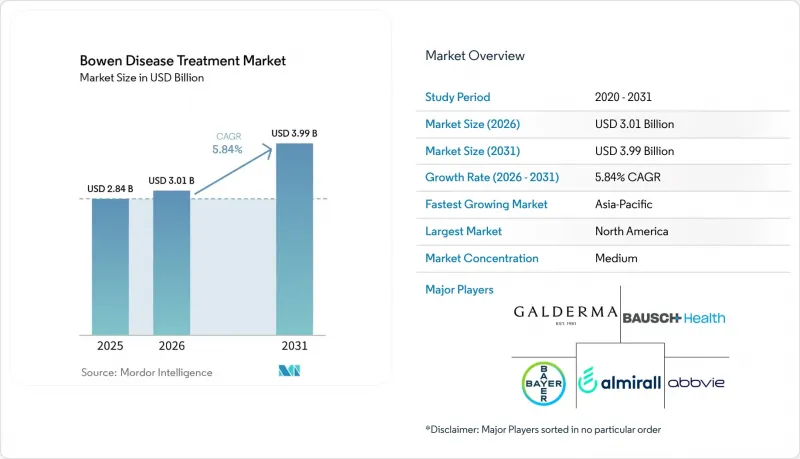
According to Mordor Intelligence, the bowen disease treatment market size was valued at USD 2.84 billion in 2025 and is estimated to grow from USD 3.01 billion in 2026 to reach USD 3.99 billion by 2031, at a CAGR of 5.84% during the forecast period (2026-2031).
Global Bowen Disease Treatment Market Trends and Insights
Rising Incidence of Bowen Disease and Non-Melanoma Skin Cancer
Epidemiological records are documenting a larger burden of Bowen disease that treatment systems have not fully absorbed. The Danish registry study of 100,705 patients found that combined keratinocyte carcinoma and Bowen disease incidence rose 172% from 2013 to 2022. The Capital Region and North Jutland recorded 714 and 405 cases per 100,000 person-years, respectively, showing material differences in recorded disease burden. These differences are consistent with variation in ultraviolet exposure and access to dermatology services. The Bowen disease treatment market benefits when health systems convert unrecorded lesions into confirmed diagnoses, planned treatment, and follow-up for lesions that may otherwise remain unmanaged. The reported incidence pattern also supports demand for protocols that accommodate lesion location, patient age, repeat monitoring, and the practical needs of dermatology services facing a growing documented caseload.
Cumulative Ultraviolet Exposure and Outdoor Occupational Risk
Cumulative solar exposure supports a durable need for skin lesion detection and treatment among outdoor workers. A nationwide Danish cohort of 2.94 million workers found an adjusted basal cell carcinoma incidence rate ratio of 1.58 in the highest occupational ultraviolet exposure quartile compared with the lowest. The study reported a similar exposure-response pattern for squamous cell carcinoma, the broader disease category that includes Bowen disease. Construction, agriculture, postal delivery, and maritime workforces remain under-screened in many countries, despite repeated exposure over long working lives. More systematic surveillance could move these workers into biopsy, referral, and treatment pathways without requiring a change in clinical practice. The Bowen disease treatment market, therefore, has an additional route to growth through employer-supported detection and occupational health referral systems.
Misdiagnosis and Delayed Biopsy
Misidentification can delay definitive care and can reduce the usefulness of lower-intensity treatment options. A 2025 case report described a patient whose Bowen disease was treated as dermatitis for 10 years before histopathological confirmation. The lesion measured 35 by 40 mm at confirmation, while lesions above 10 mm were associated with a 2.66-fold higher risk of treatment failure. Larger lesions may require more intensive treatment and can reduce clearance with nonsurgical approaches. Biopsy remains important when a lesion is clinically uncertain, particularly before treatment selection in the Bowen disease treatment market. Teledermatology and point-of-care triage can improve referral speed, but they do not replace clinical confirmation or a pathway that ensures patients receive appropriate follow-up.
Other drivers and restraints analyzed in the detailed report include:
- Aging and Immunosuppressed Patient Populations
- Laser-Assisted Photodynamic Therapy Improving Clearance
- Recurrence and Incomplete Clearance After Non-Surgical Treatment
For complete list of drivers and restraints, kindly check the Table Of Contents.
Segment Analysis
Treatment type captured 63.47% of the combined treatment modalities and drugs segment in 2025, reflecting the higher revenue per episode generated by surgical excision, photodynamic therapy, cryotherapy, and curettage with electrodessication. The Bowen disease treatment market combines procedure-related revenue with drug use when a patient requires both clinical intervention and pharmaceutical management. Topical therapy spans the modality and drug categories, retaining volume through established prescribing familiarity and use across high-resource and cost-sensitive care settings. Drug type represented the remaining 36.53% in 2025, supported by transplant-patient prescribing and a growing generic base for fluorouracil and imiquimod. The Bowen disease treatment market is shaped by the fact that laser-assisted photodynamic therapy and surgical excision often use procedural and pharmacological inputs within the same treatment episode.
Drug type is forecast to grow at a 6.27% CAGR through 2031, making it the fastest-growing part of this combined segmentation. Rising immunosuppression prevalence and the use of imiquimod and fluorouracil in post-transplant chemoprophylactic protocols expand prescribing beyond active lesion treatment. Telehealth-enabled prescribing can also support maintenance-phase topical access outside the limits of specialist appointment capacity. Next-generation photosensitizer formulations used with laser-assisted photodynamic therapy are narrowing the distinction between procedural and pharmacological treatment categories. The bowen disease treatment market may favor participants that can provide integrated modality and drug portfolios as payers and guideline organizations formalize bundled treatment benchmarks through 2031.
Complete Report Scope:
- By Treatment Modalities and Drugs
- By Treatment Type
- Topical Therapy
- Surgical Excision
- Photodynamic Therapy
- Cryotherapy
- Curettage and Electrodessication
- Others
- By Drug Type
- Fluorouracil
- Imiquimod
- Diclofenac
- Others
- By Treatment Type
- By End User
- Hospitals
- Dermatology Clinics
- Ambulatory Surgical Centers
- Others
- By Distribution Channel
- Hospital Pharmacy
- Retail Pharmacy
- Online Pharmacy
- By Geography
- North America
- United States
- Canada
- Mexico
- Europe
- Germany
- United Kingdom
- France
- Italy
- Spain
- Rest of Europe
- Asia-Pacific
- China
- India
- Japan
- Australia
- South Korea
- Rest of Asia-Pacific
- Middle East & Africa
- GCC
- South Africa
- Rest of MEA
- South America
- Brazil
- Argentina
- Rest of South America
- North America
Geography Analysis
North America held 36.41% of the Bowen disease treatment market share in 2025, supported by established biopsy referral pathways and reimbursement for photodynamic therapy and surgical excision. The United States accounted for most regional revenue and recorded 48,149 solid organ transplants in 2024. The U.S. Food and Drug Administration granted De Novo clearance to DermaSensor in January 2024 for skin cancer evaluation in primary care. The company reported 96% sensitivity for squamous cell carcinoma in a Mayo Clinic-led pivotal study of 1,005 patients and 1,579 lesions. Canada adds demand in higher-ultraviolet-exposure populations, while public health constraints limit the adoption of photodynamic therapy and image-guided superficial radiation therapy in Mexico.
Europe remains the second-largest geographic area, with Germany, the United Kingdom, France, Italy, and Spain forming its commercial base. United Kingdom epidemiological data cited in the source material reported an annual Bowen disease rate of 15 per 100,000 population, with higher rates in sun-exposed coastal and rural communities. The European Academy of Dermatology and Venereology recommendation for methyl aminolevulinate photodynamic therapy supports procedural adoption across member states. Denmark's registry tracked 190,468 keratinocyte carcinoma and Bowen disease cases over a decade. Registry-led care can connect disease surveillance with evidence-based treatment volumes.
Asia-Pacific is forecast to grow at an 8.49% CAGR through 2031, making it the fastest-growing regional part of the Bowen disease treatment market. Korea's national study found a 12-fold increase in Bowen disease incidence from 1999 to 2019. China is building light-based dermatology capacity, while Japan's in situ squamous cell carcinoma represented 18.3% of its squamous cell carcinoma-category diagnoses in the research. Australia recorded a non-melanoma skin cancer age-standardized incidence rate of 111.2 per 100,000 among women in 2024. Middle East and Africa remain smaller, with GCC investment in tertiary dermatology and South Africa serving as a principal treatment hub. Brazil leads South America through a large dermatologist base and growing private insurance coverage, while access constraints continue to favor topical generics elsewhere in the region.
- Abbvie
- Almirall S.A.
- Bausch Health
- Bayer
- Biofrontera
- DermaSensor, Inc.
- Galderma
- Leo Pharma
- Lumenis
- Merck
- Modulight Corporation
- Novartis
- Perrigo Company
- Pfizer
- Sanofi
- SkinCure Oncology
- Sun Pharmaceuticals Industries
- Taro Pharmaceutical Industries Ltd.
- Teva Pharmaceutical Industries
- Tolmar Pharmaceuticals
- Viatris
Additional Benefits:
- The market estimate (ME) sheet in Excel format
- 3 months of analyst support
TABLE OF CONTENTS
1 Introduction
- 1.1 Study Assumptions & Market Definition
- 1.2 Scope of the Study
2 Research Methodology
3 Executive Summary
4 Market Landscape
- 4.1 Market Overview
- 4.2 Market Drivers
- 4.2.1 Rising Incidence of Bowen Disease and Non-Melanoma Skin Cancer
- 4.2.2 Cumulative Ultraviolet Exposure and Outdoor Occupational Risk
- 4.2.3 Aging and Immunosuppressed Patient Populations
- 4.2.4 Preference for Non-Invasive, Cosmetic-Friendly Treatment
- 4.2.5 Wider Use of Teledermatology and Earlier Lesion Detection
- 4.2.6 Laser-Assisted Photodynamic Therapy Improving Clearance
- 4.3 Market Restraints
- 4.3.1 Misdiagnosis and Delayed Biopsy
- 4.3.2 Recurrence and Incomplete Clearance After Non-Surgical Treatment
- 4.3.3 Treatment-Protocol Heterogeneity and Limited Long-Term Evidence
- 4.3.4 Reimbursement, Access, and Treatment-Cost Gaps
- 4.4 Value / Supply-Chain Analysis
- 4.5 Regulatory Landscape
- 4.6 Technological Outlook
- 4.7 Porter's Five Forces Analysis
- 4.7.1 Threat of New Entrants
- 4.7.2 Bargaining Power of Buyers
- 4.7.3 Bargaining Power of Suppliers
- 4.7.4 Threat of Substitutes
- 4.7.5 Competitive Rivalry
5 Market Size & Growth Forecasts (Value, USD)
- 5.1 By Treatment Modalities and Drugs
- 5.1.1 By Treatment Type
- 5.1.1.1 Topical Therapy
- 5.1.1.2 Surgical Excision
- 5.1.1.3 Photodynamic Therapy
- 5.1.1.4 Cryotherapy
- 5.1.1.5 Curettage and Electrodessication
- 5.1.1.6 Others
- 5.1.2 By Drug Type
- 5.1.2.1 Fluorouracil
- 5.1.2.2 Imiquimod
- 5.1.2.3 Diclofenac
- 5.1.2.4 Others
- 5.1.1 By Treatment Type
- 5.2 By End User
- 5.2.1 Hospitals
- 5.2.2 Dermatology Clinics
- 5.2.3 Ambulatory Surgical Centers
- 5.2.4 Others
- 5.3 By Distribution Channel
- 5.3.1 Hospital Pharmacy
- 5.3.2 Retail Pharmacy
- 5.3.3 Online Pharmacy
- 5.4 By Geography
- 5.4.1 North America
- 5.4.1.1 United States
- 5.4.1.2 Canada
- 5.4.1.3 Mexico
- 5.4.2 Europe
- 5.4.2.1 Germany
- 5.4.2.2 United Kingdom
- 5.4.2.3 France
- 5.4.2.4 Italy
- 5.4.2.5 Spain
- 5.4.2.6 Rest of Europe
- 5.4.3 Asia-Pacific
- 5.4.3.1 China
- 5.4.3.2 India
- 5.4.3.3 Japan
- 5.4.3.4 Australia
- 5.4.3.5 South Korea
- 5.4.3.6 Rest of Asia-Pacific
- 5.4.4 Middle East & Africa
- 5.4.4.1 GCC
- 5.4.4.2 South Africa
- 5.4.4.3 Rest of MEA
- 5.4.5 South America
- 5.4.5.1 Brazil
- 5.4.5.2 Argentina
- 5.4.5.3 Rest of South America
- 5.4.1 North America
6 Competitive Landscape
- 6.1 Market Concentration
- 6.2 Market Share Analysis
- 6.3 Company Profiles (includes Global Level Overview, Market Level Overview, Core Segments, Financials as Available, Strategic Information, Market Rank/Share for Key Companies, Products & Services, and Recent Developments)
- 6.3.1 AbbVie Inc.
- 6.3.2 Almirall S.A.
- 6.3.3 Bausch Health Companies Inc.
- 6.3.4 Bayer AG
- 6.3.5 Biofrontera AG
- 6.3.6 DermaSensor, Inc.
- 6.3.7 Galderma S.A.
- 6.3.8 LEO Pharma A/S
- 6.3.9 Lumenis Ltd.
- 6.3.10 Merck & Co., Inc.
- 6.3.11 Modulight Corporation
- 6.3.12 Novartis AG
- 6.3.13 Perrigo Company plc
- 6.3.14 Pfizer Inc.
- 6.3.15 Sanofi S.A.
- 6.3.16 SkinCure Oncology
- 6.3.17 Sun Pharmaceutical Industries Ltd.
- 6.3.18 Taro Pharmaceutical Industries Ltd.
- 6.3.19 Teva Pharmaceutical Industries Ltd.
- 6.3.20 Tolmar Pharmaceuticals, Inc.
- 6.3.21 Viatris Inc.
7 Market Opportunities & Future Outlook
- 7.1 White-space & Unmet-need Assessment

