PUBLISHER: Mordor Intelligence | PRODUCT CODE: 2155264

PUBLISHER: Mordor Intelligence | PRODUCT CODE: 2155264
MWIR Industrial Camera - Market Share Analysis, Industry Trends & Statistics, Growth Forecasts (2026 - 2031)
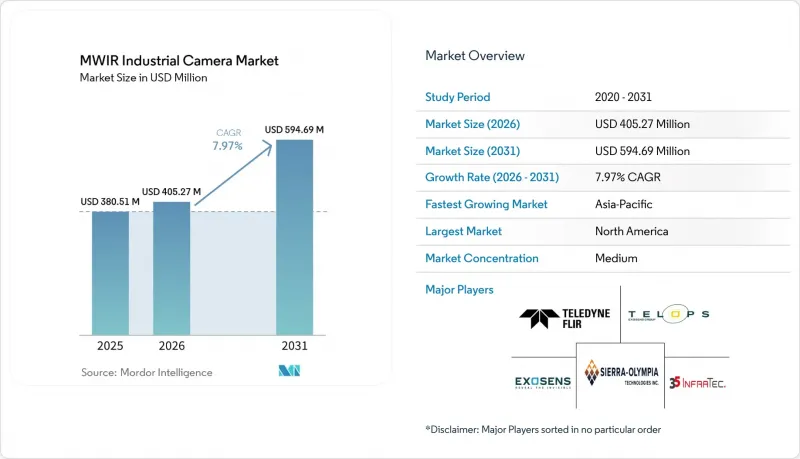
According to Mordor Intelligence, the MWIR industrial camera market size is projected to be USD 380.51 million in 2025, USD 405.27 million in 2026, and reach USD 594.69 million by 2031, growing at a CAGR of 7.97% from 2026 to 2031.
Global MWIR Industrial Camera Market Trends and Insights
Defense Modernization and Persistent ISR Procurement
Defense spending programs across NATO and Indo-Pacific countries are supporting more predictable procurement cycles for the MWIR industrial camera market. Armed drones, counter-UAS batteries, and persistent ground surveillance systems require more thermal sensors across programs. Buyers need systems with a wide performance range, compact designs, and low power requirements for land, naval, and airborne platforms. The Indian Navy acquired cooled high-definition MWIR EO/IR systems from Tonbo Imaging for more than 40 naval vessels during 2025, with vessel detection beyond 25 km. Teledyne FLIR OEM introduced the Neutrino SX8 ISR 50-1000 in February 2026, combining a 27,000-hour cooler rating, AI-ready processing, and a 34 km vehicle detection range. As platform volumes rise, suppliers are competing more directly on cooler life, integration readiness, and electronics that support automated image processing.
Industrial Predictive Maintenance and Process Automation
Industrial sites are moving from periodic thermal inspections toward installed systems that collect thermal information throughout the operating cycle. This transition supports demand for MWIR cameras that can detect abnormal heat patterns before equipment failures disrupt operations. The US Department of Energy identifies predictive maintenance as a route to lower operating costs when compared with reactive maintenance practices. Manufacturing buyers use this rationale when evaluating cameras for blast furnace monitoring, composite inspection, battery cell quality control, and semiconductor production. FLIR launched the A6450 in February 2026 with a linear cooler designed for up to 27,000 hours of operation, addressing a prior barrier to continuous deployment of cooled cameras. Thermographic maintenance guidance under NFPA 70B further supports consistent inspection practices for electrical infrastructure, manufacturing equipment, and utility assets.
Cryogenic Cooling Cost and Maintenance Burden
Cryogenic cooling remains a high-cost and service-related constraint for cooled MWIR cameras outside defense and high-value industrial applications. Legacy Stirling cryocoolers often required factory overhauls after 8,000-12,000 operating hours, creating downtime and service-planning challenges. This issue is especially important for manufacturers, utilities, and automotive facilities that need high equipment availability but do not maintain dedicated electro-optics support teams. Advances in HOT detector design are reducing cooling power needs and limiting mechanical wear at higher operating temperatures. Research on InAs/InAsSb nBn devices reported stable operation at 230 K, with noise-equivalent temperature differences below 15 mK. Research published in 2025 also reported that AI-based image enhancement could improve images from xBn MWIR cameras operating at 180 K.
Other drivers and restraints analyzed in the detailed report include:
- Optical Gas Imaging and Emissions Compliance Deployment
- Drone-Integrated Inspection and Counter-UAS Adoption
- Export Controls and ITAR/EAR Procurement Friction
For complete list of drivers and restraints, kindly check the Table Of Contents.
Segment Analysis
Fixed and mounted cameras held 42.68% of the MWIR industrial camera market share in 2025. Their position reflects use in continuous monitoring across production lines, oil and gas sites, and permanent border security installations. A longer, cooler service life makes fixed cooled systems more suitable for long operating cycles. GigE Vision and GenICam protocols also support integration with existing industrial automation environments. Handheld and portable cameras remain important for field LDAR, military reconnaissance, and inspection work where mobility is essential. Pan-tilt-zoom and multi-sensor systems serve long-range perimeter surveillance, naval installations, and applications that require motorized positioning or sensor fusion.
OEM camera cores and modules are projected to expand at a 9.84% CAGR through 2031 within the MWIR industrial camera market size. Drone, robotics, and autonomous vehicle developers can add MWIR capability without building an entire camera system. This approach reduces the need for each integrator to develop cryogenic, optical, and processing expertise internally. It also places greater emphasis on standardized interfaces, dependable supply, and application-specific calibration. LYNRED's PlugUp platform standardizes cooled MWIR detector interfaces across product families, supporting common choices for detector, cooler, and readout integration. The wider availability of modules can extend MWIR use into specialized applications without requiring module suppliers to serve every end market directly.
Complete Report Scope:
- By Product Type
- Fixed and Mounted Cameras
- Handheld and Portable Cameras
- OEM Camera Cores and Modules
- Pan Tilt Zoom and Multi Sensor Systems
- By Detector Technology
- Cooled MWIR Cameras
- Uncooled/HOT MWIR Cameras
- By End-User Industry
- Manufacturing
- Oil and Gas
- Power Generation and Utilities
- Aerospace and Defense
- Automotive and Transportation
- Research Institutes
- Other End-User Industries
- By Geography
- North America
- United States
- Canada
- Mexico
- South America
- Brazil
- Argentina
- Rest of South America
- Europe
- Germany
- United Kingdom
- France
- Italy
- Spain
- Rest of Europe
- Asia-Pacific
- China
- Japan
- South Korea
- India
- Taiwan
- Rest of Asia-Pacific
- Middle East
- United Arab Emirates
- Saudi Arabia
- Rest of Middle East
- Africa
- South Africa
- Egypt
- Rest of Africa
- North America
Geography Analysis
North America held 38.76% of the MWIR industrial camera market share in 2025. US defense ISR procurement has established optical gas imaging requirements and installed cameras at petrochemical, power, and aerospace sites to support its position. Canada's oil sands operations require remote pipeline emissions monitoring. Mexico's manufacturing expansion is adding demand for predictive maintenance systems. China's germanium export restrictions led buyers to place greater importance on secure domestic optical and detector supply. LightPath Technologies has redesigned certain infrared optical assemblies using BlackDiamond materials to reduce exposure to future germanium supply disruptions.
Asia-Pacific is projected to expand at a 9.41% CAGR through 2031. China, India, South Korea, Taiwan, and Japan are increasing their defense capabilities and investment in industrial automation. In 2025, Tonbo Imaging supplied cooled high-definition MWIR EO/IR systems for more than 40 Indian Navy vessels, with detection capabilities beyond 25 km. China's investment in HgCdTe detector production supports domestic consumption and competition in commercial camera applications. Japan allocated USD 52 million for the procurement of counter-drone systems in fiscal 2026. Taiwan's semiconductor and advanced electronics plants are adopting MWIR systems for process monitoring and non-destructive inspection of advanced packages.
Europe has an important MWIR industrial camera market because of its defense base and emissions-monitoring requirements. The United Kingdom, Germany, France, and Scandinavian countries support demand across defense and industrial applications. LYNRED's SPIRIT initiative involves 15 organizations from 9 European countries. It has a EUR 39.16 million (USD 43.08 million) budget, including EUR 29 million (USD 31.9 million) in European Defense Fund co-funding. The Middle East and Africa are buying systems for offshore patrol vessels, coastal surveillance, and critical infrastructure. South America has a developing demand for oil and gas emissions monitoring, while African demand centers on border security and infrastructure protection.
- Teledyne FLIR LLC
- Telops Inc.
- Sierra-Olympic Technologies, Inc.
- IRCameras LLC
- InfraTec GmbH
- DIAS Infrared GmbH
- New Infrared Technologies, S.L.
- Silent Sentinel Limited
- Infiniti Electro-Optics, a division of Ascendent Technology Group, Inc.
- Axiom Optics, Inc.
- Excelitas Technologies Corp.
- Lynred S.A.S.
- Exosens S.A.
- HGH Infrared Systems SAS
- LightPath Technologies, Inc.
- Princeton Infrared Technologies, Inc.
- Photonis Netherlands B.V.
- M3 Measurement Solutions, Inc.
- Optronic Laboratories, Inc.
Additional Benefits:
- The market estimate (ME) sheet in Excel format
- 3 months of analyst support
TABLE OF CONTENTS
1 INTRODUCTION
- 1.1 Study Assumptions and Market Definition
- 1.2 Scope of the Study
2 RESEARCH METHODOLOGY
3 EXECUTIVE SUMMARY
4 MARKET LANDSCAPE
- 4.1 Market Overview
- 4.2 Impact of Macroeconomic Factors on the Market
- 4.3 Market Drivers
- 4.3.1 Defense Modernization and Persistent ISR Procurement
- 4.3.2 Industrial Predictive Maintenance and Process Automation
- 4.3.3 Optical Gas Imaging and Emissions-Compliance Deployment
- 4.3.4 Drone-Integrated Inspection and Counter-UAS Adoption
- 4.3.5 Edge AI Reducing MWIR Integration Friction
- 4.3.6 High-Temperature Process Visibility Through Flames and Smoke
- 4.4 Market Restraints
- 4.4.1 Cryogenic Cooling Cost and Maintenance Burden
- 4.4.2 Export Controls and ITAR/EAR Procurement Friction
- 4.4.3 Specialist Detector and Cooler Supply Constraints
- 4.4.4 Calibration, Integration and Operator-Skills Bottlenecks
- 4.5 Industry Value Chain Analysis
- 4.6 Regulatory Landscape
- 4.7 Technological Outlook
- 4.8 Porter's Five Forces Analysis
- 4.8.1 Bargaining Power of Suppliers
- 4.8.2 Bargaining Power of Buyers
- 4.8.3 Threat of New Entrants
- 4.8.4 Threat of Substitutes
- 4.8.5 Intensity of Competitive Rivalry
5 MARKET SIZE AND GROWTH FORECASTS (VALUE)
- 5.1 By Product Type
- 5.1.1 Fixed and Mounted Cameras
- 5.1.2 Handheld and Portable Cameras
- 5.1.3 OEM Camera Cores and Modules
- 5.1.4 Pan Tilt Zoom and Multi Sensor Systems
- 5.2 By Detector Technology
- 5.2.1 Cooled MWIR Cameras
- 5.2.2 Uncooled/HOT MWIR Cameras
- 5.3 By End-User Industry
- 5.3.1 Manufacturing
- 5.3.2 Oil and Gas
- 5.3.3 Power Generation and Utilities
- 5.3.4 Aerospace and Defense
- 5.3.5 Automotive and Transportation
- 5.3.6 Research Institutes
- 5.3.7 Other End-User Industries
- 5.4 By Geography
- 5.4.1 North America
- 5.4.1.1 United States
- 5.4.1.2 Canada
- 5.4.1.3 Mexico
- 5.4.2 South America
- 5.4.2.1 Brazil
- 5.4.2.2 Argentina
- 5.4.2.3 Rest of South America
- 5.4.3 Europe
- 5.4.3.1 Germany
- 5.4.3.2 United Kingdom
- 5.4.3.3 France
- 5.4.3.4 Italy
- 5.4.3.5 Spain
- 5.4.3.6 Rest of Europe
- 5.4.4 Asia-Pacific
- 5.4.4.1 China
- 5.4.4.2 Japan
- 5.4.4.3 South Korea
- 5.4.4.4 India
- 5.4.4.5 Taiwan
- 5.4.4.6 Rest of Asia-Pacific
- 5.4.5 Middle East
- 5.4.5.1 United Arab Emirates
- 5.4.5.2 Saudi Arabia
- 5.4.5.3 Rest of Middle East
- 5.4.6 Africa
- 5.4.6.1 South Africa
- 5.4.6.2 Egypt
- 5.4.6.3 Rest of Africa
- 5.4.1 North America
6 COMPETITIVE LANDSCAPE
- 6.1 Market Concentration
- 6.2 Strategic Moves
- 6.3 Market Share Analysis
- 6.4 Company Profiles (includes Global Level Overview, Market Level Overview, Core Segments, Financials as available, Strategic Information, Market Rank/Share, Products and Services, Recent Developments)
- 6.4.1 Teledyne FLIR LLC
- 6.4.2 Telops Inc.
- 6.4.3 Sierra-Olympic Technologies, Inc.
- 6.4.4 IRCameras LLC
- 6.4.5 InfraTec GmbH
- 6.4.6 DIAS Infrared GmbH
- 6.4.7 New Infrared Technologies, S.L.
- 6.4.8 Silent Sentinel Limited
- 6.4.9 Infiniti Electro-Optics, a division of Ascendent Technology Group, Inc.
- 6.4.10 Axiom Optics, Inc.
- 6.4.11 Excelitas Technologies Corp.
- 6.4.12 Lynred S.A.S.
- 6.4.13 Exosens S.A.
- 6.4.14 HGH Infrared Systems SAS
- 6.4.15 LightPath Technologies, Inc.
- 6.4.16 Princeton Infrared Technologies, Inc.
- 6.4.17 Photonis Netherlands B.V.
- 6.4.18 M3 Measurement Solutions, Inc.
- 6.4.19 Optronic Laboratories, Inc.
7 MARKET OPPORTUNITIES AND FUTURE OUTLOOK
- 7.1 White-Space and Unmet-Need Assessment

