PUBLISHER: Mordor Intelligence | PRODUCT CODE: 2155276

PUBLISHER: Mordor Intelligence | PRODUCT CODE: 2155276
Multispectral Industrial Camera - Market Share Analysis, Industry Trends & Statistics, Growth Forecasts (2026 - 2031)
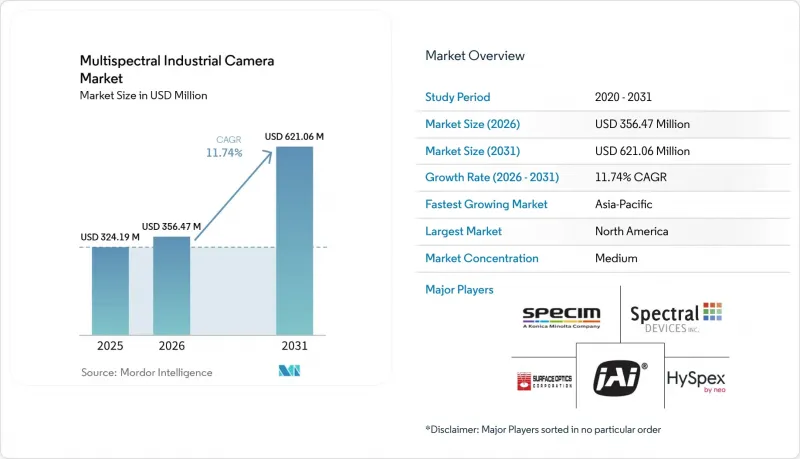
According to Mordor Intelligence, the multispectral industrial camera market size is projected to expand from USD 324.19 million in 2025 and USD 356.47 million in 2026 to USD 621.06 million by 2031, registering a CAGR of 11.74% between 2026 and 2031.
Global Multispectral Industrial Camera Market Trends and Insights
Expansion of AI-Enabled Automated Inspection
AI models trained on spectral signatures can extend industrial quality checks beyond RGB and structured-light systems, including full-line detection of contaminants, subsurface cracks, and active-ingredient distribution issues. A 2025 study demonstrated an inline, multi-wavelength pharmaceutical monitoring system using carbon nanotube photothermoelectric imagers across sub-THz and infrared frequencies without destroying the sample. This supports combined AI and spectral imaging at production speed. Processing spectral data near the camera can reduce transfer delays that previously limited inspection to sampled workflows. Suppliers that combine sensing, inference, and trained models can provide a more complete package for plants with limited spectral expertise. The multispectral industrial camera market, therefore, favors systems that make continuous spectral classification practical in ordinary production settings.
Spectral Inspection in Food and Pharmaceutical Production
Food and pharmaceutical lines require inspection methods that do not damage products. The US Food Safety Modernization Act and the European Union Official Controls Regulation establish compliance frameworks in which traceable checks matter. A 2025 pharmaceutical study found that near-infrared hyperspectral imaging improved tablet quality assessment through spectral maps of active ingredient distribution. These maps provide information that batch sampling cannot provide across every tablet. A 2025 food-quality review identified model transferability between production lines as a larger scaling issue than camera sensitivity. The multispectral industrial camera market benefits as audit practice increases demand for stable calibration, usable reporting, and repeatable inspection.
High System Integration and Calibration Costs
Production-floor deployment requires coordination among optics, illumination, spectral software, and factory-control systems, which can add 40-80% to the camera unit cost before the first production scan. A 2025 review attributed many deployment failures to shortcomings in post-installation calibration rather than to hardware limitations. Large processors can distribute these costs across high-volume lines, while small- and mid-sized manufacturers may choose simpler RGB-plus-NIR configurations. Process analytical technology guidance and machine-safety requirements can add validation work after hardware commissioning. The multispectral industrial camera market remains less accessible when deployment time and commissioning work exceed a buyer's internal capacity. Pre-calibrated systems and simplified interfaces can reduce variation between installations and lower the barrier for smaller users.
Other drivers and restraints analyzed in the detailed report include:
- Precision Agriculture and Resource-Efficient Farming
- Defense and Border-Surveillance Modernization
- Shortage of Spectral-Imaging and Machine-Vision Specialists
For complete list of drivers and restraints, kindly check the Table Of Contents.
Segment Analysis
Multispectral Camera Systems captured 44.62% of the multispectral industrial camera market share in 2025. Food sorting, pharmaceutical inspection, and semiconductor wafer verification support demand for integrated optical and spectral systems. Buyers need the optics, illumination, sensing, and calibration elements to work together. They also seek documented performance for spectral resolution, throughput, and calibration stability. Multispectral Camera Arrays serve fixed, multi-angle inspection in warehouses and logistics sites.
Multispectral Camera Modules and Sensors are projected to expand at a 14.18% CAGR through 2031. OEMs are embedding compact modules in agricultural drones, robotic picking arms, and handheld inspection equipment. Leopard Imaging and Sony Semiconductor Solutions announced the LI-IMX454 camera in May 2025. The system used 8 spectral filters per photodiode to capture 41 wavelengths from 450-850 nm in a single shot. These products increase OEM demand in the multispectral industrial camera market and broaden the industry's role.
Pushbroom Imaging held 39.84% of the technology value in 2025. It remains important for conveyor-based food sorting and pharmaceutical tablet inspection. The design offers strong spectral resolution and signal-to-noise performance in controlled line-scan environments. Specim introduced the FX19 in February 2026 for the 1,130-1,920 nm range, with 640 spatial pixels and up to 527 fps. This release shows continued improvement in pushbroom throughput within the multispectral industrial camera market.
Snapshot Imaging is projected to expand at a 13.72% CAGR through 2031. It is used for robotic bin picking, UAV monitoring, and waste classification, where movement complicates sequential capture. A 2026 study demonstrated a 9-camera NIR bandpass array for household plastic classification. The reported system reached 86.7% classification accuracy with a 2.6 µs per-pixel runtime. The multispectral industrial camera market supports this shift toward fast-moving inspection applications.
Complete Report Scope:
- By Product Type
- Multispectral Camera Systems
- Multispectral Camera Modules and Sensors
- Multispectral Camera Arrays
- Integrated Camera and Illumination Systems
- By Technology
- Snapshot Imaging
- Pushbroom Imaging
- Multiline and TDI Imaging
- Filter-Based Imaging
- By Spectral Range
- Visible to Near-Infrared (VIS-NIR)
- Short-Wave Infrared (SWIR)
- Thermal Infrared (MWIR/LWIR)
- Multi-Band Systems
- By End-User Industry
- Food and Agriculture
- Electronics and Semiconductors
- Automotive and Transportation
- Pharmaceuticals and Medical Devices
- Aerospace and Defense
- Recycling and Waste Management
- Mining and Minerals
- Research and Scientific Laboratories
- Other End-User Industries
- By Geography
- North America
- United States
- Canada
- Mexico
- South America
- Brazil
- Argentina
- Rest of South America
- Europe
- Germany
- United Kingdom
- France
- Italy
- Spain
- Rest of Europe
- Asia-Pacific
- China
- Japan
- India
- South Korea
- Australia
- Rest of Asia-Pacific
- Middle East
- United Arab Emirates
- Saudi Arabia
- Rest of Middle East
- Africa
- South Africa
- Egypt
- Rest of Africa
- North America
Geography Analysis
North America held 34.91% of the multispectral industrial camera market share in 2025. Its precision-agriculture infrastructure and advanced manufacturing base support broad deployment. Food processors, pharmaceutical producers, and semiconductor facilities can justify integrated inspection at scale. Federal defense procurement also sustains demand for MWIR and SWIR. Canada supports demand through mining applications, while Mexico's automotive and electronics corridor supports inline quality inspection.
Asia-Pacific is projected to expand at a 14.83% CAGR through 2031. The multispectral industrial camera market in China is supported by demand from the food processing, electronics manufacturing, and recycling sectors. Domestic InGaAs sensor output can reduce reliance on imported components. Japan's semiconductor fabrication ecosystem supports sophisticated SWIR and MWIR platforms. India's drone policy liberalization and South Korea's display panel and EV battery sectors drive inspection demand.
Europe is the second-largest regional market in the supplied analysis. The multispectral industrial camera market in Germany, the United Kingdom, the Netherlands, and the Nordic countries is supported by automation, food traceability, and recycling rules. The European Union Circular Economy Action Plan and Extended Producer Responsibility policies make spectral sorting more relevant for material recovery facilities. South America, the Middle East, and Africa remain earlier-stage markets, with demand tied to farming, water constraints, border security, deployment capacity, and skills availability.
- Jai A/S
- Specim, Spectral Imaging Ltd.
- Spectral Devices Inc.
- Tetracam Inc.
- SILIOS Technologies S.A.S.
- Cubert GmbH
- Telops Inc.
- Surface Optics Corporation
- Videometer A/S
- Resonon Inc.
- BaySpec, Inc.
- Photonfocus AG
- NIREOS S.r.l.
- Unispectral Ltd.
- XIMEA GmbH
- EOPTIS S.r.l.
- imec
- Photon etc. Inc.
- Middleton Spectral Vision, Inc.
- Torrent Photonics, Inc.
- ZEISS Group
- Headwall Photonics, Inc.
Additional Benefits:
- The market estimate (ME) sheet in Excel format
- 3 months of analyst support
TABLE OF CONTENTS
1 INTRODUCTION
- 1.1 Study Assumptions and Market Definition
- 1.2 Scope of the Study
2 RESEARCH METHODOLOGY
3 EXECUTIVE SUMMARY
4 MARKET LANDSCAPE
- 4.1 Market Overview
- 4.2 Market Drivers
- 4.2.1 Expansion of AI-Enabled Automated Inspection
- 4.2.2 Adoption of Spectral Inspection in Food and Pharmaceutical Production
- 4.2.3 Demand for Precision Agriculture and Resource-Efficient Farming
- 4.2.4 Defense and Border-Surveillance Modernization
- 4.2.5 Embedded On-Chip Spectral Filters Enabling Compact Industrial Cameras
- 4.2.6 Growing Availability of Curated Spectral Training Data for Material Classification
- 4.3 Market Restraints
- 4.3.1 High System Integration and Calibration Costs
- 4.3.2 Shortage of Spectral-Imaging and Machine-Vision Specialists
- 4.3.3 Calibration Drift Under Variable Industrial Lighting and Temperature
- 4.3.4 Limited Interoperability Between Spectral Data Pipelines and Factory-Control Systems
- 4.4 Impact of Macroeconomic Factors on the Market
- 4.5 Industry Supply-Chain Analysis
- 4.6 Technology Outlook
- 4.7 Regulatory Landscape
- 4.8 Porter's Five Forces Analysis
- 4.8.1 Threat of New Entrants
- 4.8.2 Bargaining Power of Suppliers
- 4.8.3 Bargaining Power of Buyers
- 4.8.4 Threat of Substitutes
- 4.8.5 Intensity of Competitive Rivalry
5 MARKET SIZE AND GROWTH FORECASTS (VALUE)
- 5.1 By Product Type
- 5.1.1 Multispectral Camera Systems
- 5.1.2 Multispectral Camera Modules and Sensors
- 5.1.3 Multispectral Camera Arrays
- 5.1.4 Integrated Camera and Illumination Systems
- 5.2 By Technology
- 5.2.1 Snapshot Imaging
- 5.2.2 Pushbroom Imaging
- 5.2.3 Multiline and TDI Imaging
- 5.2.4 Filter-Based Imaging
- 5.3 By Spectral Range
- 5.3.1 Visible to Near-Infrared (VIS-NIR)
- 5.3.2 Short-Wave Infrared (SWIR)
- 5.3.3 Thermal Infrared (MWIR/LWIR)
- 5.3.4 Multi-Band Systems
- 5.4 By End-User Industry
- 5.4.1 Food and Agriculture
- 5.4.2 Electronics and Semiconductors
- 5.4.3 Automotive and Transportation
- 5.4.4 Pharmaceuticals and Medical Devices
- 5.4.5 Aerospace and Defense
- 5.4.6 Recycling and Waste Management
- 5.4.7 Mining and Minerals
- 5.4.8 Research and Scientific Laboratories
- 5.4.9 Other End-User Industries
- 5.5 By Geography
- 5.5.1 North America
- 5.5.1.1 United States
- 5.5.1.2 Canada
- 5.5.1.3 Mexico
- 5.5.2 South America
- 5.5.2.1 Brazil
- 5.5.2.2 Argentina
- 5.5.2.3 Rest of South America
- 5.5.3 Europe
- 5.5.3.1 Germany
- 5.5.3.2 United Kingdom
- 5.5.3.3 France
- 5.5.3.4 Italy
- 5.5.3.5 Spain
- 5.5.3.6 Rest of Europe
- 5.5.4 Asia-Pacific
- 5.5.4.1 China
- 5.5.4.2 Japan
- 5.5.4.3 India
- 5.5.4.4 South Korea
- 5.5.4.5 Australia
- 5.5.4.6 Rest of Asia-Pacific
- 5.5.5 Middle East
- 5.5.5.1 United Arab Emirates
- 5.5.5.2 Saudi Arabia
- 5.5.5.3 Rest of Middle East
- 5.5.6 Africa
- 5.5.6.1 South Africa
- 5.5.6.2 Egypt
- 5.5.6.3 Rest of Africa
- 5.5.1 North America
6 COMPETITIVE LANDSCAPE
- 6.1 Market Concentration
- 6.2 Strategic Moves
- 6.3 Market Share Analysis
- 6.4 Company Profiles (includes Global Level Overview, Market Level Overview, Core Segments, Financials as available, Strategic Information, Market Rank/Share, Products and Services, Recent Developments)
- 6.4.1 Jai A/S
- 6.4.2 Specim, Spectral Imaging Ltd.
- 6.4.3 Spectral Devices Inc.
- 6.4.4 Tetracam Inc.
- 6.4.5 SILIOS Technologies S.A.S.
- 6.4.6 Cubert GmbH
- 6.4.7 Telops Inc.
- 6.4.8 Surface Optics Corporation
- 6.4.9 Videometer A/S
- 6.4.10 Resonon Inc.
- 6.4.11 BaySpec, Inc.
- 6.4.12 Photonfocus AG
- 6.4.13 NIREOS S.r.l.
- 6.4.14 Unispectral Ltd.
- 6.4.15 XIMEA GmbH
- 6.4.16 EOPTIS S.r.l.
- 6.4.17 imec
- 6.4.18 Photon etc. Inc.
- 6.4.19 Middleton Spectral Vision, Inc.
- 6.4.20 Torrent Photonics, Inc.
- 6.4.21 ZEISS Group
- 6.4.22 Headwall Photonics, Inc.
7 MARKET OPPORTUNITIES AND FUTURE OUTLOOK
- 7.1 White-Space and Unmet-Need Assessment

