PUBLISHER: Mordor Intelligence | PRODUCT CODE: 2155280

PUBLISHER: Mordor Intelligence | PRODUCT CODE: 2155280
South America ADAS - Market Share Analysis, Industry Trends & Statistics, Growth Forecasts (2026 - 2031)
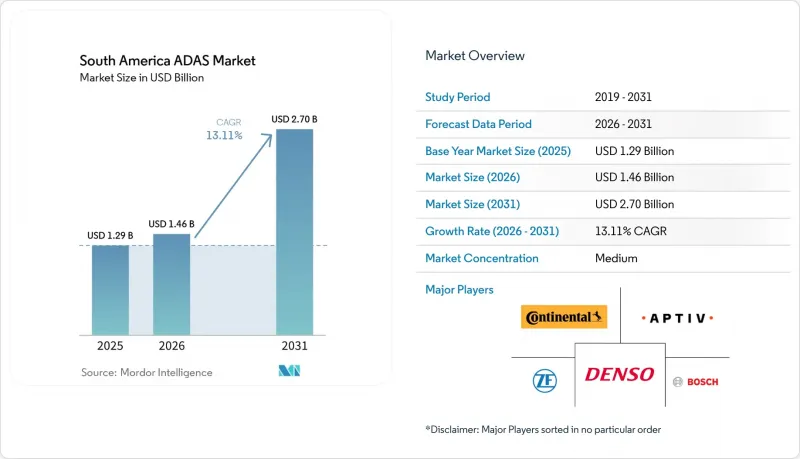
According to Mordor Intelligence, the South America ADAS market size was valued at USD 1.29 billion in 2025 and is estimated at USD 1.46 billion in 2026, and is projected to reach USD 2.70 billion by 2031, at a CAGR of 13.11% during the forecast period (2026-2031).
South America ADAS Market Trends and Insights
Rising OEM Fitment of ADAS Features
NCAP's protocol raises the fitment threshold for automatic emergency braking and lane support systems from a partial share of total sales to full coverage. The protocol influences purchasing decisions, as manufacturers must integrate qualifying features into production plans or offer them as stand-alone options. Expanded testing covers nighttime pedestrian detection, cyclist detection, and additional blind spot detection scenarios. These requirements raise the technical standards for camera, radar, and control systems in the South American ADAS market. The Kia Sportage facelift received NCAP's highest safety rating for its automatic emergency braking, lane support, and blind-spot detection systems, underscoring the adoption of these features in mid-priced vehicles. Consequently, the South American ADAS market is shifting procurement toward suppliers capable of meeting regional testing and validation requirements at scale .
Strengthening Vehicle Safety Requirements
Brazil mandates AEB for new vehicle model codes, with full-fleet compliance to follow. Under the stated framework, the stationary-obstacle detection scenario will apply to all produced vehicles. These requirements provide vehicle manufacturers with a clear incentive to integrate AEB during platform updates rather than defer implementation. The NCAP protocol places greater emphasis on AEB for vulnerable road users and introduces more stringent detection conditions for pedestrians and cyclists. It also expands blind-spot assessment coverage and more closely links top safety ratings to assisted-driving features. Collectively, these requirements make safety performance a more prominent product consideration across the South American ADAS market.
High ADAS System and Sensor Costs
Brazil imposes import duties on automotive electronics based on product classification and trade agreement coverage. This duty structure creates a cost gap between imported vehicles equipped with comprehensive sensor packages and domestically produced models with fewer features. Consequently, the South American ADAS market faces affordability constraints before advanced functions can achieve broad adoption in entry-level vehicle models. Entry-level aftermarket ADAS units are available through distributors, while integrated fleet platforms incur installation costs and recurring service charges. Local manufacturing could narrow this gap; however, achieving sufficient scale across sensor categories will require time.
Other drivers and restraints analyzed in the detailed report include:
- Fleet-Based Demand for Remote Diagnostics and Retrofit ADAS
- Localized ADAS Camera and Radar Manufacturing in Brazil
- Inadequate Lane Markings, Road Infrastructure, and Mapping Data
For complete list of drivers and restraints, kindly check the Table Of Contents.
Segment Analysis
Adaptive cruise control held the largest share of the function at 23.23% in 2025. It remained a familiar entry feature for drivers using advanced driver assistance in mid-sized and flagship passenger cars. Lane departure warning is the fastest-growing function, with a 14.78% CAGR through 2031. NCAP requires lane support system fitment to increase from a substantial share of vehicle sales to full coverage. This requirement increases the importance of lane support in vehicle model planning. The expanding fitment thresholds support the segment value of lane-related functions.
Road conditions do not eliminate demand for lane departure warning systems. Instead, incomplete or worn lane markings differentiate systems that can perform reliably under local conditions. Automatic emergency braking, blind spot detection, and forward collision warning are gaining traction as test requirements become more stringent. NCAP has introduced expanded assessment scenarios for blind spot detection. Fleet programs focused on accident liability are increasingly adopting driver monitoring systems. Adaptive front lighting and other functions currently account for smaller shares but are expected to benefit as manufacturers integrate more advanced sensor stacks. The South American ADAS market will continue to rely on functions that meet both formal assessment requirements and practical road-use needs.
LiDAR held 43.88% of the technology segment by value in 2025. Its high regional revenue share reflected module prices and system integration value rather than leadership in unit volume. Cameras and radar led unit demand across many vehicle applications. Camera systems are forecast to grow at a 15.11% CAGR through 2031. Brazil requires rear cameras in new vehicles. NCAP's expanded vulnerable road user tests also require front-facing camera capabilities to detect pedestrians and cyclists.
Radar supports collision avoidance in commercial fleets, while ultrasonic sensors remain widely used for parking assistance. Infrared sensors are primarily limited to premium night-vision and driver-monitoring applications. Sensor fusion integrates data from cameras, radar, and LiDAR through shared processing hardware, making it increasingly relevant for advanced ADAS specifications. Higher-value systems require reliable calibration across the vehicle's complete sensor suite. Therefore, the South American ADAS market requires both cost-effective camera deployment and the technical capability to support more complex sensor combinations. Local camera production can also help establish a more stable regional technology supply chain.
Complete Report Scope:
- By ADAS Function
- Adaptive Cruise Control System
- Adaptive Front-Lighting
- Automatic Emergency Braking
- Blind Spot Detection
- Driver Monitoring System
- Forward Collision Warning
- Lane Departure Warning
- Other ADAS Functions
- By Technology
- Camera
- Radar
- LiDAR
- Ultrasonic Sensor
- Infrared Sensor
- Sensor Fusion
- By Vehicle Type
- Passenger Cars
- Light Commercial Vehicles
- Heavy Commercial Vehicles
- Buses
- By Offering
- Hardware
- Software
- Integrated ADAS Systems
- Aftermarket and Retrofit Systems
- By Automation Level
- Level 0 Driver Assistance
- Level 1 Driver Assistance
- Level 2 Partial Driving Automation
- Level 3 Conditional Driving Automation
- By Country
- Brazil
- Argentina
- Chile
- Colombia
- Peru
- Rest of South America
List of Companies Covered in this Report:
- Robert Bosch GmbH
- Continental AG
- ZF Friedrichshafen AG
- Aptiv PLC
- DENSO Corporation
- Valeo SE
- Magna International Inc.
- Autoliv AB
- Hyundai Mobis Co., Ltd.
- Forvia SE
- HELLA GmbH & Co. KGaA
- Hitachi Astemo, Ltd.
- BorgWarner Inc.
- Aisin Corporation
- Harman International Industries, Incorporated
- NVIDIA Corporation
- Mobileye Global Inc.
- Infineon Technologies AG
- NXP Semiconductors N.V.
- Texas Instruments Incorporated
- Garmin Ltd.
Additional Benefits:
- The market estimate (ME) sheet in Excel format
- 3 months of analyst support
TABLE OF CONTENTS
1 Introduction
- 1.1 Study Assumptions and Market Definition
- 1.2 Scope of the Study
2 Research Methodology
3 Executive Summary
4 Market Landscape
- 4.1 Market Overview
- 4.2 Market Drivers
- 4.2.1 Rising OEM Fitment of ADAS Features
- 4.2.2 Strengthening Vehicle Safety Requirements
- 4.2.3 Increasing Consumer Demand for Safety and Driving Comfort
- 4.2.4 Expansion of Vehicle Production in Brazil and Argentina
- 4.2.5 Localized ADAS Camera and Radar Manufacturing in Brazil
- 4.2.6 Fleet-Based Demand for Remote Diagnostics and Retrofit ADAS
- 4.3 Market Restraints
- 4.3.1 High ADAS System and Sensor Costs
- 4.3.2 Inadequate Lane Markings, Road Infrastructure, and Mapping Data
- 4.3.3 Calibration Challenges Caused by Road, Weather, and Vehicle Variability
- 4.3.4 Fragmented Liability and Regulatory Frameworks for Automated Driving
- 4.4 Value and Supply-Chain Analysis
- 4.5 Regulatory Landscape
- 4.6 Technological Outlook
- 4.7 Porter's Five Forces Analysis
- 4.7.1 Threat of New Entrants
- 4.7.2 Bargaining Power of Buyers and Consumers
- 4.7.3 Bargaining Power of Suppliers
- 4.7.4 Threat of Substitute Products
- 4.7.5 Intensity of Competitive Rivalry
5 Market Size and Growth Forecasts (Value, USD)
- 5.1 By ADAS Function
- 5.1.1 Adaptive Cruise Control System
- 5.1.2 Adaptive Front-Lighting
- 5.1.3 Automatic Emergency Braking
- 5.1.4 Blind Spot Detection
- 5.1.5 Driver Monitoring System
- 5.1.6 Forward Collision Warning
- 5.1.7 Lane Departure Warning
- 5.1.8 Other ADAS Functions
- 5.2 By Technology
- 5.2.1 Camera
- 5.2.2 Radar
- 5.2.3 LiDAR
- 5.2.4 Ultrasonic Sensor
- 5.2.5 Infrared Sensor
- 5.2.6 Sensor Fusion
- 5.3 By Vehicle Type
- 5.3.1 Passenger Cars
- 5.3.2 Light Commercial Vehicles
- 5.3.3 Heavy Commercial Vehicles
- 5.3.4 Buses
- 5.4 By Offering
- 5.4.1 Hardware
- 5.4.2 Software
- 5.4.3 Integrated ADAS Systems
- 5.4.4 Aftermarket and Retrofit Systems
- 5.5 By Automation Level
- 5.5.1 Level 0 Driver Assistance
- 5.5.2 Level 1 Driver Assistance
- 5.5.3 Level 2 Partial Driving Automation
- 5.5.4 Level 3 Conditional Driving Automation
- 5.6 By Country
- 5.6.1 Brazil
- 5.6.2 Argentina
- 5.6.3 Chile
- 5.6.4 Colombia
- 5.6.5 Peru
- 5.6.6 Rest of South America
6 Competitive Landscape
- 6.1 Market Concentration
- 6.2 Strategic Moves
- 6.3 Market Share Analysis
- 6.4 Company Profiles (Includes Global Level Overview, Market Level Overview, Core Segments, Financials as available, Strategic Information, Market Rank/Share, Products and Services, Recent Developments)
- 6.4.1 Robert Bosch GmbH
- 6.4.2 Continental AG
- 6.4.3 ZF Friedrichshafen AG
- 6.4.4 Aptiv PLC
- 6.4.5 DENSO Corporation
- 6.4.6 Valeo SE
- 6.4.7 Magna International Inc.
- 6.4.8 Autoliv AB
- 6.4.9 Hyundai Mobis Co., Ltd.
- 6.4.10 Forvia SE
- 6.4.11 HELLA GmbH & Co. KGaA
- 6.4.12 Hitachi Astemo, Ltd.
- 6.4.13 BorgWarner Inc.
- 6.4.14 Aisin Corporation
- 6.4.15 Harman International Industries, Incorporated
- 6.4.16 NVIDIA Corporation
- 6.4.17 Mobileye Global Inc.
- 6.4.18 Infineon Technologies AG
- 6.4.19 NXP Semiconductors N.V.
- 6.4.20 Texas Instruments Incorporated
- 6.4.21 Garmin Ltd.
7 Market Opportunities and Future Outlook

