PUBLISHER: Mordor Intelligence | PRODUCT CODE: 2155284

PUBLISHER: Mordor Intelligence | PRODUCT CODE: 2155284
South America Motorcycle Loan - Market Share Analysis, Industry Trends & Statistics, Growth Forecasts (2026 - 2031)
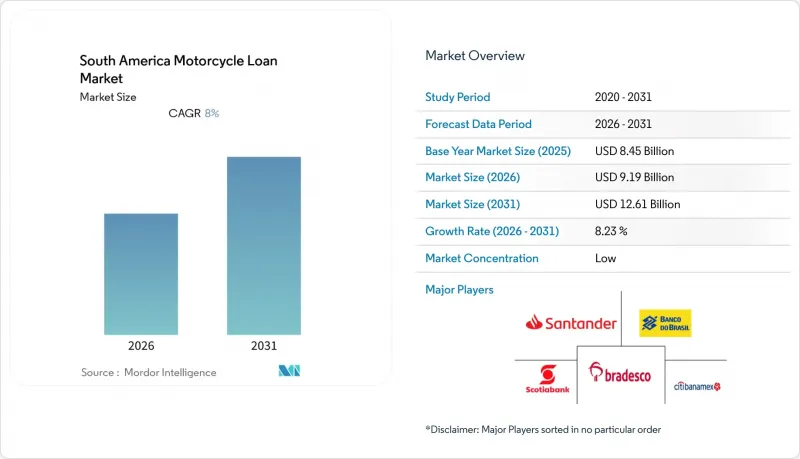
According to Mordor Intelligence, the South America motorcycle loan market size is expected to increase from USD 8.5 billion in 2025 to USD 9.20 billion in 2026 and reach USD 12.60 billion by 2031, growing at a CAGR of 6.5% over 2026-2031.
South America Motorcycle Loan Market Trends and Insights
Affordable Motorcycle Ownership Through Financing
Motorcycle credit has become an important route to ownership for lower-income and first-time buyers across South America. In Colombia, a significant share of motorcycles sold in 2025 were purchased on credit, and Hero reported that nearly 60% of its units were financed. Bajaj's dealer network offered 16 financing partnerships, including Addi, Banco de Bogota, and Sufi, which gave buyers several routes to secure a loan. Peru sold 425,880 motorcycles in 2025, supported by credit access, inventory availability, and Lima inflation of 1.51% . These conditions support the South America motorcycle loan market because a motorcycle carries a lower purchase price and lower monthly payment than a car. Banco Finandina offered financing of up to 110% of a motorcycle's purchase value and terms of up to 60 months, which reduced the initial payment barrier for first-time buyers.
Motorcycles as Essential Urban Mobility Solutions
Motorcycles serve daily transport needs for workers and households in cities where public transport, travel times, and income constraints shape purchase decisions. Brazil sold 2,197,851 motorcycles in 2025, its highest volume since 2003 and a 17.1% increase from 2024 . Abraciclo expects Brazilian registrations to reach 2.3 million units in 2026, which keeps the vehicle base relevant for lenders and dealers. Colombia registered 1.1 million motorcycles in 2025, a record annual total. The South America motorcycle loan market gains from this role because access to credit determines whether many households can purchase the vehicle they use every day. Credit products that combine vehicle finance, insurance, and simple digital processing can make this purchase path easier for borrowers.
High Interest Rates and Borrower Affordability Constraints
Interest rates remain a direct barrier for borrowers considering a motorcycle loan, as financing costs can vary significantly depending on the borrower's credit quality and lender terms. Argentina's Mi Moto program offered rates of 40%-53% TNA in 2026 and terms extending to 72 months . Longer terms can lower monthly installments, but they also extend the borrower's payment commitment. Delivery riders may be less sensitive to rates when the motorcycle supports regular earnings, while salaried first-time buyers face a firmer income limit. Full effective-cost disclosures in Brazil and consumer protection requirements in Colombia can make the total cost of borrowing more visible. The South America motorcycle loan market must balance loan access with clear pricing and payment structures that borrowers can sustain.
Other drivers and restraints analyzed in the detailed report include:
- Growth of Last-Mile Delivery and Motorcycle-Based Platform Work
- Motorcycles as Income-Generating Assets
- Inflation and Household Purchasing-Power Pressure
For complete list of drivers and restraints, kindly check the Table Of Contents.
Segment Analysis
New motorcycles held 65.1% of the South America motorcycle loan market share in 2025, supported by dealer networks and captive finance programs. Dealers can offer the motorcycle and the loan during the same customer visit. Banco Honda operated through more than 1,100 motorcycle dealership points in Brazil, and Honda Financial Services accounted for 47% of Honda motorcycle sales in Brazil during 2025 [4]. This link between purchase and financing supports new-unit loan volumes. It also gives captive lenders a direct connection to the customer, dealer, and vehicle brand. The South America motorcycle loan market continues to rely on this model for first-time buyers seeking a new vehicle with a clear warranty and dealer support. New motorcycle lending also benefits from standardized vehicle values, which can simplify loan approval and collateral assessment. The model remains strongest where branded dealer coverage is broad. It may be less accessible in smaller locations that have fewer formal dealerships.
Used motorcycles are forecast to expand at a 9.8% CAGR from 2026 to 2031, contributing to the growth of the South America motorcycle loan market size as more buyers seek lower-cost vehicles. Previously financed motorcycles enter the secondary market as original owners replace or sell their vehicles, creating a larger pool of potential borrowers. Banco Finandina finances motorcycles up to four years old, addressing a part of the used-vehicle buyer base. Fintech lenders can assess used-motorcycle collateral without relying on a single vehicle brand. Banco Central do Brasil research has indicated that vehicle lenders apply different pricing for used vehicles and lower-score borrowers. Heavy delivery use can lower the value of motorcycles that re-enter the secondary market. Lenders must therefore consider mileage, maintenance, and vehicle condition when assessing collateral. The used segment offers access to buyers beyond formal new-motorcycle dealer networks. It also requires stronger appraisal methods as secondary-market supply grows.
Banks held 39.5% of the South America motorcycle loan market share in 2025, reflecting their funding capacity and established compliance systems. Bank products remain important for customers with standard income documentation and established credit records. Their branch networks and dealer relationships also support regional distribution. Banco BV reported a BRL 5 billion (USD 1 billion) motorcycle and new-vehicle portfolio in the first quarter of 2026. Banks can compete through faster digital processing and broader dealer coverage. Their documentation requirements can still limit access for gig workers and first-time borrowers, creating room for providers with different underwriting methods. The South America motorcycle loan industry includes banks, specialized finance firms, captive lenders, and digital providers with distinct strengths.
Fintech and digital lenders are forecast to grow at an 11.5% CAGR through 2031, supporting the South America motorcycle loan market size as digital channels expand access to borrowers beyond traditional banking networks. Their model is suited to online applications, electronic verification, and data-led underwriting. CMN Resolution 5,159 widened the business options available to Brazilian credit fintechs in August 2024. The resolution supports direct origination by eligible digital entities at dealer points of sale. Non-bank financial institutions can offer flexible terms where commercial bank processes are less suited to the borrower. Captive finance companies retain an advantage because their loans are linked to the purchase decision at a branded dealer. The South America motorcycle loan market gives digital providers scope to reach borrowers outside leading cities. It also requires these lenders to manage risk without the long operating history of some incumbent banks. Stronger data systems may improve access for workers with informal but traceable earnings. Competition will depend on the speed, reliability, and affordability of each provider's loan process.
Complete Report Scope:
- By Motorcycle Condition
- New Motorcycles
- Used Motorcycles
- By Provider Type
- Banks
- Non-Bank Financial Institutions and Specialized Finance Companies
- OEM / Captive Finance Companies
- Fintech and Digital Lenders
- By Customer Type
- Individual Consumers
- Self-Employed, Gig Workers & Micro-Entrepreneurs
- Business and Fleet Operators
- By Loan Tenure
- Short-term (<= 36 months)
- Medium- to Long-term (> 36 months)
- By Distribution Channel
- Dealer/Point-of-Sale
- Direct/Digital / Branch
- By Geography
- Brazil
- Argentina
- Colombia
- Chile
- Peru
- Rest of South America (Uruguay, Paraguay, Bolivia, Venezuela, and Ecuador)
List of Companies Covered in this Report:
- Banco Honda S.A.
- Banco Yamaha Motor do Brasil S.A.
- Yamaha Motor Finance Colombia S.A.S.
- Banco Finandina S.A.
- Creditos Orbe S.A.S. (CrediOrbe)
- Banco Santander Brasil
- Banco BV
- Banco Bradesco Financiamentos
- Creditas (Brazil)
- Banco do Brasil
- Itau Unibanco
- Santander Argentina
- Banco de la Nacion Argentina
- Banco Provincia
- BBVA Argentina
- Bancolombia
- Banco de Bogota
- BBVA Colombia
- ALFIN Banco
- Galgo+
Additional Benefits:
- The market estimate (ME) sheet in Excel format
- 3 months of analyst support
TABLE OF CONTENTS
1 INTRODUCTION
- 1.1 Study Assumptions and Market Definition
- 1.2 Scope of the Study
2 RESEARCH METHODOLOGY
3 EXECUTIVE SUMMARY
4 MARKET LANDSCAPE
- 4.1 Market Overview
- 4.2 Market Drivers
- 4.2.1 Affordable Motorcycle Ownership Through Financing
- 4.2.2 Motorcycles as Essential Urban Mobility Solutions
- 4.2.3 Growth of Last-Mile Delivery and Motorcycle-Based Platform Work
- 4.2.4 Motorcycles as Income-Generating Assets
- 4.2.5 Expansion of Embedded, Dealer, and Alternative Credit Channels
- 4.3 Market Restraints
- 4.3.1 High Interest Rates and Borrower Affordability Constraints
- 4.3.2 Inflation and Household Purchasing-Power Pressure
- 4.3.3 Limited Credit Histories and Informal-Income Verification Challenges
- 4.3.4 Credit Default, Fraud, and Vehicle Recovery Risks
- 4.4 Value Chain Analysis
- 4.4.1 Motorcycle Manufacturers, Importers, and Distribution Networks
- 4.4.2 Dealerships and Motorcycle Loan Originators
- 4.4.3 Lenders, Credit Infrastructure, and Loan Servicing Providers
- 4.5 Regulatory Landscape
- 4.5.1 Consumer Credit, Pricing, and Interest-Rate Disclosure Requirements
- 4.5.2 Secured Lending, Vehicle Registration, and Collateral Enforcement Rules
- 4.5.3 Digital Lending, Data Protection, and Responsible Lending Requirements
- 4.6 Technological Outlook
- 4.6.1 Automated and Alternative-Data Credit Underwriting
- 4.6.2 Digital Loan Origination, Identity Verification, and E-Signatures
- 4.6.3 Embedded Motorcycle Financing and Digital Dealer Integration
- 4.7 Porter's Five Forces Analysis
- 4.7.1 Threat of New Entrants
- 4.7.2 Bargaining Power of Suppliers
- 4.7.3 Bargaining Power of Buyers
- 4.7.4 Threat of Substitutes
- 4.7.5 Competitive Rivalry
5 MARKET SIZE AND GROWTH FORECASTS
- 5.1 By Motorcycle Condition
- 5.1.1 New Motorcycles
- 5.1.2 Used Motorcycles
- 5.2 By Provider Type
- 5.2.1 Banks
- 5.2.2 Non-Bank Financial Institutions and Specialized Finance Companies
- 5.2.3 OEM / Captive Finance Companies
- 5.2.4 Fintech and Digital Lenders
- 5.3 By Customer Type
- 5.3.1 Individual Consumers
- 5.3.2 Self-Employed, Gig Workers & Micro-Entrepreneurs
- 5.3.3 Business and Fleet Operators
- 5.4 By Loan Tenure
- 5.4.1 Short-term (<= 36 months)
- 5.4.2 Medium- to Long-term (> 36 months)
- 5.5 By Distribution Channel
- 5.5.1 Dealer/Point-of-Sale
- 5.5.2 Direct/Digital / Branch
- 5.6 By Geography
- 5.6.1 Brazil
- 5.6.2 Argentina
- 5.6.3 Colombia
- 5.6.4 Chile
- 5.6.5 Peru
- 5.6.6 Rest of South America (Uruguay, Paraguay, Bolivia, Venezuela, and Ecuador)
6 COMPETITIVE LANDSCAPE
- 6.1 Market Concentration
- 6.2 Strategic Moves
- 6.3 Market Share Analysis (Top 5-6 players)
- 6.4 Company Profiles (includes Global Level Overview, Market Level Overview, Core Segments, Financials as available, Strategic Information, Market Rank/Share, Products and Services, Recent Developments)
- 6.4.1 Banco Honda S.A.
- 6.4.2 Banco Yamaha Motor do Brasil S.A.
- 6.4.3 Yamaha Motor Finance Colombia S.A.S.
- 6.4.4 Banco Finandina S.A.
- 6.4.5 Creditos Orbe S.A.S. (CrediOrbe)
- 6.4.6 Banco Santander Brasil
- 6.4.7 Banco BV
- 6.4.8 Banco Bradesco Financiamentos
- 6.4.9 Creditas (Brazil)
- 6.4.10 Banco do Brasil
- 6.4.11 Itau Unibanco
- 6.4.12 Santander Argentina
- 6.4.13 Banco de la Nacion Argentina
- 6.4.14 Banco Provincia
- 6.4.15 BBVA Argentina
- 6.4.16 Bancolombia
- 6.4.17 Banco de Bogota
- 6.4.18 BBVA Colombia
- 6.4.19 ALFIN Banco
- 6.4.20 Galgo+
7 MARKET OPPORTUNITIES AND FUTURE OUTLOOK
- 7.1 White-Space and Unmet-Need Assessment
- 7.1.1 Financing Solutions for Informal, Self-Employed, and Platform-Based Workers
- 7.1.2 Expanded Credit Access for Used Motorcycles and Underserved Geographies
- 7.1.3 Integrated Motorcycle Ownership Financing Solutions
- 7.2 Future Outlook
- 7.2.1 Expansion of Digital and Alternative-Data-Based Motorcycle Lending
- 7.2.2 Increasing Formalization and Inclusion of Underserved Motorcycle Borrowers
- 7.2.3 Growth of Specialized Motorcycle Finance Products and Partnerships

