PUBLISHER: Mordor Intelligence | PRODUCT CODE: 2155311

PUBLISHER: Mordor Intelligence | PRODUCT CODE: 2155311
Thermoplastic Polyolefins - Market Share Analysis, Industry Trends & Statistics, Growth Forecasts (2026 - 2031)
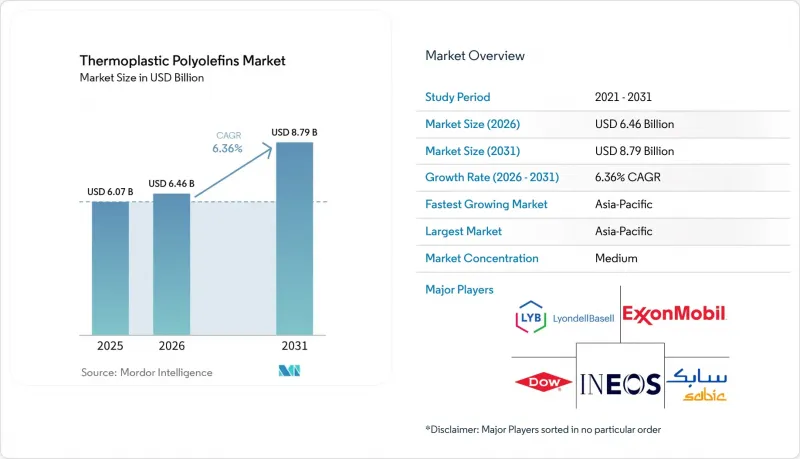
According to Mordor Intelligence, the thermoplastic polyolefins market size was valued at USD 6.07 billion in 2025 and is estimated to grow from USD 6.46 billion in 2026 to reach USD 8.79 billion by 2031, at a CAGR of 6.36% during the forecast period (2026-2031).
Global Thermoplastic Polyolefins Market Trends and Insights
Automotive Lightweighting and Emissions Compliance
Automotive lightweighting remains a central source of demand for the thermoplastic polyolefins market. The European Commission presented its Automotive Package on December 16, 2025, setting a 90% tailpipe-emissions reduction target for cars from 2035. The remaining 10% can be addressed through low-carbon steel produced in the European Union, e-fuels, or biofuels. Thermoplastic polyolefins have densities of 0.89 to 1.05 g/cm3 and can replace heavier materials in bumper fascias, door panels, and fender liners. This combination supports vehicle programs that need lower mass without sacrificing impact resistance or exterior durability. Battery electric vehicle platforms add further pressure to reduce vehicle weight because battery packs increase overall vehicle mass and raise the importance of materials used across the thermoplastic polyolefins market.
Electric Vehicle Battery and Interior Component Demand
Electric vehicle designs support demand for thermoplastic polyolefins in interior and battery-related components. Lower powertrain noise raises requirements for noise, vibration, and harshness control in cabin panels. Standard thermoplastic polyolefins (TPO) grades can serve interior and underbody areas that do not face the high temperatures associated with combustion engines. Kautex Textron won a 2025 contract for a battery housing on a multi-brand battery electric vehicle platform under its Pentatonic portfolio. These developments expand the range of vehicle areas in which TPO compounders can seek qualification in the thermoplastic polyolefins market.
Polypropylene and Elastomer Feedstock Price Volatility
Polypropylene and elastomer feedstock price volatility can weaken margins for TPO compounders. Propylene pricing follows refinery and steam-cracker conditions, which can move separately from TPO demand. Ethylene-propylene-diene monomer and polyolefin elastomer prices introduce another source of variability because they are linked to ethylene markets. Smaller compounders are more exposed when they purchase feedstocks in the spot market without the protection available to integrated producers. Margin pressure can lead to capacity rationalization when customer demand is increasing. The Carbon Border Adjustment Mechanism can add cost pressure for European compounders that import naphtha-derived feedstocks.
Other drivers and restraints analyzed in the detailed report include:
- Recyclable and Low-VOC Material Adoption
- Growth of TPO Roofing and Waterproofing Membranes
- Limited High-Temperature Performance
For complete list of drivers and restraints, kindly check the Table Of Contents.
Segment Analysis
Polypropylene held 38.91% of the value in 2025, supported by established supply chains and broad processing compatibility. The material works across injection molding and extrusion processes used for automotive, construction, appliance, and industrial parts. Its cost position remains difficult for another TPO backbone to match at a commercial scale. Polypropylene compounds can also be formulated for vehicle components that require impact resistance, surface quality, and low density. This scale and flexibility keep polypropylene central to the thermoplastic polyolefins industry.
Polyethylene is projected to advance at a 6.89% CAGR through 2031 within the thermoplastic polyolefins market size. Metallocene-catalyzed polyethylene variants support soft and impact-tolerant profiles with low-temperature performance. Their use is concentrated in medical packaging, flexible industrial sheeting, and soft-touch interior applications. These uses give the thermoplastic polyolefins market access to applications where flexibility and low-temperature impact performance carry greater weight than material cost alone. The others category includes bio-sourced building blocks and ethylene-propylene-diene terpolymers, but it remains constrained by feedstock availability and processing consistency.
Complete Report Scope:
- By Raw Material
- Polypropylene
- Polyethylene
- Others
- By Application
- Automotive
- Building and Construction
- Home Appliances
- Medical
- Industrial
- Others
- By Geography
- Asia-Pacific
- China
- India
- Japan
- South Korea
- Rest of Asia-Pacific
- North America
- United States
- Canada
- Mexico
- Europe
- Germany
- United Kingdom
- France
- Italy
- Rest of Europe
- South America
- Brazil
- Argentina
- Rest of South America
- Middle East and Africa
- Saudi Arabia
- South Africa
- Rest of Middle East and Africa
- Asia-Pacific
Geography Analysis
Asia-Pacific held 43.66% of the value in 2025 and is projected to advance at a 7.05% CAGR through 2031. China, Japan, and South Korea concentrate substantial automotive manufacturing and related materials demand. China's National VI vehicle emissions standard supports continued interest in lighter vehicle components. India's vehicle production and infrastructure activity also support automotive and roofing-related consumption. South Korea and Japan contribute to the demand for electric vehicle interior skin and appliance-grade TPO materials.
North America benefits from vehicle fuel-economy requirements and shale-derived ethane feedstock availability. The Corporate Average Fuel Economy framework continues to guide fuel-economy standards for vehicle manufacturers in the United States. Feedstock access supports the cost position of polyethylene-based grades in construction and industrial applications. The United States represents much of the regional value, while Mexico gains from automotive assembly investment by Asian and European manufacturers. Europe relies on Regulation (EU) 2019/631 and Regulation (EU) 2026/1738, which favor suppliers with lightweight materials and traceable recycled-content supply.
South America and the Middle East and Africa have smaller positions in the thermoplastic polyolefins market size. Brazil leads South American demand through automotive assembly and construction activity, with Braskem providing an integrated regional feedstock presence. Argentina's economic volatility limits near-term demand, despite its infrastructure needs. Saudi Arabia's Vision 2030 construction programs can support waterproofing membrane demand. South Africa provides a steadier base through industrial activity and vehicle assembly, while limited recovery systems restrain premium recycled-content TPO grades. These conditions leave growth linked to local construction, automotive investment, and recycling system development in the thermoplastic polyolefins market.
- Arkema
- Avient Corporation
- Borealis GmbH
- Braskem
- Celanese Corporation
- Dow
- Exxon Mobil Corporation
- Formosa Plastics Corporation
- INEOS
- LyondellBasell Industries Holdings B.V.
- Mitsui Chemicals, Inc.
- RTP Company
- SABIC
- Sumitomo Chemical Co., Ltd.
Additional Benefits:
- The market estimate (ME) sheet in Excel format
- 3 months of analyst support
TABLE OF CONTENTS
1 Introduction
- 1.1 Study Assumptions and Market Definition
- 1.2 Scope of the Study
2 Research Methodology
3 Executive Summary
4 Market Landscape
- 4.1 Market Overview
- 4.2 Market Drivers
- 4.2.1 Automotive Lightweighting and Emissions Compliance
- 4.2.2 Electric Vehicle Battery and Interior Component Demand
- 4.2.3 Recyclable and Low-VOC Material Adoption
- 4.2.4 Growth of TPO Roofing and Waterproofing Membranes
- 4.2.5 Recycled-TPO Performance Recovery Through Compatibilizers
- 4.3 Market Restraints
- 4.3.1 Polypropylene and Elastomer Feedstock Price Volatility
- 4.3.2 Limited High-Temperature Performance
- 4.3.3 Inconsistent End-of-Life Recovery Infrastructure
- 4.4 Value Chain Analysis
- 4.5 Porter's Five Forces Analysis
- 4.5.1 Bargaining Power of Suppliers
- 4.5.2 Bargaining Power of Buyers
- 4.5.3 Threat of New Entrants
- 4.5.4 Threat of Substitutes
- 4.5.5 Competitive Rivalry
5 Market Size and Growth Forecasts (Value)
- 5.1 By Raw Material
- 5.1.1 Polypropylene
- 5.1.2 Polyethylene
- 5.1.3 Others
- 5.2 By Application
- 5.2.1 Automotive
- 5.2.2 Building and Construction
- 5.2.3 Home Appliances
- 5.2.4 Medical
- 5.2.5 Industrial
- 5.2.6 Others
- 5.3 By Geography
- 5.3.1 Asia-Pacific
- 5.3.1.1 China
- 5.3.1.2 India
- 5.3.1.3 Japan
- 5.3.1.4 South Korea
- 5.3.1.5 Rest of Asia-Pacific
- 5.3.2 North America
- 5.3.2.1 United States
- 5.3.2.2 Canada
- 5.3.2.3 Mexico
- 5.3.3 Europe
- 5.3.3.1 Germany
- 5.3.3.2 United Kingdom
- 5.3.3.3 France
- 5.3.3.4 Italy
- 5.3.3.5 Rest of Europe
- 5.3.4 South America
- 5.3.4.1 Brazil
- 5.3.4.2 Argentina
- 5.3.4.3 Rest of South America
- 5.3.5 Middle East and Africa
- 5.3.5.1 Saudi Arabia
- 5.3.5.2 South Africa
- 5.3.5.3 Rest of Middle East and Africa
- 5.3.1 Asia-Pacific
6 Competitive Landscape
- 6.1 Market Concentration
- 6.2 Strategic Moves
- 6.3 Market Share (%)/Ranking Analysis
- 6.4 Company Profiles (includes Global Overview, Market Overview, Core Segments, Financials as available, Strategic Information, Products and Services, and Recent Developments)
- 6.4.1 Arkema
- 6.4.2 Avient Corporation
- 6.4.3 Borealis GmbH
- 6.4.4 Braskem
- 6.4.5 Celanese Corporation
- 6.4.6 Dow
- 6.4.7 Exxon Mobil Corporation
- 6.4.8 Formosa Plastics Corporation
- 6.4.9 INEOS
- 6.4.10 LyondellBasell Industries Holdings B.V.
- 6.4.11 Mitsui Chemicals, Inc.
- 6.4.12 RTP Company
- 6.4.13 SABIC
- 6.4.14 Sumitomo Chemical Co., Ltd.
7 Market Opportunities and Future Outlook
- 7.1 White-Space and Unmet-Need Assessment

