PUBLISHER: Mordor Intelligence | PRODUCT CODE: 2155314

PUBLISHER: Mordor Intelligence | PRODUCT CODE: 2155314
Flat Steel - Market Share Analysis, Industry Trends & Statistics, Growth Forecasts (2026 - 2031)
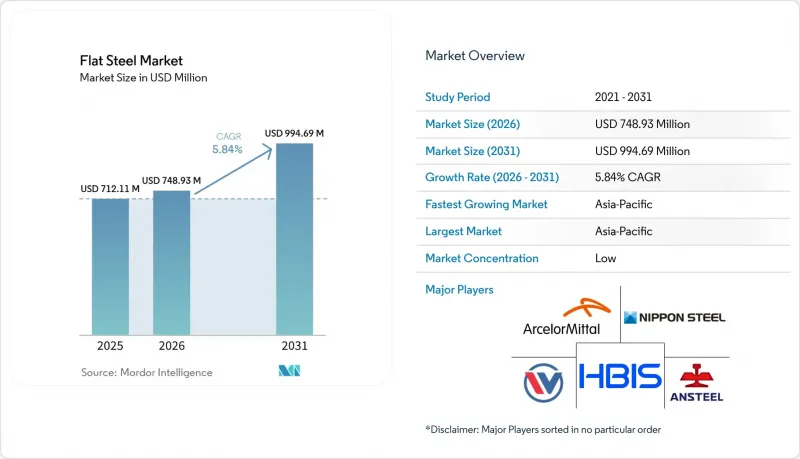
According to Mordor Intelligence, the flat steel market size was estimated at USD 712.11 million in 2025 and is estimated to grow from USD 748.93 million in 2026 to USD 994.69 million by 2031, at a CAGR of 5.84% during the forecast period (2026-2031).
Global Flat Steel Market Trends and Insights
Infrastructure Renewal and Industrial Construction
Government-backed capital spending remains a reliable source of demand for flat steel products used in building envelopes, bridge decks, warehouses, and industrial facilities. India's steel demand grew in 2025, supported by the National Infrastructure Pipeline and automotive production. The United States is directing public infrastructure spending and shipbuilding plans toward applications that use structural plate. America's Maritime Action Plan, released in February 2026, provides an additional channel for this demand. Prefabricated and modular construction uses coated and pre-painted sheets more frequently than site-formed sections, increasing the importance of product quality and finishing within the flat steel market.
Automotive Lightweighting and Electric Vehicle Production
Electric vehicle platforms create a different demand pattern for flat steel because battery packs add 400 to 800 kilograms of weight. Automakers use press-hardened steel, cold-rolled dual-phase grades, and advanced high-strength steel to manage vehicle weight and protect battery systems. Advanced high-strength steel can reduce vehicle structural weight by 15% to 25% compared with conventional steel. These grades support crash performance while allowing thinner components in body structures. The product mix, therefore, shifts away from conventional hot-rolled coil and toward specialized materials with tighter certification requirements. This favors producers that can consistently supply automotive-grade products near major vehicle manufacturing centers.
Global Steel Overcapacity and Export Pressure
Global excess steelmaking capacity reached 640 million tons in 2025 and is projected to rise to 745 million tons by 2028. China exported a record 131.2 million tons of steel in 2025, as weaker real estate activity redirected output toward export markets. This shift particularly affects producers in ASEAN, South America, and Europe that sell hot-rolled and cold-rolled flat products. China's semi-finished steel exports to Southeast Asia increased by 300% in 2025, and some of the material was re-exported after processing. The OECD recorded 75 new antidumping and countervailing duty investigations in 2025. Trade actions may limit some imports, but they do not address the underlying surplus or its effect on prices.
Other drivers and restraints analyzed in the detailed report include:
- Renewable Energy and Grid Equipment Expansion
- Advanced High-Strength Steel Adoption
- Volatile Iron Ore, Coking Coal, and Scrap Costs
For complete list of drivers and restraints, kindly check the Table Of Contents.
Segment Analysis
Sheets and strips held 74.73% of the flat steel market share by value in 2025. This reflects their use in automotive body panels, appliance casings, building envelopes, and solar racking frames. Plates are used in more specialized applications, including pressure vessels, shipbuilding, and heavy machinery frames. The wider range of end uses for sheets and strips explains their dominant position. Commodity hot-rolled coil represents the larger-output, lower-margin segment within this product group. Cold-rolled and coated variants carry a higher value due to tighter requirements for surface quality, forming, and corrosion performance.
Sheets and strips are forecast to grow at a 6.34% CAGR from 2026 to 2031. This growth is supported by zinc-aluminum-magnesium-coated products used in roofing, solar substrates, and electric vehicle structures. Japan's industrial standards work has more closely aligned domestic production with automotive original equipment manufacturer requirements for advanced high-strength grades. Suppliers are responding to competitive pressure in commodity coil by expanding into value-added finishes and higher-grade products. The heavy reliance on sheets and strips means changes in coil prices continue to influence the broader flat steel market. Producers can reduce this exposure by growing sales in coatings, automotive grades, and other differentiated product categories.
Complete Report Scope:
- By Product Type
- Sheets and Strips
- Plates
- By Production Process
- Basic Oxygen Furnace
- Electric Arc Furnace
- Others
- By End-User Industry
- Building and Infrastructure
- Mechanical Equipment
- Automotive and Other Transport
- Renewable Energy and Power Equipment
- Other End-Use Sectors
- By Geography
- Asia-Pacific
- China
- India
- Japan
- South Korea
- ASEAN Countries
- Rest of Asia-Pacific
- North America
- United States
- Canada
- Mexico
- Europe
- Germany
- United Kingdom
- France
- Italy
- NORDIC Countries
- Russia
- Rest of Europe
- South America
- Brazil
- Argentina
- Rest of South America
- Middle East and Africa
- Saudi Arabia
- South Africa
- Rest of Middle East and Africa
- Asia-Pacific
Geography Analysis
Asia-Pacific held 44.39% of the flat steel market share in 2025 and is forecast to grow at a 6.27% CAGR through 2031. China's domestic flat steel consumption declined 6.9% in 2025 as its real estate downturn continued. India's steel demand grew 9.8% in 2025. ASEAN demand grew 4.3% in 2025, supported by manufacturing investment and public infrastructure programs. South Korea and Japan recorded a combined 5.1% decline in demand in 2025.
North America is the second-largest region in the flat steel market. United States demand grew 0.7% in 2025, with industrial activity and public infrastructure spending helping to offset weak residential construction. Canada recorded 2.7% demand growth in 2025, while Mexico recorded a 4.6% decline. Section 232 tariffs, increased to 50% in June 2025, limited some import pressure on domestic producers. America's Maritime Action Plan is also expected to support plate demand from shipbuilding. Electric arc furnace producers accounted for 60% of domestic flat steel shipments in 2025, positioning the region strongly in this production route.
Europe's flat steel demand declined 1.2% in 2025, with France down 12.6% and Germany down 6.1%. The European Union raised above-quota steel tariffs from 25% to 50% in April 2026 and capped flat steel import quotas at 15% of European Union consumption. South America's demand grew 0.7% in 2025. Middle East demand grew 6.4% in 2025, while Africa grew 16.1%, supported by construction and energy infrastructure investment.
- Ansteel Group Corporation Limited
- ARCELORMITTAL
- BAOWU Metal
- Cleveland-Cliffs Inc.
- HBIS GROUP
- HYUNDAI Corporation
- JFE Steel Corporation
- JSW Steel Limited
- NIPPON STEEL CORPORATION
- Nucor Corporation
- Posco Group
- SHAGANG GROUP Inc.
- Shandong Jianlong Steel Co.
- Shougang Group Co., Ltd.
- Tata Steel Limited
- United States Steel Corporation
Additional Benefits:
- The market estimate (ME) sheet in Excel format
- 3 months of analyst support
TABLE OF CONTENTS
1 Introduction
- 1.1 Study Assumptions and Market Definition
- 1.2 Scope of the Study
2 Research Methodology
3 Executive Summary
4 Market Landscape
- 4.1 Market Overview
- 4.2 Market Drivers
- 4.2.1 Infrastructure Renewal and Industrial Construction
- 4.2.2 Automotive Lightweighting and Electric Vehicle Production
- 4.2.3 Renewable Energy and Grid Equipment Expansion
- 4.2.4 Growth of Coated and Corrosion-Resistant Flat Steel
- 4.2.5 Advanced High-Strength Steel Adoption
- 4.3 Market Restraints
- 4.3.1 Global Steel Overcapacity and Export Pressure
- 4.3.2 Volatile Iron Ore, Coking Coal and Scrap Costs
- 4.3.3 Carbon Compliance and Decarbonization Capital Requirements
- 4.4 Value Chain Analysis
- 4.5 Porter's Five Forces Analysis
- 4.5.1 Bargaining Power of Suppliers
- 4.5.2 Bargaining Power of Buyers
- 4.5.3 Threat of New Entrants
- 4.5.4 Threat of Substitutes
- 4.5.5 Competitive Rivalry
5 Market Size and Growth Forecasts (Value)
- 5.1 By Product Type
- 5.1.1 Sheets and Strips
- 5.1.2 Plates
- 5.2 By Production Process
- 5.2.1 Basic Oxygen Furnace
- 5.2.2 Electric Arc Furnace
- 5.2.3 Others
- 5.3 By End-User Industry
- 5.3.1 Building and Infrastructure
- 5.3.2 Mechanical Equipment
- 5.3.3 Automotive and Other Transport
- 5.3.4 Renewable Energy and Power Equipment
- 5.3.5 Other End-Use Sectors
- 5.4 By Geography
- 5.4.1 Asia-Pacific
- 5.4.1.1 China
- 5.4.1.2 India
- 5.4.1.3 Japan
- 5.4.1.4 South Korea
- 5.4.1.5 ASEAN Countries
- 5.4.1.6 Rest of Asia-Pacific
- 5.4.2 North America
- 5.4.2.1 United States
- 5.4.2.2 Canada
- 5.4.2.3 Mexico
- 5.4.3 Europe
- 5.4.3.1 Germany
- 5.4.3.2 United Kingdom
- 5.4.3.3 France
- 5.4.3.4 Italy
- 5.4.3.5 NORDIC Countries
- 5.4.3.6 Russia
- 5.4.3.7 Rest of Europe
- 5.4.4 South America
- 5.4.4.1 Brazil
- 5.4.4.2 Argentina
- 5.4.4.3 Rest of South America
- 5.4.5 Middle East and Africa
- 5.4.5.1 Saudi Arabia
- 5.4.5.2 South Africa
- 5.4.5.3 Rest of Middle East and Africa
- 5.4.1 Asia-Pacific
6 Competitive Landscape
- 6.1 Market Concentration
- 6.2 Strategic Moves
- 6.3 Market Share (%)/Ranking Analysis
- 6.4 Company Profiles (includes Global Overview, Market Overview, Core Segments, Financials as available, Strategic Information, Products and Services, and Recent Developments)
- 6.4.1 Ansteel Group Corporation Limited
- 6.4.2 ARCELORMITTAL
- 6.4.3 BAOWU Metal
- 6.4.4 Cleveland-Cliffs Inc.
- 6.4.5 HBIS GROUP
- 6.4.6 HYUNDAI Corporation
- 6.4.7 JFE Steel Corporation
- 6.4.8 JSW Steel Limited
- 6.4.9 NIPPON STEEL CORPORATION
- 6.4.10 Nucor Corporation
- 6.4.11 Posco Group
- 6.4.12 SHAGANG GROUP Inc.
- 6.4.13 Shandong Jianlong Steel Co.
- 6.4.14 Shougang Group Co., Ltd.
- 6.4.15 Tata Steel Limited
- 6.4.16 United States Steel Corporation
7 Market Opportunities and Future Outlook
- 7.1 White-Space and Unmet-Need Assessment

