PUBLISHER: Mordor Intelligence | PRODUCT CODE: 2155332

PUBLISHER: Mordor Intelligence | PRODUCT CODE: 2155332
South America Small UAV - Market Share Analysis, Industry Trends & Statistics, Growth Forecasts (2026 - 2031)
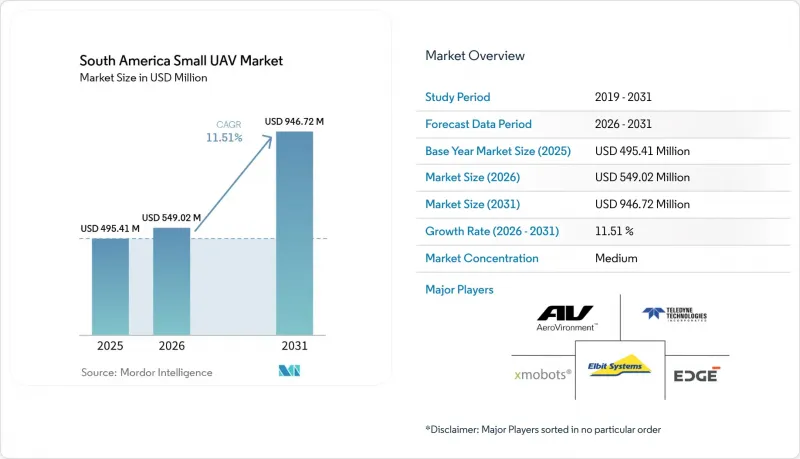
According to Mordor Intelligence, the South America small UAV market size was valued at USD 495.41 million in 2025, and is forecast to grow from USD 549.02 million in 2026 to reach USD 946.72 million by 2031, at an 11.51% CAGR during the forecast period (2026-2031).
South America Small UAV Market Trends and Insights
Defense Modernization and Tactical ISR Demand
South American armed forces are renewing equipment programs, with small UAVs supporting surveillance and operational coordination. Brazil's Army has incorporated unmanned systems into exercises to address threats posed by remotely piloted aircraft. During the Operacao Sagitta Primus, a major anti-aircraft exercise conducted by the Brazilian Army in July 2026, layered counter-RPAS procedures involving armored vehicles, signal jammers, and electronic response centers were tested. The exercise demonstrates the operational value of coordination among surveillance, electronic measures, and ground forces. ISR coverage supports identifying and tracking threats before a force commits other assets. These requirements support demand for systems that can provide persistent situational awareness across land, air, and electronic environments.
Border, Maritime, and Amazon Basin Surveillance Requirements
The Amazon basin has limited fixed infrastructure, which creates an ongoing need for mobile surveillance assets. Brazil's Army Commander stated in June 2026 that border areas remain vulnerable without drone-led technology. CENSIPAM conducts small-UAV purchases for forest monitoring through Brazil's federal procurement system. Colombia's USD 300 million Atlante II contract for 16 ISR UAVs supports maritime, riverine, and border monitoring needs. The contract covers aircraft scheduled for delivery from 2027 to 2030, which extends demand beyond a single procurement year. The South America small UAV market, therefore, favors platforms that can operate across forest, riverine, and maritime settings.
Procurement Cycles and Constrained Defense Budgets
Long approval cycles and intermittent budget releases can delay purchases even when operating needs are clear. Argentina's defense spending was USD 3.88 billion in 2025, equal to 0.76% of GDP. The government froze many procurement programs outside its F-16 acquisition, which left the indigenous UAV program dependent on FONDEF financing. Peru's 2026 defense appropriation was USD 2.55 billion, representing a 14% nominal increase. Much of that allocation was directed toward a combat aircraft program rather than toward expanding the small UAV fleet. Brazil and Colombia are therefore likely to receive a greater share of near-term contracts in the South America small UAV market.
Other drivers and restraints analyzed in the detailed report include:
- Indigenous South American Development and Local Content Objectives
- Counter-UAS and Low-Cost Attritable-System Requirements
- Export Controls, Technology-Transfer Limits, and Dependence on Imported Subsystems
For complete list of drivers and restraints, kindly check the Table Of Contents.
Segment Analysis
Fixed-wing systems held 42.44% of the South America small UAV market share in 2025. Their endurance supports large-area coverage over the Amazon basin, border corridors, and maritime areas. Fixed-wing fleets also create demand for maintenance, spare parts, and operator training after the initial system purchase. The Brazilian Air Force continued to operate Hermes 900 systems, designated RQ-900 in service, with a BRL 134 million (USD 23.5 million) support package covering maintenance, spares, and training through 2030. This type of support arrangement broadens demand beyond airframe procurement.
Rotary-wing systems serve shorter-range missions where vertical access and precise positioning are more important. They are relevant in urban locations, riverine settings, and mountainous terrain with limited landing areas. Chile's use of CAMCOPTER S-100 systems in Araucania shows the operational case for this approach. Hybrid systems are projected to grow at a 12.67% CAGR through 2031, the highest rate among wing types. These aircraft combine vertical launch capability with fixed-wing cruise endurance. The South America small UAV industry is likely to value this configuration where forces need to deploy ISR assets from remote or restricted locations.
Mini systems weighing between 2 and 20 kg accounted for 40.18% of the South America small UAV market in 2025. Their position reflects their use across ISR, logistics, and early electronic warfare tasks. These systems offer a balance between portability, payload capacity, and flight endurance. They are also practical for forces that need a deployable system without the logistics burden of larger aircraft. The existing base of mini systems supports continued demand for training, maintenance, and replacement units. It also gives suppliers a familiar platform category in which to add new payloads.
Nano/micro systems under 2 kg are projected to grow at a 13.82% CAGR through 2031. Their growth reflects demand for squad-level awareness, counter-UAS testing, and man-portable use by jungle and mountain units. Small systems weighing between 21 and 150 kg remain important for persistent ISR coverage along strategic routes. Brazil's classification framework affects how programs are structured because systems weighing between 21 and 150 kg fall within Class 2. This classification affects certification requirements before systems enter service. The South America small UAV market size for nano/micro systems benefits from tactical demand where rapid deployment and reduced transport needs matter.
Complete Report Scope:
- By Wing Type
- Fixed Wing
- Rotary Wing
- Hybrid
- By Size Class
- Nano/Micro (Less than 2 kg)
- Mini (2 to 20 kg)
- Small (21 to 150 kg)
- By Application
- Intelligence, Surveillance, and Reconnaissance (ISR)
- Combat - Loitering Munition
- Logistics and Resupply
- Electronic Warfare (EW)
- Training and Simulation
- By Propulsion Type
- Internal Combustion Engines
- Batteries
- Fuel Cells
- By Geography
- Brazil
- Argentina
- Colombia
- Chile
- Peru
- Rest of South America
List of Companies Covered in this Report:
- AeroVironment, Inc.
- Teledyne Technologies Incorporated
- Elbit Systems Ltd.
- XMOBOTS AEROESPACIAL E DEFESA LTDA
- Lockheed Martin Corporation
- The Boeing Company
- Parrot Drones SAS
- EDGE Group PJSC
- Israel Aerospace Industries Ltd.
- Quantum Systems GmbH
- Bavovna AI Navigation
Additional Benefits:
- The market estimate (ME) sheet in Excel format
- 3 months of analyst support
TABLE OF CONTENTS
1 INTRODUCTION
- 1.1 Study Assumptions and Market Definition
- 1.2 Scope of the Study
2 RESEARCH METHODOLOGY
3 EXECUTIVE SUMMARY
4 MARKET LANDSCAPE
- 4.1 Market Overview
- 4.2 Market Drivers
- 4.2.1 Defense modernization and tactical ISR demand
- 4.2.2 Border, maritime, and Amazon basin surveillance requirements
- 4.2.3 Indigenous South American development and local content objectives
- 4.2.4 Counter-UAS and low-cost attritable-system requirements
- 4.2.5 US security assistance and interoperability requirements
- 4.2.6 Mountainous and remote-terrain operational access
- 4.3 Market Restraints
- 4.3.1 Procurement cycles and constrained defense budgets
- 4.3.2 Export controls, technology-transfer limits, and dependence on imported subsystems
- 4.3.3 Shortage of military UAV operators, maintainers, and mission analysts
- 4.3.4 Fragmented airspace, certification, and rules of engagement
- 4.4 Value Chain Analysis
- 4.5 Regulatory Landscape
- 4.6 Technological Outlook
- 4.7 Porter's Five Forces Analysis
- 4.7.1 Threat of New Entrants
- 4.7.2 Bargaining Power of Buyers
- 4.7.3 Bargaining Power of Suppliers
- 4.7.4 Threat of Substitutes
- 4.7.5 Intensity of Competitive Rivalry
5 MARKET SIZE AND GROWTH FORECASTS (VALUE)
- 5.1 By Wing Type
- 5.1.1 Fixed Wing
- 5.1.2 Rotary Wing
- 5.1.3 Hybrid
- 5.2 By Size Class
- 5.2.1 Nano/Micro (Less than 2 kg)
- 5.2.2 Mini (2 to 20 kg)
- 5.2.3 Small (21 to 150 kg)
- 5.3 By Application
- 5.3.1 Intelligence, Surveillance, and Reconnaissance (ISR)
- 5.3.2 Combat - Loitering Munition
- 5.3.3 Logistics and Resupply
- 5.3.4 Electronic Warfare (EW)
- 5.3.5 Training and Simulation
- 5.4 By Propulsion Type
- 5.4.1 Internal Combustion Engines
- 5.4.2 Batteries
- 5.4.3 Fuel Cells
- 5.5 By Geography
- 5.5.1 Brazil
- 5.5.2 Argentina
- 5.5.3 Colombia
- 5.5.4 Chile
- 5.5.5 Peru
- 5.5.6 Rest of South America
6 COMPETITIVE LANDSCAPE
- 6.1 Market Concentration
- 6.2 Strategic Moves
- 6.3 Market Share Analysis
- 6.4 Company Profiles (includes Global level Overview, Market level overview, Core Segments, Financials as available, Strategic Information, Market Rank/Share, Products and Services, and Recent Developments)
- 6.4.1 AeroVironment, Inc.
- 6.4.2 Teledyne Technologies Incorporated
- 6.4.3 Elbit Systems Ltd.
- 6.4.4 XMOBOTS AEROESPACIAL E DEFESA LTDA
- 6.4.5 Lockheed Martin Corporation
- 6.4.6 The Boeing Company
- 6.4.7 Parrot Drones SAS
- 6.4.8 EDGE Group PJSC
- 6.4.9 Israel Aerospace Industries Ltd.
- 6.4.10 Quantum Systems GmbH
- 6.4.11 Bavovna AI Navigation
7 MARKET OPPORTUNITIES AND FUTURE OUTLOOK
- 7.1 White-space and Unmet-Need Assessment

