PUBLISHER: Mordor Intelligence | PRODUCT CODE: 2155334

PUBLISHER: Mordor Intelligence | PRODUCT CODE: 2155334
South America General Aviation - Market Share Analysis, Industry Trends & Statistics, Growth Forecasts (2026 - 2031)
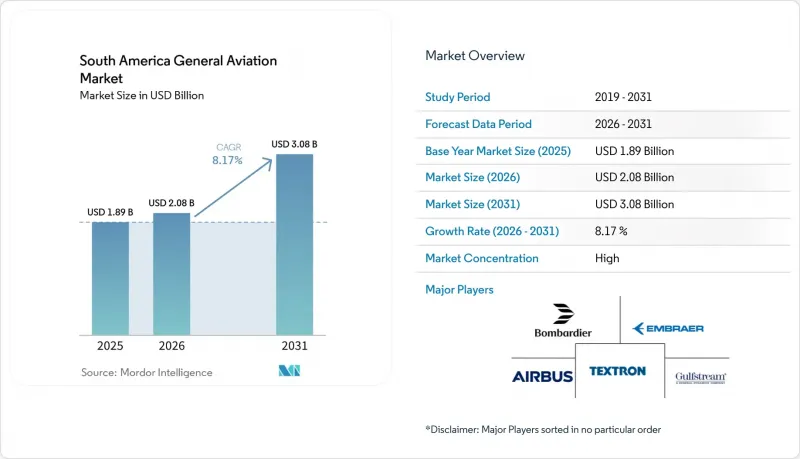
According to Mordor Intelligence, the South America general aviation market size was valued at USD 1.89 billion in 2025, and is forecast to grow from USD 2.08 billion in 2026 to reach USD 3.08 billion by 2031, at an 8.17% CAGR during the forecast period (2026-2031).
South America General Aviation Market Trends and Insights
Remote-Area Connectivity Requirements
The South America general aviation market depends on aircraft, where terrain and long travel distances restrict ground transport. The Amazon basin, Andean corridor, Chaco lowlands, and Patagonian steppe create persistent requirements for point-to-point air access. In 2025, Paraguay's SETAM resumed CASA 212 services linking Asuncion with remote Chaco settlements after a 60-day maintenance interruption. The service-connected communities, including Bahia Negra and Fuerte Olimpo, where aviation supports basic mobility. Oil, mining, and agribusiness operators in interior locations also rely on aircraft because there are few practical ground alternatives. The region's urban population pattern does not remove this need, since economic activity extends well beyond routes that can support scheduled airline service.
Growth in Corporate and Private Aviation
Brazil's executive aviation fleet reached 1,193 aircraft in May 2026, up from 906 aircraft in May 2024. Airbus Corporate Jets reported 1,103 business jets in Brazil in June 2025, placing the country second behind the US and ahead of Mexico. Registrations during the first half of 2025 included 39 light jets, 17 midsize jets, and 6 heavy jets. These additions indicate growing demand for longer-range aircraft and larger cabins among Brazilian corporate users. The South America general aviation market also benefits as private flying becomes a business travel option in second-tier Brazilian cities. Chile and Colombia offer related growth opportunities as corporate activity and cross-border travel increase.
Inadequate Regional Airports, Heliports, and MRO Facilities
Limited infrastructure is a material constraint on the South America general aviation market, particularly for operators outside major cities. Certified maintenance capacity is concentrated around Sao Paulo, Buenos Aires, and Santiago. Operators in smaller markets may need to ferry aircraft to North American facilities for heavy maintenance. This increases maintenance costs and reduces the time that aircraft are available for service. Aviasur expanded its Santiago maintenance center from 5,500 square meters to 7,100 square meters at the end of 2024. The increase supports regional demand, but available capacity remains limited for Chilean and Argentine operators.
Other drivers and restraints analyzed in the detailed report include:
- Fleet Renewal and Demand for More Efficient Aircraft
- Agribusiness, Mining, and Offshore Energy Operations
- High Fuel, Maintenance, Insurance, and Airport Costs
For complete list of drivers and restraints, kindly check the Table Of Contents.
Segment Analysis
Business jets held 33.98% of the South America general aviation market share in 2025, making them the largest aircraft segment. Their comparatively lower acquisition cost and shorter runway needs suit Brazil's broad secondary-airport network. Brazil's executive jet fleet reached 1,193 aircraft in May 2026, rising 31.7% from 906 aircraft in May 2024. Midsize and large jets are gaining relevance as companies seek more range for regional and transatlantic missions. The six heavy aircraft registrations recorded in the first half of 2025 point to demand moving into larger cabin classes.
Turboprops remain important for agricultural work and access to remote communities. Brazil's turboprop business aviation fleet grew 23% between May 2024 and May 2026. Piston aircraft remained the largest absolute fleet category in Brazil, totaling 6,170 aircraft in May 2026. Rotorcraft support offshore energy, emergency medical work, and urban charter operations, while turbine helicopters grew 19% in Brazil over the same period. The South America general aviation market size for eVTOL and AAM vehicles is forecast to grow at a 10.85% CAGR through 2031. Eve targets certification by Brazil's ANAC in 2028 and signed a binding framework with Revo for up to 50 eVTOL aircraft.
Conventional piston/turbine aircraft held 65.98% of the South America general aviation market share in 2025. The installed fleet relies on piston trainers, agricultural turboprops, and turbofan business jets that have established maintenance and operating practices. This base limits the prospect of rapid near-term replacement by alternative propulsion systems. Brazil had 6,170 piston aircraft in May 2026, many of which served training and utility work. All-electric aircraft remain at an early stage of commercial development. The US Government Accountability Office reported in 2026 that the FAA was still evaluating certification issues for electric aircraft.
Hybrid-electric propulsion is forecast to grow at a 12.29% CAGR through 2031. The FAA approved the G-1 Issue Paper for Ampaire's AMP-H570 hybrid-electric propulsion system in March 2025. Electra's EL9 program proceeded with its G-1 Issue Paper process in July 2026 after a Part 23 type-certification application in November 2025. Hybrid aircraft could serve regional routes of 300-600 km, where battery-only range may remain insufficient. These routes may support lower operating costs than conventional turbines where passenger demand is thin. The South America general aviation market is likely to follow FAA and EASA certification precedents as Brazil and Argentina develop their own pathways.
Complete Report Scope:
- By Aircraft Type
- Business Jets
- Large Jet
- Mid-Size Jet
- Light/Very-Light Jet
- Turboprop Fixed-Wing
- Piston Fixed-Wing
- Rotorcraft
- Advanced Air Mobility eVTOLs
- Business Jets
- By Propulsion Type
- Conventional Piston/Turbine
- Hybrid-Electric
- All-Electric
- By Ownership Model
- Full Private Ownership
- Fractional Ownership
- Charter/Air-Taxi Operators
- Training and Academic Institutions
- Government and Special-Mission Operators
- By End-User Application
- Business/Corporate Transport
- Personal and Leisure Flying
- Special Mission (ISR, Surveillance, Law Enforcement)
- Emergency Medical/Air-Ambulance
- Pilot Training
- By Geography
- Brazil
- Argentina
- Chile
- Colombia
- Venezuela
- Peru
- Rest of South America
List of Companies Covered in this Report:
- Embraer S.A.
- Textron Aviation Inc.
- Bombardier Inc.
- Airbus SE
- Leonardo S.p.A.
- Gulfstream Aerospace Corporation (General Dynamics Corporation)
- Dassault Aviation SA
- Pilatus Aircraft Ltd.
- Piper Aircraft, Inc.
- Honda Aircraft Company (Honda Motor Co., Ltd.)
- Avantto
- Robinson Helicopter Company, Inc.
- Lider Aviacao
- Voar Aviation
- Sete Taxi Aereo
Additional Benefits:
- The market estimate (ME) sheet in Excel format
- 3 months of analyst support
TABLE OF CONTENTS
1 INTRODUCTION
- 1.1 Study Assumptions and Market Definition
- 1.2 Scope of the Study
- 1.3 Research Methodology
2 EXECUTIVE SUMMARY
3 MARKET LANDSCAPE
- 3.1 Market Overview
- 3.2 Market Drivers
- 3.2.1 Growth in corporate and private aviation
- 3.2.2 Remote-area connectivity requirements
- 3.2.3 Fleet renewal and demand for more efficient aircraft
- 3.2.4 Agribusiness, mining, and offshore energy operations
- 3.2.5 Expansion of fractional ownership and on-demand charter models
- 3.2.6 Rising aeromedical and emergency-response requirements
- 3.3 Market Restraints
- 3.3.1 Inadequate regional airports, heliports, and MRO facilities
- 3.3.2 High fuel, maintenance, insurance, and airport costs
- 3.3.3 Economic volatility, currency risk, and financing constraints
- 3.3.4 Aircraft-part lead times and pilot availability constraints
- 3.4 Value Chain Analysis
- 3.5 Technological Outlook
- 3.6 Porter's Five Forces Analysis
- 3.6.1 Threat of New Entrants
- 3.6.2 Bargaining Power of Suppliers
- 3.6.3 Bargaining Power of Buyers
- 3.6.4 Threat of Substitutes
- 3.6.5 Intensity of Competitive Rivalry
4 MARKET SIZE AND GROWTH FORECASTS (VALUE)
- 4.1 By Aircraft Type
- 4.1.1 Business Jets
- 4.1.1.1 Large Jet
- 4.1.1.2 Mid-Size Jet
- 4.1.1.3 Light/Very-Light Jet
- 4.1.2 Turboprop Fixed-Wing
- 4.1.3 Piston Fixed-Wing
- 4.1.4 Rotorcraft
- 4.1.5 Advanced Air Mobility eVTOLs
- 4.1.1 Business Jets
- 4.2 By Propulsion Type
- 4.2.1 Conventional Piston/Turbine
- 4.2.2 Hybrid-Electric
- 4.2.3 All-Electric
- 4.3 By Ownership Model
- 4.3.1 Full Private Ownership
- 4.3.2 Fractional Ownership
- 4.3.3 Charter/Air-Taxi Operators
- 4.3.4 Training and Academic Institutions
- 4.3.5 Government and Special-Mission Operators
- 4.4 By End-User Application
- 4.4.1 Business/Corporate Transport
- 4.4.2 Personal and Leisure Flying
- 4.4.3 Special Mission (ISR, Surveillance, Law Enforcement)
- 4.4.4 Emergency Medical/Air-Ambulance
- 4.4.5 Pilot Training
- 4.5 By Geography
- 4.5.1 Brazil
- 4.5.2 Argentina
- 4.5.3 Chile
- 4.5.4 Colombia
- 4.5.5 Venezuela
- 4.5.6 Peru
- 4.5.7 Rest of South America
5 COMPETITIVE LANDSCAPE
- 5.1 Market Concentration
- 5.2 Strategic Moves
- 5.3 Market Share Analysis
- 5.4 Company Profiles (includes Global level Overview, Market level overview, Core Segments, Financials as available, Strategic Information, Market Rank/Share for key companies, Products and Services, and Recent Developments)
- 5.4.1 Embraer S.A.
- 5.4.2 Textron Aviation Inc.
- 5.4.3 Bombardier Inc.
- 5.4.4 Airbus SE
- 5.4.5 Leonardo S.p.A.
- 5.4.6 Gulfstream Aerospace Corporation (General Dynamics Corporation)
- 5.4.7 Dassault Aviation SA
- 5.4.8 Pilatus Aircraft Ltd.
- 5.4.9 Piper Aircraft, Inc.
- 5.4.10 Honda Aircraft Company (Honda Motor Co., Ltd.)
- 5.4.11 Avantto
- 5.4.12 Robinson Helicopter Company, Inc.
- 5.4.13 Lider Aviacao
- 5.4.14 Voar Aviation
- 5.4.15 Sete Taxi Aereo
6 MARKET OPPORTUNITIES AND FUTURE OUTLOOK
- 6.1 White-space and Unmet-Need Assessment

