PUBLISHER: Mordor Intelligence | PRODUCT CODE: 2155338

PUBLISHER: Mordor Intelligence | PRODUCT CODE: 2155338
Lacrimal Devices - Market Share Analysis, Industry Trends & Statistics, Growth Forecasts (2026 - 2031)
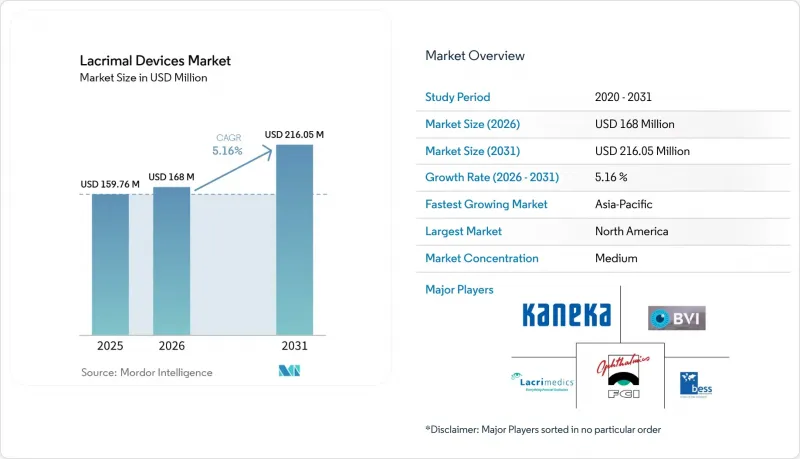
According to Mordor Intelligence, the lacrimal devices market size is expected to grow from USD 159.76 million in 2025 to USD 168 million in 2026 and is forecast to reach USD 216.05 million by 2031 at 5.16% CAGR over 2026-2031.
Global Lacrimal Devices Market Trends and Insights
Rising Prevalence of Dry Eye and Nasolacrimal Duct Obstruction
The lacrimal devices market is supported by a substantial ocular surface disease burden that extends beyond older adults. A 2025 South Korean population-based study found that dry eye disease prevalence exceeded 21.96% among individuals aged 70-74, compared with 8.88% across the overall study population. The study also identified a separate prevalence peak among working-age adults, associated with occupational screen exposure. A 2024 study conducted in Tianjin reported dry eye disease in 39% of adults aged 50 and older. Asymptomatic dry eye accounted for 53.6% of affected participants, indicating a sizable population that remains undiagnosed or untreated. Collectively, these trends expand the addressable demand for diagnosis, punctal occlusion, and related lacrimal care over the forecast period.
Shift Toward Minimally Invasive Lacrimal Procedures
The shift from external to endoscopic dacryocystorhinostomy is reshaping device demand within the lacrimal devices market. A 2025 retrospective analysis of 14,135 procedures in the United States found that the share of endoscopic dacryocystorhinostomy increased from 12.9% to 40.1% of all procedures over 20 years. Long-term revision outcomes for endoscopic procedures remained comparable to those of external surgery, ranging from 85.3% to 91.4% at 20 years. A separate 2025 survey found that 57% of junior surgeons used endoscopic surgery in more than 66% of cases, compared with 18.3% of senior surgeons. Endonasal procedures require dedicated silicone tube systems and integrated metallic guides rather than basic probe and cannula kits. This transition creates opportunities for manufacturers offering preloaded, guide-integrated bicanalicular systems that eliminate the need for nasal retrieval.
High Device and Procedure Costs
High device and procedure costs continue to constrain adoption in the lacrimal devices market, particularly for premium intubation and stenting systems. In developed markets, nasolacrimal stenting procedures typically cost USD 3,000-8,000, including the overall care costs cited in the draft. Providers may face challenges in adopting premium single-use formats while operating within fixed procedure budgets. Regulation (EU) 2017/745 has introduced more stringent conformity assessment and post-market surveillance requirements for medical devices in Europe. These requirements increase the administrative and clinical evidence burden on smaller specialty manufacturers. In South America and Sub-Saharan Africa, healthcare systems may classify lacrimal interventions as elective procedures, increasing out-of-pocket costs for patients with limited ability to pay.
Other drivers and restraints analyzed in the detailed report include:
- Aging Population and Age-Related Lacrimal Disorders
- Expanding Ophthalmic Infrastructure and Patient Awareness
- Limited Reimbursement Coverage
For complete list of drivers and restraints, kindly check the Table Of Contents.
Segment Analysis
Punctal plugs held 38.65% share of the lacrimal devices market in 2025, supported by their use in outpatient dry eye management, post-surgical ocular surface protection, and contact lens intolerance. The category has broad clinical applicability when topical lubricants do not provide sufficient relief. Absorbable plugs enable patients to trial punctal occlusion before selecting a longer-lasting device. Lacrimal stents maintain duct patency following dacryocystorhinostomy, while tubes, cannulas, and spatulas are used during surgical procedures. Demand for these products, therefore, tracks procedure volumes. Manufacturers also commonly include lacrimal dilators in intubation kits and market them as procedural consumables.
The lacrimal devices market is increasingly shifting toward integrated procedural kits that combine multiple disposable components. Intubation sets are forecast to grow at a CAGR of 7.43% through 2031, driven by the growing adoption of endoscopic surgery. Demand is increasing for systems that reduce operating room time and streamline insertion. FCI Ophthalmic describes its Nunchaku system as a self-retaining bicanalicular intubation stent with integrated metallic guides and a push-insertion technique. As the system does not require nasal retrieval, it can support consistent use across surgeons with varying experience levels. Integrated intubation systems, biodegradable stents, and single-use packaging can also reduce dependence on multi-vendor procedural trays.
Complete Report Scope:
- By Product
- Punctal Plugs
- Lacrimal Stents
- Intubation Sets
- Lacrimal Tubes
- Lacrimal Cannulas and Spatulas
- Other Product Types
- By Application
- Dry Eye
- Glaucoma
- Epiphora
- Drainage Obstruction
- Lacrimal Gland Inflammation
- Other Applications
- By End User
- Hospitals
- Ophthalmic Clinics
- Diagnostic Centers
- Other End Users
- Geography
- North America
- United States
- Canada
- Mexico
- Europe
- Germany
- United Kingdom
- France
- Italy
- Spain
- Rest of Europe
- Asia-Pacific
- China
- Japan
- India
- Australia
- South Korea
- Rest of Asia-Pacific
- Middle East and Africa
- GCC
- South Africa
- Rest of Middle East and Africa
- South America
- Brazil
- Argentina
- Rest of South America
- North America
Geography Analysis
North America is projected to hold a 44.28% share of the lacrimal devices market in 2025, supported by a high prevalence of physician-diagnosed dry eye disease, established reimbursement systems, and a strong base of specialty manufacturers. The source draft estimates that more than 38 million adults in the United States have been diagnosed with dry eye disease. The region has also advanced furthest in the transition to endoscopic dacryocystorhinostomy. This shift increases the use of intubation consumables per procedure, even when procedure volumes do not accelerate. Canada represents another active market for medically necessary lacrimal procedures under universal healthcare coverage.
Europe is projected to hold the second-largest regional share of the lacrimal devices market. Germany, France, the United Kingdom, and the Nordic countries lead regional procedure volumes, supported by national healthcare coverage for dacryocystorhinostomy and lacrimal intubation. Regulation (EU) 2017/745 has increased evidence and compliance requirements for suppliers operating in the European market. This regulatory environment can favor companies that maintain compliant product portfolios and conduct post-market clinical follow-up. A 2026 analysis of endoscopic dacryocystorhinostomy from a high-volume tertiary center is also expected to reflect continued surgical research activity in the region.
Asia-Pacific is forecast to grow at a CAGR of 6.54% through 2031, making it the fastest-growing regional market for lacrimal devices. A 2024 study of 139,556 Asian participants reported a dry eye disease prevalence of 23.9%, including 16.2% among individuals under 30 years of age and 26.7% among those over 70 years of age. Saudi Arabia's investment in tertiary care supports dacryocystorhinostomy capabilities across the Gulf Cooperation Council. Africa has a pooled dry eye disease prevalence of 43.6% across 15 studies, although limited healthcare infrastructure and reimbursement coverage constrain treatment access. South America is projected to remain the smallest regional contributor, with Brazil and Mexico serving as its primary markets. The expansion of private clinics in major cities is beginning to generate procedural volume.
- Alcon
- Aurolab
- B. Braun
- Besse Medizintechnik GmbH
- BVI Medical
- Cook Group
- FCI Ophthalmic
- Gunther Weiss Scientific Glass
- Innovia Medical
- JEDMED Instrument Company
- Kaneka
- Medennium
- Nordics Pharma
- OASIS Medical, Inc.
- Porex Surgical, Inc.
- Rumex International Co.
- Walsh Medical Devices
Additional Benefits:
- The market estimate (ME) sheet in Excel format
- 3 months of analyst support
TABLE OF CONTENTS
1 Introduction
- 1.1 Study Assumptions & Market Definition
- 1.2 Scope Of The Study
2 Research Methodology
3 Executive Summary
4 Market Landscape
- 4.1 Market Overview
- 4.2 Market Drivers
- 4.2.1 Rising Prevalence of Dry Eye and Nasolacrimal Duct Obstruction
- 4.2.2 Shift Toward Minimally Invasive Lacrimal Procedures
- 4.2.3 Aging Population and Age-Related Lacrimal Disorders
- 4.2.4 Expanding Ophthalmic Infrastructure and Patient Awareness
- 4.2.5 Adoption of Single-Use Devices in Endoscopic Dacryocystorhinostomy
- 4.2.6 Preloaded Self-Retaining Intubation Reducing Operating-Room Time
- 4.3 Market Restraints
- 4.3.1 High Device and Procedure Costs
- 4.3.2 Limited Reimbursement Coverage
- 4.3.3 Biofilm Formation, Plug Migration, and Revision Procedures
- 4.3.4 Fragmented Device Sizing and Procedural Standardization
- 4.4 Supply-Chain Analysis
- 4.5 Regulatory Landscape
- 4.6 Technological Outlook
- 4.7 Porter's Five Forces Analysis
- 4.7.1 Threat Of New Entrants
- 4.7.2 Bargaining Power Of Buyers
- 4.7.3 Bargaining Power Of Suppliers
- 4.7.4 Threat Of Substitutes
- 4.7.5 Competitive Rivalry
5 Market Size & Growth Forecasts (Value, USD)
- 5.1 By Product
- 5.1.1 Punctal Plugs
- 5.1.2 Lacrimal Stents
- 5.1.3 Intubation Sets
- 5.1.4 Lacrimal Tubes
- 5.1.5 Lacrimal Cannulas and Spatulas
- 5.1.6 Other Product Types
- 5.2 By Application
- 5.2.1 Dry Eye
- 5.2.2 Glaucoma
- 5.2.3 Epiphora
- 5.2.4 Drainage Obstruction
- 5.2.5 Lacrimal Gland Inflammation
- 5.2.6 Other Applications
- 5.3 By End User
- 5.3.1 Hospitals
- 5.3.2 Ophthalmic Clinics
- 5.3.3 Diagnostic Centers
- 5.3.4 Other End Users
- 5.4 Geography
- 5.4.1 North America
- 5.4.1.1 United States
- 5.4.1.2 Canada
- 5.4.1.3 Mexico
- 5.4.2 Europe
- 5.4.2.1 Germany
- 5.4.2.2 United Kingdom
- 5.4.2.3 France
- 5.4.2.4 Italy
- 5.4.2.5 Spain
- 5.4.2.6 Rest of Europe
- 5.4.3 Asia-Pacific
- 5.4.3.1 China
- 5.4.3.2 Japan
- 5.4.3.3 India
- 5.4.3.4 Australia
- 5.4.3.5 South Korea
- 5.4.3.6 Rest of Asia-Pacific
- 5.4.4 Middle East and Africa
- 5.4.4.1 GCC
- 5.4.4.2 South Africa
- 5.4.4.3 Rest of Middle East and Africa
- 5.4.5 South America
- 5.4.5.1 Brazil
- 5.4.5.2 Argentina
- 5.4.5.3 Rest of South America
- 5.4.1 North America
6 Competitive Landscape
- 6.1 Market Concentration
- 6.2 Market Share Analysis
- 6.3 Company Profiles {(Includes Global Level Overview, Market Level Overview, Core Segments, Financials As Available, Strategic Information, Market Rank/Share For Key Companies, Products & Services, And Recent Developments)}
- 6.3.1 Alcon Inc.
- 6.3.2 Aurolab
- 6.3.3 B. Braun Melsungen AG
- 6.3.4 Besse Medizintechnik GmbH
- 6.3.5 BVI
- 6.3.6 Cook Medical
- 6.3.7 FCI Ophthalmic
- 6.3.8 Gunther Weiss Scientific Glass
- 6.3.9 Innovia Medical
- 6.3.10 JEDMED Instrument Company
- 6.3.11 Kaneka Corporation
- 6.3.12 Medennium
- 6.3.13 Nordics Pharma
- 6.3.14 OASIS Medical, Inc.
- 6.3.15 Porex Surgical, Inc.
- 6.3.16 Rumex International Co.
- 6.3.17 Walsh Medical Devices Inc.
7 Market Opportunities & Future Outlook
- 7.1 White-Space & Unmet-Need Assessment

