PUBLISHER: Mordor Intelligence | PRODUCT CODE: 2155539

PUBLISHER: Mordor Intelligence | PRODUCT CODE: 2155539
Photon-Counting X-Ray Inspection Systems - Market Share Analysis, Industry Trends & Statistics, Growth Forecasts (2026 - 2031)
According to Mordor Intelligence, the Photon-Counting X-Ray inspection systems market size is projected to expand from USD 156.56 million in 2025 and USD 184.77 million in 2026 to USD 455.82 million by 2031, registering a CAGR of 19.79% between 2026 and 2031.
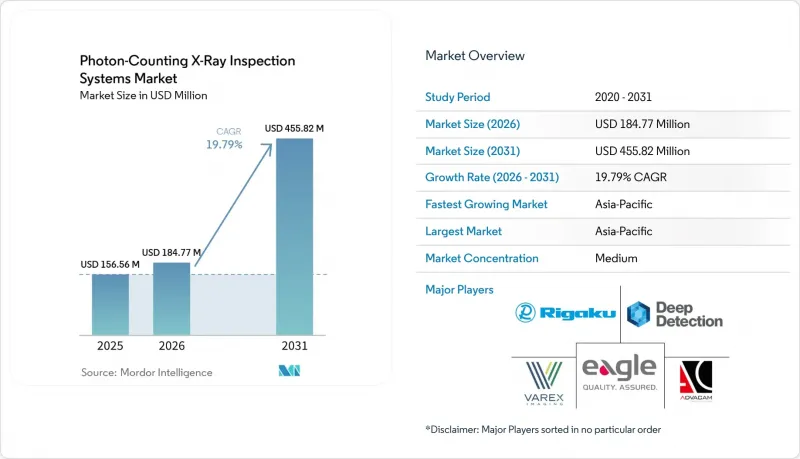
Global Photon-Counting X-Ray Inspection Systems Market Trends and Insights
Tightening Traceability Requirements for High-Reliability Manufacturing
Traceability requirements now extend beyond food lots and pharmaceutical serialization. Aerospace, automotive, and electronics suppliers increasingly need documented inspection records for individual components. The Photon-Counting X-Ray Inspection Systems Market can generate machine-readable evidence at the point of manufacture. The U.S. Food and Drug Administration identifies preventive controls for human food under 21 CFR Part 117, which strengthens the need for documented food-safety controls. These records can connect inspection activity with quality management and manufacturing execution systems. The resulting software and data integration can make a supplier relationship more durable after installation.
Expansion of Automated Food and Pharmaceutical Inspection Lines
The Photon-Counting X-Ray Inspection Systems Market serves food producers updating inspection lines to handle a wider range of products and more demanding package formats. The Photon-Counting X-Ray Inspection Systems Market benefits when a dual-energy system replaces separate inspection stages. Material contrast can improve the detection of low-density contaminants, including soft plastics, rubber gaskets, and fish bones. Eagle Product Inspection expanded its PXT photon-counting capabilities across its advanced inspection range in April 2026. The update focused on material discrimination and validated performance for food processors operating under FSIS verification programs. Retailer audits also continue to reinforce demand for dependable inspection of premium food and personal care products.
High System and Shielding Costs
Photon-counting X-ray systems can cost 1.5x to 3x as much as comparable scintillator-based units. Detector area, energy resolution, and throughput requirements affect the difference. Site investment can also include shielding, structural work, and lead-equivalent enclosures. Smaller food and beverage producers often face capital approval cycles of 12-24 months. Multi-energy systems are particularly costly and remain best suited for battery, semiconductor, and aerospace applications. Import duties and limited financing can further restrict adoption in South America, the Middle East and Africa, and smaller Asia-Pacific markets.
Other drivers and restraints analyzed in the detailed report include:
- Rising Demand for High-Speed In-Line Computed Tomography
- Growth of Semiconductor, Battery, and Advanced-Packaging Manufacturing
- Radiation-Safety and Validation Complexity
For complete list of drivers and restraints, kindly check the Table Of Contents.
Segment Analysis
Dual-energy systems held 38.81% of the Photon-Counting X-Ray Inspection Systems Market share in 2025. Their lead reflects established use in food and pharmaceuticals, where two-material discrimination is validated and commercially supported. Retailer audit processes and traceability systems also fit this mature technology. Single-energy systems remain relevant for entry-level food inspection and high-energy industrial radiography. Energy-threshold and energy-resolving systems serve selected blister and vial inspection needs.
Multi-energy or spectral systems are projected to expand at a 24.41% CAGR through 2031. The Photon-Counting X-Ray Inspection Systems Market is seeing battery and semiconductor lines that require several material classes to be distinguished in a single CT acquisition. These materials can include electrodes, binder coatings, and metallic current collectors. Sony Semiconductor Solutions announced planned mass production of the IMX711 direct-conversion X-ray CMOS sensor in June 2026, with a maximum frame rate of 26,100 fps. ADVACAM's CdTe-based WidePIX cameras use 55 µm pixel pitch and adjustable energy thresholds for CT inspection.
Line-scan systems accounted for 48.61% of the Photon-Counting X-Ray Inspection Systems Market size in 2025. The Photon-Counting X-Ray Inspection Systems Market serves food and beverage plants that use them across continuous belt-fed production lines. Their installed base supports data sets for calibration, algorithms, and audit documentation. These data sets can create switching costs beyond those tied to detector performance. Area-scan and laminography systems serve stationary parts and specialized micro-bump geometries.
Computed tomography systems are projected to expand at a 25.51% CAGR through 2031. Their use is increasing where batteries need volumetric checks and packages contain buried connections. Comet Yxlon introduced a 160 kV nanofocus tube option for the FF35 CT in June 2026. Nordson's Dynamic Planar CT software supports faster image acquisition for flip-chip inspection. Hardware and software updates can reduce the barrier to CT workflows.
Complete Report Scope:
- By Detector Technology
- Single-Energy Photon-Counting
- Dual-Energy Photon-Counting
- Multi-Energy and Spectral Photon-Counting
- Energy-Threshold and Energy-Resolving Photon Counting
- Other Photon-Counting Technologies
- By System Configuration
- Line-Scan Systems
- Area-Scan Systems
- Computed Tomography (CT) Systems
- 3D and Laminography Systems
- Other System Configurations
- By Application
- Foreign-Object Detection
- Defect and Void Inspection
- Dimensional Metrology and Weight Estimation
- Material Decomposition and Sorting
- Weld, Composite, and Additive-Manufacturing Inspection
- Other Applications
- By End-User Industry
- Food and Beverage
- Pharmaceuticals and Personal Care
- Electronics and Semiconductors
- Automotive and Electric Vehicles
- Aerospace and Defense
- Other End-User Industries
- By Geography
- North America
- United States
- Canada
- Mexico
- South America
- Brazil
- Argentina
- Rest of South America
- Europe
- Germany
- United Kingdom
- France
- Italy
- Spain
- Rest of Europe
- Asia-Pacific
- China
- Japan
- India
- South Korea
- Rest of Asia-Pacific
- Middle East and Africa
- Middle East
- Saudi Arabia
- Turkey
- United Arab Emirates
- Rest of the Middle East
- Africa
- South Africa
- Kenya
- Rest of Africa
- Middle East
- North America
Geography Analysis
North America has a developed base for photon-counting X-ray inspection. The Photon-Counting X-Ray Inspection Systems Market in North America is supported by food safety enforcement and automation investment, and pharmaceutical fill-and-finish upgrades support demand. The U.S. FDA extended the Food Traceability Final Rule compliance date to July 2028, aligning procurement activity with the 2026-2028 period. Eagle Product Inspection demonstrated 3 advanced X-ray systems at IPPE 2026 in January. Canada and Mexico are smaller markets tied to North American supply chains.
Europe is the second-largest geographic area in the Photon-Counting X-Ray Inspection Systems Market. Food-control and pharmaceutical frameworks support demand for replacement and upgrades. Germany, the United Kingdom, and France have deep automation infrastructure and active pharmaceutical and automotive bases. BRCGS food-safety standards contribute to audit and validation requirements. Italy, Spain, and Eastern Europe add demand for food, pharmaceuticals, automotive, and electronics.
Asia-Pacific held 29.11% of the Photon-Counting X-Ray Inspection Systems Market share in 2025 and is projected to expand at a 22.61% CAGR through 2031. The Photon-Counting X-Ray Inspection Systems Market has a key source of demand in China because of battery-cell manufacturing. Japan, South Korea, and ASEAN add semiconductor, display, and electronics requirements. South America, the Middle East, and Africa remain earlier-stage areas because import costs, infrastructure gaps, and limited application engineering restrict adoption.
- Eagle Product Inspection
- Varex Imaging Corporation
- ADVACAM s.r.o.
- Deep Detection
- Rigaku Holdings Corporation
- Nikon Metrology NV
- Nordson Corporation
- YXLON International GmbH
- VJ Technologies, Inc.
- Mettler-Toledo International Inc.
- Anritsu Corporation
- Smiths Detection Group Limited
- Viscom AG
- VITROX CORPORATION BERHAD
- Test Research, Inc.
- Ishida Co., Ltd.
- Sesotec GmbH
- Waygate Technologies GmbH
- VisiConsult X-ray Systems and Solutions GmbH
- North Star Imaging, Inc.
Additional Benefits:
- The market estimate (ME) sheet in Excel format
- 3 months of analyst support
TABLE OF CONTENTS
1 INTRODUCTION
- 1.1 Study Assumptions and Market Definition
- 1.2 Scope of the Study
2 RESEARCH METHODOLOGY
3 EXECUTIVE SUMMARY
4 MARKET LANDSCAPE
- 4.1 Market Overview
- 4.2 Market Drivers
- 4.2.1 Tightening Traceability Requirements for High-Reliability Manufacturing
- 4.2.2 Expansion of Automated Food and Pharmaceutical Inspection Lines
- 4.2.3 Rising Demand for High-Speed In-Line Computed Tomography
- 4.2.4 Growth of Semiconductor, Battery, and Advanced-Packaging Manufacturing
- 4.2.5 Material Decomposition from Multi-Energy Photon Counting
- 4.2.6 Lower False-Reject Economics in Complex Food Products
- 4.3 Market Restraints
- 4.3.1 High System and Shielding Cost
- 4.3.2 Radiation-Safety and Validation Complexity
- 4.3.3 Pixel-Pile-Up and High-Flux Calibration Challenges
- 4.3.4 Limited Integrator and Application-Engineering Capacity
- 4.4 Industry Supply Chain Analysis
- 4.5 Regulatory Landscape
- 4.6 Technological Outlook
- 4.7 Impact of Macroeconomic Factors on the Market
- 4.8 Porter's Five Forces Analysis
- 4.8.1 Threat of New Entrants
- 4.8.2 Bargaining Power of Suppliers
- 4.8.3 Bargaining Power of Buyers
- 4.8.4 Threat of Substitutes
- 4.8.5 Intensity of Competitive Rivalry
5 MARKET SIZE AND GROWTH FORECASTS (VALUE)
- 5.1 By Detector Technology
- 5.1.1 Single-Energy Photon-Counting
- 5.1.2 Dual-Energy Photon-Counting
- 5.1.3 Multi-Energy and Spectral Photon-Counting
- 5.1.4 Energy-Threshold and Energy-Resolving Photon Counting
- 5.1.5 Other Photon-Counting Technologies
- 5.2 By System Configuration
- 5.2.1 Line-Scan Systems
- 5.2.2 Area-Scan Systems
- 5.2.3 Computed Tomography (CT) Systems
- 5.2.4 3D and Laminography Systems
- 5.2.5 Other System Configurations
- 5.3 By Application
- 5.3.1 Foreign-Object Detection
- 5.3.2 Defect and Void Inspection
- 5.3.3 Dimensional Metrology and Weight Estimation
- 5.3.4 Material Decomposition and Sorting
- 5.3.5 Weld, Composite, and Additive-Manufacturing Inspection
- 5.3.6 Other Applications
- 5.4 By End-User Industry
- 5.4.1 Food and Beverage
- 5.4.2 Pharmaceuticals and Personal Care
- 5.4.3 Electronics and Semiconductors
- 5.4.4 Automotive and Electric Vehicles
- 5.4.5 Aerospace and Defense
- 5.4.6 Other End-User Industries
- 5.5 By Geography
- 5.5.1 North America
- 5.5.1.1 United States
- 5.5.1.2 Canada
- 5.5.1.3 Mexico
- 5.5.2 South America
- 5.5.2.1 Brazil
- 5.5.2.2 Argentina
- 5.5.2.3 Rest of South America
- 5.5.3 Europe
- 5.5.3.1 Germany
- 5.5.3.2 United Kingdom
- 5.5.3.3 France
- 5.5.3.4 Italy
- 5.5.3.5 Spain
- 5.5.3.6 Rest of Europe
- 5.5.4 Asia-Pacific
- 5.5.4.1 China
- 5.5.4.2 Japan
- 5.5.4.3 India
- 5.5.4.4 South Korea
- 5.5.4.5 Rest of Asia-Pacific
- 5.5.5 Middle East and Africa
- 5.5.5.1 Middle East
- 5.5.5.1.1 Saudi Arabia
- 5.5.5.1.2 Turkey
- 5.5.5.1.3 United Arab Emirates
- 5.5.5.1.4 Rest of the Middle East
- 5.5.5.2 Africa
- 5.5.5.2.1 South Africa
- 5.5.5.2.2 Kenya
- 5.5.5.2.3 Rest of Africa
- 5.5.5.1 Middle East
- 5.5.1 North America
6 COMPETITIVE LANDSCAPE
- 6.1 Market Concentration
- 6.2 Strategic Moves
- 6.3 Market Share Analysis
- 6.4 Company Profiles (includes Global Level Overview, Market Level Overview, Core Segments, Financials as available, Strategic Information, Market RankandShare, Products and Services, Recent Developments)
- 6.4.1 Eagle Product Inspection
- 6.4.2 Varex Imaging Corporation
- 6.4.3 ADVACAM s.r.o.
- 6.4.4 Deep Detection
- 6.4.5 Rigaku Holdings Corporation
- 6.4.6 Nikon Metrology NV
- 6.4.7 Nordson Corporation
- 6.4.8 YXLON International GmbH
- 6.4.9 VJ Technologies, Inc.
- 6.4.10 Mettler-Toledo International Inc.
- 6.4.11 Anritsu Corporation
- 6.4.12 Smiths Detection Group Limited
- 6.4.13 Viscom AG
- 6.4.14 VITROX CORPORATION BERHAD
- 6.4.15 Test Research, Inc.
- 6.4.16 Ishida Co., Ltd.
- 6.4.17 Sesotec GmbH
- 6.4.18 Waygate Technologies GmbH
- 6.4.19 VisiConsult X-ray Systems and Solutions GmbH
- 6.4.20 North Star Imaging, Inc.
7 MARKET OPPORTUNITIES AND FUTURE OUTLOOK
- 7.1 White-Space and Unmet-Need Assessment

