PUBLISHER: Mordor Intelligence | PRODUCT CODE: 2155546

PUBLISHER: Mordor Intelligence | PRODUCT CODE: 2155546
Automotive Wrap - Market Share Analysis, Industry Trends & Statistics, Growth Forecasts (2026 - 2031)
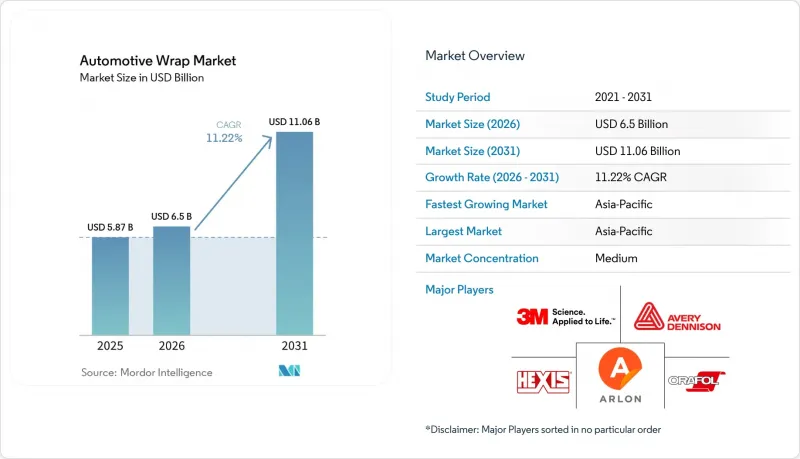
According to Mordor Intelligence, the automotive wrap market size was valued at USD 5.87 billion in 2025 and is estimated to grow from USD 6.50 billion in 2026 to reach USD 11.06 billion by 2031, at a CAGR of 11.22% during the forecast period (2026-2031).
Global Automotive Wrap Market Trends and Insights
Vehicle Customization and Aesthetic Personalization
Vehicle personalization has expanded beyond a narrow enthusiast audience as professional films have become more accessible to consumers. Buyers seek full-color changes and finishes such as matte, satin, chrome, and color-shifting options that conventional repainting cannot match with the same flexibility. U.S. specialty vehicle modification spending reached USD 52.65 billion in 2024, with vehicle appearance products forming a growing share of this aftermarket activity. The automotive wrap market benefits from this trend because an applied film can change a vehicle's appearance without permanently altering its factory finish. Some vehicle manufacturers are testing dealer-adjacent programs for factory-matched designs, creating a potential business-to-business channel alongside retail demand. These programs also raise performance expectations for installers and films across the automotive wrap market.
Fleet Branding and Mobile Advertising
Wrapped vehicles in dense urban areas can generate 30,000 to 70,000 visual impressions each day, depending on local traffic conditions. This visibility gives fleet operators a measurable reason to use vehicle graphics alongside other advertising formats. Logistics and e-commerce operators increasingly view vehicle branding as a practical part of their operating model. Replacement cycles of 3 to 5 years provide film suppliers and installers with recurring orders rather than one-time retail work. Last-mile delivery, ride-hailing, and food-delivery fleets expand the addressable base for the automotive wrap market in Asia-Pacific and Europe. Partial wraps also lower the entry cost for smaller operators by covering key identification and branding areas.
High Installation Cost and Skilled-Labor Dependency
A professional full-vehicle wrap requires 14 to 28 labor hours, depending on vehicle size and body complexity. Master installer hourly rates in high-demand North American locations have reached USD 95, increasing the cost of premium installations. The United States has no federally mandated installer certification standard, which contributes to uneven application quality. Buyers may delay purchases when qualified installers are not available in their area. Manufacturer and association training programs help develop technicians, including professional development work supported by the Specialty Equipment Market Association (SEMA). However, limited training capacity continues to constrain growth in the automotive wrap market in smaller cities across North America, Europe, and Asia-Pacific.
Other drivers and restraints analyzed in the detailed report include:
- Paint Preservation and Reversible Vehicle Modification
- Expansion of Automotive Aftermarket and Detailing Networks
- Film Performance Degradation Under Severe Climate Exposure
For complete list of drivers and restraints, kindly check the Table Of Contents.
Segment Analysis
Cast films accounted for 55.13% of the automotive wrap market share in 2025. Their manufacturing process produces low internal stress, allowing the film to conform to compound curves, deep channels, and riveted surfaces. These characteristics make cast films suitable for full-vehicle applications where finish quality and edge stability are important. 3M provides vehicle wrap films designed for demanding applications, supporting professional installers' preference for premium film systems. Cast films remain the reference product for difficult three-dimensional surfaces, which contributes significantly to their revenue within the automotive wrap market.
Calendered films are forecast to grow at a 12.78% CAGR through 2031. They are well-suited to commercial fleet and partial-wrap work, where flat panels reduce the need for high conformability. Their lower material cost is relevant when fleet operators seek broad coverage within controlled budgets. Improved plasticizers, air-release adhesives, and structured liners are improving handling and durability compared with earlier products. These changes expand the use of calendered film on moderate curves that previously relied more heavily on cast films. Window films serve distinct functions through heat rejection, ultraviolet attenuation, and privacy, while specialty films offer chrome, textured, carbon-fiber-effect, and color-shifting finishes. ORAFOL expanded its ORACAL 970RA range to 139 color variants in 2025, reflecting the continued importance of color choice in premium specialty applications.
Complete Report Scope:
- By Product Type
- Cast Films
- Calendared Films
- Window Films
- Other Product Types
- By Vehicle Type
- Passenger Cars
- Light Commercial Vehicles
- Trucks
- Buses
- By Geography
- Asia-Pacific
- China
- India
- Japan
- South Korea
- ASEAN Countries
- Rest of Asia-Pacific
- North America
- United States
- Canada
- Mexico
- Europe
- Germany
- United Kingdom
- France
- Italy
- NORDIC Countries
- Russia
- Rest of Europe
- South America
- Brazil
- Argentina
- Rest of South America
- Middle East and Africa
- Saudi Arabia
- South Africa
- Rest of Middle East and Africa
- Asia-Pacific
Geography Analysis
Asia-Pacific held 32.56% of the automotive wrap market share in 2025 and is forecast to grow at a 13.82% CAGR through 2031. New energy vehicle ownership in China exceeded 35 million units in the first quarter of 2026, thereby supporting demand for premium wrap and protection products. India is expanding its organized detailing base, with more than 125 CarzSpa studios operating across India and Nepal. Japan and South Korea support premium applications through high vehicle ownership density and demand for precise installation. ASEAN countries contribute additional units as vehicle ownership and aftermarket adoption expand.
North America has a mature vehicle customization ecosystem. U.S. vehicle modification spending reached USD 52.65 billion in 2024, with appearance products among the key aftermarket activities. Europe has strong demand in Germany, the United Kingdom, France, and the Nordic countries, where premium cast films and certified installation are well established. South America shows growing demand in Brazil and Argentina, although economic volatility affects spending consistency. Fleet branding and organized automotive service chains support baseline demand in these markets. The Middle East and Africa combine high spending on luxury vehicles in Gulf Cooperation Council markets with growing demand from logistics and transport programs.
Markets with mature detailing networks, including North America, Germany, and Japan, tend to support higher per-vehicle spending. India, Southeast Asia, and Brazil offer stronger unit growth as franchise service networks expand. Asia-Pacific is also shifting toward higher-value cast and thermoplastic polyurethane (TPU) films as premium vehicle ownership and electric vehicle adoption increase. Distribution partnerships and authorized installer networks in Dubai, Riyadh, and Johannesburg support access to premium customers. North America and Europe retain advantages in average selling prices, installer sophistication, and revenue per installation. These factors support continued geographic expansion of the automotive wrap market through 2031.
- 3M
- A.P.A. S.p.A.
- Arlon Graphics, LLC
- Avery Dennison Corporation
- Eastman Chemical Company
- Fedrigoni S.P.A.
- Grafityp
- Guangzhou Carbins Film Co., Ltd.
- HEXIS S.A.S.
- JMR Graphics, Inc.
- KPMF
- Mactac
- ORAFOL Europe GmbH
- TeckWrap International
- The VViViD Shop
- XPEL
Additional Benefits:
- The market estimate (ME) sheet in Excel format
- 3 months of analyst support
TABLE OF CONTENTS
1 Introduction
- 1.1 Study Assumptions and Market Definition
- 1.2 Scope of the Study
2 Research Methodology
3 Executive Summary
4 Market Landscape
- 4.1 Market Overview
- 4.2 Market Drivers
- 4.2.1 Vehicle Customization and Aesthetic Personalization
- 4.2.2 Fleet Branding and Mobile Advertising
- 4.2.3 Paint Preservation and Reversible Vehicle Modification
- 4.2.4 Expansion of Automotive Aftermarket and Detailing Networks
- 4.2.5 Increasing Adoption of Electric and Premium Vehicles
- 4.3 Market Restraints
- 4.3.1 High Installation Cost and Skilled-Labor Dependency
- 4.3.2 Film Performance Degradation Under Severe Climate Exposure
- 4.3.3 PVC, Adhesive, and End-of-Life Recycling Constraints
- 4.4 Value Chain Analysis
- 4.5 Porter's Five Forces Analysis
- 4.5.1 Bargaining Power of Suppliers
- 4.5.2 Bargaining Power of Buyers
- 4.5.3 Threat of New Entrants
- 4.5.4 Threat of Substitutes
- 4.5.5 Competitive Rivalry
5 Market Size and Growth Forecasts (Value)
- 5.1 By Product Type
- 5.1.1 Cast Films
- 5.1.2 Calendared Films
- 5.1.3 Window Films
- 5.1.4 Other Product Types
- 5.2 By Vehicle Type
- 5.2.1 Passenger Cars
- 5.2.2 Light Commercial Vehicles
- 5.2.3 Trucks
- 5.2.4 Buses
- 5.3 By Geography
- 5.3.1 Asia-Pacific
- 5.3.1.1 China
- 5.3.1.2 India
- 5.3.1.3 Japan
- 5.3.1.4 South Korea
- 5.3.1.5 ASEAN Countries
- 5.3.1.6 Rest of Asia-Pacific
- 5.3.2 North America
- 5.3.2.1 United States
- 5.3.2.2 Canada
- 5.3.2.3 Mexico
- 5.3.3 Europe
- 5.3.3.1 Germany
- 5.3.3.2 United Kingdom
- 5.3.3.3 France
- 5.3.3.4 Italy
- 5.3.3.5 NORDIC Countries
- 5.3.3.6 Russia
- 5.3.3.7 Rest of Europe
- 5.3.4 South America
- 5.3.4.1 Brazil
- 5.3.4.2 Argentina
- 5.3.4.3 Rest of South America
- 5.3.5 Middle East and Africa
- 5.3.5.1 Saudi Arabia
- 5.3.5.2 South Africa
- 5.3.5.3 Rest of Middle East and Africa
- 5.3.1 Asia-Pacific
6 Competitive Landscape
- 6.1 Market Concentration
- 6.2 Strategic Moves
- 6.3 Market Share (%)/Ranking Analysis
- 6.4 Company Profiles (includes Global Overview, Market Overview, Core Segments, Financials as available, Strategic Information, Products and Services, and Recent Developments)
- 6.4.1 3M
- 6.4.2 A.P.A. S.p.A.
- 6.4.3 Arlon Graphics, LLC
- 6.4.4 Avery Dennison Corporation
- 6.4.5 Eastman Chemical Company
- 6.4.6 Fedrigoni S.P.A.
- 6.4.7 Grafityp
- 6.4.8 Guangzhou Carbins Film Co., Ltd.
- 6.4.9 HEXIS S.A.S.
- 6.4.10 JMR Graphics, Inc.
- 6.4.11 KPMF
- 6.4.12 Mactac
- 6.4.13 ORAFOL Europe GmbH
- 6.4.14 TeckWrap International
- 6.4.15 The VViViD Shop
- 6.4.16 XPEL
7 Market Opportunities and Future Outlook
- 7.1 White-Space and Unmet-Need Assessment

