PUBLISHER: Mordor Intelligence | PRODUCT CODE: 2155547

PUBLISHER: Mordor Intelligence | PRODUCT CODE: 2155547
Dry Mix Sprayed Concrete - Market Share Analysis, Industry Trends & Statistics, Growth Forecasts (2026 - 2031)
According to Mordor Intelligence, the dry mix sprayed concrete market size was valued at USD 6.23 billion in 2025 and is estimated to grow from USD 6.65 billion in 2026 to reach USD 9.38 billion by 2031, at a CAGR of 7.13% during the forecast period (2026-2031).
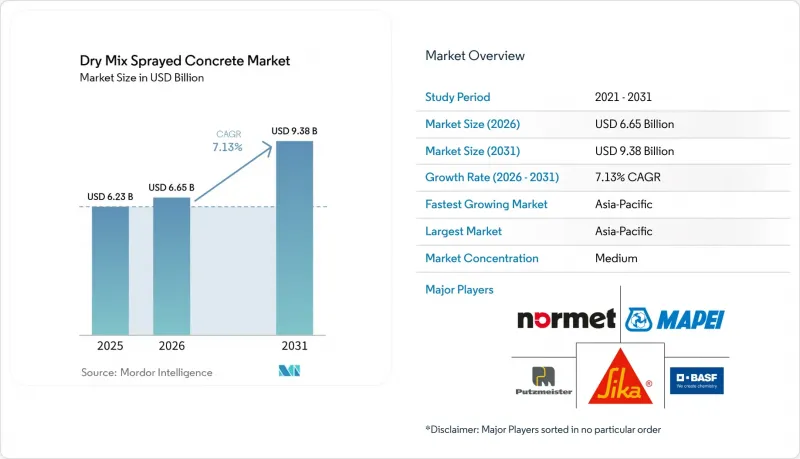
Global Dry Mix Sprayed Concrete Market Trends and Insights
Expansion of Metro, Road, Rail, Utility, and Hydropower Tunnels
The dry mix sprayed concrete market is supported by concurrent underground transport programs in the Asia-Pacific and Europe. India's Mumbai-Ahmedabad Bullet Train project includes a 21 km underground tunnel, with its second tunnel-boring machine beginning a 7 km undersea drive below Thane Creek in July 2026. This configuration requires continuous primary lining and favors portable spraying equipment. Hyderabad Metro Phase II covers 122.9 km across 8 corridors and had a stated project cost of INR 38,595 crore (USD 4.6 billion) when its Detailed Project Report was submitted in May 2026. Hydropower tunnels in South and Southeast Asia add demand independent of transport budgets, broadening the project pipeline for the dry mix sprayed concrete market.
Underground Mining Ground-Support Requirements
Declining ore grades are pushing mine development to greater depths, where stable ground support becomes more critical. Dry mix sprayed concrete is used for rapid, high-adhesion support before secondary reinforcement is installed. The International Energy Agency expects global copper demand to rise by 30% by 2040, supporting continued development of underground copper projects. Epiroc Ground Support and Master Builders Solutions formed a partnership in March 2026 to develop chemical technologies for underground mining. Their first product, BoltX-P, is a thixotropic resin designed for deep and high-stress geological conditions. Open-pit-to-underground transitions at copper and gold mines can create new demand for access tunnels, stopes, and ventilation raises in the dry mix sprayed concrete market.
Skilled Nozzleman Scarcity and Variable Application Quality
Dry mix performance depends on the nozzle operator's control of water addition. Research found that rebound and waste can exceed 50% of the applied material when trained operators are unavailable. ACI CP-60 remains an established benchmark for nozzleman competency. Certified labor is concentrated in aging workforces in Germany, Japan, and North America. OSHA silica requirements also encourage enclosed-cab robotic sprayers, although their capital cost can limit use by smaller contractors. The dry mix sprayed concrete market is more exposed than the wet-mix market because water control depends directly on the operator.
Other drivers and restraints analyzed in the detailed report include:
- Aging Infrastructure Rehabilitation and Emergency Repair
- Automation, Remote Operation, and Digital Thickness Verification
- Dry Mix Rebound, Dust and Material-Waste Penalties
For complete list of drivers and restraints, kindly check the Table Of Contents.
Segment Analysis
Normal-strength concrete accounted for 54.06% of the dry mix sprayed concrete market share in 2025. It remains suitable for general tunnel lining, slope stabilization, and routine mining support, where moderate compressive strength is sufficient. High-strength concrete is well-suited to projects with more demanding geological conditions and metro tunnel requirements. Ultra-high-strength concrete is forecast to grow at a 7.67% CAGR from 2026 to 2031, driven by structural rehabilitation projects requiring rapid strength development.
Florida International University tested a sprayable Ultra-High-Performance Concrete (UHPC) mix that achieved 30 MPa in 24 hours, delivering 2.5 to 5 times the 6-hour performance of ordinary sprayed concrete, with rebound below 5%. An eco-friendly sprayed UHPC formulation using manufactured sand and industrial slag achieved 110.9 MPa at 28 days. These properties support seismic retrofitting and the strengthening of existing tunnel linings. Premium grades can generate higher unit margins than normal-strength mixes. Producers that standardize ultra-high-strength concrete products for modern dosing systems are positioned to serve a growing segment of the dry mix sprayed concrete market.
Complete Report Scope:
- By Concrete Type
- Normal-Strength Concrete
- High-Strength Concrete
- Ultra-High-Strength Concrete
- By Application
- Tunneling
- Mining
- Civil Engineering
- Industrial
- Water-Retaining Structures
- Other Applications
- By Geography
- Asia-Pacific
- China
- India
- Japan
- South Korea
- Rest of Asia-Pacific
- North America
- United States
- Canada
- Mexico
- Europe
- Germany
- United Kingdom
- France
- Italy
- Rest of Europe
- South America
- Brazil
- Argentina
- Rest of South America
- Middle East and Africa
- Saudi Arabia
- South Africa
- Rest of Middle East and Africa
- Asia-Pacific
Geography Analysis
Asia-Pacific accounted for 40.18% of the dry mix sprayed concrete market share in 2025 and is forecast to grow at a 7.76% CAGR through 2031. China, India, Japan, and South Korea combine major tunnel programs with expanding underground mining activity. China completed the Yangtze River underwater breakthrough for the 14.25 km Chongming-Taicang high-speed railway tunnel in July 2026, with the full project targeted for completion by the end of 2026. India's metro and rail programs provide additional demand for lining materials and equipment.
Europe's demand is driven by construction in the Alpine corridor and tunnel rehabilitation. Germany's infrastructure funding and the Brenner Base Tunnel support high-specification shotcrete work. BAUER Group's SPESA division began rehabilitating the Holzminden tunnel in April 2025, using 1,000 tons of shotcrete for the tunnel crown reconstruction. North America remains a high-value dry mix sprayed concrete market, as permanent tunnel-lining specifications and silica controls support more controlled application methods.
South America, the Middle East, and Africa are developing demand centers. Chilean mine transitions and Brazil's hydropower tunnel activity support remote-site use where batching infrastructure is limited. Saudi Arabia's Jabal Sayid mine has maintained continuous underground contracting for 15 years. South Africa's deep gold and platinum mines require fiber-reinforced products suited to seismic conditions. Import-dependent accelerator supply can expose both regions to higher cost volatility, making local sourcing and dependable technical support key factors influencing the dry mix sprayed concrete market in these regions.
- BASF
- CEMEX S.A.B. de C.V.
- Epiroc AB
- GCP Applied Technologies Inc.
- Heidelberg Materials AG
- HOLCIM
- MAPEI S.p.A.
- Normet
- Putzmeister
- REED International
- Saint-Gobain
- Shotcrete Technologies Inc.
- Sika AG
- The Euclid Chemical Company
- The QUIKRETE Companies
Additional Benefits:
- The market estimate (ME) sheet in Excel format
- 3 months of analyst support
TABLE OF CONTENTS
1 Introduction
- 1.1 Study Assumptions and Market Definition
- 1.2 Scope of the Study
2 Research Methodology
3 Executive Summary
4 Market Landscape
- 4.1 Market Overview
- 4.2 Market Drivers
- 4.2.1 Expansion of Metro, Road, Rail, Utility and Hydropower Tunnels
- 4.2.2 Underground Mining Ground-Support Requirements
- 4.2.3 Aging Infrastructure Rehabilitation and Emergency Repair
- 4.2.4 Automation, Remote Operation and Digital Thickness Verification
- 4.2.5 Low-Alkali Chemistry and Fiber-Reinforced Performance Upgrades
- 4.3 Market Restraints
- 4.3.1 Skilled Nozzleman Scarcity and Variable Application Quality
- 4.3.2 Dry Mix Rebound, Dust and Material-Waste Penalties
- 4.3.3 Cement, Fiber and Admixture Cost Volatility
- 4.4 Value Chain Analysis
- 4.5 Porter's Five Forces Analysis
- 4.5.1 Bargaining Power of Suppliers
- 4.5.2 Bargaining Power of Buyers
- 4.5.3 Threat of New Entrants
- 4.5.4 Threat of Substitutes
- 4.5.5 Competitive Rivalry
5 Market Size and Growth Forecasts (Value)
- 5.1 By Concrete Type
- 5.1.1 Normal-Strength Concrete
- 5.1.2 High-Strength Concrete
- 5.1.3 Ultra-High-Strength Concrete
- 5.2 By Application
- 5.2.1 Tunneling
- 5.2.2 Mining
- 5.2.3 Civil Engineering
- 5.2.4 Industrial
- 5.2.5 Water-Retaining Structures
- 5.2.6 Other Applications
- 5.3 By Geography
- 5.3.1 Asia-Pacific
- 5.3.1.1 China
- 5.3.1.2 India
- 5.3.1.3 Japan
- 5.3.1.4 South Korea
- 5.3.1.5 Rest of Asia-Pacific
- 5.3.2 North America
- 5.3.2.1 United States
- 5.3.2.2 Canada
- 5.3.2.3 Mexico
- 5.3.3 Europe
- 5.3.3.1 Germany
- 5.3.3.2 United Kingdom
- 5.3.3.3 France
- 5.3.3.4 Italy
- 5.3.3.5 Rest of Europe
- 5.3.4 South America
- 5.3.4.1 Brazil
- 5.3.4.2 Argentina
- 5.3.4.3 Rest of South America
- 5.3.5 Middle East and Africa
- 5.3.5.1 Saudi Arabia
- 5.3.5.2 South Africa
- 5.3.5.3 Rest of Middle East and Africa
- 5.3.1 Asia-Pacific
6 Competitive Landscape
- 6.1 Market Concentration
- 6.2 Strategic Moves
- 6.3 Market Share (%)/Ranking Analysis
- 6.4 Company Profiles (includes Global Overview, Market Overview, Core Segments, Financials as available, Strategic Information, Products and Services, and Recent Developments)
- 6.4.1 BASF
- 6.4.2 CEMEX S.A.B. de C.V.
- 6.4.3 Epiroc AB
- 6.4.4 GCP Applied Technologies Inc.
- 6.4.5 Heidelberg Materials AG
- 6.4.6 HOLCIM
- 6.4.7 MAPEI S.p.A.
- 6.4.8 Normet
- 6.4.9 Putzmeister
- 6.4.10 REED International
- 6.4.11 Saint-Gobain
- 6.4.12 Shotcrete Technologies Inc.
- 6.4.13 Sika AG
- 6.4.14 The Euclid Chemical Company
- 6.4.15 The QUIKRETE Companies
7 Market Opportunities and Future Outlook
- 7.1 White-Space and Unmet-Need Assessment

