PUBLISHER: Mordor Intelligence | PRODUCT CODE: 2155550

PUBLISHER: Mordor Intelligence | PRODUCT CODE: 2155550
Infant Radiant Warmer - Market Share Analysis, Industry Trends & Statistics, Growth Forecasts (2026 - 2031)
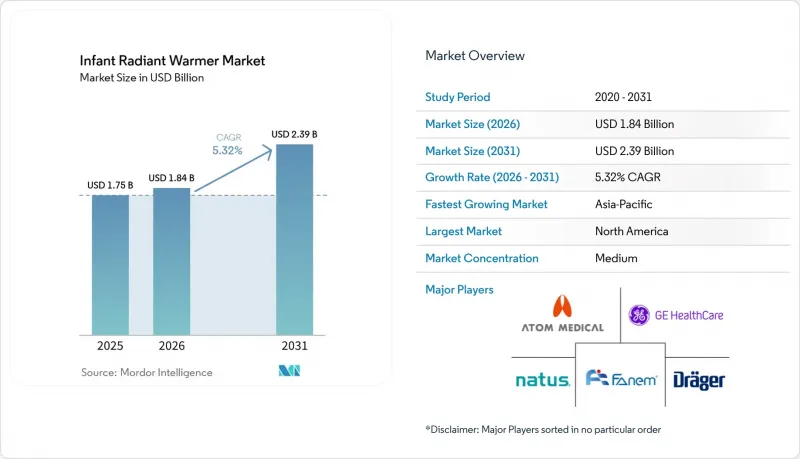
According to Mordor Intelligence, the infant radiant warmer market size is expected to grow from USD 1.75 billion in 2025 to USD 1.84 billion in 2026 and is forecast to reach USD 2.39 billion by 2031 at 5.32% CAGR over 2026-2031.
Global Infant Radiant Warmer Market Trends and Insights
Rising Preterm and Low-Birth-Weight Infant Care Demand
The infant radiant warmer market is supported by the need to care for preterm and low-birth-weight newborns. The CDC reported a U.S. preterm birth rate of 10.41% in 2023, while early-term births at 34 to 36 weeks reached 29.84% of all births. This larger group increases the number of babies who may need active temperature management after delivery. It also brings maternity wards and step-down units into equipment planning that once focused largely on high-acuity NICUs. WHO data show that low birth weight affects more than 20 million newborns each year, with a high burden in South Asia and Sub-Saharan Africa. The infant radiant warmer market consequently has demand across both advanced neonatal centers and facilities building basic newborn care capacity.
Expansion of NICU and Delivery-Room Infrastructure
The infant radiant warmer market benefits when hospitals add or renovate newborn care capacity. Private-room and family-centered NICU designs require equipment in more individual care spaces than older open-bay layouts. VCU Health opened a 20-bed NICU at the Children's Tower in January 2026, adding to the 40-bed NICU on its adjacent campus. The opening illustrates how a facility project can create a concentrated equipment purchasing cycle around commissioning. New delivery-room and NICU capacity also requires equipment that supports stabilization immediately after birth. These projects support demand for radiant warmers, monitoring systems, and related service arrangements within the infant radiant warmer market.
High Acquisition, Maintenance, and Calibration Costs
The infant radiant warmer market faces a cost barrier when buyers must account for service, calibration, and safety obligations in addition to the purchase price. The FDA posted a Class 2 recall for selected GE HealthCare Giraffe and Panda iRes warmers in September 2024 after incomplete electrical safety testing raised a potential leakage-current concern. The event shows why maintenance and safety documentation remain material parts of ownership costs. Premium integrated platforms can require a larger initial commitment and recurring calibration support. These costs can strain district hospitals, where operating budgets have limited room after initial procurement. In such settings, missed maintenance can reduce device usefulness and delay replacement or upgrade decisions.
Other drivers and restraints analyzed in the detailed report include:
- Smart Servo-Control and Integrated Monitoring Adoption
- Government and Donor Investment in Neonatal Care
- Limited Availability of Trained Biomedical Service Personnel
For complete list of drivers and restraints, kindly check the Table Of Contents.
Segment Analysis
Mobile infant radiant warmers held 52.31% of product-type revenue in 2025. Their wheeled design supports movement among delivery rooms, step-down bays, and intermediate care wards. This flexibility allows hospitals to use equipment across several care settings within one facility. Standard warmers remain relevant for fixed, high-acuity NICU installations, while wall-mounted models serve maternity units with limited floor space in Europe and Asia.
Transport infant radiant warmers are projected to grow at a 7.65% CAGR from 2026 to 2031. The infant radiant warmer market size for this subtype is supported by spoke-and-hub referral systems that require newborn stabilization during transfer. Johns Hopkins Medicine's 2024 transport vehicle deployment demonstrates the operational model behind this need. Equipment used in transport must sustain thermal performance during vibration and movement. These higher specifications distinguish transport systems from many stationary models and support their use as referral care expands.
Servo-controlled warmers held 68.24% of the operating-mode segment in 2025. They are also projected to grow at a 7.22% CAGR from 2026 to 2031, showing that the leading mode continues to gain adoption. A 2025 randomized controlled trial reported 91% cooling-time compliance for servo control compared with 68% for manual methods. The trial found no temperature deviations below the 32°C safety threshold in the servo-control group. These results support clinical interest in more consistent, automated thermal management.
Manual warmers still have a role in the infant radiant warmer market where facilities have limited infrastructure and technical support. Their simpler design can fit rural settings in Sub-Saharan Africa and remote South Asia. The FDA's Class 2 classification requires U.S. manufacturers to demonstrate substantial equivalence through the 510(k) process. This requirement reinforces the focus on validated servo performance among regulated suppliers. Manufacturers are adding sensor-detection features that halt heating after probe displacement, responding to safety concerns in North American and European procurement specifications.
Complete Report Scope:
- By Product Type
- Standard Infant Radiant Warmers
- Mobile Infant Radiant Warmers
- Wall-Mounted Infant Radiant Warmers
- Transport Infant Radiant Warmers
- Integrated Radiant Warmer
- By Operating Mode
- Manual Warmers
- Servo-Controlled Warmers
- By Technology
- Infrared Heating Technology
- Convection-Assist Technology
- Combination Heating Systems
- Other Technologies
- By End User
- Hospitals and Neonatal Intensive Care Units
- Maternity and Delivery Centers
- Specialty Clinics and Baby Care Centers
- Other End Users
- By Distribution Channel
- Direct Institutional Sales
- Distributor and Dealer Sales
- Online and E-Procurement Sales
- By Geography
- North America
- United States
- Canada
- Mexico
- Europe
- Germany
- United Kingdom
- France
- Italy
- Spain
- Rest of Europe
- Asia-Pacific
- China
- Japan
- India
- Australia
- South Korea
- Rest of Asia-Pacific
- Middle East and Africa
- GCC
- South Africa
- Rest of Middle East and Africa
- South America
- Brazil
- Argentina
- Rest of South America
- North America
Geography Analysis
North America held 34.61% of the infant radiant warmer market in 2025. The market in the United States is supported by a mature NICU network and continuing facility investment. VCU Health opened 20 additional NICU beds in January 2026, bringing its related campus capacity to 60 beds and creating equipment demand when care spaces became operational. Canada remains in a measured replacement cycle, while Mexico is directing resources toward maternal health infrastructure in secondary cities.
North America's established regulatory pathway favors suppliers with validated product lines and quality systems. Infant radiant warmers are Class 2 devices under 21 CFR 880.5130 and require 510(k) clearance before U.S. marketing. Europe is the second-largest region, led by Germany, the United Kingdom, France, Italy, and Spain. France is upgrading public hospital fleets toward servo-controlled platforms, while Spain and Italy are in active replacement cycles. The Middle East and Africa sub-region is led by Saudi Arabia, the United Arab Emirates, and South Africa, where newer tertiary hospitals procure premium systems, and African facilities need portable, battery-backed models.
Asia-Pacific is projected to grow at a 7.65% CAGR from 2026 to 2031. India's preterm birth rate exceeded 13% of live births, while the National Health Mission activity is supporting district-hospital newborn care, and AIIMS-Patna expanded its NICU from 8 beds to 24 beds in October 2024. China's 14th Five-Year Plan is supporting provincial hospital upgrades beyond major coastal clusters. Japan continues to require premium servo-controlled equipment despite its declining birth rate. Brazil's SUS network leads South American growth, while Fanem's South-South cooperation approach indicates wider emerging-market neonatal equipment activity.
- Atom Medical
- AVI Healthcare Pvt. Ltd.
- BIcakcIlar Medical Devices
- Dragerwerk
- Fanem Ltda.
- Fisher & Paykel Healthcare
- GE Healthcare
- Ginevri S.r.l.
- Heal Force Bio-Meditech Holdings Limited
- IndoSurgicals Private Limited
- Koninklijke Philips
- Mediprema
- nice Neotech Medical Systems Pvt. Ltd.
- Ningbo David Medical Device
- Phoenix Medical Systems
- Shenzhen Comen Medical Instruments Co., Ltd.
- Weyer GmbH
- Zhengzhou Dison Instrument and Meter Co., Ltd.
Additional Benefits:
- The market estimate (ME) sheet in Excel format
- 3 months of analyst support
TABLE OF CONTENTS
1 Introduction
- 1.1 Study Assumptions and Market Definition
- 1.2 Scope of the Study
2 Research Methodology
3 Executive Summary
4 Market Landscape
- 4.1 Market Overview
- 4.2 Market Drivers
- 4.2.1 Rising Preterm and Low-Birth-Weight Infant Care Demand
- 4.2.2 Expansion of NICU and Delivery-Room Infrastructure
- 4.2.3 Smart Servo-Control and Integrated Monitoring Adoption
- 4.2.4 Government and Donor Investment in Neonatal Care
- 4.2.5 Neonatal Transport and Stabilization Networks
- 4.2.6 Heat-Profile and Sensor-Placement Standardization as an Unmet Need
- 4.3 Market Restraints
- 4.3.1 High Acquisition, Maintenance, and Calibration Costs
- 4.3.2 Limited Availability of Trained Biomedical Service Personnel
- 4.3.3 Probe Detachment, Measurement Error, and Thermal-Injury Liability
- 4.3.4 Power Instability and Backup-Energy Requirements in Low-Resource Facilities
- 4.4 Supply-Chain Analysis
- 4.5 Regulatory Landscape
- 4.6 Technological Outlook
- 4.7 Porter's Five Forces Analysis
- 4.7.1 Bargaining Power of Suppliers
- 4.7.2 Bargaining Power of Buyers
- 4.7.3 Threat of New Entrants
- 4.7.4 Threat of Substitutes
- 4.7.5 Intensity of Rivalry
5 Market Size & Growth Forecasts (Value, USD)
- 5.1 By Product Type
- 5.1.1 Standard Infant Radiant Warmers
- 5.1.2 Mobile Infant Radiant Warmers
- 5.1.3 Wall-Mounted Infant Radiant Warmers
- 5.1.4 Transport Infant Radiant Warmers
- 5.1.5 Integrated Radiant Warmer
- 5.2 By Operating Mode
- 5.2.1 Manual Warmers
- 5.2.2 Servo-Controlled Warmers
- 5.3 By Technology
- 5.3.1 Infrared Heating Technology
- 5.3.2 Convection-Assist Technology
- 5.3.3 Combination Heating Systems
- 5.3.4 Other Technologies
- 5.4 By End User
- 5.4.1 Hospitals and Neonatal Intensive Care Units
- 5.4.2 Maternity and Delivery Centers
- 5.4.3 Specialty Clinics and Baby Care Centers
- 5.4.4 Other End Users
- 5.5 By Distribution Channel
- 5.5.1 Direct Institutional Sales
- 5.5.2 Distributor and Dealer Sales
- 5.5.3 Online and E-Procurement Sales
- 5.6 By Geography
- 5.6.1 North America
- 5.6.1.1 United States
- 5.6.1.2 Canada
- 5.6.1.3 Mexico
- 5.6.2 Europe
- 5.6.2.1 Germany
- 5.6.2.2 United Kingdom
- 5.6.2.3 France
- 5.6.2.4 Italy
- 5.6.2.5 Spain
- 5.6.2.6 Rest of Europe
- 5.6.3 Asia-Pacific
- 5.6.3.1 China
- 5.6.3.2 Japan
- 5.6.3.3 India
- 5.6.3.4 Australia
- 5.6.3.5 South Korea
- 5.6.3.6 Rest of Asia-Pacific
- 5.6.4 Middle East and Africa
- 5.6.4.1 GCC
- 5.6.4.2 South Africa
- 5.6.4.3 Rest of Middle East and Africa
- 5.6.5 South America
- 5.6.5.1 Brazil
- 5.6.5.2 Argentina
- 5.6.5.3 Rest of South America
- 5.6.1 North America
6 Competitive Landscape
- 6.1 Market Concentration
- 6.2 Market Share Analysis
- 6.3 Company Profiles (includes Global Level Overview, Market Level Overview, Core Segments, Financials as available, Strategic Information, Market Rank/Share, Products and Services, Recent Developments)
- 6.3.1 Atom Medical Corporation
- 6.3.2 AVI Healthcare Pvt. Ltd.
- 6.3.3 BIcakcIlar Medical Devices
- 6.3.4 Dragerwerk AG & Co. KGaA
- 6.3.5 Fanem Ltda.
- 6.3.6 Fisher & Paykel Healthcare Limited
- 6.3.7 GE HealthCare
- 6.3.8 Ginevri S.r.l.
- 6.3.9 Heal Force Bio-Meditech Holdings Limited
- 6.3.10 IndoSurgicals Private Limited
- 6.3.11 Koninklijke Philips N.V.
- 6.3.12 Mediprema
- 6.3.13 nice Neotech Medical Systems Pvt. Ltd.
- 6.3.14 Ningbo David Medical Device Co., Ltd.
- 6.3.15 Phoenix Medical Systems (P) Ltd
- 6.3.16 Shenzhen Comen Medical Instruments Co., Ltd.
- 6.3.17 Weyer GmbH
- 6.3.18 Zhengzhou Dison Instrument and Meter Co., Ltd.
7 Market Opportunities and Future Outlook
- 7.1 White-Space and Unmet-Need Assessment

