PUBLISHER: Mordor Intelligence | PRODUCT CODE: 2155552

PUBLISHER: Mordor Intelligence | PRODUCT CODE: 2155552
Anhydrite - Market Share Analysis, Industry Trends & Statistics, Growth Forecasts (2026 - 2031)
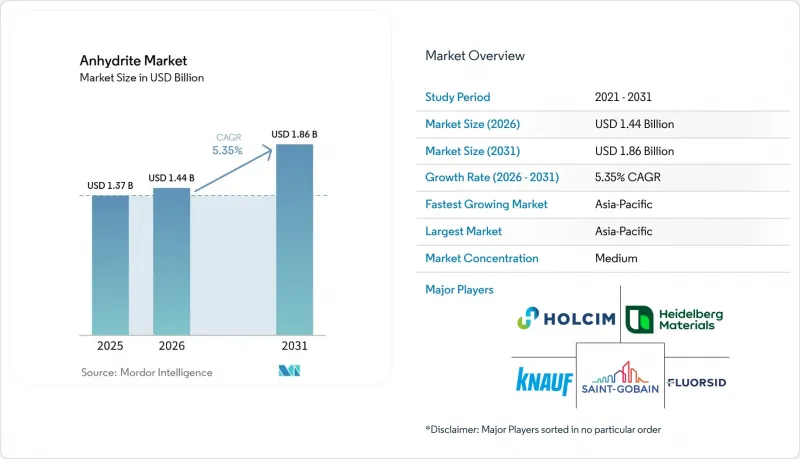
According to Mordor Intelligence, the anhydrite market size was estimated at USD 1.37 billion in 2025 and is estimated to grow from USD 1.44 billion in 2026 to USD 1.86 billion by 2031, at a CAGR of 5.35% during the forecast period (2026-2031).
Global Anhydrite Market Trends and Insights
Expansion of Self-Leveling Floor Screeds
Anhydrite-based calcium sulfate screeds can be placed at rates of up to 2,000 m2 per day with a small crew. This throughput is approximately 20 times that of traditional sand-and-cement screeds, supporting their use where labor costs are high or large open-plan floors are specified. The anhydrite market benefits when underfloor heating projects require materials with lower shrinkage and improved heat-transfer characteristics. LKAB Minerals offers Gypsol TS-15 for commercial flooring applications at depths as low as 15 mm. Lower application depths reduce material use per square meter of floor while maintaining the required screed performance. In January 2026, LANXESS received Environmental Product Declarations from Institut Bauen und Umwelt for CAB 30 under DIN EN 13454, supporting its use in European green-building projects.
Cement Set-Control and Sulfate Optimization Demand
Anhydrite II regulates early ettringite formation during clinker hydration by releasing sulfate ions. Research published in 2025 found that anhydrite could replace natural gypsum in CEM I and CEM II cements with comparable or stronger compressive-strength results at an SO3 addition level of approximately 3.5% by weight. The anhydrite market, therefore, depends on cement mills that require mineralogically consistent sulfate sources. The U.S. Geological Survey reported world gypsum and anhydrite mine production of 160 million tons in 2025, down from 162 million tons in 2024. New clinker grinding circuits in India and China present opportunities for anhydrite suppliers to qualify their products before established gypsum suppliers secure long-term contracts.
Substitution by Gypsum and Supplementary Cementitious Materials
Natural gypsum and synthetic flue-gas desulfurization gypsum retain cost advantages in wallboard and plasterboard applications, where moisture resistance is manageable. Gypsum dihydrate also sets more quickly in formulations that prioritize rapid strength development. These conditions limit the anhydrite market in selected residential construction applications. Fly ash, slag, and silica fume have gained wider engineering acceptance in North American composite cement systems. Heidelberg Materials commissioned calcined clay production at its Airvault cement plant in France in May 2026, with an option to further reduce clinker content. As low-clinker formulations develop, sulfate requirements may shift, reducing the use of anhydrite per metric ton of finished cement.
Other drivers and restraints analyzed in the detailed report include:
- Industrial By-Product Valorization
- Low-Carbon Binder and Circular Construction Specifications
- Geographic Concentration and Freight Exposure
For complete list of drivers and restraints, kindly check the Table Of Contents.
Segment Analysis
Natural anhydrite held 63.53% of the anhydrite market share in 2025. Its position reflects the presence of established evaporite deposits in Europe, the Middle East, and Asia. The material serves as a bulk input for cement set control and floor screed binders. A single quarry can supply grades ranging from cement mill feed to micronized products for dry-mix mortars. Demand from large integrated cement operations in China supports a stable offtake. This scale advantage enables producers to utilize extraction assets across multiple end uses. The segment also benefits from a cost structure suited to high-quantity applications. Cement grinding mills use anhydrite as a sulfate source in clinker grinding. CASEA processes natural and thermal anhydrite at facilities in Germany and Spain. Its offering demonstrates how access to multiple feedstock types can reduce exposure to fluctuations in the supply of flue-gas desulfurization gypsum. The anhydrite market remains dependent on consistent quality, even in high-quantity applications. Suppliers with secure deposits can support long-term cement and screed contracts.
Synthetic anhydrite is projected to grow at a 6.06% CAGR from 2026 to 2031. The anhydrite market size for synthetic material is supported by tighter natural supply in Western Europe and demand for high-purity calcium sulfate. Fluoroanhydrite is produced during hydrofluoric acid production and can reach a CaSO4 content near 99%. Derivados Del Fluor and Fluorsid supply materials for premium screed and specialty chemical applications. These grades can require less post-processing than inconsistent natural material. Their composition can be useful in applications with stricter performance requirements. Research published in 2024 showed that activated fluoroanhydrite binders could achieve compressive strength comparable to that of natural anhydrite. This supports its technical use in structural flooring systems. LKAB Minerals markets Anricite for self-leveling compounds, adhesives, and industrial formulations. Engineered consistency creates a differentiated tier in the anhydrite market and can support premium pricing for users who need predictable mineral behavior. Synthetic supply remains tied to the location and continuity of industrial source streams.
Complete Report Scope:
- By Type
- Natural Anhydrite
- Synthetic Anhydrite
- By Application
- Construction
- Fertilizers and Soil Treatment
- Industrial Applications
- Drying Agents
- Others
- By Geography
- Asia-Pacific
- China
- India
- Japan
- South Korea
- ASEAN Countries
- Rest of Asia-Pacific
- North America
- United States
- Canada
- Mexico
- Europe
- Germany
- United Kingdom
- France
- Italy
- NORDIC Countries
- Rest of Europe
- South America
- Brazil
- Argentina
- Rest of South America
- Middle East and Africa
- Saudi Arabia
- South Africa
- Rest of Middle East and Africa
- Asia-Pacific
Geography Analysis
Asia-Pacific held 39.06% of the anhydrite market share in 2025 and is projected to grow at a 6.43% CAGR through 2031. China's clinker grinding capacity of 3.1 billion tons per year and India's expanding cement sector support regional demand. China's retirement of coal-fired power units may reduce the availability of flue-gas desulfurization gypsum, potentially tightening the regional calcium sulfate supply balance. Japan and South Korea sustain demand through industrial by-product use and advanced construction-material standards.
ASEAN countries, including Vietnam and Indonesia, are additional demand centers as urbanization supports cement consumption. India produces more than 600 million tons of cement annually, and its demand for anhydrite follows additions in cement capacity. A change in sulfate specifications at even some Indian grinding mills could substantially increase demand. The Asia-Pacific anhydrite market is also shaped by regional suppliers' ability to provide consistent feedstock. Infrastructure cycles in China and India make cement-related offtake an important source of demand stability.
Europe and North America have more developed application mixes for anhydrite. European producers operate under DIN EN 13454 and BS EN 13813 requirements for calcium sulfate screed binders. Renovation activity linked to building energy performance requirements supports demand for high-performance floor leveling. U.S. apparent gypsum consumption reached 44 million tons in 2025. South America, the Middle East, and Africa offer smaller but relevant opportunities through Brazilian soil treatment, Saudi construction, and Omani exports to South Asia and East Africa. The anhydrite market in these regions remains sensitive to local production, port access, and freight costs.
- Buzzi S.p.A.
- Derivados Del Fluor
- Etex Group
- Fluorsid
- Georgia-Pacific LLC
- Heidelberg Materials AG
- HOLCIM
- Knauf Group
- LKAB Minerals
- REMONDIS SE & Co. KG
- Saint-Gobain
- Siniat
- USG Corporation
- Vanich Gypsum Co., Ltd.
- ZKG International
Additional Benefits:
- The market estimate (ME) sheet in Excel format
- 3 months of analyst support
TABLE OF CONTENTS
1 Introduction
- 1.1 Study Assumptions and Market Definition
- 1.2 Scope of the Study
2 Research Methodology
3 Executive Summary
4 Market Landscape
- 4.1 Market Overview
- 4.2 Market Drivers
- 4.2.1 Expansion of Self-Leveling Floor Screeds
- 4.2.2 Cement Set-Control and Sulfate Optimization Demand
- 4.2.3 Industrial By-Product Valorization
- 4.2.4 Agricultural Calcium and Sulfur Deficiency Management
- 4.2.5 Low-Carbon Binder and Circular Construction Specifications
- 4.2.6 High-Purity Anhydrite for Specialty Formulations
- 4.3 Market Restraints
- 4.3.1 Substitution by Gypsum and Supplementary Cementitious Materials
- 4.3.2 Geographic Concentration and Freight Exposure
- 4.3.3 Synthetic-Grade Variability and Qualification Requirements
- 4.3.4 Limited Agronomic Field Validation for Anhydrite-Based Amendments
- 4.4 Value Chain Analysis
- 4.5 Porter's Five Forces Analysis
- 4.5.1 Bargaining Power of Suppliers
- 4.5.2 Bargaining Power of Buyers
- 4.5.3 Threat of New Entrants
- 4.5.4 Threat of Substitutes
- 4.5.5 Competitive Rivalry
5 Market Size and Growth Forecasts (Value)
- 5.1 By Type
- 5.1.1 Natural Anhydrite
- 5.1.2 Synthetic Anhydrite
- 5.2 By Application
- 5.2.1 Construction
- 5.2.2 Fertilizers and Soil Treatment
- 5.2.3 Industrial Applications
- 5.2.4 Drying Agents
- 5.2.5 Others
- 5.3 By Geography
- 5.3.1 Asia-Pacific
- 5.3.1.1 China
- 5.3.1.2 India
- 5.3.1.3 Japan
- 5.3.1.4 South Korea
- 5.3.1.5 ASEAN Countries
- 5.3.1.6 Rest of Asia-Pacific
- 5.3.2 North America
- 5.3.2.1 United States
- 5.3.2.2 Canada
- 5.3.2.3 Mexico
- 5.3.3 Europe
- 5.3.3.1 Germany
- 5.3.3.2 United Kingdom
- 5.3.3.3 France
- 5.3.3.4 Italy
- 5.3.3.5 NORDIC Countries
- 5.3.3.6 Rest of Europe
- 5.3.4 South America
- 5.3.4.1 Brazil
- 5.3.4.2 Argentina
- 5.3.4.3 Rest of South America
- 5.3.5 Middle East and Africa
- 5.3.5.1 Saudi Arabia
- 5.3.5.2 South Africa
- 5.3.5.3 Rest of Middle East and Africa
- 5.3.1 Asia-Pacific
6 Competitive Landscape
- 6.1 Market Concentration
- 6.2 Strategic Moves
- 6.3 Market Share (%)/Ranking Analysis
- 6.4 Company Profiles (includes Global Overview, Market Overview, Core Segments, Financials as available, Strategic Information, Products and Services, and Recent Developments)
- 6.4.1 Buzzi S.p.A.
- 6.4.2 Derivados Del Fluor
- 6.4.3 Etex Group
- 6.4.4 Fluorsid
- 6.4.5 Georgia-Pacific LLC
- 6.4.6 Heidelberg Materials AG
- 6.4.7 HOLCIM
- 6.4.8 Knauf Group
- 6.4.9 LKAB Minerals
- 6.4.10 REMONDIS SE & Co. KG
- 6.4.11 Saint-Gobain
- 6.4.12 Siniat
- 6.4.13 USG Corporation
- 6.4.14 Vanich Gypsum Co., Ltd.
- 6.4.15 ZKG International
7 Market Opportunities and Future Outlook
- 7.1 White-Space and Unmet-Need Assessment

