PUBLISHER: Mordor Intelligence | PRODUCT CODE: 2155559

PUBLISHER: Mordor Intelligence | PRODUCT CODE: 2155559
Facial Paralysis - Market Share Analysis, Industry Trends & Statistics, Growth Forecasts (2026 - 2031)
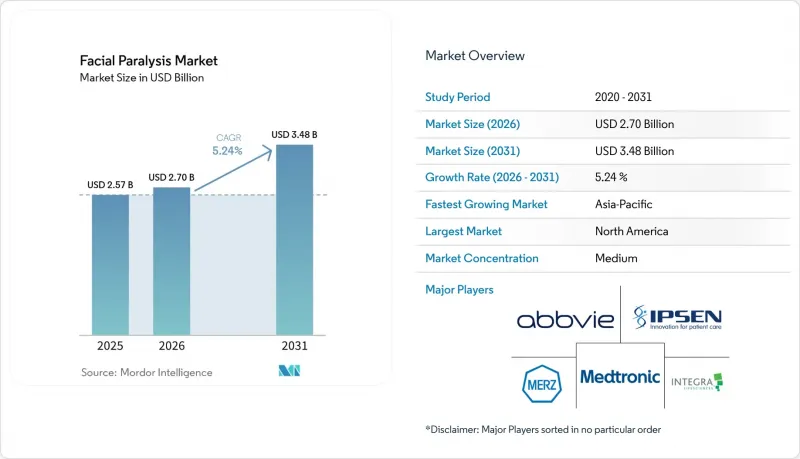
According to Mordor Intelligence, the facial paralysis market is projected to expand from USD 2.57 billion in 2025 and USD 2.70 billion in 2026 to USD 3.48 billion by 2031, registering a CAGR of 5.24% between 2026 and 2031.
Global Facial Paralysis Market Trends and Insights
Rising Recognition of Facial Nerve Disorders Beyond Bell's Palsy
Bell's palsy historically received most clinical and commercial attention, which left other facial nerve conditions less visible. A U.S. claims analysis found adult incidence of all facial nerve disorders reached 30.5 per 100,000, while Bell's palsy incidence reached 24.5 per 100,000, and total incidence rose by 2.1 cases per 100,000 adults each year from 2007 to 2022.The same research found higher incidence among men and older age groups, which increases demand for care as populations age. A 2025 analysis of TriNetX records also reported that Bell's palsy incidence increased from 48 per 100,000 in 2016-2017 to 69 per 100,000 in 2023-2024, while prevalence rose from 228 to 434 per 100,000. Broader training for neurologists, ENT specialists, and primary care clinicians can bring Ramsay Hunt Syndrome, acquired palsy after head and neck surgery, and congenital conditions into the facial paralysis market sooner. Earlier referral also makes specialist care more relevant before delayed treatment reduces functional recovery options.
Expansion of Functional Facial Reanimation Surgery
Functional facial reanimation is becoming a more established care option for people with permanent or prolonged palsy. Earlier microneurosurgical intervention, masseteric nerve transfer, and dual-innervation procedures have improved the consistency of surgical planning. A 2025 systematic review and meta-analysis found that masseteric nerve transposition performed better than cross-facial nerve grafting on commissural excursion and recovery measures. The facial paralysis market can therefore gain from demand for grafts, implants, and intraoperative monitoring as surgeons adopt common reporting approaches. An international multispecialty consensus published in 2026 established a framework for reporting outcomes after nerve repair, free muscle transfer, and selective myectomy.
Uneven Access to Specialized Facial Nerve Care
Facial palsy outcomes depend heavily on timely access to clinicians who can assess and treat the full condition. Multidisciplinary facial nerve centers are concentrated in tertiary academic institutions in North America and Western Europe. A 2025 review found that individualized plans based on intelligent sensor data reduced recovery time by 40% and recurrence by 27%, but these approaches require infrastructure that is not widely available. In South America, the Middle East, and sub-Saharan Africa, limited specialist capacity can lead to underdiagnosis and delayed treatment. This restricts the facial paralysis market despite the underlying need for care.
Other drivers and restraints analyzed in the detailed report include:
- Growing Adoption of Structured Facial Neuromuscular Rehabilitation
- AI-Assisted Facial Function Assessment and Tele-Rehabilitation
- High Cost and Limited Reimbursement for Advanced Reanimation
For complete list of drivers and restraints, kindly check the Table Of Contents.
Segment Analysis
Bell's palsy held 38.72% of the facial paralysis market share in 2025 and remained the largest etiology segment. Published research identified a global annual incidence range of 11.5 to 53.3 per 100,000, making it the most common acute mononeuropathy of the facial nerve. Its demand base includes acute corticosteroid treatment, rehabilitation, and botulinum toxin A for post-paralytic synkinesis. These care settings help sustain medication volume and initial diagnostic demand across the facial paralysis market.
Ramsay Hunt syndrome is forecasted to grow at a 6.15% CAGR through 2031, with rising herpes zoster reactivation in older populations supporting this pattern. Specialist referral and digital triage can reduce this gap, while acquired palsy after parotid tumor resection or skull base surgery is gaining relevance as surgical reporting becomes standardized. Congenital facial paralysis represents a smaller patient group but can require complex procedures and supports higher-value care within the facial paralysis market.
Complete Report Scope:
- By Etiology
- Bell's Palsy
- Ramsay Hunt Syndrome
- Traumatic Facial Paralysis
- Congenital Facial Paralysis
- Other Etiologies
- By Component
- Diagnosis
- Clinical Examination and Facial Grading
- Electromyography
- Computed Tomography
- Other Diagnoses
- Treatment
- Medications
- Physical and Rehabilitation Therapy
- Surgical Intervention
- Combination Therapy
- Diagnosis
- By End-User
- Hospitals
- Ambulatory Surgical Centers
- Specialty Clinics
- Diagnostic Centers
- Other End-Users
- By Geography
- North America
- United States
- Canada
- Mexico
- Europe
- Germany
- United Kingdom
- France
- Italy
- Spain
- Rest of Europe
- Asia-Pacific
- China
- Japan
- India
- Australia
- South Korea
- Rest of Asia-Pacific
- Middle East and Africa
- GCC
- South Africa
- Rest of Middle East and Africa
- South America
- Brazil
- Argentina
- Rest of South America
- North America
Geography Analysis
North America held 46.27% of facial paralysis market share in 2025 and remained the largest regional contributor. The United States has a dense concentration of multidisciplinary facial nerve programs and broad use of chemodenervation and surgical reanimation. Canada and Mexico add regional demand, although specialist capacity and reimbursement are less consistent than in the United States.
Europe remained the second-largest regional area for the facial paralysis market, supported by established programs in Germany, the United Kingdom, France, and Spain. Universal healthcare systems can improve treatment access compared with similarly sized markets that have more fragmented coverage. The United Kingdom has facial palsy pathways through specialist providers including Queen Victoria Hospital NHS Foundation Trust, while Germany combines a strong ENT surgical base with demand for neurology monitoring and EMG equipment. Italy, Spain, and France are seeing wider use of botulinum toxin A protocols in ENT and plastic surgery outpatient care.
Asia-Pacific is projected to grow at an 8.32% CAGR from 2026 to 2031, the fastest regional pace in the facial paralysis market. Aging populations, herpes zoster burden, expanding ENT infrastructure, and private healthcare investment in India support demand across major countries. A Korean cohort study published in 2025 found an 87.5% complete recovery rate with corticosteroid-based ENT department care and stronger results in severe cases. South Korea's reimbursement-based herbal medicine research reflects willingness to assess complementary approaches within its health system. The Middle East and Africa and South America remain underpenetrated because prevalence data and specialist infrastructure are limited, although GCC investment and Brazil's private hospital expansion offer future opportunities.
- Abbvie
- Axogen, Inc.
- Boston Scientific
- Brain Lab
- GE HealthCare Technologies Inc.
- GlaxoSmithKline
- Integra LifeSciences
- Ipsen
- Johnson & Johnson
- Medtronic
- Merz Pharma
- Natus Medical
- Neurotrigger Ltd
- Nihon Kohden
- Novartis
- Pfizer
- Sanofi
- Siemens Healthineers
- Stryker
- Teva Pharmaceutical Industries
Additional Benefits:
- The market estimate (ME) sheet in Excel format
- 3 months of analyst support
TABLE OF CONTENTS
1 Introduction
- 1.1 Study Assumptions and Market Definition
- 1.2 Scope of the Study
2 Research Methodology
3 Executive Summary
4 Market Landscape
- 4.1 Market Overview
- 4.2 Market Drivers
- 4.2.1 Rising Recognition of Facial Nerve Disorders Beyond Bell's Palsy
- 4.2.2 Earlier Referral to Multidisciplinary Facial Nerve Centers
- 4.2.3 Expansion of Functional Facial Reanimation Surgery
- 4.2.4 Growing Adoption of Structured Facial Neuromuscular Rehabilitation
- 4.2.5 AI-Assisted Facial Function Assessment and Tele-Rehabilitation
- 4.2.6 Increasing Need for Eye-Surface Protection and Blink Restoration
- 4.3 Market Restraints
- 4.3.1 Uneven Access to Specialized Facial Nerve Care
- 4.3.2 High Cost and Limited Reimbursement for Advanced Reanimation
- 4.3.3 Limited Evidence for Emerging Bioelectronic Therapies
- 4.3.4 Treatment Delay and Heterogeneous Outcome Measurement
- 4.4 Supply/Value Chain Analysis
- 4.5 Regulatory Landscape
- 4.6 Technological Outlook
- 4.7 Porter's Five Forces Analysis
- 4.7.1 Threat of New Entrants
- 4.7.2 Bargaining Power of Suppliers
- 4.7.3 Bargaining Power of Buyers
- 4.7.4 Threat of Substitutes
- 4.7.5 Competitive Rivalry
5 Market Size & Growth Forecasts (Value, USD)
- 5.1 By Etiology
- 5.1.1 Bell's Palsy
- 5.1.2 Ramsay Hunt Syndrome
- 5.1.3 Traumatic Facial Paralysis
- 5.1.4 Congenital Facial Paralysis
- 5.1.5 Other Etiologies
- 5.2 By Component
- 5.2.1 Diagnosis
- 5.2.1.1 Clinical Examination and Facial Grading
- 5.2.1.2 Electromyography
- 5.2.1.3 Computed Tomography
- 5.2.1.4 Other Diagnoses
- 5.2.2 Treatment
- 5.2.2.1 Medications
- 5.2.2.2 Physical and Rehabilitation Therapy
- 5.2.2.3 Surgical Intervention
- 5.2.2.4 Combination Therapy
- 5.2.1 Diagnosis
- 5.3 By End-User
- 5.3.1 Hospitals
- 5.3.2 Ambulatory Surgical Centers
- 5.3.3 Specialty Clinics
- 5.3.4 Diagnostic Centers
- 5.3.5 Other End-Users
- 5.4 By Geography
- 5.4.1 North America
- 5.4.1.1 United States
- 5.4.1.2 Canada
- 5.4.1.3 Mexico
- 5.4.2 Europe
- 5.4.2.1 Germany
- 5.4.2.2 United Kingdom
- 5.4.2.3 France
- 5.4.2.4 Italy
- 5.4.2.5 Spain
- 5.4.2.6 Rest of Europe
- 5.4.3 Asia-Pacific
- 5.4.3.1 China
- 5.4.3.2 Japan
- 5.4.3.3 India
- 5.4.3.4 Australia
- 5.4.3.5 South Korea
- 5.4.3.6 Rest of Asia-Pacific
- 5.4.4 Middle East and Africa
- 5.4.4.1 GCC
- 5.4.4.2 South Africa
- 5.4.4.3 Rest of Middle East and Africa
- 5.4.5 South America
- 5.4.5.1 Brazil
- 5.4.5.2 Argentina
- 5.4.5.3 Rest of South America
- 5.4.1 North America
6 Competitive Landscape
- 6.1 Market Concentration
- 6.2 Market Share Analysis
- 6.3 Company Profiles (includes Global level Overview, Market level overview, Core Segments, Financials as available, Strategic Information, Market Rank/Share for key companies, Products & Services, Recent Developments)
- 6.3.1 AbbVie Inc.
- 6.3.2 Axogen, Inc.
- 6.3.3 Boston Scientific Corporation
- 6.3.4 Brainlab AG
- 6.3.5 GE HealthCare Technologies Inc.
- 6.3.6 GSK plc
- 6.3.7 Integra LifeSciences Holdings Corporation
- 6.3.8 Ipsen S.A.
- 6.3.9 Johnson & Johnson
- 6.3.10 Medtronic plc
- 6.3.11 Merz Pharma GmbH & Co. KGaA
- 6.3.12 Natus Medical Incorporated
- 6.3.13 Neurotrigger Ltd
- 6.3.14 Nihon Kohden Corporation
- 6.3.15 Novartis AG
- 6.3.16 Pfizer Inc.
- 6.3.17 Sanofi S.A.
- 6.3.18 Siemens Healthineers AG
- 6.3.19 Stryker Corporation
- 6.3.20 Teva Pharmaceutical Industries Ltd.
7 Market Opportunities & Future Outlook
- 7.1 White-space & Unmet-need Assessment

