PUBLISHER: Mordor Intelligence | PRODUCT CODE: 2155572

PUBLISHER: Mordor Intelligence | PRODUCT CODE: 2155572
Securities Lending - Market Share Analysis, Industry Trends & Statistics, Growth Forecasts (2026 - 2031)
According to Mordor Intelligence, the securities lending market size was estimated at USD 4.1 trillion in 2025 and is projected to grow from USD 4.6 trillion in 2026 to reach USD 6.6 trillion by 2031, growing at a CAGR of 7.5% from 2026 to 2031.
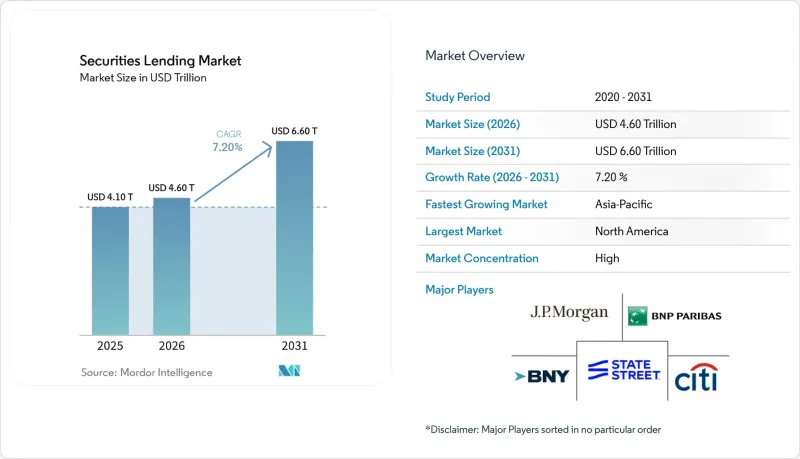
Lending revenue reached USD 14.9 billion in 2025, supported by equity volatility tied to artificial intelligence, larger exchange-traded fund lending balances, and renewed activity in Asian markets after South Korea lifted its short-selling ban in March 2025. This report is Segmented by Asset Class (Equities, Corporate Bonds, and More), Participant Type (Pension Funds, Banks, and More), Lending Model (Agent Lending and Principal Lending), and Geography (North America, South America, and More). The Market Forecasts are Provided in Terms of Value (USD).
Global Securities Lending Market Trends and Insights
Growing Short-Selling and Relative-Value Trading Activity Increasing Securities Borrow Demand
Short-selling and relative-value positions are increasing the need for borrowed securities across the securities lending market. Global equity lending revenue rose 38% year over year to USD 5.4 billion in the first half of 2026. Asia-Pacific generated USD 2.1 billion as semiconductor, artificial intelligence infrastructure, and electric vehicle positions remained on loan for longer periods. Curated counterparty lists and flexible term-lending arrangements can improve fee capture when demand centers on a smaller group of special securities. Convertible issuance linked to artificial intelligence infrastructure financing also expanded convertible-arbitrage borrowing demand in 2026. EquiLend processed 121,800 United States equity trades on the June 2026 Russell reconstitution date, showing the operational importance of managing large event-driven demand peaks
Expansion of Institutional and ETF Asset Pools Increasing the Supply of Lendable Securities
Institutional portfolios and exchange-traded funds are widening the inventory available to the securities lending market. Larger exchange-traded fund portfolios give lenders more individual positions that can be offered to borrowers, instead of relying only on broad custodial pools. Active, leveraged, and crypto-related exchange-traded fund holdings can have distinct borrowing patterns from passive index positions. Exchange-traded fund lending revenue reached USD 405 million in the first half of 2026, an increase of 62% from the prior year. This broader inventory can support lending programs with more specific securities and loan terms. It also helps programs respond when demand shifts between index positions, concentrated equity trades, and other collateral needs.
Capital and Balance-Sheet Constraints Limiting Intermediary Lending Capacity
Capital requirements are limiting how much balance sheet some intermediaries can devote to the securities lending market. The United Kingdom Prudential Regulation Authority published final Basel 3.1 rules in January 2026, with implementation scheduled for January 2027. Regulation (EU) 2025/1215 changed net stable funding ratio requirements for certain securities financing transactions with residual maturities below 6 months. These rules can make short-term general collateral intermediation less attractive for bank balance sheets. Centrally cleared structures can help participants use multilateral netting and reduce risk-weighted assets. The resulting economics favor agents that can provide cleared triparty arrangements and broader collateral-management support.
Other drivers and restraints analyzed in the detailed report include:
- Rising Institutional Adoption of Securities Lending for Incremental Portfolio Income
- Increasing Securities Borrow Demand for Market Making and Settlement Coverage
- Cross-Border Tax, Legal, and Settlement Complexity Restricting International Lending
For complete list of drivers and restraints, kindly check the Table Of Contents.
Segment Analysis
Equities accounted for 45.3% of the securities lending market size in 2025 and are forecast to grow at an 8% CAGR through 2031. Equity lending is supported by exchange-traded fund activity, semiconductor-linked positions, and volatility surrounding artificial intelligence-related securities. Common shares, ADRs, and equity exchange-traded products generated USD 11.5 billion of USD 14.9 billion in global lending revenue during 2025. Asian technology and semiconductor names were among the higher-earning special securities. Exchange-traded fund lending revenue then rose to USD 405 million in the first half of 2026.
Government and sovereign bonds formed the next major fixed-income source of lending activity. Revenue from government bond lending increased 27% in the first half of 2026 as high-quality liquid asset demand and clearing deadlines increased borrowing needs. Corporate bond lending balances in North American investment-grade securities also expanded as managers used holdings to manage credit-spread risk and monetize inventory during issuance periods. Agency bonds, supranationals, and convertibles expanded the range of fixed-income and hybrid collateral available to programs. Convertible issuance connected to artificial intelligence infrastructure financing created related convertible-arbitrage equity borrowing demand. This cross-asset mix broadens the securities lending market size opportunity by enabling lenders to capture both collateral-driven demand and higher-margin special-security opportunities.
Complete Report Scope:
- By Asset Class
- Equities (including common shares, preferred shares, equity ETFs/ETPs, ADRs, and other equity securities)
- Government / Sovereign Bonds
- Corporate Bonds
- Other Fixed Income and Hybrid Securities (agency/supranational bonds, convertible securities, and other eligible fixed-income or hybrid instruments)
- By Participant Type
- Pension Funds
- Insurance Companies
- Banks
- Broker-Dealers
- Collective Investment Vehicles / Asset Managers
- Government / Sovereign Entities and Official Institutions
- Other Institutional Investors (endowments, foundations, corporations, etc.)
- By Lending Model
- Agent Lending
- Principal Lending
- By Geography
- North America
- United States
- Canada
- Mexico
- South America
- Brazil
- Argentina
- Rest of South America
- Europe
- United Kingdom
- Germany
- France
- Italy
- Spain
- Rest of Europe
- Asia-Pacific
- China
- Japan
- India
- South Korea
- Australia
- Indonesia
- Thailand
- Malaysia
- Singapore
- Vietnam
- Rest of Asia-Pacific
- Middle East and Africa
- Saudi Arabia
- United Arab Emirates
- Turkey
- South Africa
- Egypt
- Rest of Middle East and Africa
- North America
Geography Analysis
North America held 38.2% of the securities lending market share in 2025. Deep equity custodial pools and a high concentration of hedge-fund borrowers support the region's position. North American equity lending revenue reached USD 2.3 billion in the first half of 2026. Artificial intelligence trading, biotechnology event positions, credit exchange-traded fund demand, and energy short positions drove activity. The December 2026 Treasury clearing deadline is changing how participants manage inventory and funding.
Europe has growing fixed-income borrowing needs as liquidity conditions change and participants manage high-quality liquid assets. EMEA equity lending revenue reached USD 959 million in the first half of 2026, led by industrial, financial, and merger-related positions. Germany generated USD 132 million as industrial and auto-sector positions increased. SFTR compliance and CSDR provisions add cost and operational requirements for European programs. SAB Invest appointed J.P. Morgan as agent for its Saudi equity securities lending program in June 2026.
Asia-Pacific is forecast to grow at a 10.2% CAGR, the fastest regional rate in the securities lending market size. Asia-Pacific equity lending revenue rose to USD 2.1 billion in the first half of 2026. South Korea's reopening to short selling increased on-loan balances after the prior ban was removed. Taiwan has become important for artificial intelligence hardware supply-chain positions. Japan's policy normalization supports yield-enhancement demand in Japanese government bonds.
- J.P. Morgan
- BNY Mellon
- State Street Corporation
- Northern Trust Corporation
- Citi
- BNP Paribas
- Goldman Sachs
- Morgan Stanley
- UBS Group
- Bank of America
- Deutsche Bank
- Barclays
- HSBC Holdings
- Societe Generale
- Wells Fargo
- Mizuho Financial Group
- Natixis Corporate & Investment Banking
- Jefferies Financial Group
- RBC Capital Markets
- Brown Brothers Harriman
Additional Benefits:
- The market estimate (ME) sheet in Excel format
- 3 months of analyst support
TABLE OF CONTENTS
1 INTRODUCTION
- 1.1 Study Assumptions and Market Definition
- 1.2 Scope of the Study
2 RESEARCH METHODOLOGY
3 EXECUTIVE SUMMARY
4 MARKET LANDSCAPE
- 4.1 Market Overview
- 4.2 Market Drivers
- 4.2.1 Growing Short-Selling and Relative-Value Trading Activity Increasing Securities Borrow Demand
- 4.2.2 Expansion of Institutional and ETF Asset Pools Increasing the Supply of Lendable Securities
- 4.2.3 Rising Institutional Adoption of Securities Lending for Incremental Portfolio Income
- 4.2.4 Increasing Securities Borrow Demand for Market Making and Settlement Coverage
- 4.2.5 Higher Utilization and Fee Generation from Scarce and Special Securities
- 4.2.6 Expansion of Agency and Centralized Securities Lending Programs Improving Asset Mobilization
- 4.3 Market Restraints
- 4.3.1 Capital and Balance-Sheet Constraints Limiting Intermediary Lending Capacity
- 4.3.2 Counterparty and Collateral Risks Discouraging Beneficial Owner Participation
- 4.3.3 Cross-Border Tax, Legal, and Settlement Complexity Restricting International Lending
- 4.3.4 High Operational Costs Associated with Collateral Management and Post-Trade Processing
- 4.4 Value Chain Analysis
- 4.5 Regulatory Landscape
- 4.6 Technological Outlook
- 4.7 Securities Lending Demand by Use Case
- 4.8 Beneficial Owner Participation and Mandate Preferences
- 4.9 Collateral Reinvestment and Optimization Practices
- 4.10 Settlement Efficiency and Fail Management Dynamics
- 4.11 Operational and Counterparty Due Diligence Practices
- 4.12 Porter's Five Forces Analysis
- 4.12.1 Threat of New Entrants
- 4.12.2 Bargaining Power of Suppliers
- 4.12.3 Bargaining Power of Buyers
- 4.12.4 Threat of Substitutes
- 4.12.5 Intensity of Competitive Rivalry
5 Market Size and Growth Forecasts
- 5.1 By Asset Class
- 5.1.1 Equities (including common shares, preferred shares, equity ETFs/ETPs, ADRs, and other equity securities)
- 5.1.2 Government / Sovereign Bonds
- 5.1.3 Corporate Bonds
- 5.1.4 Other Fixed Income and Hybrid Securities (agency/supranational bonds, convertible securities, and other eligible fixed-income or hybrid instruments)
- 5.2 By Participant Type
- 5.2.1 Pension Funds
- 5.2.2 Insurance Companies
- 5.2.3 Banks
- 5.2.4 Broker-Dealers
- 5.2.5 Collective Investment Vehicles / Asset Managers
- 5.2.6 Government / Sovereign Entities and Official Institutions
- 5.2.7 Other Institutional Investors (endowments, foundations, corporations, etc.)
- 5.3 By Lending Model
- 5.3.1 Agent Lending
- 5.3.2 Principal Lending
- 5.4 By Geography
- 5.4.1 North America
- 5.4.1.1 United States
- 5.4.1.2 Canada
- 5.4.1.3 Mexico
- 5.4.2 South America
- 5.4.2.1 Brazil
- 5.4.2.2 Argentina
- 5.4.2.3 Rest of South America
- 5.4.3 Europe
- 5.4.3.1 United Kingdom
- 5.4.3.2 Germany
- 5.4.3.3 France
- 5.4.3.4 Italy
- 5.4.3.5 Spain
- 5.4.3.6 Rest of Europe
- 5.4.4 Asia-Pacific
- 5.4.4.1 China
- 5.4.4.2 Japan
- 5.4.4.3 India
- 5.4.4.4 South Korea
- 5.4.4.5 Australia
- 5.4.4.6 Indonesia
- 5.4.4.7 Thailand
- 5.4.4.8 Malaysia
- 5.4.4.9 Singapore
- 5.4.4.10 Vietnam
- 5.4.4.11 Rest of Asia-Pacific
- 5.4.5 Middle East and Africa
- 5.4.5.1 Saudi Arabia
- 5.4.5.2 United Arab Emirates
- 5.4.5.3 Turkey
- 5.4.5.4 South Africa
- 5.4.5.5 Egypt
- 5.4.5.6 Rest of Middle East and Africa
- 5.4.1 North America
6 COMPETITIVE LANDSCAPE
- 6.1 Market Concentration
- 6.2 Strategic Moves
- 6.3 Market Share Analysis (Top 5-6 players)
- 6.4 Company Profiles (includes Global Level Overview, Market Level Overview, Core Segments, Financials as available, Strategic Information, Market Rank/Share, Products and Services, Recent Developments)
- 6.4.1 J.P. Morgan
- 6.4.2 BNY Mellon
- 6.4.3 State Street Corporation
- 6.4.4 Northern Trust Corporation
- 6.4.5 Citi
- 6.4.6 BNP Paribas
- 6.4.7 Goldman Sachs
- 6.4.8 Morgan Stanley
- 6.4.9 UBS Group
- 6.4.10 Bank of America
- 6.4.11 Deutsche Bank
- 6.4.12 Barclays
- 6.4.13 HSBC Holdings
- 6.4.14 Societe Generale
- 6.4.15 Wells Fargo
- 6.4.16 Mizuho Financial Group
- 6.4.17 Natixis Corporate & Investment Banking
- 6.4.18 Jefferies Financial Group
- 6.4.19 RBC Capital Markets
- 6.4.20 Brown Brothers Harriman
7 Market Opportunities and Future Outlook
- 7.1 White-Space and Unmet-Need Assessment

