PUBLISHER: Mordor Intelligence | PRODUCT CODE: 2155579

PUBLISHER: Mordor Intelligence | PRODUCT CODE: 2155579
South America Commercial Aircraft Cabin Interior - Market Share Analysis, Industry Trends & Statistics, Growth Forecasts (2026 - 2031)
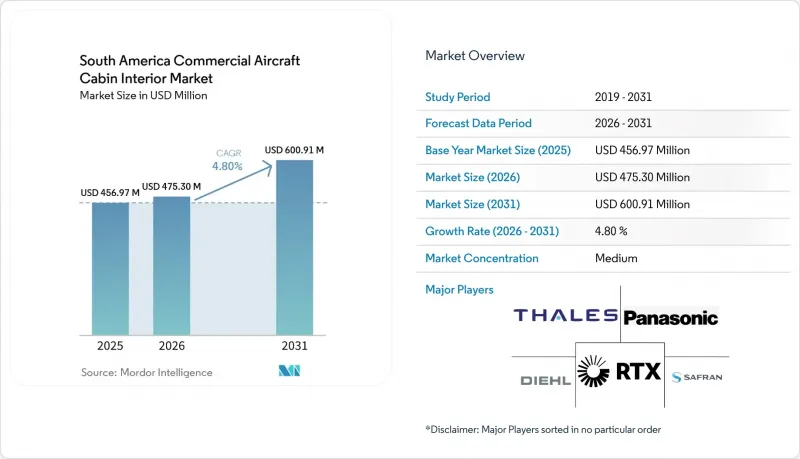
According to Mordor Intelligence, the South America commercial aircraft cabin interior market size was valued at USD 456.97 million in 2025, and is projected to grow from USD 475.30 million in 2026 to USD 600.91 million by 2031, at a 4.80% CAGR during the forecast period (2026-2031).
South America Commercial Aircraft Cabin Interior Market Trends and Insights
Post-Pandemic Passenger Traffic Recovery
South America's commercial aviation sector continued to expand in 2025, supporting opportunities for cabin interior suppliers. Argentina recorded 33.3 million passengers, up 13.2% year on year, with domestic traffic increasing 9.1% and international traffic rising 18.2%. Airlines are also investing in cabin equipment alongside fleet development. In April 2025, Azul selected RECARO CL6710 Business Class and CL3710 Economy Class seats for its new Airbus A330 aircraft, with deliveries scheduled to begin in 2025. These developments expand the installed base of cabin equipment and support ongoing requirements for seating, replacement components, maintenance, and interior upgrades across South America.
Embraer-Led Regional Fleet Renewal
Brazil-based Embraer delivered 78 commercial aircraft in 2025, up approximately 6.8% from 2024, while its commercial aviation backlog reached USD 14.5 billion at year-end. The company continues to target 80-85 commercial aircraft deliveries in 2026. In July 2026, Abra Group, parent of South American carriers Avianca and GOL, agreed to acquire 20 E195-E2 aircraft, with 10 purchase options and 15 purchase rights, bringing the potential total to 45 aircraft. First deliveries are expected in Q4 2027. The E195-E2 platform includes cabin elements such as seating, overhead storage, galleys, and lavatories, with connectivity configurable to airline requirements. This agreement represents a potential source of future demand for cabin interiors in South America.
High Certification and Airworthiness Compliance Costs
Commercial aircraft cabin modifications in South America must comply with national airworthiness and maintenance requirements. Brazil's ANAC, Chile's DGAC, Colombia's Aerocivil, and Argentina's ANAC oversee certification and maintenance frameworks within their respective markets. Major modifications may require approved design data or supplemental type certification, while appropriately approved organizations must perform maintenance and alterations. These requirements increase the technical documentation, engineering, inspection, and coordination involved in cabin retrofit programs. The need for certified designs, approved components, and qualified maintenance capability can add cost and complexity to interior modifications and affect project schedules across the market.
Other drivers and restraints analyzed in the detailed report include:
- Airline Cabin Retrofit and Premiumization
- Rising Demand for Connected Passenger Experiences
- Import Dependence and Supply-Chain Volatility
For complete list of drivers and restraints, kindly check the Table Of Contents.
Segment Analysis
Seating accounted for an estimated 30.45% of the South America commercial aircraft cabin interior market in 2025. The region's large narrowbody fleet supports demand and includes both retrofit activity and installations on new aircraft. Premium cabin programs increase interior content on selected long-haul aircraft, while economy-class installations continue to generate higher seat volumes. In August 2025, RECARO announced a 41-shipset PL3530 Premium Comfort retrofit program for LATAM's B787-8 and B787-9 aircraft, with deliveries beginning in the first half of 2027. The program demonstrates continued investment in differentiated seating alongside standard economy-class requirements.
IFEC is forecast to be the fastest-growing product category, with an estimated CAGR of 6.25% from 2026 to 2031. In July 2026, SES was selected to equip more than 60 LATAM A320neo, A321XLR, and E195-E2 aircraft with multi-orbit connectivity over the coming years. LATAM already operates more than 250 SES-connected aircraft. The program supports demand for electronically steered antennas, in-cabin network integration, software, installation, and maintenance support. Galleys, monuments, overhead bins, lighting, and interior panels remain relevant line-fit and retrofit categories, broadening cabin equipment opportunities as airlines combine conventional interior upgrades with connected passenger-experience systems.
Narrowbody aircraft accounted for an estimated 68.50% of the South America commercial aircraft cabin interior market in 2025. This share reflects the large installed base operating across domestic and regional networks. LATAM alone ended 2025 with 291 Airbus narrowbody passenger aircraft, compared with 60 widebody aircraft. Varying operating models drive demand for both higher-density layouts and differentiated premium sections, with LATAM offering Premium Economy on its narrowbody fleet. This generates recurring requirements for seating, overhead storage, cabin monuments, connectivity equipment, and other interior systems across new deliveries and retrofit programs.
Regional jets are forecast to record the fastest growth, at an estimated 5.65% CAGR from 2026 to 2031, based on the market segmentation used in this study. A growing E195-E2 order pipeline in South America supports this outlook. LATAM ordered 24 firm E195-E2 aircraft with 50 purchase options in September 2025, while Abra Group agreed in July 2026 to acquire 20 E195-E2 aircraft with 10 options and 15 purchase rights, bringing its potential requirement to 45 aircraft. Widebody aircraft remain relevant for higher-content long-haul cabin configurations, while turboprops continue to serve secondary and remote regional markets. Demand across aircraft types, therefore, combines the scale of the narrowbody installed base with a growing pipeline of smaller-capacity E2 aircraft.
Complete Report Scope:
- By Product Type
- Seating
- Cabin Lighting
- In-flight Entertainment and Connectivity (IFEC)
- Galley and Monument
- Lavatory Systems
- Cabin Windows and Windshields
- Overhead Stowage Bins
- Interior Panels and Floorboards
- Others (Water and Waste Management Systems, Air Ionization and Purification System, Oxygen Systems, etc.)
- By Aircraft Type
- Narrowbody Aircraft
- Widebody Aircraft
- Regional Jets
- Turboprop Aircraft
- By Cabin Class
- First Class and Business Class
- Premium Economy Class
- Economy Class
- By Fit Type
- Original Equipment Manufacturer (OEM)
- Aftermarket
- By Material
- Composites
- Aluminum Alloys
- Steel and Other Alloys
- Advanced Thermoplastics
- By Geography
- Brazil
- Argentina
- Chile
- Colombia
- Peru
- Ecuador
- Rest of South America
List of Companies Covered in this Report:
- Safran SA
- Panasonic Avionics Corporation
- Collins Aerospace (RTX Corporation)
- Diehl Stiftung & Co. KG
- RECARO Aircraft Seating GmbH & Co. KG (RECARO Holding GmbH)
- Thales Group
- Thompson Aero Seating Limited (Aviation Industry Corporation of China)
- JAMCO Corporation
- Geven S.p.A.
- Singapore Technologies Engineering Ltd.
- FACC AG
- MRO Holdings Inc.
- Astronics Corporation
Additional Benefits:
- The market estimate (ME) sheet in Excel format
- 3 months of analyst support
TABLE OF CONTENTS
1 INTRODUCTION
- 1.1 Study Assumptions and Market Definition
- 1.2 Scope of the Study
2 RESEARCH METHODOLOGY
3 EXECUTIVE SUMMARY
4 MARKET LANDSCAPE
- 4.1 Market Overview
- 4.2 Market Drivers
- 4.2.1 Post-pandemic passenger traffic recovery
- 4.2.2 Embraer-led regional fleet renewal
- 4.2.3 Airline cabin retrofit and premiumization
- 4.2.4 Rising demand for connected passenger experiences
- 4.2.5 Brazilian aerospace and MRO capability expansion
- 4.2.6 Cabin localization for dense and thin South American routes
- 4.3 Market Restraints
- 4.3.1 High certification and airworthiness compliance costs
- 4.3.2 Foreign-exchange exposure in airline procurement
- 4.3.3 Import dependence and supply-chain volatility
- 4.3.4 Limited regional availability of certified cabin-interior capacity
- 4.4 Value Chain Analysis
- 4.5 Regulatory Landscape
- 4.6 Technological Outlook
- 4.7 Porter's Five Forces Analysis
- 4.7.1 Bargaining Power of Suppliers
- 4.7.2 Bargaining Power of Buyers
- 4.7.3 Threat of New Entrants
- 4.7.4 Threat of Substitutes
- 4.7.5 Intensity of Competitive Rivalry
5 MARKET SIZE AND GROWTH FORECASTS (VALUE)
- 5.1 By Product Type
- 5.1.1 Seating
- 5.1.2 Cabin Lighting
- 5.1.3 In-flight Entertainment and Connectivity (IFEC)
- 5.1.4 Galley and Monument
- 5.1.5 Lavatory Systems
- 5.1.6 Cabin Windows and Windshields
- 5.1.7 Overhead Stowage Bins
- 5.1.8 Interior Panels and Floorboards
- 5.1.9 Others (Water and Waste Management Systems, Air Ionization and Purification System, Oxygen Systems, etc.)
- 5.2 By Aircraft Type
- 5.2.1 Narrowbody Aircraft
- 5.2.2 Widebody Aircraft
- 5.2.3 Regional Jets
- 5.2.4 Turboprop Aircraft
- 5.3 By Cabin Class
- 5.3.1 First Class and Business Class
- 5.3.2 Premium Economy Class
- 5.3.3 Economy Class
- 5.4 By Fit Type
- 5.4.1 Original Equipment Manufacturer (OEM)
- 5.4.2 Aftermarket
- 5.5 By Material
- 5.5.1 Composites
- 5.5.2 Aluminum Alloys
- 5.5.3 Steel and Other Alloys
- 5.5.4 Advanced Thermoplastics
- 5.6 By Geography
- 5.6.1 Brazil
- 5.6.2 Argentina
- 5.6.3 Chile
- 5.6.4 Colombia
- 5.6.5 Peru
- 5.6.6 Ecuador
- 5.6.7 Rest of South America
6 COMPETITIVE LANDSCAPE
- 6.1 Market Concentration
- 6.2 Strategic Moves
- 6.3 Market Share Analysis
- 6.4 Company Profiles (includes Global-level Overview, Market-level Overview, Core Segments, Financials, Strategic Information, Market Rank/Share, Products and Services, and Recent Developments)
- 6.4.1 Safran SA
- 6.4.2 Panasonic Avionics Corporation
- 6.4.3 Collins Aerospace (RTX Corporation)
- 6.4.4 Diehl Stiftung & Co. KG
- 6.4.5 RECARO Aircraft Seating GmbH & Co. KG (RECARO Holding GmbH)
- 6.4.6 Thales Group
- 6.4.7 Thompson Aero Seating Limited (Aviation Industry Corporation of China)
- 6.4.8 JAMCO Corporation
- 6.4.9 Geven S.p.A.
- 6.4.10 Singapore Technologies Engineering Ltd.
- 6.4.11 FACC AG
- 6.4.12 MRO Holdings Inc.
- 6.4.13 Astronics Corporation
7 MARKET OPPORTUNITIES AND FUTURE OUTLOOK
- 7.1 White-space and Unmet-Need Assessment

