PUBLISHER: Mordor Intelligence | PRODUCT CODE: 2155591

PUBLISHER: Mordor Intelligence | PRODUCT CODE: 2155591
Industrial Vision Maintenance Services - Market Share Analysis, Industry Trends & Statistics, Growth Forecasts (2026 - 2031)
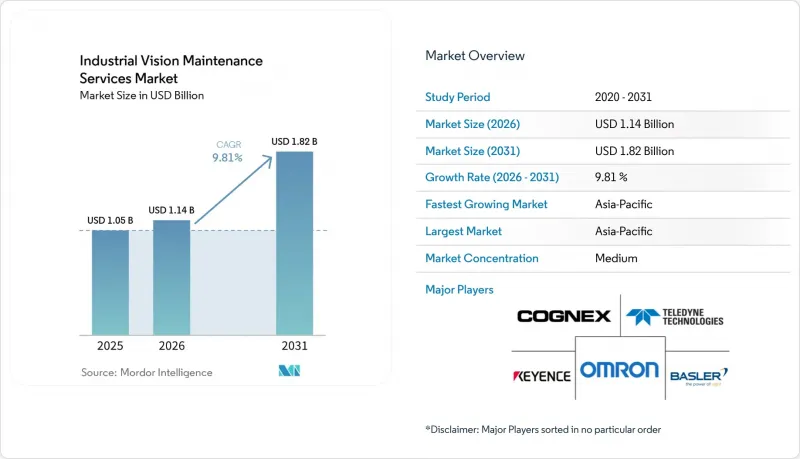
According to Mordor Intelligence, the industrial vision maintenance services market size was USD 1.14 billion in 2026 and is projected to reach USD 1.82 billion by 2031, growing at a CAGR of 9.81% from 2026 to 2031.
Global Industrial Vision Maintenance Services Market Trends and Insights
Expansion of Zero-Defect Manufacturing Raises Inspection System Uptime Standards
Zero-defect requirements are increasing the need for dependable vision system maintenance across automotive, pharmaceutical, and electronics supply chains. Customer quality requirements can make calibration records, model version histories, and response times part of the service agreement. These records help manufacturers demonstrate that inspection systems are managed consistently. ISO 9001 and IATF 16949 documentation requirements also increase the importance of maintaining traceable service records. As factories add more robotic cells and cameras, interdependent calibration tasks can make the service requirement more complex than that of a single-camera installation. The industrial vision maintenance services market, therefore, benefits when inspection uptime becomes linked to supplier quality obligations.
Rising Cost of Unplanned Vision-System Downtime Creates Urgent Demand for Preventive Programs
Unplanned vision system downtime can disrupt production and expose manufacturers to defects that go undetected. A production line stoppage in automotive assembly can cost USD 2 million per hour, which makes planned service easier to justify for critical lines. Partial system degradation can be particularly difficult to detect because a weakened camera in a multi-sensor setup may reduce inspection accuracy without triggering a clear alarm. Research on AI-assisted camera maintenance describes how condition monitoring can help identify performance deterioration before it affects output quality. Providers with real-time health monitoring can use that capability to support higher-value service agreements. Reactive repair can cost 5 to 10 times the planned maintenance rate, which continues to support preventive enrollment across the industrial vision maintenance services market.
High Retrofit and Integration Costs Limit Service Adoption in Brownfield Environments
Older production lines were often not designed for connected diagnostics, which can raise the cost of adding service infrastructure. Legacy protocols such as Modbus and Profibus may require additional integration work because they lack standard application interfaces. Real-time performance needs and safety isolation requirements can add further engineering work. Facilities may also need custom camera mounts, conduit changes, and network installations while keeping production operating. These conditions can delay the start of formal service agreements after a vision system is installed. The barrier is especially relevant in South America, Southeast Asia, and Eastern Europe, where established facilities represent a meaningful part of the potential industrial vision maintenance services market.
Other drivers and restraints analyzed in the detailed report include:
- Shift Toward Predictive and Outcome-Based Maintenance Contracts Restructures Market Revenue
- Growth of Edge AI and Remote Diagnostics Expands Service Reach
- Shortage of Vision-Service Specialists Constrains Service Delivery Capacity
For complete list of drivers and restraints, kindly check the Table Of Contents.
Segment Analysis
Preventive Maintenance Services held 27.43% of revenue in 2025. The segment covers scheduled camera cleaning, lens recalibration, lighting checks, and firmware updates. These tasks help maintain inspection accuracy across the installed base of vision equipment. Their role is most visible on high-throughput automotive and electronics lines where small accuracy losses can lead to costly quality issues. Scheduled work also gives manufacturers a documented maintenance history for systems linked to production quality requirements. Preventive programs remain the core service approach for buyers who have not yet adopted continuous condition monitoring. The work covers both physical assets and operating settings that can affect image quality. It also creates a regular provider relationship that can support later adoption of more advanced service models.
Remote Monitoring and Diagnostics is projected to expand at a CAGR of 11.34% through 2031. Edge AI makes continuous collection and review of vision system telemetry more practical without a dedicated technician on site. The line between preventive maintenance and remote diagnostics is becoming less clear as software handles more condition-assessment work. Cognex made OneVision commercially available in May 2026 to centralize AI model life-cycle management across device fleets. The company reported that early adopters reduced multi-site scaling costs by up to 50%. Corrective Maintenance and Repair Services, Software and Firmware Maintenance, Performance Optimization Services, and Spare Parts and Component Replacement cover other stages of the equipment life cycle. Spare parts are important in locations with particulate contamination or thermal cycling because cameras and sensors can wear more quickly. These service categories make the industrial vision maintenance services market relevant across hardware, software, and system performance needs.
On-Site Services accounted for 53.78% of service delivery revenue in 2025. Physical work remains necessary for camera position checks, lens cleaning, lighting replacement, and spatial calibration. Semiconductor wafer inspection and automotive metrology can require direct optical alignment that remote access cannot provide. This requirement supports continuing demand for local field technicians and partner networks. On-site visits also allow technicians to inspect the production setting around the vision equipment. Dust, vibration, heat, and mechanical changes can all affect camera performance. The large share shows that digital tools have not eliminated the need for hands-on maintenance. Instead, they have changed how providers determine when a visit is required.
Remote Services is projected to expand at a CAGR of 10.87% through 2031. Edge-deployed AI models and secure remote access allow technicians to identify software issues, install firmware updates, and track model performance without travel. A remote specialist can support more systems than a field technician who must travel between sites. Hybrid Services combine scheduled physical visits with continuous remote review of software and performance metrics. This structure can help providers set visit frequency based on measured system condition rather than a fixed calendar. Fuji Film Business Innovation developed an AI-integrated unified maintenance support platform in 2026 and began deployments across Japan, Asia-Pacific, and Europe in July 2026. The platform reflects investment by established equipment suppliers in operating models that combine field work with digital maintenance support. The industrial vision maintenance services market can use this approach to preserve physical maintenance quality while reducing unnecessary dispatches.
Complete Report Scope:
- By Service Type
- Preventive Maintenance Services
- Corrective Maintenance and Repair Services
- Remote Monitoring and Diagnostics
- Software and Firmware Maintenance
- Performance Optimization Services
- Spare Parts and Component Replacement
- By Service Delivery
- On-Site Services
- Remote Services
- Hybrid Services
- By System Component
- Cameras and Imaging Sensors
- Lenses and Optics
- Lighting Systems
- Image Processing and Computing Systems
- Vision Software and Controllers
- Cabling, Interfaces and Connectivity
- By Contract Type
- Time-and-Material Services
- Annual Maintenance Contracts
- Performance-Based / SLA Contracts
- Managed Vision Services
- By Application
- Quality Inspection
- Process Monitoring and Control
- Robotic Guidance and Bin Picking
- Metrology and Dimensional Verification
- Identification, Traceability, and Code Reading
- By Industry Vertical
- Automotive and Mobility
- Electronics and Semiconductors
- Industrial Machinery and Equipment
- Aerospace and Defense
- Pharmaceuticals and Life Sciences
- Food and Beverage
- Other Industry Verticals
- By Geography
- North America
- United States
- Canada
- Mexico
- South America
- Brazil
- Argentina
- Chile
- Rest of South America
- Europe
- Germany
- United Kingdom
- France
- Italy
- Spain
- Rest of Europe
- Asia-Pacific
- China
- Japan
- India
- South Korea
- Rest of Asia-Pacific
- Middle East
- United Arab Emirates
- Saudi Arabia
- Qatar
- Rest of Middle East
- Africa
- South Africa
- Egypt
- Nigeria
- Rest of Africa
- North America
Geography Analysis
Asia-Pacific accounted for 34.76% of regional revenue in 2025 and is projected to grow at a CAGR of 11.47% through 2031. China provides the largest absolute volume in the region through electronics assembly clusters in Guangdong, Jiangsu, and Zhejiang. These clusters have dense vision-system installations that increasingly require formal maintenance programs. South Korea and Japan support demand for high-precision services through semiconductor and automotive inspection applications. India is adding electronics and automotive capacity that is expected to enter the maintenance cycle through 2026 and later years. SICK AG announced an investment of RM1 billion (USD 227 million) in a high-tech manufacturing and sensor hub in Johor, Malaysia. Phase 1 involved RM280 million (USD 63.7 million) and was scheduled to begin by 2026. These investments reinforce Asia-Pacific's role in the industrial vision maintenance services market.
North America held the second-largest geographic share in 2025. The United States accounted for the largest share of regional revenue. Automotive operations in the Midwest and semiconductor fabrication centers in Arizona, Texas, and New York have dense deployments of vision systems. High downtime costs in these environments support demand for premium maintenance agreements. The US Bureau of Labor Statistics recorded 462,000 open manufacturing positions in March 2026. Limited labor availability can increase interest in managed and remote support models that reduce the need for on-site specialists. Canada and Mexico add demand through integrated automotive supply chains and supplier quality requirements. These conditions sustain the industrial vision maintenance services market in North America.
Europe represented the third-largest geographic segment in 2025. Germany, the United Kingdom, and France formed the core of regional demand, supported by industrial machinery, automotive, and precision manufacturing. Germany has an established systems integration base and major OEM activity from SICK AG, Basler AG, IDS Imaging Development Systems GmbH, and Baumer Holding AG. The EU NIS2 Directive increased cybersecurity requirements for connected service platforms in 2024, adding compliance considerations for remote monitoring contracts. SICK Korea signed an MOU with Hyundai Motor in June 2026 to cooperate on advanced safety technology for future smart manufacturing applications. The Middle East remains an early-stage opportunity as industrial diversification programs increase non-oil manufacturing investment. Africa remains at an earlier stage, with South Africa and Egypt providing the most immediate entry points as manufacturing complexity grows. These conditions support the industrial vision maintenance services market across Europe and adjacent regions.
- Cognex Corporation
- Keyence Corporation
- Basler AG
- Teledyne Technologies Incorporated
- OMRON Corporation
- SICK AG
- Allied Vision Technologies GmbH
- IDS Imaging Development Systems GmbH
- JAI A/S
- LMI Technologies Inc.
- MVTec Software GmbH
- ISRA VISION GmbH
- Datalogic S.p.A.
- Baumer Holding AG
- Hikrobot Technology Co., Ltd.
- Daheng Imaging Co., Ltd.
- Matrox Electronic Systems Ltd.
- STEMMER IMAGING AG
- Vieworks Co., Ltd.
Additional Benefits:
- The market estimate (ME) sheet in Excel format
- 3 months of analyst support
TABLE OF CONTENTS
1 INTRODUCTION
- 1.1 Study Assumptions and Market Definition
- 1.2 Scope of the Study
2 RESEARCH METHODOLOGY
3 EXECUTIVE SUMMARY
4 MARKET LANDSCAPE
- 4.1 Market Overview
- 4.2 Market Drivers
- 4.2.1 Expansion of Zero-Defect Manufacturing
- 4.2.2 Rising Cost of Unplanned Vision-System Downtime
- 4.2.3 Shift Toward Predictive and Outcome-Based Maintenance Contracts
- 4.2.4 Growth of Edge AI and Remote Diagnostics
- 4.2.5 Optical and Camera Drift in Harsh Production Environments
- 4.2.6 Vision-Model Drift from Frequent SKU and Recipe Changes
- 4.3 Market Restraints
- 4.3.1 High Retrofit and Integration Costs
- 4.3.2 Shortage of Vision-Service Specialists
- 4.3.3 Proprietary Calibration Data and Vendor Lock-In
- 4.3.4 Cybersecurity and Data-Residency Exposure in Connected Service Models
- 4.4 Impact of Macroeconomic Factors on the Market
- 4.5 Industry Value Chain Analysis
- 4.6 Regulatory Landscape
- 4.7 Technological Outlook
- 4.8 Porter's Five Forces Analysis
- 4.8.1 Bargaining Power of Suppliers
- 4.8.2 Bargaining Power of Buyers
- 4.8.3 Threat of New Entrants
- 4.8.4 Threat of Substitutes
- 4.8.5 Competitive Rivalry
5 MARKET SIZE AND GROWTH FORECASTS (VALUE)
- 5.1 By Service Type
- 5.1.1 Preventive Maintenance Services
- 5.1.2 Corrective Maintenance and Repair Services
- 5.1.3 Remote Monitoring and Diagnostics
- 5.1.4 Software and Firmware Maintenance
- 5.1.5 Performance Optimization Services
- 5.1.6 Spare Parts and Component Replacement
- 5.2 By Service Delivery
- 5.2.1 On-Site Services
- 5.2.2 Remote Services
- 5.2.3 Hybrid Services
- 5.3 By System Component
- 5.3.1 Cameras and Imaging Sensors
- 5.3.2 Lenses and Optics
- 5.3.3 Lighting Systems
- 5.3.4 Image Processing and Computing Systems
- 5.3.5 Vision Software and Controllers
- 5.3.6 Cabling, Interfaces and Connectivity
- 5.4 By Contract Type
- 5.4.1 Time-and-Material Services
- 5.4.2 Annual Maintenance Contracts
- 5.4.3 Performance-Based / SLA Contracts
- 5.4.4 Managed Vision Services
- 5.5 By Application
- 5.5.1 Quality Inspection
- 5.5.2 Process Monitoring and Control
- 5.5.3 Robotic Guidance and Bin Picking
- 5.5.4 Metrology and Dimensional Verification
- 5.5.5 Identification, Traceability, and Code Reading
- 5.6 By Industry Vertical
- 5.6.1 Automotive and Mobility
- 5.6.2 Electronics and Semiconductors
- 5.6.3 Industrial Machinery and Equipment
- 5.6.4 Aerospace and Defense
- 5.6.5 Pharmaceuticals and Life Sciences
- 5.6.6 Food and Beverage
- 5.6.7 Other Industry Verticals
- 5.7 By Geography
- 5.7.1 North America
- 5.7.1.1 United States
- 5.7.1.2 Canada
- 5.7.1.3 Mexico
- 5.7.2 South America
- 5.7.2.1 Brazil
- 5.7.2.2 Argentina
- 5.7.2.3 Chile
- 5.7.2.4 Rest of South America
- 5.7.3 Europe
- 5.7.3.1 Germany
- 5.7.3.2 United Kingdom
- 5.7.3.3 France
- 5.7.3.4 Italy
- 5.7.3.5 Spain
- 5.7.3.6 Rest of Europe
- 5.7.4 Asia-Pacific
- 5.7.4.1 China
- 5.7.4.2 Japan
- 5.7.4.3 India
- 5.7.4.4 South Korea
- 5.7.4.5 Rest of Asia-Pacific
- 5.7.5 Middle East
- 5.7.5.1 United Arab Emirates
- 5.7.5.2 Saudi Arabia
- 5.7.5.3 Qatar
- 5.7.5.4 Rest of Middle East
- 5.7.6 Africa
- 5.7.6.1 South Africa
- 5.7.6.2 Egypt
- 5.7.6.3 Nigeria
- 5.7.6.4 Rest of Africa
- 5.7.1 North America
6 COMPETITIVE LANDSCAPE
- 6.1 Market Concentration
- 6.2 Strategic Moves
- 6.3 Market Share Analysis
- 6.4 Company Profiles (includes Global Level Overview, Market Level Overview, Core Segments, Financials as available, Strategic Information, Market Rank/Share, Products and Services, Recent Developments)
- 6.4.1 Cognex Corporation
- 6.4.2 Keyence Corporation
- 6.4.3 Basler AG
- 6.4.4 Teledyne Technologies Incorporated
- 6.4.5 OMRON Corporation
- 6.4.6 SICK AG
- 6.4.7 Allied Vision Technologies GmbH
- 6.4.8 IDS Imaging Development Systems GmbH
- 6.4.9 JAI A/S
- 6.4.10 LMI Technologies Inc.
- 6.4.11 MVTec Software GmbH
- 6.4.12 ISRA VISION GmbH
- 6.4.13 Datalogic S.p.A.
- 6.4.14 Baumer Holding AG
- 6.4.15 Hikrobot Technology Co., Ltd.
- 6.4.16 Daheng Imaging Co., Ltd.
- 6.4.17 Matrox Electronic Systems Ltd.
- 6.4.18 STEMMER IMAGING AG
- 6.4.19 Vieworks Co., Ltd.
7 MARKET OPPORTUNITIES AND FUTURE OUTLOOK
- 7.1 White-Space and Unmet-Need Assessment

