PUBLISHER: Mordor Intelligence | PRODUCT CODE: 2155605

PUBLISHER: Mordor Intelligence | PRODUCT CODE: 2155605
Drone Thermal Inspection - Market Share Analysis, Industry Trends & Statistics, Growth Forecasts (2026 - 2031)
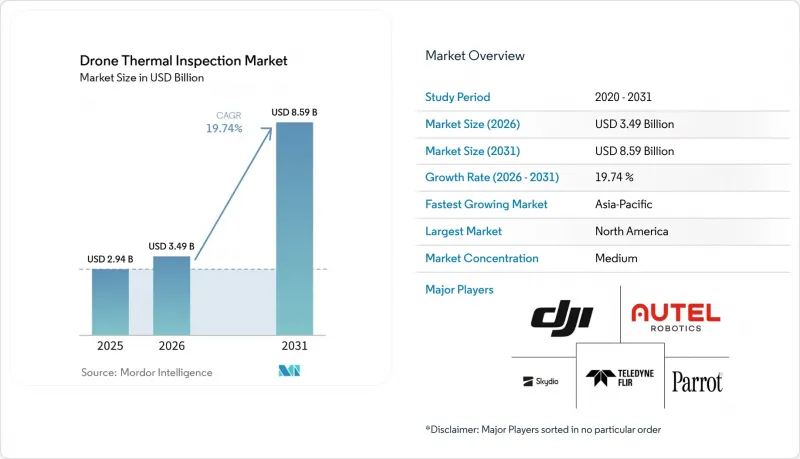
According to Mordor Intelligence, the drone thermal inspection market size was valued at USD 2.94 billion in 2025 and estimated to expand from USD 3.49 billion in 2026 to reach USD 8.59 billion by 2031, at a CAGR of 19.74% during the forecast period (2026-2031).
Global Drone Thermal Inspection Market Trends and Insights
Aging Power and Renewable Energy Infrastructure
Electricity networks built from the 1950s through the 1980s require more frequent condition checks as aging components remain in service. Karnataka Power Transmission Corporation Limited used thermal-imaging drones across more than 3,370 km of high-voltage transmission lines in 2025 and identified more than 150,000 technical defects, while reported transmission-related outages fell by 85%. The drone thermal inspection market gains from this requirement because aerial thermal imaging can inspect conductors, connections, substations, and related equipment without routine manual access. The International Energy Agency reported record global renewable capacity additions in 2023 and 2024, adding a larger installed asset base that requires inspection and maintenance. Drone-based thermal work can provide repeatable visual records for maintenance, insurance, and warranty requirements across dispersed sites. It also helps utilities compare new findings with earlier observations and direct field teams toward assets with repeated temperature differences or visible anomalies.
Expansion of Predictive Maintenance Programs
Utilities, oil and gas operators, and industrial facilities are shifting from fixed inspection schedules toward maintenance based on asset condition. AEP Ohio piloted drone inspections in 2025 across 4% of its distribution system and found more than 150 Tier 1 issues, including thermal anomalies detected by infrared sensors. Repeated flights create a condition history that helps maintenance teams compare the same assets over time. The drone thermal inspection market benefits when these records are incorporated into reliability programs rather than as a separate visual survey. Connected mission planning, data processing, and work-order workflows can reduce the time between a finding and a repair decision. Service providers can support this model with pilots, analysts, reporting processes, and recurring inspections for asset owners that do not want to build every capability internally.
Fragmented Airspace and BVLOS Approvals
National rules and local authorization practices still limit the scale of long-range drone operations because approval for one route may not apply to nearby infrastructure. The FAA's proposed framework indicates continued regulatory work, but operations remain subject to existing requirements until a final rule takes effect. This creates uncertainty for firms that need predictable access to long transmission or pipeline corridors and can delay fleet investment. The drone thermal inspection market is affected because aircraft designed for extended routes may not be used to their full technical capacity. Providers must also prepare different procedures across jurisdictions, which extend planning and recovery periods for equipment and training costs. Until approval becomes more stable, short-range and site-based operations are likely to remain the more accessible inspection models.
Other drivers and restraints analyzed in the detailed report include:
- BVLOS Regulatory Normalization
- AI-Enabled Thermal Anomaly Detection
- Thermal Data Interpretation and Calibration Requirements
For complete list of drivers and restraints, kindly check the Table Of Contents.
Segment Analysis
Multirotor drones commanded 58.47% of the drone thermal inspection market revenue in 2025 because they can operate around substations, rooftop solar arrays, industrial facilities, and confined spaces. Their ability to take off vertically and hover near a target makes close inspection of individual components possible. Operators can use them where precise positioning is more important than maximum distance. Their compact design also supports work in places with limited launch space. Compatible radiometric payloads have helped establish these aircraft in routine utility and commercial programs. Fixed-wing drones serve a more focused role where corridor speed and endurance are central to the inspection task. Their inability to hover limits the time available to inspect a single component from several positions. The drone thermal inspection industry most often uses fixed-wing systems when the asset route is long and the inspection objective is broad coverage.
Hybrid VTOL platforms are projected to expand at a 22.63% CAGR through 2031 as operators seek longer range without sacrificing vertical takeoff capability. These aircraft can support inspections of transmission, pipelines, railways, and other linear assets that extend beyond a single site. The FIXAR 007 NG supports flight times exceeding 59 minutes with a thermal payload and distances up to 60 km in a single sortie. This performance illustrates why hybrid aircraft are relevant where multirotor battery limits interrupt corridor work. The drone thermal inspection market can use hybrid VTOL systems more widely when operating approvals permit consistent long-distance routes. Drone-in-a-box systems can also extend the usefulness of multirotors at fixed sites by enabling scheduled flights and recharging. Product selection will continue to depend on the asset layout, the required dwell time, and the operating permissions available to the provider.
Radiometric thermal payloads accounted for 52.63% of the drone thermal inspection market revenue in 2025 because they record temperature information for each pixel. This capability supports inspection records that require more than a visible contrast between hot and cold areas. Operators can use radiometric data to review the severity and location of a possible anomaly. The data is relevant for solar, electrical, and industrial inspections that require documented findings. These payloads are commonly used in inspection programs that require defensible thermal records for maintenance, insurance, or warranty review. Non-radiometric payloads remain relevant for cost-sensitive work that focuses on identifying visible heat differences. Their use is more limited when the operator needs absolute temperature information and controlled reporting conditions. The size of the drone thermal inspection market for radiometric payloads underscores the importance of documented inspection quality in asset-intensive operations.
Multisensor thermal payloads are projected to advance at a 22.87% CAGR through 2031. They combine radiometric thermal sensing, optical zoom, and laser rangefinding in a single gimbal. This configuration can reduce the need to fly separate missions for thermal and visual documentation. An inspection team can view a potential thermal issue and collect contextual visual evidence in the same flight. Larger multirotor and hybrid VTOL aircraft can carry these payloads more easily as their capacity improves. Teledyne FLIR's focus on uncooled thermal imaging under the US Army DUTCH initiative underscores continued work on size, weight, power, and cost considerations for thermal systems. The drone thermal inspection industry can benefit from payload suppliers that offer modules and software compatible with multiple airframe platforms. This structure allows operators to select an aircraft-payload combination that fits each inspection setting.
Complete Report Scope:
- By Product Type
- Multirotor Drones
- Fixed-Wing Drones
- Hybrid VTOL Drones
- By Thermal Payload Type
- Radiometric Thermal Payloads
- Non-Radiometric Thermal Payloads
- Multisensor Thermal Payloads
- By Range / Operating Distance
- Short-Range / VLOS
- Medium-Range / Extended VLOS
- Long-Range / BVLOS
- By End-User Industry
- Electric Utilities
- Renewable-Energy Operators
- Oil and Gas Companies
- Industrial Manufacturers
- Construction and Real-Estate Companies
- Government and Emergency Services
- Inspection-Service Companies
- Other End-User Industries
- By Geography
- North America
- United States
- Canada
- Mexico
- South America
- Brazil
- Argentina
- Rest of South America
- Europe
- Germany
- United Kingdom
- France
- Italy
- Spain
- Rest of Europe
- Asia-Pacific
- China
- Japan
- India
- South Korea
- ASEAN
- Rest of Asia-Pacific
- Middle East and Africa
- Middle East
- Saudi Arabia
- United Arab Emirates
- Turkey
- Rest of the Middle East
- Africa
- South Africa
- Nigeria
- Rest of Africa
- Middle East
- North America
Geography Analysis
North America accounted for 34.91% of the global drone thermal inspection market revenue in 2025. The region has a large utility customer base, a developed commercial drone services sector, and broad demand for grid and industrial asset inspections. The proposed FAA BVLOS framework can expand the operating area available to approved long-range inspection providers. North American utilities can use thermal drone programs for transmission networks, distribution systems, substations, and high fire-risk areas. Canada adds demand through established utility inspection activity and drone testing conditions. Mexico provides opportunities as power infrastructure expands and service providers seek additional customers. The drone thermal inspection market share in the region reflects its established utility adoption and the availability of specialized service providers.
Asia-Pacific is projected to expand at a 22.46% CAGR through 2031, making it the fastest-growing regional area. China's grid inspection programs support demand across ultra-high-voltage transmission, urban substations, and distribution networks. DJI Enterprise won State Grid Corporation of China's first-batch 2026 drone inspection procurement at a bid of CNY 1.83 billion (USD 250 million), covering work across 26 provinces. India also has a large and aging transmission network that requires condition monitoring. Karnataka Power Transmission Corporation Limited's 2025 deployment demonstrates the operational potential of thermal drone surveys for long-line networks. Japan and South Korea have industrial asset bases capable of supporting inspection demand. Southeast Asian infrastructure development can provide further opportunities as drone rules and operating practices mature.
Europe benefits from established approaches to risk assessment for drone operations and from asset-integrity requirements in the energy sector. National Grid's centralized autonomous aerial inspection activity in England and Wales demonstrates the use of BVLOS operations for transmission infrastructure. Germany, the United Kingdom, and France have demand linked to offshore wind, aging gas networks, and energy-sector maintenance requirements. DRONE VOLT and SKIPPER NDT signed a 2026 collaboration agreement to integrate AI, geospatial analysis, and electromagnetic detection into drone platforms for pipeline and critical infrastructure inspection. South America remains at an earlier stage, although Brazil's offshore oil and gas activities and Argentina's renewable base can create demand. The Middle East and Africa have potential in utility and oil and gas maintenance, as well as photovoltaic inspection associated with large renewable programs. The drone thermal inspection market will develop at different speeds across these regions because regulatory access, service capacity, and asset investment differ by country.
- DJI Technology Co., Ltd.
- Skydio, Inc.
- Parrot Drones SAS
- Autel Robotics Co., Ltd.
- Teledyne FLIR LLC
- Workswell s.r.o.
- Percepto Ltd.
- Flyability SA
- Voliro Airborne Robotics AG
- Terra Drone Corporation
- DRONE VOLT S.A.
- Quantum-Systems GmbH
- Delair SAS
- JOUAV Automation Technology Co., Ltd.
- Wingtra AG
- AgEagle Aerial Systems Inc.
- Inspired Flight Technologies Inc.
- Watts Innovations, Inc.
- Acecore Technologies B.V.
- SmartDrones sp. z o.o.
- Aerialtronics DV B.V.
- Harris Aerial, LLC
Additional Benefits:
- The market estimate (ME) sheet in Excel format
- 3 months of analyst support
TABLE OF CONTENTS
1 INTRODUCTION
- 1.1 Study Assumptions and Market Definition
- 1.2 Scope of the Study
2 RESEARCH METHODOLOGY
3 EXECUTIVE SUMMARY
4 MARKET LANDSCAPE
- 4.1 Market Overview
- 4.2 Market Drivers
- 4.2.1 Aging Power and Renewable-Energy Infrastructure
- 4.2.2 Expansion of Predictive Maintenance Programs
- 4.2.3 BVLOS Regulatory Normalization
- 4.2.4 AI-Enabled Thermal Anomaly Detection
- 4.2.5 Thermal Inspection Demand After Extreme-Weather Events
- 4.2.6 Insurance and Compliance-Led Thermographic Documentation
- 4.3 Market Restraints
- 4.3.1 Fragmented Airspace and BVLOS Approvals
- 4.3.2 Thermal Data Interpretation and Calibration Requirements
- 4.3.3 Battery-Endurance Limits for Radiometric Payloads
- 4.3.4 Cybersecurity and Critical-Infrastructure Data Restrictions
- 4.4 Impact of Macroeconomic Factors on the Market
- 4.5 Industry Supply-Chain Analysis
- 4.6 Technology Outlook
- 4.7 Regulatory Landscape
- 4.8 Porter's Five Forces Analysis
- 4.8.1 Threat of New Entrants
- 4.8.2 Bargaining Power of Suppliers
- 4.8.3 Bargaining Power of Buyers
- 4.8.4 Threat of Substitutes
- 4.8.5 Intensity of Competitive Rivalry
5 MARKET SIZE AND GROWTH FORECASTS (VALUE)
- 5.1 By Product Type
- 5.1.1 Multirotor Drones
- 5.1.2 Fixed-Wing Drones
- 5.1.3 Hybrid VTOL Drones
- 5.2 By Thermal Payload Type
- 5.2.1 Radiometric Thermal Payloads
- 5.2.2 Non-Radiometric Thermal Payloads
- 5.2.3 Multisensor Thermal Payloads
- 5.3 By Range / Operating Distance
- 5.3.1 Short-Range / VLOS
- 5.3.2 Medium-Range / Extended VLOS
- 5.3.3 Long-Range / BVLOS
- 5.4 By End-User Industry
- 5.4.1 Electric Utilities
- 5.4.2 Renewable-Energy Operators
- 5.4.3 Oil and Gas Companies
- 5.4.4 Industrial Manufacturers
- 5.4.5 Construction and Real-Estate Companies
- 5.4.6 Government and Emergency Services
- 5.4.7 Inspection-Service Companies
- 5.4.8 Other End-User Industries
- 5.5 By Geography
- 5.5.1 North America
- 5.5.1.1 United States
- 5.5.1.2 Canada
- 5.5.1.3 Mexico
- 5.5.2 South America
- 5.5.2.1 Brazil
- 5.5.2.2 Argentina
- 5.5.2.3 Rest of South America
- 5.5.3 Europe
- 5.5.3.1 Germany
- 5.5.3.2 United Kingdom
- 5.5.3.3 France
- 5.5.3.4 Italy
- 5.5.3.5 Spain
- 5.5.3.6 Rest of Europe
- 5.5.4 Asia-Pacific
- 5.5.4.1 China
- 5.5.4.2 Japan
- 5.5.4.3 India
- 5.5.4.4 South Korea
- 5.5.4.5 ASEAN
- 5.5.4.6 Rest of Asia-Pacific
- 5.5.5 Middle East and Africa
- 5.5.5.1 Middle East
- 5.5.5.1.1 Saudi Arabia
- 5.5.5.1.2 United Arab Emirates
- 5.5.5.1.3 Turkey
- 5.5.5.1.4 Rest of the Middle East
- 5.5.5.2 Africa
- 5.5.5.2.1 South Africa
- 5.5.5.2.2 Nigeria
- 5.5.5.2.3 Rest of Africa
- 5.5.5.1 Middle East
- 5.5.1 North America
6 COMPETITIVE LANDSCAPE
- 6.1 Market Concentration
- 6.2 Strategic Moves
- 6.3 Market Share Analysis
- 6.4 Company Profiles (includes Global Level Overview, Market Level Overview, Core Segments, Financials as available, Strategic Information, Market Rank/Share, Products and Services, Recent Developments)
- 6.4.1 DJI Technology Co., Ltd.
- 6.4.2 Skydio, Inc.
- 6.4.3 Parrot Drones SAS
- 6.4.4 Autel Robotics Co., Ltd.
- 6.4.5 Teledyne FLIR LLC
- 6.4.6 Workswell s.r.o.
- 6.4.7 Percepto Ltd.
- 6.4.8 Flyability SA
- 6.4.9 Voliro Airborne Robotics AG
- 6.4.10 Terra Drone Corporation
- 6.4.11 DRONE VOLT S.A.
- 6.4.12 Quantum-Systems GmbH
- 6.4.13 Delair SAS
- 6.4.14 JOUAV Automation Technology Co., Ltd.
- 6.4.15 Wingtra AG
- 6.4.16 AgEagle Aerial Systems Inc.
- 6.4.17 Inspired Flight Technologies Inc.
- 6.4.18 Watts Innovations, Inc.
- 6.4.19 Acecore Technologies B.V.
- 6.4.20 SmartDrones sp. z o.o.
- 6.4.21 Aerialtronics DV B.V.
- 6.4.22 Harris Aerial, LLC
7 MARKET OPPORTUNITIES AND FUTURE OUTLOOK
- 7.1 White-Space and Unmet-Need Assessment

