PUBLISHER: Mordor Intelligence | PRODUCT CODE: 2155607

PUBLISHER: Mordor Intelligence | PRODUCT CODE: 2155607
Nano Therapy - Market Share Analysis, Industry Trends & Statistics, Growth Forecasts (2026 - 2031)
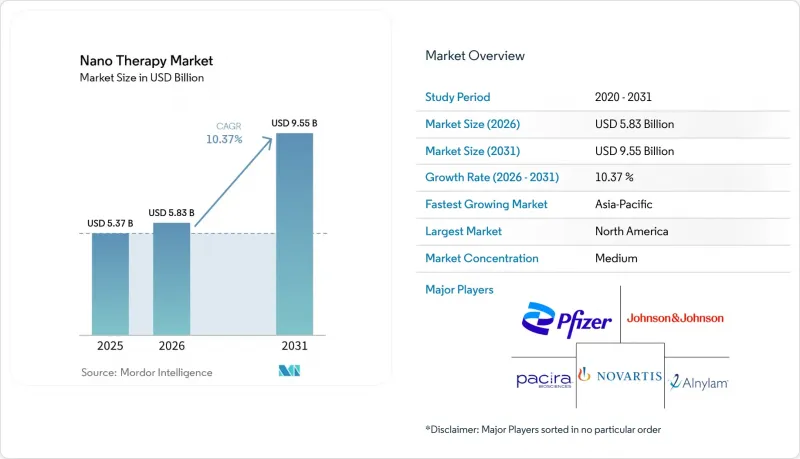
According to Mordor Intelligence, the nano therapy market is expected to grow from USD 5.37 billion in 2025 to USD 5.83 billion in 2026 to reach USD 9.55 billion by 2031, at a CAGR of 10.4% during the forecast period (2026-2031).
Global Nano Therapy Market Trends and Insights
Rising Chronic Disease and Cancer Burden
The nano therapy market benefits from persistent demand for treatments that can improve drug delivery in cancer and chronic disease care. The World Health Organization recorded 20.6 million new cancer diagnoses in 2024 and expects annual cases to reach 35 million by 2050. Only 12 countries were on track to reduce premature cancer mortality by 33% by 2030, while 48 countries recorded rising mortality rates. These patterns keep attention on treatments that may improve how therapeutic payloads reach diseased tissue. China reported more than 4.8 million new cancer cases annually, which supports the region's growing need for oncology treatment capacity. Aging populations also increase the number of people living with cardiometabolic and neurological conditions, creating additional settings for nanoparticle-enabled delivery.
Growth of RNA, mRNA, Gene-Editing, and Nucleic Acid Therapeutics
The nano therapy market is gaining support from nucleic acid medicines that need delivery systems to protect and transport their payloads. Alnylam expects USD 4 billion in combined net product revenues in 2026, representing 71% growth over 2025, and its RNA interference franchise is a major commercial reference point for this field. In October 2025, Arrowhead Pharmaceuticals and Novartis closed a license and collaboration agreement for ARO-SNCA, an siRNA treatment candidate for Parkinson's disease that uses Arrowhead's TRiM delivery platform.The agreement included USD 200 million upfront and potential milestone payments of up to USD 2 billion. These arrangements show that large drug companies value delivery platforms alongside individual drug programs. They also give the nano therapy market a larger base of potential use cases across genetic, metabolic, and neurological diseases.
Complex Regulatory and Nanospecific Characterization Requirements
The nano therapy market faces regulatory uncertainty because nanotechnology-based medicines are generally assessed within existing pharmaceutical and biologic frameworks. A 2025 review of European and U.S. pathways found that nanotechnology-enabled products face differences in regulatory expectations across jurisdictions. Developers must characterize particle size, composition, stability, release behavior, and interactions with biological systems. These requirements can make development plans more detailed than plans for conventional small-molecule products. Case-by-case discussions can also slow advancement for complex polymer-based formulations and first-in-class products.
Other drivers and restraints analyzed in the detailed report include:
- Expansion of Targeted and Controlled Drug Delivery
- Public and Private Nanomedicine R&D Investment
- High Development, Manufacturing, and Quality-Control Costs
For complete list of drivers and restraints, kindly check the Table Of Contents.
Segment Analysis
Nanoparticle-based therapy held 43.18% of the nano therapy market share in 2025, supported by its ability to carry small molecules, biologics, and nucleic acids within tailored delivery architectures. The category benefits from an established base of approved products and familiar administration practices in clinical settings. Liposomal therapy is forecasted to grow at 10.54% CAGR from 2026 to 2031 as RNA-based programs and liposomal combination regimens progress. Lipid nanoparticle systems are widely used in the clinical development of mRNA delivery approaches for cancer, autoimmune conditions, and genetic diseases. The nano therapy market therefore includes both established liposomal products and newer lipid nanoparticle platforms.
Liposomal therapy has a relatively mature clinical and manufacturing base compared with newer nanoparticle classes. Its adoption is linked to the practical need to improve drug solubility, circulation time, and tissue exposure for selected treatments. Polymeric nanoparticle therapy serves different needs, including oral delivery and controlled release applications. Nanocrystal therapy addresses solubility constraints for medicines with poor aqueous dissolution.
Oncology held 39.26% of the nano therapy market share in 2025, reflecting the long history of liposomal and nanoparticulate development in cancer treatment. Cancer remains an important testing ground because treatment benefit can depend on drug exposure, toxicity control, and tumor tissue access. Cardiovascular diseases are expected to grow at an 11.13% CAGR from 2026 to 2031. The higher growth rate reflects efforts to apply RNA interference and lipid nanoparticle systems to cardiac and vascular targets.
Cardiovascular development may broaden the demand base for targeted nucleic acid delivery. The candidate is designed to silence PCSK9 and APOC3, two targets relevant to atherosclerotic cardiovascular disease. Neurological disorders are also developing as a relevant application area through siRNA programs and research portfolios focused on neurological diseases. Infectious diseases provide further use cases where nucleic acid and nanoparticle technologies can be relevant. Regenerative medicine remains a longer-term area for polymeric scaffold and exosome delivery approaches. Together, these applications make the nano therapy market less dependent on oncology alone.
Complete Report Scope:
- By Therapy Type
- Nanoparticle-Based Therapy
- Liposomal Therapy
- Polymeric Nanoparticle Therapy
- Nanocrystal Therapy
- Other Therapy Types
- By Application
- Oncology
- Cardiovascular Diseases
- Neurological Disorders
- Infectious Diseases
- Regenerative Medicine
- Other Applications
- By Nanomaterial Type
- Lipid-Based Nanoparticles
- Polymeric Nanoparticles
- Inorganic Nanoparticles
- Gold Nanoparticles
- Magnetic Nanoparticles
- Other Nanomaterial Types
- By Route of Administration
- Intravenous
- Oral
- Transdermal
- Other Route of Administrations
- By Distribution Channel
- Hospital Pharmacies
- Retail Pharmacies
- Online Pharmacies
- By Geography
- North America
- United States
- Canada
- Mexico
- Europe
- Germany
- United Kingdom
- France
- Italy
- Spain
- Rest of Europe
- Asia-Pacific
- China
- Japan
- India
- Australia
- South Korea
- Rest of Asia-Pacific
- Middle East and Africa
- GCC
- South Africa
- Rest of Middle East and Africa
- South America
- Brazil
- Argentina
- Rest of South America
- North America
Geography Analysis
North America held 46.73% of the nano therapy market share in 2025, supported by a concentration of approved liposomal and lipid nanoparticle therapeutics, clinical research activity, and RNA interference developers. The United States remains the region's main commercial center because of its large pharmaceutical base and established clinical trial infrastructure. Regulatory experience with nanotechnology-enabled products has also helped sponsors pursue market access under existing drug and biologic frameworks. A review of U.S. and European pathways highlighted the importance of clear product characterization and regulatory expectations for nanotechnology-enabled health products. Canada is developing domestic biomanufacturing capabilities that can support regional supply resilience. Mexico contributes mainly through hospital demand for established oncology products and expanding access to newer therapies.
Asia-Pacific is projected to grow at a 13.35% CAGR from 2026 to 2031, making it the fastest-growing regional part of the nano therapy market. The region has substantial cancer treatment needs and expanding public and private investment in research and manufacturing. China's cancer burden reinforces the need for oncology capacity and drug development activity. Japan has issued guidance for siRNA-loaded nanoformulations and liposomal products, helping sponsors identify relevant development considerations. China, Japan, India, and South Korea each add different strengths through patient scale, regulation, biotechnology investment, and formulation capability.
Europe holds the second-largest revenue share globally, with Germany, the United Kingdom, and France serving as major contributors. The region combines an established pharmaceutical sector with academic and industrial research in nanomedicine. European developers work within a regulatory environment that is considering more specific treatment of nanotechnology-based products. Germany supports both product research and manufacturing-scale work in lipid-based systems. The Middle East and Africa, along with South America, remain smaller but developing end markets. Gulf countries are expanding oncology infrastructure and hospital procurement of nanoformulated medicines. Brazil and Argentina are adopting nanoformulated oncology generics as patents on earlier liposomal products expire. These regions can widen access to established nanoparticle therapies at lower cost points.
- Abbvie
- Acuitas Therapeutics, Inc.
- Alnylam Pharmaceuticals
- Arrowhead Pharmaceuticals
- Cristal Therapeutics B.V.
- CytImmune Sciences, Inc.
- Roche
- Johnson & Johnson
- Merck
- Nanobiotix S.A.
- Nanospectra Biosciences, Inc.
- NanoVation Therapeutics, Inc.
- Novartis
- Pacira BioSciences
- Pfizer
- Sanofi
- Selecta Biosciences, Inc.
- Sirnaomics
- Starpharma Holdings
- Taiwan Liposome Company, Ltd.
Additional Benefits:
- The market estimate (ME) sheet in Excel format
- 3 months of analyst support
TABLE OF CONTENTS
1 Introduction
- 1.1 Study Assumptions and Market Definition
- 1.2 Scope of the Study
2 Research Methodology
3 Executive Summary
4 Market Landscape
- 4.1 Market Overview
- 4.2 Market Drivers
- 4.2.1 Rising Chronic Disease and Cancer Burden
- 4.2.2 Expansion of Targeted and Controlled Drug Delivery
- 4.2.3 Growth of RNA, mRNA, Gene-Editing, and Nucleic Acid Therapeutics
- 4.2.4 Public and Private Nanomedicine R&D Investment
- 4.2.5 Extrahepatic Delivery Platforms Moving Beyond Liver Tropism
- 4.2.6 Formulation and Manufacturing Platforms Becoming Partnerable Infrastructure
- 4.3 Market Restraints
- 4.3.1 Complex Regulatory and Nanospecific Characterization Requirements
- 4.3.2 High Development, Manufacturing, and Quality-Control Costs
- 4.3.3 Translational Fragility of Passive Tumor Targeting and the EPR Effect
- 4.3.4 Dependence on a Narrow Set of Qualified Lipid, Microfluidic, and CDMO Inputs
- 4.4 Supply/Value Chain Analysis
- 4.5 Regulatory Landscape
- 4.6 Technological Outlook
- 4.7 Porter's Five Forces Analysis
- 4.7.1 Threat of New Entrants
- 4.7.2 Bargaining Power of Suppliers
- 4.7.3 Bargaining Power of Buyers
- 4.7.4 Threat of Substitutes
- 4.7.5 Competitive Rivalry
5 Market Size & Growth Forecasts (Value, USD)
- 5.1 By Therapy Type
- 5.1.1 Nanoparticle-Based Therapy
- 5.1.2 Liposomal Therapy
- 5.1.3 Polymeric Nanoparticle Therapy
- 5.1.4 Nanocrystal Therapy
- 5.1.5 Other Therapy Types
- 5.2 By Application
- 5.2.1 Oncology
- 5.2.2 Cardiovascular Diseases
- 5.2.3 Neurological Disorders
- 5.2.4 Infectious Diseases
- 5.2.5 Regenerative Medicine
- 5.2.6 Other Applications
- 5.3 By Nanomaterial Type
- 5.3.1 Lipid-Based Nanoparticles
- 5.3.2 Polymeric Nanoparticles
- 5.3.3 Inorganic Nanoparticles
- 5.3.4 Gold Nanoparticles
- 5.3.5 Magnetic Nanoparticles
- 5.3.6 Other Nanomaterial Types
- 5.4 By Route of Administration
- 5.4.1 Intravenous
- 5.4.2 Oral
- 5.4.3 Transdermal
- 5.4.4 Other Route of Administrations
- 5.5 By Distribution Channel
- 5.5.1 Hospital Pharmacies
- 5.5.2 Retail Pharmacies
- 5.5.3 Online Pharmacies
- 5.6 By Geography
- 5.6.1 North America
- 5.6.1.1 United States
- 5.6.1.2 Canada
- 5.6.1.3 Mexico
- 5.6.2 Europe
- 5.6.2.1 Germany
- 5.6.2.2 United Kingdom
- 5.6.2.3 France
- 5.6.2.4 Italy
- 5.6.2.5 Spain
- 5.6.2.6 Rest of Europe
- 5.6.3 Asia-Pacific
- 5.6.3.1 China
- 5.6.3.2 Japan
- 5.6.3.3 India
- 5.6.3.4 Australia
- 5.6.3.5 South Korea
- 5.6.3.6 Rest of Asia-Pacific
- 5.6.4 Middle East and Africa
- 5.6.4.1 GCC
- 5.6.4.2 South Africa
- 5.6.4.3 Rest of Middle East and Africa
- 5.6.5 South America
- 5.6.5.1 Brazil
- 5.6.5.2 Argentina
- 5.6.5.3 Rest of South America
- 5.6.1 North America
6 Competitive Landscape
- 6.1 Market Concentration
- 6.2 Market Share Analysis
- 6.3 Company Profiles (includes Global level Overview, Market level overview, Core Segments, Financials as available, Strategic Information, Market Rank/Share for key companies, Products & Services, Recent Developments)
- 6.3.1 AbbVie Inc.
- 6.3.2 Acuitas Therapeutics, Inc.
- 6.3.3 Alnylam Pharmaceuticals, Inc.
- 6.3.4 Arrowhead Pharmaceuticals, Inc.
- 6.3.5 Cristal Therapeutics B.V.
- 6.3.6 CytImmune Sciences, Inc.
- 6.3.7 F. Hoffmann-La Roche Ltd
- 6.3.8 Johnson & Johnson
- 6.3.9 Merck & Co., Inc.
- 6.3.10 Nanobiotix S.A.
- 6.3.11 Nanospectra Biosciences, Inc.
- 6.3.12 NanoVation Therapeutics, Inc.
- 6.3.13 Novartis AG
- 6.3.14 Pacira BioSciences, Inc.
- 6.3.15 Pfizer Inc.
- 6.3.16 Sanofi S.A.
- 6.3.17 Selecta Biosciences, Inc.
- 6.3.18 Sirnaomics, Inc.
- 6.3.19 Starpharma Holdings Limited
- 6.3.20 Taiwan Liposome Company, Ltd.
7 Market Opportunities & Future Outlook
- 7.1 White-space & Unmet-need Assessment

