PUBLISHER: Mordor Intelligence | PRODUCT CODE: 2155651

PUBLISHER: Mordor Intelligence | PRODUCT CODE: 2155651
Singapore Personal Accident Insurance - Market Share Analysis, Industry Trends & Statistics, Growth Forecasts (2026 - 2031)
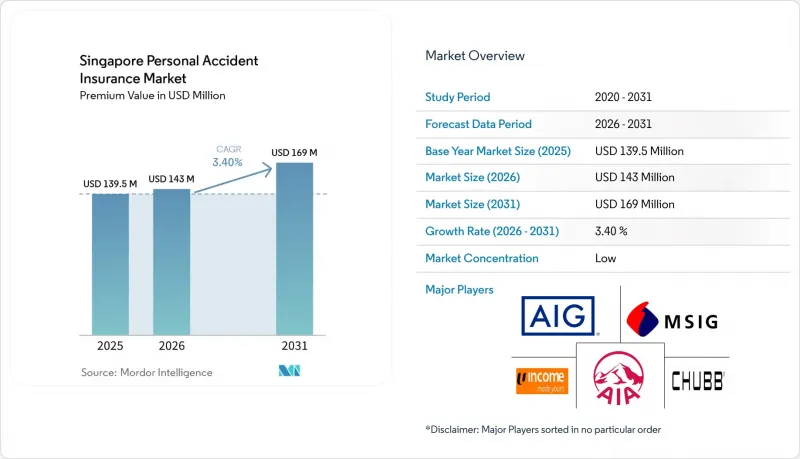
According to Mordor Intelligence, the Singapore personal accident insurance market size was valued at USD 139.5 million in 2025 and is estimated to grow from USD 143.0 million in 2026 to reach USD 169.0 million by 2031, at a CAGR of 3.4% during the forecast period (2026-2031).
Singapore Personal Accident Insurance Market Trends and Insights
Rising Healthcare and Post-Accident Rehabilitation Costs
Rehabilitation costs widen the gap between a medical event and a household's full recovery needs. Ministry of Health benchmarks showed subsidized Ward C rehabilitation bills ranging from USD 1,551 to USD 6,882 in Singapore. Private ward rehabilitation bills ranged from USD 19,497 to USD 26,010 before insurance payouts. Serious injuries also create inpatient, surgical, and follow-up expenses that can exceed the immediate hospital stay. The Singapore personal accident insurance market benefits when policies reimburse rehabilitation and support income during recovery. Products that combine a capital payment with practical recovery support can address costs that public schemes do not fully cover.
Growing Protection Needs Among Singapore's Ageing but Active Population
Singapore reached super-aged status in 2025, with 20.7% of its population aged 65 or older. The share had risen from 13.1% in 2005, which increased attention to disability and recovery needs. Senior pedestrians represented 75% of pedestrian fatalities in 2025, according to the Singapore Police Force. Accidents involving elderly pedestrians rose 21.7% year over year to 247 cases during the same year. These patterns support policies with recovery benefits for older adults who remain active outside their homes. The Singapore personal accident insurance market can also serve working adults who want clearer financial protection for disability and care needs.
High Existing Insurance Coverage and Perceived Product Duplication
High insurance ownership narrows the pool of consumers seeking an additional standalone policy. Employer Group PA represented 46.1% of the Singapore personal accident insurance market size in 2025, so many workers received accident coverage through their employment. This arrangement can limit active consideration of additional personal protection. The Singapore personal accident insurance market must show where a policy supplements, rather than repeats, health or employer benefits. Consumers may view accident cover as a standard workplace benefit unless they understand recovery costs and income disruption. Clear differences in rehabilitation reimbursement, household support, and benefit portability can make standalone coverage easier to assess.
Other drivers and restraints analyzed in the detailed report include:
- High Travel, Commuting and Everyday Mobility Exposure
- Digital-First Distribution and Embedded Insurance Expansion
- Consumer Preference for Comprehensive Health and Integrated Protection Products
For complete list of drivers and restraints, kindly check the Table Of Contents.
Segment Analysis
Employer Group PA held 46.1% of the Singapore personal accident insurance market share in 2025. Workplace procurement gives employers a practical way to provide employees with consistent accident benefits. Standardized policy terms can also simplify administration across large employee groups. Employer obligations and group purchasing practices keep this form central to the Singapore personal accident insurance market. Affinity, Association and Scheme PA is forecast to grow at a 5.1% CAGR from 2026 to 2031. The Platform Workers Act took effect on January 1, 2025, and made work injury compensation insurance mandatory for covered platform operators.
CPF contribution rates for platform operators increased from 3.5% to 7% on January 1, 2026. This change reinforces the importance of compliant protection arrangements for riders and drivers. Individual and Family PA remains a route for households seeking protection across several family members. Its progress is limited by existing health and employer coverage. Singlife's GigConnect program combines Group Personal Accident and Group Prolonged Medical Leave benefits through gig-platform partnerships. Such arrangements allow consumers to enroll through the platform relationship while receiving group-style benefits. This shifts attention toward affinity schemes for self-employed and nontraditional workers. The Singapore personal accident insurance industry is therefore balancing established employer contracts with newer partner-led coverage models.
Complete Report Scope:
- By Issuance Form
- Individual and Family PA
- Employer Group PA
- Affinity, Association and Scheme PA
- By Distribution Channel
- Tied Agents and Financial Advisers
- Insurance Brokers
- Bancassurance
- Direct Insurer Channels
- Embedded and Partner Enrolment
- By Lead Benefit Architecture
- Capital-Benefit PA
- Recovery-Benefit PA
- Blended Practice PA
List of Companies Covered in this Report:
- MSIG Insurance (Singapore) Pte. Ltd.
- Income Insurance Limited
- AIG Asia Pacific Insurance Pte. Ltd.
- Chubb Insurance Singapore Limited
- AIA Singapore Private Limited
- Prudential Assurance Company Singapore (Pte) Limited
- FWD Singapore Pte. Ltd.
- Singapore Life Ltd. (Singlife)
- Sompo Insurance Singapore Pte. Ltd.
- Tokio Marine Insurance Singapore Ltd.
- QBE Insurance (Singapore) Pte. Ltd.
- HSBC Life (Singapore) Pte. Ltd.
- Manulife (Singapore) Pte. Ltd.
- China Taiping Insurance (Singapore) Pte. Ltd.
- United Overseas Insurance Limited (UOI)
- EQ Insurance Company Limited
- Liberty Insurance Pte. Ltd.
- Great Eastern General Insurance Limited
- HL Assurance Pte. Ltd.
Additional Benefits:
- The market estimate (ME) sheet in Excel format
- 3 months of analyst support
TABLE OF CONTENTS
1 INTRODUCTION
- 1.1 Study Assumptions and Market Definition
- 1.2 Scope of the Study
2 RESEARCH METHODOLOGY
3 EXECUTIVE SUMMARY
4 MARKET LANDSCAPE
- 4.1 Market Overview
- 4.2 Market Drivers
- 4.2.1 Rising Healthcare and Post-Accident Rehabilitation Costs
- 4.2.2 Growing Protection Needs Among Singapore's Ageing but Active Population
- 4.2.3 High Travel, Commuting and Everyday Mobility Exposure
- 4.2.4 Digital-First Distribution and Embedded Insurance Expansion
- 4.2.5 Growth in Gig Economy and Non-Traditional Employment
- 4.2.6 Increasing Demand for Flexible and Lifestyle-Oriented Accident Protection
- 4.3 Market Restraints
- 4.3.1 High Existing Insurance Coverage and Perceived Product Duplication
- 4.3.2 Consumer Preference for Comprehensive Health and Integrated Protection Products
- 4.3.3 Limited Consumer Understanding of Personal Accident Policy Coverage and Exclusions
- 4.3.4 Premium Sensitivity and Increasing Consumer Scrutiny of Insurance Value
- 4.4 Value Chain Analysis
- 4.4.1 Product Development, Pricing and Underwriting
- 4.4.2 Multi-Channel Distribution and Digital Customer Acquisition
- 4.4.3 Claims Management, Customer Servicing and Benefit Settlement
- 4.5 Regulatory Landscape
- 4.5.1 Monetary Authority of Singapore Licensing and Prudential Supervision
- 4.5.2 Insurance Act and Fair Dealing Requirements for Product Distribution
- 4.5.3 Data Protection and Digital Conduct Requirements Under Singapore's Regulatory Framework
- 4.6 Technological Outlook
- 4.6.1 Digital Distribution, E-KYC and End-to-End Electronic Policy Issuance
- 4.6.2 AI-Enabled Claims Assessment and Automated Claims Processing
- 4.6.3 Embedded Insurance and Ecosystem-Based Distribution Partnerships
- 4.7 Porter's Five Forces Analysis
- 4.7.1 Threat of New Entrants
- 4.7.2 Bargaining Power of Suppliers
- 4.7.3 Bargaining Power of Buyers
- 4.7.4 Threat of Substitutes
- 4.7.5 Competitive Rivalry
5 MARKET SIZE AND GROWTH FORECASTS
- 5.1 By Issuance Form
- 5.1.1 Individual and Family PA
- 5.1.2 Employer Group PA
- 5.1.3 Affinity, Association and Scheme PA
- 5.2 By Distribution Channel
- 5.2.1 Tied Agents and Financial Advisers
- 5.2.2 Insurance Brokers
- 5.2.3 Bancassurance
- 5.2.4 Direct Insurer Channels
- 5.2.5 Embedded and Partner Enrolment
- 5.3 By Lead Benefit Architecture
- 5.3.1 Capital-Benefit PA
- 5.3.2 Recovery-Benefit PA
- 5.3.3 Blended Practice PA
6 COMPETITIVE LANDSCAPE
- 6.1 Market Concentration
- 6.2 Strategic Moves
- 6.3 Market Share Analysis (Top 5-6 players)
- 6.4 Company Profiles (includes Global Level Overview, Market Level Overview, Core Segments, Financials as available, Strategic Information, Market Rank/Share, Products and Services, Recent Developments)
- 6.4.1 MSIG Insurance (Singapore) Pte. Ltd.
- 6.4.2 Income Insurance Limited
- 6.4.3 AIG Asia Pacific Insurance Pte. Ltd.
- 6.4.4 Chubb Insurance Singapore Limited
- 6.4.5 AIA Singapore Private Limited
- 6.4.6 Prudential Assurance Company Singapore (Pte) Limited
- 6.4.7 FWD Singapore Pte. Ltd.
- 6.4.8 Singapore Life Ltd. (Singlife)
- 6.4.9 Sompo Insurance Singapore Pte. Ltd.
- 6.4.10 Tokio Marine Insurance Singapore Ltd.
- 6.4.11 QBE Insurance (Singapore) Pte. Ltd.
- 6.4.12 HSBC Life (Singapore) Pte. Ltd.
- 6.4.13 Manulife (Singapore) Pte. Ltd.
- 6.4.14 China Taiping Insurance (Singapore) Pte. Ltd.
- 6.4.15 United Overseas Insurance Limited (UOI)
- 6.4.16 EQ Insurance Company Limited
- 6.4.17 Liberty Insurance Pte. Ltd.
- 6.4.18 Great Eastern General Insurance Limited
- 6.4.19 HL Assurance Pte. Ltd.
7 MARKET OPPORTUNITIES AND FUTURE OUTLOOK
- 7.1 White-Space and Unmet-Need Assessment
- 7.1.1 Flexible and Affordable Protection for Gig, Freelance and Platform Workers
- 7.1.2 Age-Appropriate Accident Protection and Recovery Support for Active Seniors
- 7.1.3 Enhanced Recovery and Rehabilitation Benefits Beyond Traditional Lump-Sum Compensation
- 7.2 Future Product and Distribution Outlook
- 7.2.1 Growth of Modular and Personalised Personal Accident Insurance Products
- 7.2.2 Expansion of Embedded and Ecosystem-Based Insurance Distribution
- 7.2.3 Increasing Automation Across Underwriting, Claims and Customer Servicing

