PUBLISHER: Mordor Intelligence | PRODUCT CODE: 2155661

PUBLISHER: Mordor Intelligence | PRODUCT CODE: 2155661
Indonesia Urban Logistics - Market Share Analysis, Industry Trends & Statistics, Growth Forecasts (2026 - 2031)
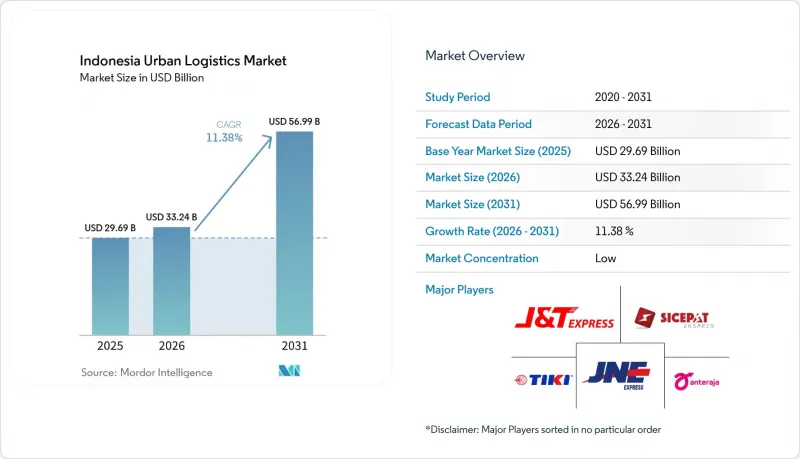
According to Mordor Intelligence, the Indonesia urban logistics market size is expected to grow from USD 29.69 billion in 2025 to USD 33.24 billion in 2026 and is forecast to reach USD 56.99 billion by 2031 at 11.38% CAGR over 2026-2031.
Indonesia Urban Logistics Market Trends and Insights
E-Commerce and Social-Commerce Parcel Growth
Indonesia's e-commerce GMV reached USD 71 billion in 2025, growing 14% year on year, sustaining its position as Southeast Asia's largest digital consumer market by GMV. Video commerce was a major growth driver, with transaction volumes increasing 90% year on year to 2.6 billion in 2025, while active sellers and online shops grew 75% to 800,000. This expansion increased demand for high-frequency, small-batch parcel movements, including same-day and instant deliveries, alongside conventional standard-delivery services. This volume supports regular parcel flows between urban sellers, fulfillment sites, and households. The concentration gives carriers in Java denser routes and stronger asset utilization than networks serving outer islands. The Indonesia urban logistics market, therefore, has room to grow through both higher activity in established corridors and gradual extension to less-served urban locations.
Faster Delivery Expectations in Dense Urban Corridors
Urban buyers increasingly expect delivery windows that fit daily routines and favor dependable service. Quick commerce data showed that deliveries completed within 11 to 30 minutes represented 52.1% of volumes in 2025. Dark stores and demand forecasting systems have helped operators achieve 85% first-attempt delivery success in Jakarta and Surabaya. These service models need inventory close to demand clusters, which raises the importance of small urban fulfillment sites. A delivery network must also manage traffic uncertainty, driver availability, and the cost of maintaining local stock. Operators that improve route reliability can build a clearer service advantage than those that compete only on the shortest stated delivery time.
Urban Congestion and Loading-Space Constraints
Jakarta's peak-hour average road speed fell to 11 km/h in 2025, limiting the number of stops that delivery fleets can complete during a shift. Congestion raises vehicle operating time and can require additional drivers or vehicles to maintain delivery commitments. The DKI Jakarta Provincial Government established a 5-hectare container truck parking facility at Terminal Tanah Merdeka with a capacity for at least 200 containers. It also waived parking fees in July and August 2026 to reduce truck queuing on Jalan Cakung-Cilincing. These steps may improve local flow, but operators still need route planning and loading access that can absorb daily traffic disruption. Higher delays favor businesses that have capital for dense facilities, routing tools, and operational buffers.
Other drivers and restraints analyzed in the detailed report include:
- Platform-Integrated Fulfillment and Delivery Networks
- Growth of MSME Digital Commerce and On-Demand Logistics
- Archipelagic Delivery Economics and Service Variability
For complete list of drivers and restraints, kindly check the Table Of Contents.
Segment Analysis
Transportation services held the largest position in the Indonesian urban logistics market, accounting for 67.04% of the market in 2025, as daily parcel movement creates a broad revenue base. E-commerce fulfillment, on-demand delivery, and intercity cargo all require regular transportation activity. Large parcel counts can sustain transport revenue even when individual shipments have limited value-added services. This service type also depends on consistent driver availability, sorting capacity, and route planning. Fulfillment services represent the fastest-growing category as sellers position inventory closer to urban buyers. The Indonesia urban logistics market size for fulfillment is supported by demand for same-day and next-day service from marketplaces and direct-to-consumer brands.
Fulfillment services represent the fastest-growing category, expanding at a CAGR of 13.30% through 2031 as sellers position inventory closer to urban buyers. Blibli's Gudang Marunda hub reduced FMCG fulfillment time by 70% and cancellation rates by 35%, showing the operating value of integrated inventory and delivery management. Warehousing and urban storage are also expanding as operators add micro-fulfillment capacity in Greater Jakarta and secondary cities. Real estate constraints are encouraging multi-story warehouse formats in high-demand locations. Reverse logistics remains smaller, but fashion and electronics returns require more inspection, sorting, and customer coordination. Value-added logistics services include packaging, labeling, and quality checks. These capabilities can help fulfillment providers meet the documentation and handling requirements of healthcare and electronics customers.
Standard delivery held the largest parcel-volume position in the Indonesia urban logistics market, accounting for 51.28% in 2025. It suits price-sensitive buyers and routes outside the limited areas where instant delivery is practical. Standard services support high shipment counts but earn less per item than faster tiers. Next-day delivery provides a middle option for consumers who want dependable service without the price of an instant option. Scheduled delivery also serves businesses and subscription models that value predictable timing. The Indonesia urban logistics market share of standard delivery is therefore supported by broad coverage and routine household demand.
Instant and same-day delivery is the fastest-growing delivery-speed category, expanding at a CAGR of 12.47% through 2031 as demand increases for faster urban fulfillment. Quick commerce networks can charge 3 to 5 times the standard tariff for immediate service. Jakarta, Surabaya, and Bandung have sufficient local fulfillment density to support sub-30-minute delivery commitments. These services require close inventory placement and accurate dispatch decisions. As hub density increases, the cost gap between same-day and next-day delivery can narrow. This could place pressure on operators that rely on a premium next-day proposition without comparable local fulfillment capacity.
Complete Report Scope:
- By Service Type
- Transportation Services
- Warehousing and Urban Storage Services
- Fulfillment Services
- Reverse Logistics Services
- Value-Added Logistics (VAL) Services
- By Delivery Speed
- Instant and Same-Day Delivery
- Next-Day Delivery
- Scheduled Delivery
- Standard Delivery
- By Customer Type
- Business-to-Business (B2B)
- Business-to-Consumer (B2C)
- Consumer-to-Consumer (C2C)
- By End-Use Industry
- E-commerce and Retail
- Food and Beverage
- Healthcare and Pharmaceuticals
- Consumer Electronics
- Fashion and Apparel
- Automotive Parts
- Industrial and Manufacturing
- Others
- By City
- Jakarta
- Bandung
- Surabaya
- Medan
- Tasikmalaya
- Yogyakarta
- Semarang
- Denpasar
- Makassar
- Rest of Cities
List of Companies Covered in this Report:
- JNE Express
- SiCepat Ekspres
- TIKI
- AnterAja
- Ninja Van
- Lion Parcel
- Paxel
- Deliveree
- Lalamove
- GoSend
- GrabExpress
- SAPX Express
- RPX Indonesia
- Indah Logistik Cargo
- IDexpress
- DHL Indonesia
- FedEx
- UPS
- SF Express Indonesia
- SPX Express
Additional Benefits:
- The market estimate (ME) sheet in Excel format
- 3 months of analyst support
TABLE OF CONTENTS
1 Introduction
- 1.1 Study Assumptions and Market Definition
- 1.2 Scope of the Study
2 Research Methodology
3 Executive Summary
4 Market Landscape
- 4.1 Market Overview and Importance of Urban Logistics
- 4.2 Market Drivers
- 4.2.1 E-commerce and Social-Commerce Parcel Growth
- 4.2.2 Faster Delivery Expectations in Dense Urban Corridors
- 4.2.3 Platform-Integrated Fulfillment and Delivery Networks
- 4.2.4 Growth of MSME Digital Commerce and On-Demand Logistics
- 4.2.5 Motorcycle Fleet Electrification Opportunity
- 4.2.6 Micro-Fulfillment Expansion into Tier-2 Cities
- 4.3 Market Restraints
- 4.3.1 Urban Congestion and Loading-Space Constraints
- 4.3.2 Archipelagic Delivery Economics and Service Variability
- 4.3.3 Insufficient Charging and Battery-Swapping Infrastructure
- 4.3.4 Courier Financing and Income Pressure During Fleet Electrification
- 4.4 Industry Regulatory Framework
- 4.5 Value Chain and Distribution Channel Architecture Analysis
- 4.6 Technology Megatrends and Structural Shifts in Urban Logistics
- 4.7 Porter's Five Forces Analysis
- 4.7.1 Threat of New Entrants
- 4.7.2 Bargaining Power of Suppliers
- 4.7.3 Bargaining Power of Buyers
- 4.7.4 Threat of Substitutes
- 4.7.5 Rivalry Among Competitors
- 4.8 Cost Structure Analysis
- 4.9 Urban Infrastructure Assessment
- 4.10 Sustainability and Green Logistics
- 4.11 Impact of Geo-Political Events on Supply Chain Shifts
5 Market Size & Growth Forecasts (Value, 2026-2031)
- 5.1 By Service Type
- 5.1.1 Transportation Services
- 5.1.2 Warehousing and Urban Storage Services
- 5.1.3 Fulfillment Services
- 5.1.4 Reverse Logistics Services
- 5.1.5 Value-Added Logistics (VAL) Services
- 5.2 By Delivery Speed
- 5.2.1 Instant and Same-Day Delivery
- 5.2.2 Next-Day Delivery
- 5.2.3 Scheduled Delivery
- 5.2.4 Standard Delivery
- 5.3 By Customer Type
- 5.3.1 Business-to-Business (B2B)
- 5.3.2 Business-to-Consumer (B2C)
- 5.3.3 Consumer-to-Consumer (C2C)
- 5.4 By End-Use Industry
- 5.4.1 E-commerce and Retail
- 5.4.2 Food and Beverage
- 5.4.3 Healthcare and Pharmaceuticals
- 5.4.4 Consumer Electronics
- 5.4.5 Fashion and Apparel
- 5.4.6 Automotive Parts
- 5.4.7 Industrial and Manufacturing
- 5.4.8 Others
- 5.5 By City
- 5.5.1 Jakarta
- 5.5.2 Bandung
- 5.5.3 Surabaya
- 5.5.4 Medan
- 5.5.5 Tasikmalaya
- 5.5.6 Yogyakarta
- 5.5.7 Semarang
- 5.5.8 Denpasar
- 5.5.9 Makassar
- 5.5.10 Rest of Cities
6 Competitive Landscape
- 6.1 Key Strategic Moves
- 6.2 Market Share Analysis
- 6.3 Company Profiles (includes Global level Overview, Market level overview, Core Segments, Financials as available, Strategic Information, Geographic/Network Coverage, Products & Services, and Recent Developments)
- 6.3.1 JNE Express
- 6.3.2 SiCepat Ekspres
- 6.3.3 TIKI
- 6.3.4 AnterAja
- 6.3.5 Ninja Van
- 6.3.6 Lion Parcel
- 6.3.7 Paxel
- 6.3.8 Deliveree
- 6.3.9 Lalamove
- 6.3.10 GoSend
- 6.3.11 GrabExpress
- 6.3.12 SAPX Express
- 6.3.13 RPX Indonesia
- 6.3.14 Indah Logistik Cargo
- 6.3.15 IDexpress
- 6.3.16 DHL Indonesia
- 6.3.17 FedEx
- 6.3.18 UPS
- 6.3.19 SF Express Indonesia
- 6.3.20 SPX Express
7 Market Opportunities & Future Outlook
- 7.1 White-space & Unmet-Need Assessment

