PUBLISHER: Mordor Intelligence | PRODUCT CODE: 2155680

PUBLISHER: Mordor Intelligence | PRODUCT CODE: 2155680
Mono Rapid Testing - Market Share Analysis, Industry Trends & Statistics, Growth Forecasts (2026 - 2031)
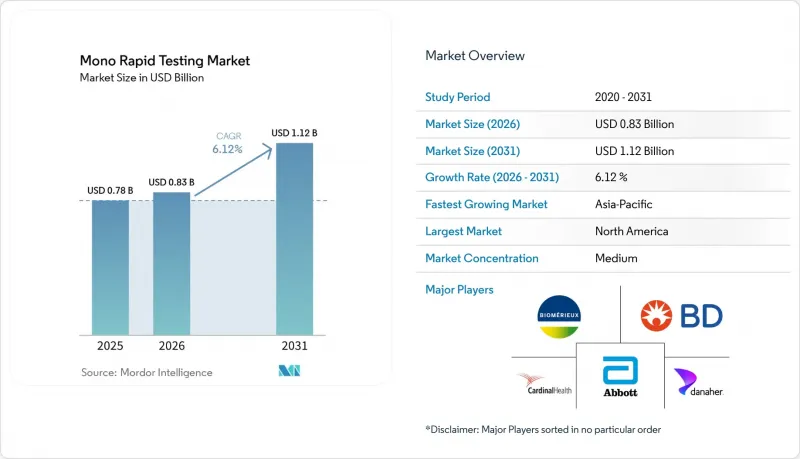
According to Mordor Intelligence, the mono rapid testing market size is projected to expand from USD 0.78 billion in 2025 and USD 0.83 billion in 2026 to USD 1.12 billion by 2031, registering a CAGR of 6.12% between 2026 and 2031.
Global Mono Rapid Testing Market Trends and Insights
Need for Rapid Diagnosis of Infectious Mononucleosis
Infectious mononucleosis can resemble streptococcal pharyngitis, influenza, and respiratory syncytial virus infection at presentation. This overlap makes a quick clinical distinction useful in frontline settings. Ampicillin or amoxicillin treatment can cause a rash in patients with infectious mononucleosis, which makes correct identification important. A positive monospot result can guide care during the same visit and reduce inappropriate antibiotic use. The American Medical Society of Sports Medicine recognizes heterophile antibody testing as one tool used alongside EBV-specific antibody testing and PCR in athletic care. High specificity in adults supports action after a positive result, although persistent clinical suspicion after a negative result can warrant follow-up testing.
High Demand for Testing Among Adolescents and Young Adults
Adolescents and young adults aged 15-24 remain the main population for symptomatic infectious mononucleosis. In many developing countries, EBV infection occurs during early childhood and is usually asymptomatic. In higher-income countries, delayed primary infection concentrates symptomatic disease in secondary schools, universities, and sports programs. At least 1 in 4 teenagers and young adults who contract EBV develop infectious mononucleosis. This pattern supports regular test procurement by campus health clinics and sports medicine services. The mono rapid testing market, therefore, retains a recurring base of demand that is less exposed to automation changes in adult laboratory medicine.
Reduced Sensitivity During Early-Stage Infection
The main clinical limitation of the monospot test is lower sensitivity early in the illness. Heterophile antibodies can rise during the second and third weeks of infection, leaving early presentations with a false-negative risk. A 2024 University Hospitals Cleveland Medical Center analysis reported 64% monospot sensitivity, compared with 96.4% for EBV antibody profiles in adolescents and adults. Clinicians may repeat a monospot test later or move to EBV serology after an early negative result. This can increase diagnostic time and cost in pediatric emergency and inpatient settings. Cross-reactivity and lower performance in younger children and older adults further narrow the situations where a standalone monospot result is sufficient.
Other drivers and restraints analyzed in the detailed report include:
- Expansion of Point-of-Care Testing in Clinics and Emergency Departments
- Growing Use of Rapid Testing in Student Health and Sports Medicine
- Substitution by Epstein-Barr Virus-Specific Serology and Molecular Testing
For complete list of drivers and restraints, kindly check the Table Of Contents.
Segment Analysis
Monospot cassette tests held 37.65% of the mono rapid testing market share in 2025. The format fits point-of-care use because it supports fingerstick whole-blood testing and does not need an instrument. Abbott's Clearview IM II reports 98% positive agreement and 99% negative agreement in product documentation. Sekisui Diagnostics offers the OSOM Mono Test for rapid whole-blood testing, while cassette designs support use in physician offices, urgent care centers, and lower-resource settings. The mono rapid testing industry continues to rely on cassette formats where rapid decisions matter.
Slide agglutination monospot tests are forecast to grow at an 8.5% CAGR through 2031. Their manual workflow can still support batch testing when student clinics manage seasonal testing demand. A 2025 study examined a clinical scoring tool to predict monospot positivity and reduce unnecessary orders. This approach may improve testing efficiency in settings that process many samples together, while card and tube-based agglutination tests continue to serve older hospital and reference laboratory procurement channels. The mono rapid testing market is shifting toward formats that combine reliable handling with simpler workflow control.
Complete Report Scope:
- By Test Format
- Monospot Cassette Tests
- Monospot Card Tests
- Slide Agglutination Monospot Tests
- Tube-Based Agglutination Tests
- By Sample Type
- Whole Blood
- Serum
- Plasma
- By End User
- Hospitals and Health Systems
- Independent Diagnostic Laboratories
- Physician Offices
- Urgent Care Centers
- Academic and Student Health Institutions
- Other End Users
- Geography
- North America
- United States
- Canada
- Mexico
- Europe
- Germany
- United Kingdom
- France
- Italy
- Spain
- Rest of Europe
- Asia-Pacific
- China
- Japan
- India
- Australia
- South Korea
- Rest of Asia-Pacific
- Middle East and Africa
- GCC
- South Africa
- Rest of Middle East and Africa
- South America
- Brazil
- Argentina
- Rest of South America
- North America
Geography Analysis
North America held 42.65% of the mono rapid testing market share in 2025. The region has a large base of CLIA-waived testing sites and high diagnostic use in physician offices and urgent care centers. Whole-blood cassette tests fit these settings because they do not require instrument investment. Canada and Mexico add demand through formulary-led purchasing and clinical care networks. The mono rapid testing market remains well established in North America because rapid tests are embedded in outpatient workflows.
Europe has lower testing volumes in some systems because primary care is more strongly managed through gatekeeping. However, the EU In Vitro Diagnostic Regulation supports investment in compliant test portfolios. Meridian Bioscience achieved IVDR certification for its Alethia molecular assay portfolio in February 2026. Germany, the United Kingdom, and France remain important sources of demand through large primary care networks. The mono rapid testing market in Europe is shaped by regulatory compliance and the replacement of older test formats.
Asia-Pacific is forecast to grow at a 7.4% CAGR through 2031. China and India have large potential patient populations, although clinical confirmation has historically been limited by primary care testing access. Roche's Elecsys EBV VCA IgG received innovation approval from China's National Medical Products Administration in December 2025, raising the profile of EBV diagnostics in China. Middle East and Africa and South America remain smaller markets, but growing point-of-care diagnostic capacity supports demand across private hospitals, community sites, and university health settings.
- Abbott Laboratories
- Arlington Scientific, Inc.
- Beckton Dickinson
- Beckton Dickinson
- bioMerieux
- Bio-Rad Laboratories
- Cardinal Health
- Danaher
- DiaSource Diagnostics
- Immunostics, Inc.
- Launch Diagnostics
- Meridian Bioscience, Inc.
- QuidelOrtho
- Roche Diagnostics International Ltd.
- Sekisui Diagnostics
- Siemens Healthineers
- Thermo Fisher Scientific
- ZEUS Scientific, Inc.
Additional Benefits:
- The market estimate (ME) sheet in Excel format
- 3 months of analyst support
TABLE OF CONTENTS
1 Introduction
- 1.1 Study Assumptions & Market Definition
- 1.2 Scope Of The Study
2 Research Methodology
3 Executive Summary
4 Market Landscape
- 4.1 Market Overview
- 4.2 Market Drivers
- 4.2.1 Need for Rapid Diagnosis of Infectious Mononucleosis
- 4.2.2 High Demand for Testing Among Adolescents and Young Adults
- 4.2.3 Expansion of Point-of-Care Testing in Clinics and Emergency Departments
- 4.2.4 Low Equipment Requirements for Monospot Testing
- 4.2.5 Growing Use of Rapid Testing in Student Health and Sports Medicine
- 4.2.6 Increasing Access to Decentralized Diagnostics in Emerging Markets
- 4.3 Market Restraints
- 4.3.1 Reduced Sensitivity During Early-Stage Infection
- 4.3.2 Lower Test Performance in Young Children and Older Adults
- 4.3.3 Cross-Reactivity and False-Positive Results
- 4.3.4 Substitution by Epstein-Barr Virus-Specific Serology and Molecular Testing
- 4.4 Supply-Chain Analysis
- 4.5 Regulatory Landscape
- 4.6 Technological Outlook
- 4.7 Porter's Five Forces Analysis
- 4.7.1 Threat Of New Entrants
- 4.7.2 Bargaining Power Of Buyers
- 4.7.3 Bargaining Power Of Suppliers
- 4.7.4 Threat Of Substitutes
- 4.7.5 Competitive Rivalry
5 Market Size & Growth Forecasts (Value, USD)
- 5.1 By Test Format
- 5.1.1 Monospot Cassette Tests
- 5.1.2 Monospot Card Tests
- 5.1.3 Slide Agglutination Monospot Tests
- 5.1.4 Tube-Based Agglutination Tests
- 5.2 By Sample Type
- 5.2.1 Whole Blood
- 5.2.2 Serum
- 5.2.3 Plasma
- 5.3 By End User
- 5.3.1 Hospitals and Health Systems
- 5.3.2 Independent Diagnostic Laboratories
- 5.3.3 Physician Offices
- 5.3.4 Urgent Care Centers
- 5.3.5 Academic and Student Health Institutions
- 5.3.6 Other End Users
- 5.4 Geography
- 5.4.1 North America
- 5.4.1.1 United States
- 5.4.1.2 Canada
- 5.4.1.3 Mexico
- 5.4.2 Europe
- 5.4.2.1 Germany
- 5.4.2.2 United Kingdom
- 5.4.2.3 France
- 5.4.2.4 Italy
- 5.4.2.5 Spain
- 5.4.2.6 Rest of Europe
- 5.4.3 Asia-Pacific
- 5.4.3.1 China
- 5.4.3.2 Japan
- 5.4.3.3 India
- 5.4.3.4 Australia
- 5.4.3.5 South Korea
- 5.4.3.6 Rest of Asia-Pacific
- 5.4.4 Middle East and Africa
- 5.4.4.1 GCC
- 5.4.4.2 South Africa
- 5.4.4.3 Rest of Middle East and Africa
- 5.4.5 South America
- 5.4.5.1 Brazil
- 5.4.5.2 Argentina
- 5.4.5.3 Rest of South America
- 5.4.1 North America
6 Competitive Landscape
- 6.1 Market Concentration
- 6.2 Market Share Analysis
- 6.3 Company Profiles {(Includes Global Level Overview, Market Level Overview, Core Segments, Financials As Available, Strategic Information, Market Rank/Share For Key Companies, Products & Services, And Recent Developments)}
- 6.3.1 Abbott Laboratories
- 6.3.2 Arlington Scientific, Inc.
- 6.3.3 Becton, Dickinson and Company
- 6.3.4 Beckman Coulter, Inc.
- 6.3.5 bioMerieux SA
- 6.3.6 Bio-Rad Laboratories, Inc.
- 6.3.7 Cardinal Health
- 6.3.8 Danaher Corporation
- 6.3.9 DiaSource Diagnostics
- 6.3.10 Immunostics, Inc.
- 6.3.11 Launch Diagnostics Limited
- 6.3.12 Meridian Bioscience, Inc.
- 6.3.13 QuidelOrtho Corporation
- 6.3.14 Roche Diagnostics International Ltd.
- 6.3.15 Sekisui Diagnostics
- 6.3.16 Siemens Healthineers AG
- 6.3.17 Thermo Fisher Scientific Inc.
- 6.3.18 ZEUS Scientific, Inc.
7 Market Opportunities & Future Outlook
- 7.1 White-Space & Unmet-Need Assessment

